Device for protecting electric motors
US20060275140A1
2006-12-07
11/375,712
2006-03-13
✅ Patent granted
US 7,460,022 B2
2008-12-02
-
-
George A Bugg | Jennifer Mehmood
2026-12-04
Abstract:
A device for the explosion protection of electric motors or similar electrical devices such as pumps, in which the motor has a protective housing and works together with an interconnected sensor accommodated in a separate protective housing. A favorable construction is achieved in that the motor protection housing and the sensor protection housing are configured for protection classes of different levels, the lower protection class being provided for the motor protection housing, and the higher protection class being provided for the sensor protection housing, and the protective device being provided for the lower protection class.
Assignee:
- BOSCH REXROTH AG 122 🇩🇪 Stuttgart, Germany
Interested in similar patents?
Get notified when new applications in this technology area are published.
Classification:
G08B23/00 IPC
Alarms responsive to unspecified undesired or abnormal conditions
H02K5/136 » CPC main
Casings; Enclosures; Supports; Casings or enclosures characterised by the shape, form or construction thereof specially adapted for operating in liquid or gas explosion-proof
H02K11/21 » CPC further
Structural association of dynamo-electric machines with electric components or with devices for shielding, monitoring or protection for measuring, monitoring, testing, protecting or switching Devices for sensing speed or position, or actuated thereby
H02K11/25 » CPC further
Structural association of dynamo-electric machines with electric components or with devices for shielding, monitoring or protection for measuring, monitoring, testing, protecting or switching Devices for sensing temperature, or actuated thereby
F04B49/06 IPC
Control, e.g. of pump delivery, or pump pressure of, or safety measures for, machines, pumps, or pumping installations, not otherwise provided for, or of interest apart from, groups - Control using electricity
G08B21/00 IPC
Alarms responsive to a single specified undesired or abnormal condition and not otherwise provided for
H02K5/10 IPC
Casings; Enclosures; Supports; Casings or enclosures characterised by the shape, form or construction thereof with arrangements for protection from ingress, e.g. water or fingers
H02K5/12 IPC
Casings; Enclosures; Supports; Casings or enclosures characterised by the shape, form or construction thereof specially adapted for operating in liquid or gas
Description
FIELD OF THE INVENTIONThe present invention relates to a device for the explosion protection of electric motors or similar electrical devices such as pumps, in which the motor has a protective housing and works together with an interconnected sensor accommodated in a protective housing.
BACKGROUND INFORMATIONSuch electrical devices, particularly motors, must have a protection against explosions for various environments so as to protect persons and objects against damage. According to the DIN standard EN 50014, different protection classes are prescribed for different environments, for example, the low protection class ex-p and the adjoining higher protection class ex-d. The sensor may be used for various purposes, for example, for position information for the motor as such or for the rotor, for regulating the speed of the motor, etc.
The protection class ex-p prescribes that the motor protection housing and the sensor protection housing have to be designed to be only overpressure-resistant, requiring the implementation of suitable purging measures. For this purpose, the overpressure-resistant protective housings must be provided with purge openings to which for the motor protection housing as well as for the sensor protection housing in each case a separate monitored purge circuit having a monitoring device and a purge device is connected.
The protection class ex-d prescribes that the motor protection housing and the sensor protection housing must be designed to be pressure-resistant, the sensor itself having to be designed to be explosion-proof. The protective housings must pressure-resistant to such a degree that, if an ignitable gas mixture explodes in these protective housings, they withstand the explosion in the interior without igniting an ignitable gas mixture outside these protective housings. Purge circuits are not required in this case.
In protection class ex-p two purge circuits having the appropriate devices and an explosion-protected sensor are thus required, whereby substantial costs for protection are incurred. In protection class ex-d, high-quality protective housings and also an explosion-protected sensor are required such that substantial costs also arise for protection.
An objective of the present invention is to provide a protective device, in which a reliable explosion protection is obtained at the lowest possible expense.
SUMMARY OF THE INVENTIONThis objective is achieved according to the present invention. In this connection there is a provision for the motor protection housing and the sensor protection housing to be configured for protection classes of various levels, the lower protection class being provided for the motor protection housing and the higher protection class being provided for the sensor protection housing and the protection device being provided for the lower protection class.
As a result, only a relatively inexpensive motor protection housing having only one purge circuit and a pressure-resistant sensor protection housing are required, it being possible to use an inexpensive standard sensor.
Another useful development of the present invention provides for the motor protection housing to be configured to be overpressure-resistant and to be provided with purge holes and for the sensor protection housing to be configured to be pressure-resistant without a purging device.
According to another advantageous development of the present invention, the sensor protection housing is provided with gaps for dissipating an explosion wave.
In accordance with another advantageous development of the present invention, the sensor protection housing having the sensor is located outside on the motor protection housing.
According to an alternative advantageous development of the present invention, the sensor protection housing having the sensor is located inside the motor protection housing.
Another advantageous measure for an inexpensive construction is to use a simple standard sensor as the sensor, which as such has no explosion protection provisions.
Measures for connecting a monitored purging agent circuit having a monitoring device and a purging device to the purge holes contribute to a reliable functioning.
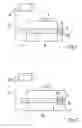
BRIEF DESCRIPTION OF THE DRAWINGSFIG. 1 shows a basic representation of a protection device for an electric motor having a sensor situated on it according to one of the first exemplary embodiments of the present invention.
FIG. 2 shows a basic representation of a protection device for an electric motor having a sensor situated on it according to another exemplary embodiment of the present invention.
DETAILED DESCRIPTIONIn FIG. 1, a protective housing 1 for an electric motor 2, which may also be the stator of this motor, is provided with purge holes 3, 4. A purge circuit 5 is connected to these purge holes 3, 4, in which a monitoring device 6 and a purging device 7 are situated. Purging device 7 may include a compressed air source, which conducts compressed air through protective housing 1. Protective housing 1 only has to be pressure-resistant to such a degree that it withstands the compressed air pressure. For this purpose, protective housing 1 does not have to be an elaborate design. Monitoring device 6 measures the temperature of the exhaust air coming from protective housing 1 and regulates the volume of the fresh air supplied to protective housing 1 accordingly. Purging device 7 and monitoring device 6 lie outside of the explosive environment. The purging takes place in the ex-p-encapsulated space 8.
Attached to protective housing 1 or to motor 2 is a sensor protection housing 9 having an ex-d-encapsulated space 10, which is sealed off against ex-p-encapsulated space 8. Sensor protection housing 9 is a small, sturdy housing that is configured to be pressure-resistant. It is provided with known gaps in a manner not shown. Sensor protection housing 9 and the gap are configured in such a way that sensor protection housing 9 withstands an explosion within space 10, the gap ensuring that the explosion wave dissipates. A sensor 11, which is connected to the motor shaft, is situated inside sensor protection housing 9. Sensor 11 is advantageously a simple and inexpensive standard design, which as such does not have to be designed for the requirements of explosion protection.
FIG. 2 shows a second embodiment of the protective device in accordance with the present invention for an electric motor 2. Protective housing 1′ having the connected purging circuit is configured similarly as in FIG. 1. Sensor protection housing 9 having sensor 11 is also configured similarly as in FIG. 1. The difference is that sensor protection housing 9 is situated inside of protective housing 1′ in the ex-p-encapsulated space 8′.
Claims
What is claimed is:1. A device for an explosion protection of an electric motor, the motor cooperating with an interconnected sensor, the device comprising:
a motor protection housing accommodating the motor; and
a separate sensor protection housing accommodating the sensor,
wherein the motor protection housing and the sensor protection housing are configured for protection classes of different levels, a lower protection class being provided for the motor protection housing, and a higher protection class being provided for the sensor protection housing, and the protective device being provided for the lower protection class.
2. The device according to claim 1, wherein the motor is a pump.
3. The device according to claim 1, wherein the motor protection housing is configured to be superpressure-resistant and is configured with purge holes, and the sensor protection housing is configured without purge holes.
4. The device according to claim 1, wherein the sensor protection housing has gaps for dissipating an explosion wave.
5. The device according to claim 1, wherein the sensor protection housing has the sensor situated outside on an engine protection housing.
6. The device according to claim 1, wherein the sensor protection housing has the sensor situated in an interior of an engine protection housing.
7. The device according to claim 1, wherein the sensor has no explosion protection device.
8. The device according to claim 3, further comprising a monitored purging agent circuit, including a monitoring device and a purging device, connected to the purge holes.
Images & Drawings included:

Sources:
- United States Patent and Trademark Office - verify current appl. status at the USPTO↗
Similar patent applications:
- » 20150263509
Rotor temperature detecting device in an electric motor and overheat protection device of an electric motor - » 20050128660
Anti-pinch and electrical motor protection device - » 20140197769
Over temperature protection device for electric motors - » 20060244405
Protection device for electric motor driving devices and corresponding driving device - » 20240322618
SYNCHRONOUS ELECTRIC MOTOR, RANGE OF ELECTRIC MOTORS, DEVICE FOR CLOSING, SHADING OR PROTECTING AGAINST THE SUN, COMPRISING AN ELECTRIC MOTOR FROM SUCH A RANGE AND METHOD FOR PRODUCING SAME - » 20160004225
METHOD AND PROTECTION DEVICE FOR PROTECTING AN ELECTRIC MOTOR AND/OR AN OPERATING MACHINE WHICH IS COUPLED THERETO FROM INCORRECT CONTROL OPERATIONS - » 20080111510
Windscreen wiper comprising a protection device for the electric motor thereof - » 10329978
Protective device for an electric motor with sensor and evaluation unit - » 20190154024
Method for protecting an electric motor of a device with a motor driven consumer with a continuous capacity control system and choice of such a motor - » 20160206073
Electric hairdryer with a motor protecting device
Recent applications in this class:
- » 20250055345 2025-02-13
COATED ROTATING ELECTRIC MACHINE AND COATING APPLICATION METHOD ON A ROTATING ELECTRIC MACHINE - » 20230223811 2023-07-13
HYDROGEN RECIRCULATION BLOWER - » 20230034461 2023-02-02
Rotary electric machine - » 20210159754 2021-05-27
Line bushing and terminal studs with increased ignition gaps - » 20210126505 2021-04-29
Motor - » 20200395810 2020-12-17
Internal pressure reduction device and explosion-proof electric machine - » 20200366154 2020-11-19
Electric machine with a sealed enclosure having a printed circuit board with tracks and stopping elements and a releasing structure for the tracks - » 20200244135 2020-07-30
Fire-spread prevention member, electrical device, and image forming apparatus - » 20190372421 2019-12-05
Motor - » 20180358861 2018-12-13
Compressor and heat cycle system for refrigerator
Recent applications for this Assignee:
- » 20100269496 2010-10-28
Drive and hydrostatic piston engine with brake energy recovery - » 20090231018 2009-09-17
Circuit arrangement and a method for galvanically separate triggering of a semiconductor switch - » 20090176197 2009-07-09
HYDROSTATIC TRAINING DEVICE - » 20090165451 2009-07-02
HYDRAULIC FLUID ACCUMULATOR WITH INTEGRATED HIGH-PRESSURE AND LOW-PRESSURE CHAMBER - » 20090100829 2009-04-23
Hydraulic catapult drive - » 20090091276 2009-04-09
Linear motor and method for operating a linear motor - » 20090084102 2009-04-02
Hydrostatic drive - » 20090078142 2009-03-26
Web offset printing press and method for operating a web offset printing press - » 20090064673 2009-03-12
Hydraulic control device - » 20090036248 2009-02-05
DRIVE WITH A TORQUE SPLIT TRANSMISSION