Part for protecting the leading edge of a blade
US20060275626A1
2006-12-07
11/279,675
2006-04-13
✅ Patent granted
US 7,510,778 B2
2009-03-31
-
-
Keith D Hendricks | Jason L Savage
2026-11-14
Abstract:
A protection part comprising at least two layers including an outer layer and an inner layer has its outer layer made of an aluminum alloy that is reinforced with particles of SiC, the SiC particle content in said alloy lying in the range 15% to 40% by weight, while the inner layer is made of an aluminum alloy that is optionally reinforced with SiC particles, the SiC particle content within the layers increasing from the inner layer towards the outer layer. The part is for use in protecting the leading edge of a blade, in particular a blade or vane in a turbomachine, a helicopter blade, or a propeller blade.
Inventors:
- Claude Marcel Mons 33 🇫🇷 Savigny le Temple, France
- Isabelle PESLERBE 5 🇫🇷 Ollainville, France
- Jacques BERNARD 1 🇫🇷 Vaux Le Penil, France
- Thierry Thomas 1 🇫🇷 Montfermeil, France
Assignee:
- SNECMA 2,018 🇫🇷 Paris, France
Interested in similar patents?
Get notified when new applications in this technology area are published.
Classification:
B32B15/20 IPC
Layered products comprising a layer of metal comprising aluminium or copper
F01D5/28 » CPC further
Blades; Blade-carrying members ; Heating, heat-insulating, cooling or antivibration means on the blades or the members; Blades Selecting particular materials; Particular measures relating thereto; Measures against erosion or corrosion
B23P15/04 » CPC main
Making specific metal objects by operations not covered by a single other subclass or a group in this subclass turbine or like blades from several pieces
F01D5/147 » CPC further
Blades; Blade-carrying members ; Heating, heat-insulating, cooling or antivibration means on the blades or the members; Blades; Form or construction Construction, i.e. structural features, e.g. of weight-saving hollow blades
F04D29/324 » CPC further
Details, component parts, or accessories; Rotors specially for elastic fluids for axial flow pumps for axial flow compressors Blades
F05D2240/303 » CPC further
Components; Rotors; Characteristics of rotor blades, i.e. of any element transforming dynamic fluid energy to or from rotational energy and being attached to a rotor related to the leading edge of a rotor blade
F05D2300/173 » CPC further
Materials; Properties thereof; Metals, alloys or intermetallic compounds; Alloys Aluminium alloys, e.g. AlCuMgPb
F05D2300/2261 » CPC further
Materials; Properties thereof; Oxide or non-oxide ceramics; Non-oxide ceramics; Carbides of silicon
F05D2300/702 » CPC further
Materials; Properties thereof; Treatment or modification of materials Reinforcement
Y02T50/60 » CPC further
Aeronautics or air transport Efficient propulsion technologies, e.g. for aircraft
Y02T50/60 » CPC further
Aeronautics or air transport Efficient propulsion technologies, e.g. for aircraft
Y10T428/12458 » CPC further
Stock material or miscellaneous articles; All metal or with adjacent metals having composition, density, or hardness gradient
Y10T428/12764 » CPC further
Stock material or miscellaneous articles; All metal or with adjacent metals; Composite; i.e., plural, adjacent, spatially distinct metal components [e.g., layers, joint, etc.]; Al-base component Next to Al-base component
Y10T428/30 » CPC further
Stock material or miscellaneous articles Self-sustaining carbon mass or layer with impregnant or other layer
Y10T428/31678 » CPC further
Stock material or miscellaneous articles; Composite [nonstructural laminate] Of metal
B32B9/00 IPC
Layered products characterised by particular substances used
B32B9/00 IPC
Layered products comprising a layer of a particular substance not covered by groups -
B32B15/04 IPC
Layered products comprising a layer of metal comprising metal as the main or only constituent of a layer, next to another layer of a
B32B7/02 IPC
Layered products characterised by the relation between layers; Layered products characterised by the relative orientation of features between layers, or by the relative values of a measurable parameter between layers, i.e. products comprising layers having different physical, chemical or physicochemical properties; Layered products characterised by the interconnection of layers Physical, chemical or physicochemical properties
Description
The invention relates to a protection part used, for example, for protecting the leading edge of a blade in a turbomachine, a propeller blade, or a helicopter blade.
BACKGROUND OF THE INVENTIONIn the field of aviation, and more particularly in the field of aircraft turbojets, reducing the weight of the component parts of the turbojet is a perpetual preoccupation.
Thus, blades have been developed for turbojet fans or stators that are made of an organic-matrix composite material (e.g. based on cyanate-ester, bismaleimide, or epoxy resin), such that the blades are lighter in weight than metal blades.
Nevertheless, the leading edges of such blades need to be protected against erosion and possible impacts by means of a protection part fitted to the leading edge.
Until now, such protection parts have been made of titanium alloy of the TA6V type. That solution is technically viable, since the alloy presents good resistance to erosion and to impacts. Nevertheless, it is found that the weight of such protection parts is excessive.
OBJECTS AND SUMMARY OF THE INVENTIONAn object of the invention is to propose protection parts of lighter weight than prior art parts made of titanium alloy, and that are strong enough to perform their protection function.
To achieve this object, the invention provides a protection part presenting an outer protection face and wherein said outer face is made of an aluminum alloy reinforced by particles of SiC, the SiC particle content in said alloy lying in the range 15% to 40% by weight, and advantageously 15% to 30% by weight.
The density of SiC-reinforced aluminum alloys is about 40% less than that of the titanium alloys that are generally used. This results in a significant saving in weight, and makes it possible amongst other things to limit the stresses due to centrifugal forces acting on the hubs of the blade-carrier disk. That makes it possible to design disks that do not need to be so strong and that are therefore lighter in weight, thereby further reducing the weight of the turbojet.
The SiC particles serve to improve the strength of the aluminum. At below 15% SiC, this strength is not sufficient. Above 40% SiC, the alloy is too difficult to form. Advantageously, the SiC content remains below 30% in order to facilitate forming.
In a particular embodiment of the invention, the part comprises at least two layers including an outer layer and an inner layer, the outer layer being made of said reinforced aluminum alloy and the inner layer being made of an aluminum alloy that is optionally reinforced with SiC particles, the content of SiC particles within the layers increasing on going from the inner layer towards the outer layer. Thus, mechanical strength increases going from the inside towards the outside of the part.
Using an aluminum alloy that is reinforced little or not at all for the inner layer makes it easier to secure said layer to the blade. This is particularly true when the blade is made of organic-matrix composite material (as opposed to metal-matrix composite material) and the protection part is bonded thereto by adhesive. In practice, in order to secure the protection part of the invention, it is possible to use the same adhesives and adhesive techniques that are already used for securing protection parts made of TA6V titanium alloy. There is therefore no need to develop adhesives that are specific for the part of the invention.
The protection part of the invention has been developed more particularly for fitting to a blade made of composite material, and in particular an organic-matrix composite material. Nevertheless, it could also be fitted to a blade made of some other type of material.
BRIEF DESCRIPTION OF THE DRAWINGThe invention and its advantages can be better understood on reading the following detailed description which refers to the accompanying sheet of figures, in which:
FIG. 1 is a perspective view of a blade showing its cross-section, the blade having a protection part of the invention fitted to its leading edge; and
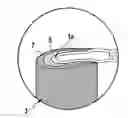
FIG. 2 is a detail view on a larger scale of the cross-section of the FIG. 1 blade.
MORE DETAILED DESCRIPTIONFIGS. 1 and 2 show the airfoil portion of a turbomachine blade 1. The leading edge 1a of the blade 1 is covered by a protection part 3 of the invention.
The protection part 3 is substantially U-shaped in section, enabling it to be placed astride the leading edge 1a of the blade 1. The part 3 is made up of two layers, an inner layer 5 and an outer layer 7. The outer layer 7 is of aluminum alloy reinforced with particles of SiC, while the inner layer 5 is made of the same aluminum alloy, but is not reinforced with SiC. Preferably, for aviation applications, an aluminum alloy of the 7000 series is selected.
Naturally, the protection part may have more than two layers, with the content of SiC particles in each layer increasing going from the inside towards the outside. Thus, in an embodiment not shown, the protection part is made of four layers C1, C2, C3, and C4 with the SiC content in the inner layer C1 being zero, about 10% by weight in C2, about 20% in C3, and about 30% in the outer layer C4.
In order to assemble the layers of the protection part to one another, various techniques can be used.
Advantageously, use is made of co-extrusion or of roll-bonding, which two techniques work well with aluminum alloys, whether or not they are reinforced with sic.
Co-extrusion consists in causing a bar of non-reinforced aluminum alloy surrounded by a sleeve of SiC-reinforced aluminum alloy to pass through a die (a reduction cone). The compression forces and the heating generated by friction between the two materials at their interface, ensure that the two materials become intimately bonded. This produces a bar with a core of non-reinforced aluminum alloy and a covering of SiC-reinforced aluminum alloy. The bar obtained in this way can subsequently be formed, e.g. by stamping.
Roll-bonding consists in pressing together a plurality of aluminum alloy plates either hot or cold in order to bond them to one another. In order to obtain a protection part 3 as shown in FIG. 1 having two layers 5 and 7, an SiC-reinforced aluminum alloy plate is pressed against a plate of non-reinforced aluminum alloy. As a general rule, two cylindrical rollers are used with the plates being cause to pass between them. Thereafter, the final plate is formed (to take up a U-shape), e.g. by forging or by stamping.
Once the protection part 3 has been formed, it is bonded to the leading edge 1a of the blade 1.
In order to make said sleeve or said plate of SiC-reinforced aluminum alloy, use is made of conventional powder-metallurgy techniques, consisting in mixing an aluminum alloy powder with an SiC powder, and in densifying the powder mixture, e.g. by sintering, so as to give it the desired shape.
The blade 1 is the airfoil portion of a blade or a vane in a turbomachine. More particularly, it may form part of a fan blade or of a stator vane for a turbojet. The airfoil portion of a blade is the portion surmounting the blade root, while the blade root is the portion used for securing the blade to the remainder of the turbomachine.
When the blade 1 is a fan blade, it can be made by injecting resin on a fiber preform. The fiber preform and the resin then respectively constitute the fiber reinforcement and the matrix of the resulting composite material. The fiber preform may be obtained in particular by weaving and various known methods of injecting resin onto a fiber preform can be used, including the resin transfer molding (RTM) method.
The blade 1 could also be a propeller blade or a helicopter blade.
Claims
What is claimed is:1. A protection part presenting an outer protection face, and wherein said outer face is made of an aluminum alloy reinforced by particles of SiC, the SiC particle content in said alloy lying in the range 15% to 40% by weight.
2. A protection part according to claim 1, wherein the content of SiC particles in said alloy lies in the range 15% to 30% by weight.
3. A protection part according to claim 1, comprising at least two layers, including an outer layer and an inner layer, the outer layer being made of said reinforced aluminum alloy and the inner layer being made of an aluminum alloy that is optionally reinforced with SiC particles, the content of SiC particles in the layers increasing from the inner layer to the outer layer.
4. A protection part according to claim 1, comprising at least two layers, and wherein the layers are assembled together by co-extrusion or by roll-bonding.
5. A protection part according to claim 1, presenting a section that is substantially U-shaped.
6. A protection part for protecting the leading edge of a blade according to claim 1.
7. A method for protecting the leading edge of a blade, in particular a turbomachine blade or vane, a helicopter blade, or a propeller blade, using a protection part according to claim 1.
8. An assembly comprising a blade presenting a leading edge and a protection part according to claim 1, fitted onto the leading edge in order to protect it.
9. An assembly according to claim 8, wherein said protection part is bonded on the leading edge by adhesive.
10. An assembly according to claim 8, wherein the blade is made of an organic-matrix composite material.
Images & Drawings included:

Sources:
- United States Patent and Trademark Office - verify current appl. status at the USPTO↗
Recent applications in this class:
- » 20250121463 2025-04-17
METHOD OF MAKING A TURBINE BLADE AND RUNNER INCLUDING SUCH A BLADE - » 20250091167 2025-03-20
GANTRY SYSTEM FOR MANUFACTURING A WIND TURBINE BLADE AND METHOD FOR MANUFACTURING A WIND TURBINE BLADE - » 20240351151 2024-10-24
ORBITAL FRICTION WELDING METHOD OF A BLADE TO A STUB ON A TURBOMACHINE ROTOR DISC - » 20240157490 2024-05-16
METHOD OF MANUFACTURING A TURBINE COMPONENT - » 20240017362 2024-01-18
Method for manufacturing a turbomachine compressor blade by compacting - » 20220347802 2022-11-03
Bonding system for dual walled turbine components - » 20220339746 2022-10-27
Mini-core surface bonding - » 20220219267 2022-07-14
Method for manufacturing or for repairing a component of a rotary machine as well as a component manufactured or repaired using such a method - » 20220134493 2022-05-05
Assembly of an outlet guide vane for an aircraft turbomachine using an inflatable bladder - » 20220063028 2022-03-03
Method for producing a metal reinforcement for a turbomachine blade
Recent applications for this Assignee:
- » 20190330996 2019-10-31
Control ring for a stage of variable-pitch vanes for a turbine engine - » 20190024274 2019-01-24
Fiber blank woven as a single piece by three-dimensional weaving to make a closed box-structure platform out of composite material for a turbine engine fan - » 20180304421 2018-10-25
Method and system for cutting a preform intended for the production of a turbomachine part - » 20180230858 2018-08-16
Tool and method for frontal unscrewing of a link nut in a twin-spool turbine - » 20180202303 2018-07-19
Assembly forming a gasket for a turbomachine, comprising a brush seal - » 20180196083 2018-07-12
Test bench, in particular for accelerometers - » 20180195978 2018-07-12
Method for characterising a part - » 20180172111 2018-06-21
Tool for balancing a turbine engine module - » 20180163965 2018-06-14
Combustion chamber in a turbine engine - » 20180163740 2018-06-14
Compressor shroud comprising a sealing element provided with a structure for entraining and diverting discharge air