Method for the quality control of functionalized surfaces
US20060292612A1
2006-12-28
11/452,422
2006-06-14
Abstract:
The invention relates to a method which can be used to test firstly a reaction and secondly the distribution of functional groups on a surface. This method is employed in a situation that demands documentation or testing of a distribution of surface functionalization, which is as homogeneous as possible.
Assignee:
- FEBIT BIOTECH GMBH 4 🇩🇪 Heidelberg, Germany
Interested in similar patents?
Get notified when new applications in this technology area are published.
Classification:
G01N33/5436 » CPC main
Investigating or analysing materials by specific methods not covered by groups -; Biological material, e.g. blood, urine ; Haemocytometers; Chemical analysis of biological material, e.g. blood, urine; Testing involving biospecific ligand binding methods; Immunological testing; Immunoassay; Biospecific binding assay; Materials therefor with an insoluble carrier for immobilising immunochemicals with ligand physically entrapped within the solid phase
B01J19/0046 » CPC further
Chemical, physical or physico-chemical processes in general; Their relevant apparatus Sequential or parallel reactions, e.g. for the synthesis of polypeptides or polynucleotides; Apparatus and devices for combinatorial chemistry or for making molecular arrays
B82Y30/00 » CPC further
Nanotechnology for materials or surface science, e.g. nanocomposites
G01N33/532 » CPC further
Investigating or analysing materials by specific methods not covered by groups -; Biological material, e.g. blood, urine ; Haemocytometers; Chemical analysis of biological material, e.g. blood, urine; Testing involving biospecific ligand binding methods; Immunological testing; Immunoassay; Biospecific binding assay; Materials therefor; Production of immunochemical test materials Production of labelled immunochemicals
G01N33/58 » CPC further
Investigating or analysing materials by specific methods not covered by groups -; Biological material, e.g. blood, urine ; Haemocytometers; Chemical analysis of biological material, e.g. blood, urine; Testing involving biospecific ligand binding methods; Immunological testing involving labelled substances
B01J2219/00497 » CPC further
Chemical, physical or physico-chemical processes in general; Their relevant apparatus; Sequential or parallel reactions; Apparatus and devices for combinatorial chemistry or for making arrays; Chemical library technology; Apparatus Features relating to the solid phase supports
B01J2219/00527 » CPC further
Chemical, physical or physico-chemical processes in general; Their relevant apparatus; Sequential or parallel reactions; Apparatus and devices for combinatorial chemistry or for making arrays; Chemical library technology; Apparatus; Features relating to the solid phase supports Sheets
B01J2219/00574 » CPC further
Chemical, physical or physico-chemical processes in general; Their relevant apparatus; Sequential or parallel reactions; Apparatus and devices for combinatorial chemistry or for making arrays; Chemical library technology; Apparatus; Means for coding or tagging the apparatus or the reagents; Chemical means radioactive
B01J2219/00576 » CPC further
Chemical, physical or physico-chemical processes in general; Their relevant apparatus; Sequential or parallel reactions; Apparatus and devices for combinatorial chemistry or for making arrays; Chemical library technology; Apparatus; Means for coding or tagging the apparatus or the reagents; Chemical means fluorophore
B01J2219/00578 » CPC further
Chemical, physical or physico-chemical processes in general; Their relevant apparatus; Sequential or parallel reactions; Apparatus and devices for combinatorial chemistry or for making arrays; Chemical library technology; Apparatus; Means for coding or tagging the apparatus or the reagents; Chemical means electrophoric
B01J2219/00585 » CPC further
Chemical, physical or physico-chemical processes in general; Their relevant apparatus; Sequential or parallel reactions; Apparatus and devices for combinatorial chemistry or for making arrays; Chemical library technology; Features relative to the processes being carried out Parallel processes
B01J2219/00596 » CPC further
Chemical, physical or physico-chemical processes in general; Their relevant apparatus; Sequential or parallel reactions; Apparatus and devices for combinatorial chemistry or for making arrays; Chemical library technology; Features relative to the processes being carried out Solid-phase processes
B01J2219/00605 » CPC further
Chemical, physical or physico-chemical processes in general; Their relevant apparatus; Sequential or parallel reactions; Apparatus and devices for combinatorial chemistry or for making arrays; Chemical library technology; Features relative to the processes being carried out; Making arrays on substantially continuous surfaces the compounds being directly bound or immobilised to solid supports
B01J2219/00612 » CPC further
Chemical, physical or physico-chemical processes in general; Their relevant apparatus; Sequential or parallel reactions; Apparatus and devices for combinatorial chemistry or for making arrays; Chemical library technology; Features relative to the processes being carried out; Making arrays on substantially continuous surfaces the compounds being directly bound or immobilised to solid supports the surface being inorganic
B01J2219/00621 » CPC further
Chemical, physical or physico-chemical processes in general; Their relevant apparatus; Sequential or parallel reactions; Apparatus and devices for combinatorial chemistry or for making arrays; Chemical library technology; Features relative to the processes being carried out; Making arrays on substantially continuous surfaces the compounds being directly bound or immobilised to solid supports; Delimitation of the attachment areas by physical means, e.g. trenches, raised areas
B01J2219/00637 » CPC further
Chemical, physical or physico-chemical processes in general; Their relevant apparatus; Sequential or parallel reactions; Apparatus and devices for combinatorial chemistry or for making arrays; Chemical library technology; Features relative to the processes being carried out; Making arrays on substantially continuous surfaces the compounds being directly bound or immobilised to solid supports; Introduction of reactive groups to the surface by coating it with another layer
B01J2219/00657 » CPC further
Chemical, physical or physico-chemical processes in general; Their relevant apparatus; Sequential or parallel reactions; Apparatus and devices for combinatorial chemistry or for making arrays; Chemical library technology; Features relative to the processes being carried out; Making arrays on substantially continuous surfaces One-dimensional arrays
B01J2219/00659 » CPC further
Chemical, physical or physico-chemical processes in general; Their relevant apparatus; Sequential or parallel reactions; Apparatus and devices for combinatorial chemistry or for making arrays; Chemical library technology; Features relative to the processes being carried out; Making arrays on substantially continuous surfaces Two-dimensional arrays
B01J2219/00675 » CPC further
Chemical, physical or physico-chemical processes in general; Their relevant apparatus; Sequential or parallel reactions; Apparatus and devices for combinatorial chemistry or for making arrays; Chemical library technology; Features relative to the processes being carried out; Making arrays on substantially continuous surfaces In-situ synthesis on the substrate
B01J2219/00693 » CPC further
Chemical, physical or physico-chemical processes in general; Their relevant apparatus; Sequential or parallel reactions; Apparatus and devices for combinatorial chemistry or for making arrays; Chemical library technology; Means for controlling the apparatus of the process Means for quality control
B01J2219/00711 » CPC further
Chemical, physical or physico-chemical processes in general; Their relevant apparatus; Sequential or parallel reactions; Apparatus and devices for combinatorial chemistry or for making arrays; Chemical library technology; Type of synthesis Light-directed synthesis
B01J2219/0072 » CPC further
Chemical, physical or physico-chemical processes in general; Their relevant apparatus; Sequential or parallel reactions; Apparatus and devices for combinatorial chemistry or for making arrays; Chemical library technology; Type of compounds synthesised Organic compounds
B01J2219/00722 » CPC further
Chemical, physical or physico-chemical processes in general; Their relevant apparatus; Sequential or parallel reactions; Apparatus and devices for combinatorial chemistry or for making arrays; Chemical library technology; Type of compounds synthesised; Organic compounds Nucleotides
B01J2219/00725 » CPC further
Chemical, physical or physico-chemical processes in general; Their relevant apparatus; Sequential or parallel reactions; Apparatus and devices for combinatorial chemistry or for making arrays; Chemical library technology; Type of compounds synthesised; Organic compounds Peptides
B01J2219/00729 » CPC further
Chemical, physical or physico-chemical processes in general; Their relevant apparatus; Sequential or parallel reactions; Apparatus and devices for combinatorial chemistry or for making arrays; Chemical library technology; Type of compounds synthesised; Organic compounds Peptide nucleic acids [PNA]
B01J2219/00731 » CPC further
Chemical, physical or physico-chemical processes in general; Their relevant apparatus; Sequential or parallel reactions; Apparatus and devices for combinatorial chemistry or for making arrays; Chemical library technology; Type of compounds synthesised; Organic compounds Saccharides
C40B30/06 IPC
Methods of screening libraries by measuring effects on living organisms, tissues or cells
C40B40/08 IPC
Libraries , e.g. arrays, mixtures; Libraries containing only organic compounds; Libraries containing nucleotides or polynucleotides, or derivatives thereof Libraries containing RNA or DNA which encodes proteins, e.g. gene libraries
C12Q1/68 IPC
Measuring or testing processes involving enzymes, nucleic acids or microorganisms ; Compositions therefor; Processes of preparing such compositions involving nucleic acids
G01N33/53 IPC
Investigating or analysing materials by specific methods not covered by groups -; Biological material, e.g. blood, urine ; Haemocytometers; Chemical analysis of biological material, e.g. blood, urine; Testing involving biospecific ligand binding methods; Immunological testing Immunoassay; Biospecific binding assay; Materials therefor
C12M1/34 IPC
Apparatus for enzymology or microbiology Measuring or testing with condition measuring or sensing means, e.g. colony counters
Description
DESCRIPTIONThe invention relates to a method which can be used to test firstly a reaction and secondly the distribution of functional groups on a surface. This method is employed in a situation that demands documentation or testing of a distribution of surface functionalization, which is as homogeneous as possible. Said functionalization is carried out using a coating method suitable for the surface material and coating molecules. The method of the invention is used in particular for quality control in the preparation of reaction supports for biochips, gene chips and microarrays.
The preparation of reaction supports or arrays firstly comprises functionalization of the support, wherein functional groups are usually applied to the surface in a coating process. The functionalized surfaces are then available in a next processing step for further coating with corresponding biologically or chemically functional materials and, respectively, molecules. Examples of said biologically or chemically functional materials and, respectively, molecules are nucleic acids or nucleic acid analogs such as DNA, RNA, PNA, LNA, oligonucleotides (independently of the direction of synthesis), saccharides and carbohydrates, peptides, proteins and further mixed forms, but also derivatives of combinatorial chemistry or linker molecules, and building blocks for the synthesis of such molecules.
One problem here, however, is the fact that it is not possible to determine the quality of the functionalized surface with sufficient accuracy.
The present invention relates to a method for testing functionalized groups on a surface,
-
- (a) providing a support comprising a surface,
- (b) coating at least part of the surface of said support with first functional coating molecules, using first coating molecules which carry a reversibly bound label,
- (c) detecting the existence and/or density or/and distribution of the labels on the surface,
- (d) removing the labels and
- (e) where appropriate, coating the support with further functional coating molecules, which react with functional groups of said first coating molecules, said functional groups having preferably been uncovered due to removal of the labeling groups.
The invention further relates to a reagent, in particular for carrying out the abovementioned method, containing at least one first functional coating molecule having a reversibly bound label and at least one further functional coating molecule capable of reacting with functional groups of said first coating molecule, said functional groups having preferably been uncovered due to removal of the labeling groups.
The supports may be functionalized with customary reagents, for example with silanization reagents for glass supports. According to the invention, the molecules used for functionalization carry a label or a plurality of labels which can be detected by suitable methods. Accordingly, the label may be analyzed using absorption, emission, radioactivity, plasmon resonance, light diffraction, light scattering, ellipsometry, electron diffraction or electrical signals etc. Preference is given to optically measurable markers such as fluorophores. Preference is given to silanes having at least one, for example one or two, functional groups to react with biological substances, and at least one label. Particular preference is given to functionalization reagents containing a silane group for binding to glass surfaces and a building block for nucleic acid synthesis, for example a phosphoramidite group.
The invention is employed in particular in processes comprising a step-by-step synthesis of receptors, preferably of a plurality of different receptors on a single support, from a plurality of synthesis building blocks. The support may be any support, for example a support having a planar or structured surface.
The support is preferably a microfluidic support, in particular a support having closed channels on whose surface receptor synthesis takes place. Preferred examples of supports are described in WO 00/13018 and WO 00/13017.
A suitable reaction procedure must enable the label to be removed from the coating molecules selectively and, in particular, location-specifically, for example by way of chemical and/or photochemical methods. The location-specific uncovering of the reaction center allows the independent synthesis of functional molecules, for example probes (independently of the sequence and/or type of probes, for example oligonucleotides, peptides, etc.). Particular preference is given to molecules disclosed in the application PCT/EP03/14826 “Verfahren zum validierten Aufbau von Arrays” [Method for the validated construction of arrays], in particular types I, II, VI and VII. Furthermore, preference is given to two-stage protective groups, in particular modified trityl groups as described in WO 03/004510. Reference is explicitly made to the contents of these documents.
After analyzing the data, the signals coming from the labeling groups are used for assessing the homogeneity of surface occupation. Subsequently, the labeling groups are removed by chemical reagents and/or irradiation in order to synthesize functional molecules.
The invention provided functionalized supports which have measurable surface characteristics and which can be used as starting materials for constructing reaction supports and arrays.
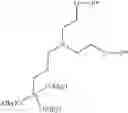
Special exemplary embodiments based on silanes and fluorescent dyes:
P* [protective group carrying a label]
Aside from fluorescent dyes such as pyrenes, coumarines, rhodamines, cyanines, for example, nano-particles and other fluorescent labels may also be considered.
Claims
1. A method for testing functionalized groups on a surface,
(a) providing a support comprising a surface,
(b) coating at least part of the surface of said support with first functional coating molecules, using first coating molecules which carry a reversibly bound label,
(c) detecting the existence and/or density or/and distribution of the labels on the surface,
(d) removing the labels and
(e) where appropriate, coating the support with further functional coating molecules, which react with functional groups of said first coating molecules, said functional groups having preferably been uncovered due to removal of the labeling groups.
2. The method as claimed in claim 1 for preparing supports for biochips, gene chips and microarrays.
3. The method as claimed in claim 1, wherein the further functional coating molecules are selected from:
(a) nucleic acids or nucleic acid analogs or building blocks for the synthesis thereof,
(b) peptides or proteins or building blocks for the synthesis thereof,
(c) carbohydrates or building blocks for the synthesis thereof,
(d) compounds of combinatorial chemistry or building blocks for the synthesis thereof, and
(e) linker molecules or building blocks for the synthesis thereof.
4. A reagent for carrying out the method as claimed in claim 1, containing at least one first functional coating molecule having a reversibly bound label and at least one further functional coating molecule capable of reacting with functional groups of said first coating molecule, said functional groups having preferably been uncovered due to removal of the labeling groups.
Images & Drawings included:

Sources:
- United States Patent and Trademark Office - verify current appl. status at the USPTO↗
Recent applications in this class:
- » 20250093345 2025-03-20
Optical biomodule for detection of diseases at an early onset - » 20250067732 2025-02-27
CRITICALLY-LOCKED MECHANICAL METAMATERIAL FOR HYPER-RESPONSIVE MOLECULAR PROFILING - » 20250003960 2025-01-02
APOPTOTIC CELL MIMIC - » 20240272148 2024-08-15
METHOD OF STABILIZING MOLECULES WITHOUT REFRIGERATION USING WATER SOLUBLE POLYMERS AND APPLICATIONS THEREOF IN PERFORMING CHEMICAL REACTIONS - » 20240219382 2024-07-04
Apoptotic cell mimic - » 20240027438 2024-01-25
NOVEL THYROID PEROXIDASE AUTOANTIBODY IMMUNOASSAY - » 20230106756 2023-04-06
METHODS FOR FORMING A MATRIX FOR RECEIVING TISSUE SAMPLES - » 20220236259 2022-07-28
Thyroid peroxidase autoantibody immunoassay - » 20220065851 2022-03-03
Method of stabilizing molecules without refrigeration using water soluble polymers and applications thereof in performing chemical reactions - » 20210356459 2021-11-18
Thyroid peroxidase autoantibody immunoassay
Recent applications for this Assignee:
- » 20100029008 2010-02-04
POLYMERASE-INDEPENDENT ANALYSIS OF THE SEQUENCE OF POLYNUCLEOTIDES - » 20070087349 2007-04-19
Highly parallel template-based dna synthesizer - » 20070031877 2007-02-08
Support for analyte determination methods and method for producing the support