Sharpening guidelines for blades
US20070015445A1
2007-01-18
11/178,672
2005-07-12
Abstract:
The patent feature on this knife blade is having knife sharpening guide lines etched or inked onto the length of the knife blade's surface as a proper, linear guide for maintaining the best knife sharpening pattern for a specific knife shape. The etch lines on the surface of the knife blade will be placed at ⅛″ to 1/16″ intervals, but will vary depending on blade size. We are seeking a patent on the lines, themselves, delineating knife sharpening wear patterns on a knife blade surface that best serve the food processing industry. The etched guidelines and the blade's length will provide a format to be followed by the knife sharpener, for consistently achieving a productive, safe, knife blade shape. This feature will be most specifically used on high production knives within the food processing industry. Knives that are used in high-production, food processing plants are sharpened at least twice a day. Maintaining and controlling proper blade shapes, using these guidelines, will allow the properly shaped knife blade to track well through a cut, controlling the cut to maximize yields, for the life of the knife. Maintaining a proper blade shape, especially at the tip, will keep the knife tip from getting too thin and dangerous. Thin tips break most readily. The guidelines will also offer a guide for a knife life expectancy to be achieved. Once a knife wears down to a certain size, it becomes unproductive. The last of these etched lines on the upper part of the blade's surface will be the indicator that the end of the knife's life has been reached and the knife blade is no longer productive for proper, high-yield, on-line cutting. Using the etched blade guidelines, management will be able to create their own guideline on how long they want a knife blade to last, in terms of time of productive service. The knife sharpener will be able to gauge the amount of sharpening pressure and sharpening strokes needed to achieve an extended, productive life on a knife blade, in terms of time of productive service. These guidelines are obvious improvements to the unskilled or skilled user.
Inventors:
- Kathleen Harden 4 🇺🇸 Dunlap, TN, United States
- Jeffrey A. Harden 2 🇺🇸 Dunlap, TN, United States
Interested in similar patents?
Get notified when new applications in this technology area are published.
Classification:
B26B9/00 » CPC main
Blades for hand knives
A22B5/0047 » CPC further
Accessories for use during or after slaughtering; Apparatus for cutting, dividing or deboning carcasses Hand-tools for deboning, cutting or dividing carcasses
B26B3/00 » CPC further
Hand knives with fixed blades
B26D1/0006 » CPC further
Cutting through work characterised by the nature or movement of the cutting member or particular materials not otherwise provided for ; Apparatus or machines therefor; Cutting members therefor Cutting members therefor
B26D7/12 » CPC further
Details of apparatus for cutting, cutting-out, stamping-out, punching, perforating, or severing by means other than cutting; Means for treating work or cutting member to facilitate cutting by sharpening the cutting member
B26D7/22 » CPC further
Details of apparatus for cutting, cutting-out, stamping-out, punching, perforating, or severing by means other than cutting Safety devices specially adapted for cutting machines
B26D2001/002 » CPC further
Cutting through work characterised by the nature or movement of the cutting member or particular materials not otherwise provided for ; Apparatus or machines therefor; Cutting members therefor; Cutting members therefor Materials or surface treatments therefor, e.g. composite materials
G01S13/74 » CPC further
Systems using the reflection or reradiation of radio waves, e.g. radar systems; Analogous systems using reflection or reradiation of waves whose nature or wavelength is irrelevant or unspecified Systems using reradiation of radio waves, e.g. secondary radar systems; Analogous systems
B24B1/00 IPC
Processes of grinding or polishing; Use of auxiliary equipment in connection with such processes
Description
BACKGROUND OF THE INVENTIONSharpening Guidelines for Blades
The idea for this new Sharpening Guidelines for blades design is to allow the knife sharpening person or user guidelines to maintain the curvature, tracking, and disposal life. In researching through major knife manufacturer in the United States, such as Dexter Russell and Chicago Cutlery, there has never been any knife produced with guidelines on the knife to allow the user of the knife the ability to sharpen the blade while using the guidelines to maintain exact curvature of blade. The guidelines also identify when the life of the knife is over and may have a dual purpose in identification and location. In detail, within the embodiment of this patent application. This design of guidelines can be applied to any knife on the market today.
Within the body of researching our patent developments, we believe that these guidelines are unique and different and venture into a higher level of product efficiency and effectiveness There are many unique, new features and benefits to the new Sharpening Guidelines for blades that have been brought about through its development. The following innovative descriptions best outline the background of this new product's development.
The Sharpening Guidelines for blades aid the sharpening person to follow the exact curvature of the knife blade. After reputedly sharpening, we have found that the original shape of the blade is lost due to having no guidelines. This invention will quickly lend professionalism to those unskilled hands.
-
- The Blade Sharpening Guidelines aid the user and sharpening person to know when the life of the knife is used up. By using the last guideline as a stopping point, the knife is thrown away as it reaches a point of not being an effective cutting utensil.
- The Blade Sharpening Guidelines can also be used with new technology available today to insert electronic sensing ink or etching on knives in Food Processing plants to track lost knifes in product.
The idea for this new Sharpening Guidelines for blades design is to allow the knife sharpening person or user guidelines to maintain the curvature and disposal life of the blade. Researching knife manufacturer such as Dexter Russell and Chicago Cutlery, there has never been any knife produced with guidelines on the knife. This design can be used and applied to any blade on the market today.
Within the body of researching our patent developments, we believe that these guidelines are unique and different and venture into a higher level of product efficiency and effectiveness
The patent feature on this knife blade is having knife sharpening guide lines etched or inked onto the length of the knife blade's surface as a proper, linear guide for maintaining the best knife sharpening pattern for a specific knife shape. The etch or inked lines on the surface of the knife blade will be placed at ⅛″ to 1/16″ intervals, but will vary depending on blade size. We are seeking a patent on the lines, themselves, delineating knife sharpening wear patterns on a knife blade surface that best serve the food processing industry. The etched guidelines and the blade's length will provide a format to be followed by the knife sharpener, for consistently achieving a productive, safe, knife blade shape. This feature will be most specifically used on high production knives within the food processing industry. Knives that are used in high-production, food processing plants are sharpened at least twice a day. Maintaining and controlling proper blade shapes, using these guidelines, will allow the properly shaped knife blade to track well through a cut, controlling the cut to maximize yields, for the life of the knife. Maintaining a proper blade shape, especially at the tip, will keep the knife tip from getting too thin and dangerous. Thin tips break most readily. The guidelines will also offer a guide for a knife life expectancy to be achieved. Once a knife wears down to a certain size, it becomes unproductive. The last of these etched or inked lines on the upper part of the blade's surface will be the indicator that the end of the knife's life has been reached and the knife blade is no longer productive for proper, high-yield, on-line cutting. Using the etched or inked blade guidelines, management will be able to create their own guideline on how long they want a knife blade to last, in terms of time of productive service. The knife sharpener will be able to gauge the amount of sharpening pressure and sharpening strokes needed to achieve an extended, productive life on a knife blade, in terms of time of productive service. These guidelines are obvious improvements to the unskilled or skilled user.
Also claimed, is the use of these guidelines RF-ID Radio Frequency Identification. These lines may be produced with a special ink which has Radio Frequency Identification properties built in. This would help the processing facility track lost knives without shutting the plant down. Also this would help plants track the wearing of the knife over time as each guideline was removed from blade.
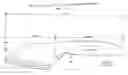
BRIEF DESCRIPTION OF THE DRAWINGSFIG. 1 is a view of etched or inked lines on the surface of the knife blade placed at ⅛″ to 1/16″ intervals.
FIG. 2 is a view of etched or inked lines on a table trim knife with linear blade sharpening guideline end view.
PHYSICAL DESCRIPTION OF SHARPENING GUIDELINES FOR BLADESFIG. 1. Front or Rear View of the Quad Rod X-Sharp Sharpener
Shown in FIG. 1 is a view of etched or inked lines on the surface of the knife blade placed at ⅛″ to 1/16″ intervals.
Shown in FIG. 2 is an end view of etched or inked lines on the surface of the knife blade.
Claims
What is claimed is:1. The patent feature on this knife blade is having knife sharpening guide lines etched or inked onto the length of the knife blade's surface as a proper, linear guide for maintaining the best knife sharpening pattern for a specific knife shape. The etched or inked lines on the surface of the knife blade will be placed at ⅛″ to 1/16″ intervals, but will vary depending on blade size. We are seeking a patent on the lines, themselves, delineating knife sharpening wear patterns on a knife blade surface that best serve the food processing industry. The etched guidelines and the blade's length will provide a format to be followed by the knife sharpener, for consistently achieving a productive, safe, knife blade shape. This feature will be most specifically used on high production knives within the food processing industry. Knives that are used in high-production, food processing plants are sharpened at least twice a day. Maintaining and controlling proper blade shapes, using these guidelines, will allow the properly shaped knife blade to track well through a cut, controlling the cut to maximize yields, for the life of the knife. Maintaining a proper blade shape, especially at the tip, will keep the knife tip from getting too thin and dangerous. Thin tips break most readily. The guidelines will also offer a guide for a knife life expectancy to be achieved. Once a knife wears down to a certain size, it becomes unproductive. The last of these etched lines on the upper part of the blade's surface will be the indicator that the end of the knife's life has been reached and the knife blade is no longer productive for proper, high-yield, on-line cutting. Using the etched blade guidelines, management will be able to create their own guideline on how long they want a knife blade to last, in terms of time of productive service. The knife sharpener will be able to gauge the amount of sharpening pressure and sharpening strokes needed to achieve an extended, productive life on a knife blade, in terms of time of productive service. Obvious improvements to the unskilled or skilled user.
2. Also claimed, is the use of these guidelines RF-ID Radio Frequency Identification. These lines may be produced with a special ink which has Radio Frequency Identification properties built in. This would help the processing facility track lost knives without shutting the plant down. Also this would help plants track the wearing of the knife over time as each guideline was removed from blade.
Images & Drawings included:


Sources:
- United States Patent and Trademark Office - verify current appl. status at the USPTO↗
Recent applications in this class:
- » 20250073935 2025-03-06
KITCHEN KNIFE AND METHOD OF MANUFACTURING KITCHEN KNIFE - » 20250042048 2025-02-06
Carbide Blade for Utility Knife - » 20250018587 2025-01-16
CERAMIC CUTTING BLADES - » 20240198544 2024-06-20
UTILITY KNIFE BLADE WITH FUNCTIONAL CUTOUTS - » 20240190029 2024-06-13
CUTTING IMPLEMENT - » 20240173878 2024-05-30
KITCHEN KNIFE AND METHOD FOR MANUFACTURING KITCHEN KNIFE - » 20230234248 2023-07-27
Food Chopping Device - » 20230166412 2023-06-01
METHOD OF MANUFACTURING A KNIFE BLADE AND KNIFE BLADE - » 20230050474 2023-02-16
KNIFE BLADE - » 20220088807 2022-03-24
Internal gradient materials, implements and methods