Method for creating a pattern on a concrete or asphalt surface.
US20070026152A1
2007-02-01
11/161,278
2005-07-28
Abstract:
This invention relates to a method of creating a pattern on a concrete or asphalt surface. A stencil is gently adhered to a concrete or asphalt surface and a liquid coating is applied over the stencil covering the entire concrete or asphalt surface. A stone aggregate is broadcast onto the liquid coating absorbing the liquid coating. The stencil is removed prior to the liquid coating substantially setting or curing. The loose excess stone aggregate is then removed from the surface. The surface directly below the stencil is void of stone aggregate and provides the appearance of a brick and a mortar joint.
Interested in similar patents?
Get notified when new applications in this technology area are published.
Classification:
C04B41/71 » CPC main
After-treatment of mortars, concrete, artificial stone or ceramics; Treatment of natural stone of only artificial stone; Coating or impregnation for obtaining at least two superposed coatings having different compositions at least one coating being an organic material
E01C19/44 » CPC further
Machines, tools or auxiliary devices for preparing or distributing paving materials, for working the placed materials, or for forming, consolidating, or finishing the paving for consolidating or finishing laid-down unset materials Hand-actuated tools other than rollers, tampers, or vibrators, specially adapted for imparting a required finish to freshly-laid paving courses
C04B41/48 » CPC further
After-treatment of mortars, concrete, artificial stone or ceramics; Treatment of natural stone; Coating or impregnating e.g. injection in masonry, partial coating of green or fired ceramics, organic coating compositions for adhering together two concrete elements, with organic materials Macromolecular compounds
C04B41/52 » CPC further
After-treatment of mortars, concrete, artificial stone or ceramics; Treatment of natural stone; Coating or impregnating e.g. injection in masonry, partial coating of green or fired ceramics, organic coating compositions for adhering together two concrete elements, Multiple coating or impregnating multiple coating or impregnating with the same composition or with compositions only differing in the concentration of the constituents, is classified as single coating or impregnation
C04B14/00 » CPC further
Use of materials as fillers
C04B14/00 » CPC further
Use of inorganic materials as fillers, e.g. pigments, for mortars, concrete or artificial stone; Treatment of inorganic materials specially adapted to enhance their filling properties in mortars, concrete or artificial stone
C04B41/4545 » CPC further
After-treatment of mortars, concrete, artificial stone or ceramics; Treatment of natural stone; Coating or impregnating e.g. injection in masonry, partial coating of green or fired ceramics, organic coating compositions for adhering together two concrete elements, characterised by the method of application applied as a powdery material
C04B41/4572 » CPC further
After-treatment of mortars, concrete, artificial stone or ceramics; Treatment of natural stone; Coating or impregnating e.g. injection in masonry, partial coating of green or fired ceramics, organic coating compositions for adhering together two concrete elements, Partial coating or impregnation of the surface of the substrate
C04B41/009 » CPC further
After-treatment of mortars, concrete, artificial stone or ceramics; Treatment of natural stone characterised by the material treated
C04B28/02 » CPC further
Compositions of mortars, concrete or artificial stone, containing inorganic binders or the reaction product of an inorganic and an organic binder, e.g. polycarboxylate cements containing hydraulic cements other than calcium sulfates
B05D1/12 IPC
Processes for applying liquids or other fluent materials performed by spraying Applying particulate materials
B05D5/00 IPC
Processes for applying liquids or other fluent materials to surfaces to obtain special surface effects, finishes or structures
Description
BACKGROUND OF THE INVENTIONVarious methods have been devised to create a decorative pattern on concrete and asphalt surfaces. Most of these methods require stamping a pattern into the soft concrete or asphalt and then applying a liquid or dry coating to resemble a brick or stone surface. Another method is to apply a stencil and spray or trowel a coating over the stencil, removing the stencil to reveal a brick or stone appearance.
BRIEF SUMMARY OF THE INVENTIONThis invention utilizes a stencil gently adhered to the substrate, a liquid coating spread over the stencil and an aggregate broadcast onto the liquid coating. The stencil is removed prior to the coating substantially setting. The excess aggregate is then removed from the surface.
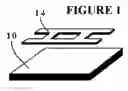
BRIEF DESCRIPTION OF THE DRAWINGS(FIG. 1) A stencil with a predetermined pattern 14 and a concrete or asphalt surface 10.
(FIG.2) The stencil with the predetermined pattern 14 is gently adhered to the concrete or asphalt surface 10.
(FIG.3) A liquid coating 12 is applied over the stencil 14 covering the concrete or asphalt surface 10.
(FIG.4) A stone aggregate 16 is broadcast onto the liquid coating 12.
(FIG.5) The stencil 14 is removed from the concrete or asphalt substrate 10 revealing the substrate 10 below the stencil 14 replicating a brick and mortar appearance.
Claims
What is claimed is:1. A method of creating a pattern on a concrete or asphalt surface by gently adhering a stencil to the substrate; applying a liquid coating over the stencil, broadcasting an aggregate onto the liquid coating, removing the stencil prior to the coating substantially setting, removing the excess loose stone from the surface when the coating has set.
2. A method according to claim 1, wherein the stencil is a predetermined pattern.
3. A method according to claim 2, wherein the stencil is constructed of paper.
4. A method according to claim 2, wherein the stencil is constructed of plastic.
5. A method according to claim 1, wherein the liquid coating is a settable coating.
6. A method according to claim 1, wherein the aggregate is a stone aggregate.
Images & Drawings included:



Sources:
- United States Patent and Trademark Office - verify current appl. status at the USPTO↗
Recent applications in this class:
- » 20250084009 2025-03-13
GLASS OVERLAY FOR CONCRETE - » 20240002304 2024-01-04
METHOD FOR MANUFACTURING A DECORATIVE ELEMENT COMPRISING AN ENGINEERED STONE AND A DECORATIVE ELEMENT COMPRISING AN ENGINEERED STONE - » 20220177381 2022-06-09
Glass overlay for concrete - » 20210292249 2021-09-23
PROCESS TO OBTAIN A CONCRETE STRUCTURE WITH A SURFACE LAYER OF RESIN-MODIFIED CONCRETE - » 20190359533 2019-11-28
COATED CONCRETE BODY - » 20120247372 2012-10-04
CONCRETE COLORING COMPOSITIONS AND METHODS - » 20120015199 2012-01-19
Method of Sealing Concrete and Sealed Product - » 20100092664 2010-04-15
Two part, low molecular weight self curing, low viscosity acrylic penetrant, sealant and coating composition, and methods for using the same - » 20090139435 2009-06-04
Concrete coloring compositions and methods - » 20080187738 2008-08-07
Constructional board capable of capturing and decomposing aldehyde