Expanded armed wheelchair
US20070040348A1
2007-02-22
11/367,797
2006-03-06
Abstract:
A expandable arm wheelchair which is comprised of a wheelchair base (1) expandable arm (2) locking mechanism (3) Geared locking mechanism (4).
Interested in similar patents?
Get notified when new applications in this technology area are published.
Classification:
A61G5/12 » CPC main
Chairs or personal conveyances specially adapted for patients or disabled persons, e.g. wheelchairs; Parts, details or accessories Rests specially adapted therefor, e.g. for the head or the feet
A61G5/1054 » CPC further
Chairs or personal conveyances specially adapted for patients or disabled persons, e.g. wheelchairs; Parts, details or accessories Large wheels, e.g. higher than the seat portion
A61G5/125 » CPC further
Chairs or personal conveyances specially adapted for patients or disabled persons, e.g. wheelchairs; Parts, details or accessories; Rests specially adapted therefor, e.g. for the head or the feet for arms
B62M1/14 IPC
Rider propulsion of wheeled vehicles operated exclusively by hand power
Description
CROSS REFERENCE TO RELATED APPLICATIONThis application relates to and claims priority from U.S. Provisional Patent Application Ser. No. U.S. 60/709,751 filed Aug. 22, 2005, the specifications which are incorporated herein by reference.
FEDERALLY SPONSORED RESEARCHNot Applicable
SEQUENCE LISTING OR PROGRAMNot Applicable
BACKGROUND OF INVENTION—FIELD OF INVENTIONHealthcare officials in the past have been using wheelchairs for quite some time however, with obese people, it has been quite a challenge for the healthcare industry. The wheelchairs in existence today do not accommodate obese people as well as they should. Furthermore, transportation with wheelchairs has and is, a challenge because the larger the occupant is, the wider the wheels have to be to accommodate the occupant because of the width of the occupant. To add, when a person with obesity has to be transported, the lift on a vehicle which does the transport, is unable to accommodate the width of the very wide wheelchair which in turn is caused from the width of the obese occupant. This new product Expandable Armed Wheelchair which will be referred to as “EAW” proves the EAW to be far superior to the U.S. Patent 20050248143 Sato Hisayoshi discloses a complex adjustable wheelchair but the problem for the obese user still exist with the current adjustable wheelchair. The issues with unloading and loading in transport vehicles of the obese user will still be a stigma. The problems which arise are the more obese the person or end user is the wider the wheel base on the wheelchair has to be. U.S. Patent 20050248143 Sato Hisayoshi does not address the issue of obese people like the EAW does. U.S. Patent 20050248143 Sato Hisayoshi does not address the issue of the heath care industry as far as moving obese clients in and out of vans as well as loading and unloading from transport vehicles. U.S. Patent 20050248143 Sato Hisayoshi does not look at the real problem that exist which is the wide wheel base on the present wheelchairs today.
To add, another problem is abundantly clear is the width of the door ways today. The more and more people continue to be inflicted by obesity the wider doorways need to be. Now there is two different issues here one being new construction with new codes and two the renovation of old construction to provide wider door ways. Now w/new codes and construction is not to much of a problem, however; it does merit being mentioned. Where a major problem exist is the fact that the larger and wider people continue to get renovation of commercial as well as residential building will indeed need to transpire. The “EAW” will help relieve the codes as well as the renovation of old commercial and residential buildings. For, with the “EAW” having the wheelbase remain the same instead of changing for the over whelming obesity problem we face today.
- a. The wheelchairs used today for obese people do not fit through most doorways in old construction.
- b. The wheelchairs used today for obese people are creating many new codes.
- c. The wheelchairs used today for obese people are very hard to maneuver because of width of wheelbase.
- d. The wheelchairs used today for obese people are unsafe because of wheel base trying to fit through door ways.
- e. The wheelchairs used today for obese people are unsafe because of wheel base for unloading and loading on ramps of vehicles.
Accordingly, besides the objects and advantages of the “EAW” described in my above patent, several objects and advantages of the present invention are:
- A. The “EAW” will relieve the problem of the current wheelchairs in the width of old constructed door ways.
- B. The “EAW” could relieve the ongoing code changing issues w/new and old construction wether residential or commercial.
- C. The “EAW” will be much easier to maneuver because of shorter wheel base.
- D. The “EAW” will be more safe as far as maneuvering obese people through doorways.
- E. The “EAW” will be more safe for people loading and unloading from transport vehicles as well as the end user of the “EAW”.
In accordance with the present invention, the “EAW” comprises a locking mechanism, an expandable arm, a geared locking arm, padded side mechanism.
In the drawings, closely related figures have the same number but different numerical suffixes.
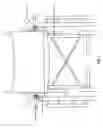
DRAWINGS—FIGURESFIG. 1(1) rear view illustrates the entire body and structure of a wheelchair.
FIG. 1(2) rear view illustrates the expandable arm.
FIG. 1(3) rear view illustrates the locking mechanism.
FIG. 1(4) Rear view Illustrates the geared locking Mechanism.
FIG. 2(1) side view illustrates the entire body and structure of a wheelchair.
FIG. 2(2) side view illustrates the expandable arm.
FIG. 2(3) side view illustrates the locking mechanism.
FIG. 2(4) side view Illustrates the geared locking Mechanism.
FIG. 3(1) top view illustrates the entire body and structure of a wheelchair.
FIG. 3(2) top view illustrates the expandable arm.
FIG. 3(3) top view illustrates the locking mechanism.
FIG. 3(4) top view Illustrates the geared locking Mechanism.
DRAWINGS—Reference Numerals
| 1 wheelchair base | |
| 2 expandable arm | |
| 3 locking mechanism | |
| 4 geared locking arm | |
A preferred embodiment of the EAW present invention is illustrated in FIG. 1 (1) (rear view) illustrates the entire structure of the wheelchair 1 (2) illustrates the expandable arm of the wheelchair base FIG. 1(3) illustrates the locking mechanism fog1(4) illustrates the geared locking mechanism. FIG. 2 (1) side view illustrates the wheelchair base FIG. 2 (2) illustrates expandable arm of the wheelchair base FIG. 2 (3) illustrates locking mechanism FIG. 2 (4) illustrates the geared locking mechanism. FIG. 3(1) top view illustrates the wheel chair base FIG. 3 (2) illustrates the expandable arm mechanism of the wheelchair base FIG. 3 (3) illustrates the locking mechanism FIG. 3 (4) illustrates the geared locking mechanism.
The wheelchair base will have the expandable arm adhered to the locking mechanism which will embody the geared locking mechanism.
Advantages
From the description above a number of advantages of my EAW become evident.
(a) The “EAW” will relieve the problem of the current wheelchairs in the width of old constructed door ways.
(b) The “EAW” could relieve the ongoing code changing issues w/new and old construction wether residential or commercial.
(c) The “EAW” will be much easier to maneuver because of shorter wheel base.
(d) The “EAW” will be more safe as far as maneuvering obese people through doorways.
(e) The “EAW” will be more safe for people loading and unloading from transport vehicles as well as the end user of the “EAW”.
Accordingly, the reader will conclude that the EAW is more safe and far more superior way of moving as well as transporting the end user.
CONCLUSION, RAMIFICATIONS, AND SCOPE
-
- The “EAW” will relieve the problem of the current wheelchairs in the width of old constructed door ways.
- The “EAW” could relieve the ongoing code changing issues w/new and old construction wether residential or commercial.
- The “EAW” will be much easier to maneuver because of shorter wheel base.
- The “EAW” will be more safe as far as maneuvering obese people through doorways.
- The “EAW” will be more safe for people loading and unloading from transport vehicles as well as the end user of the “EAW”.
Although the product described above has many specifics, it does not limit the scope of the invention but merely providing illustrations through verbiage as well as drawings of some of the patent present embodiments.
Claims
We claim:1. A method for expanding a wheelchair.
(i) Wheelchair base
(ii) Expandable arm
(iii) Locking mechanism
(iv) Geared locking mechanism
2. A wheelchair with the capabilities of expanding the arms with locking mechanisms.
(i) Wheelchair base
(ii) Expandable arm
(iii) Locking mechanism
(iv) Geared locking mechanism
Images & Drawings included:



Sources:
- United States Patent and Trademark Office - verify current appl. status at the USPTO↗
Recent applications in this class:
- » 20220175598 2022-06-09
ASSISTANCE INFORMATION MANAGEMENT SYSTEM - » 20210315753 2021-10-14
Exercise apparatus and method of use - » 20200093667 2020-03-26
Novel appendage rest - » 20190374415 2019-12-12
EXERCISE APPARATUS AND METHOD OF USE - » 20180185216 2018-07-05
Sliding arm mechanism for wheelchairs - » 20180021194 2018-01-25
Support assembly with selective orbital rotation about bracket - » 20170143563 2017-05-25
Exercise apparatus and method of use - » 20160367418 2016-12-22
Backrest fixation system and an electrically powered wheelchair comprising the same - » 20160331609 2016-11-17
Leg rest device of power vehicle - » 20160279003 2016-09-29
CHAIR FOR PERSON TRANSFER