Artificial floral assembly with illumination
US20070048464A1
2007-03-01
11/525,338
2006-09-22
Abstract:
The artificial floral assembly with illumination comprises a stem backbone, electrical light fixture wiring, a flower bloom, and a leaf structure as well as an optional stem interface. The stem backbone may have wire, electrical wiring, polyethylene sheet material, cloth reinforced adhesive tape, caulking, and fabric. The flower bloom may have wire rings joined together at a center point, fabric covering the wire rings, and strands of wire dangling from the center point. The wire rings may be attached to a metal collar which slides over the top of the stem backbone/light fixture.
Interested in similar patents?
Get notified when new applications in this technology area are published.
Description
This application is a continuation-in-part of application Ser. No. 10/892,943, filed on Jul. 16, 2004. The prior application (Ser. No. 10/892,943) is hereby incorporated by reference.
BACKGROUND OF THE INVENTIONArtificial flowers and decorations based on artificial flowers and plant-like structures are commonplace. Consequently, there is an ongoing need for assembly/artificial flowers which are long lasting, durable, and constructed from inexpensive, environmentally safe materials. Also, there is a need for resilient stems, petals, and leaf structures that are easy to work with and easy to assemble in a variety of floral composites and mixtures.
Problems and difficulties occur with conventional practices to create artificial flora. Typically, silk, plastic, or a woven polyester fabric has been used as the material for duplicating leaves or petals in flower construction. Silk is extremely light and requires substantial support to maintain a desired shape of petal or leaf. Plastic materials typically require costly molds and forms so that the plastic may assume various surface textures and simulate the leaf or petal. Woven polyester fabric also has been molded and then sized with a stiffening agent so that the resulting fabric retains an appropriate shape. Generally, any of these materials result in surface textures that require additional painstaking painting and decorative steps.
Alternatively, dried flowers have been used; they are obtained by preserving natural flowers. Typical preservation methods include freeze drying, drying with a desiccant such as silica sand, plasticizing, dipping in paint, and treating with chemicals such as glycerine. U.S. Pat. No. 4,943,455 is directed to a structure in which each petal component is formed from a rubberized material or elastic construction. The edge marginal regions of each of the components internally contracts so as to provide a wavy or terminating edge which is meant to resemble a leaf or a petal. Two other patents, U.S. Pat. Nos. 5,108,800 and 5,240,526, are directed toward a different method of making artificial flowers. In these cases, the tips of the petals are heated to a temperature sufficient to melt the fabric in the region of the tips while the petal in other areas is protected from the heat. With this process, a shriveled, dried-up appearance is imparted to the artificial flower.
SUMMARY OF THE INVENTIONThe artificial floral assembly with illumination comprises a stem backbone, electrical light fixture wiring, a flower bloom, and a leaf structure as well as an optional stem interface. The stem backbone may have wire, electrical wiring, polyethylene sheet material, cloth reinforced adhesive tape, caulking, and fabric. The flower bloom may have wire rings joined together at a center point, fabric covering the wire rings, and strands of wire dangling from the center point. The leaf structure may have fabric, adhesive material, and wires. The process for making the stem backbone may involve attaching an electrical wiring to section of a wire segment, then wrapping polyethylene material, cloth reinforced adhesive tape, adhesive, and fabric along the entire wire segment to the plug. The process for making the flower bloom may involve forming a plurality of wire rings which are positioned around a center point, covering each ring with fabric, and painting the fabric. The wire rings may be attached to a metal collar which slides over the top of the stem backbone/light fixture.
The collar provides a mechanism for the wires (of the flower blooms) to be linked together and fastened. The length and inside diameter of the collar is sized to allow rotation about the longitudinal axis, while limiting rocking about the transverse axes. The fastening does not require a chemical or mechanical interface or a separate bonding agent. The collar's placement provides an attractive sheath for the light fixture. Because the collar is removable, the floral arrangement can be separated into discrete parts. Therefore, the overall structure can be packaged easily, stored in separate compartments, and assembled as needed. Because the collar can be removed or replaced, different floral bloom arrangements can be substituted or replaced as needed.
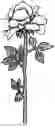
BRIEF DESCRIPTION OF THE DRAWINGSFIG. 1 shows a side plan view of the completed artificial floral assembly.
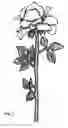
FIG. 2 shows a side plan view of the completed artificial floral assembly with illumination.
FIG. 3 shows a side plan view of three wires (used to create the wire frame).
FIG. 4 shows a perspective view of a sheet of fabric with the wires positioned along the sheet and the top layer of fabric partially folded over the bottom layer of fabric.
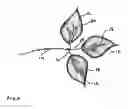
FIG. 5 shows a side plan view of three leaves joined together by twisted wires.
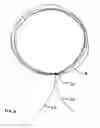
FIG. 6 shows five loops of wire twisted and tied together, forming one set of five rings.
FIG. 7 shows three sets of rings, forming a total of fifteen rings; each set of wire rings containing five loops of wire (as shown in FIG. 5).
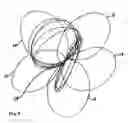
FIG. 8 shows the fifteen rings spread out and placed strategically around a center point; one of the outermost rings has closed end stretch nylon tube material covering the individual ring.
FIG. 9 shows a side plan view of the rings with the outermost rings covered with closed end stretch nylon tube material.
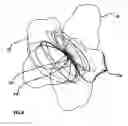
FIG. 10 shows a top plan view of the rings with most of the outermost rings covered with closed end stretch nylon tube material.
FIG. 11 shows a side plan view of the same ring structure shown in FIG. 9.
FIG. 12 shows a perspective view of a completed flower bloom (with the dangling strands of wire and with the fifteen rings covered with closed end stretch nylon tube material).
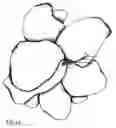
FIG. 13 shows a bottom plan view of a completed flower bloom.
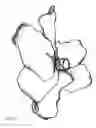
FIG. 14 shows a top plan view of a completed flower bloom.
FIG. 15 shows a sectional view of the lampholder, lampholder base, and related components.
FIG. 16 shows a side perspective of the wall plug connected to electrical wires.
FIG. 17 shows a side view of the lampholder connected to the stem.
FIG. 18 shows a perspective view of the mount with tabs.
FIG. 19 shows a side view of the mount with a wire from the base of the flower bloom wrapped around the outer circumference of the mount.
FIG. 20 shows a side view of the mount connected to the flower bloom by the wire wrapping.
FIG. 21 shows a perspective view of the same structure shown in FIG. 20.
FIG. 22 shows a perspective view of an alternative mount with a lip and holes.
FIG. 23 shows a perspective view of a stem interface.
Similar reference characters denote corresponding features consistently throughout the attached drawings. The figures are not drawn to scale.
DETAILED DESCRIPTION OF THE INVENTIONIn general, the artificial floral assembly can be considered a construct of five subassemblies: (1) frame for individual leaves, (2) leaf structure, (3) flower bloom/collar, (4) stem backbone of floral assembly. Each subassembly is constructed separately and independently of the other subassemblies. Depending on the application, individual subassemblies may or may not be used. In any given artificial floral assembly, not all five subassemblies are required.
An aspect of the invention involves building many different combinations of flowers, leaves, stems, and branches. As constructed, the overall assembly and the individual components are not limited to specific sizes, shapes, or color combinations. The flower bloom in particular is easy to adjust and modify. Another aspect of the invention is the ability to add to existing structures or subtract from existing structures.
In addition, the completed structure does not show dust, dirt, or ordinary wear easily. Another aspect is that the completed structure is not susceptible to most typical household solvents and fluids. Food, drink, and other materials might “stain” the fabric but they will not affect the structural integrity. There is no need for regular cleaning or maintenance work. Yet, the artificial floral assembly can be washed with a stream or hose of water. If necessary, the flower bloom can be repaired with nail polish and the individual flower petals can be replaced.
Another aspect of the invention is its longevity. The stem structure will support flowers and leaves over a long time period (as much as 3 to 20 years). Individual flowers and leaves will not typically wilt, disintegrate, or fall off the stem.
Both the completed artificial floral assembly and the individual parts are not sensitive to temperature, humidity, light, darkness, altitude, or varying climates. The assembly will hold up under hot lights. It is not sensitive to sound or other extreme environmental conditions.
Another aspect of the invention is that the assembly can be squashed down, seriously wrinkled, and then resuscitated (that is, repaired to appear as an original). In particular, the wires on petals can be wrinkled/crunched. The artificial floral assembly can be transported in various containers/luggage. Consequently, the invention can be set up and torn down with ease. The materials are both difficult to damage and simultaneously easy to repair.
Also, the starting materials may be generally cost effective and environmentally safe. There may be minimal waste of materials; that is, each material may be utilized fully depending on the application. For example, the knot of the closed ended stretch nylon tube that binds the rings together also provides the center of the flower bloom. Besides providing color, the spray paint makes closed ended stretch nylon tube much stronger than silk alone.
Because of these factors, the artificial floral assembly can fit into all different design showcases. In addition, it can be kept separately and sold in custom or standard assembly packages with paint and caulking material supplied either separately or integrated into the assembly packages.
Process Steps for Creating the Artificial Floral AssemblyFirst Subassembly: Frame for Individual Leaves
- 1. Create the wire frame for the leaf structure:
- 1. Put one 2″ wire piece 2 across another 8″ wire piece 4 toward one end (approx. 2Δ from the end). Note: larger flower leaves can be created with longer wire pieces.
- 2. Wrap the two wire pieces tightly together several times so that they are firmly fixed together, as shown in FIG. 3.
- 2. Cut a strip 6 of the fabric that is approx. 60″ long, 10″ wide, and less than ⅛″ deep.
- 3. Stream 2′ to 4′ of caulking across the strip of fabric so that the caulking covers ½ of the available surface area 8, as shown in FIG. 4. Spread completely and evenly over ½ of the fabric strip 6 using fingers or a spatula.
- 4. Line the wire frames across the side 8 where the caulking material is spread out, as shown in FIG. 4. Place the frames on the caulked surface in a pattern so that at least 4″ separates the frames. For example, for a strip of fabric 26″ long and 8″ wide, 9 medium sized frames may be used. For substantially larger leaves, the entire area can be covered with caulking and a second whole strip of fabric placed on top.
- 5. Fold over the uncaulked side 10 of fabric onto the caulked side 8 of fabric with the wire frames laid out, as shown in FIG. 4. Press and smooth over so that the caulking is distributed evenly across the entire surface area and wire frames are sandwiched between the two sides.
- 6. Let set for 1 hr. to 24 hr. so that the caulking cures properly.
- 7. Cut the fabric into leaf shapes 12, which are shown in FIG. 5. Each leaf has a stem of exposed wires 14 and veins which are actually wires 16 imprinted inside the fabric material. Leaves can and should be differently shaped and sized, depending on design plans.
Second Subassembly: Leaf Structure - 1. Place one leaf 12 in a horizontal plane and then place two leaves 12 approx. 2½″ underneath the top leaf and at a 90 degree angle from the top, so that exposed wires 14 intersect as shown in FIG. 5.
- 2. Twist sections of wire 14 of the three leaves together, as shown in FIG. 5.
- 3. Wrap black chenille stem material around exposed wire 14 so that all exposed wire 14 is covered completely. The individual black chenille stem material is approx. 6″ to 18″ long and approx. ⅛″ to ¼″ in diameter.
- 4. Cut thin polyester fur into thin strips that are ½″ to 1″ wide. (It is acceptable if the thin polyester fur rolls onto itself and twists into a soft bundle.)
- 5. Put caulking over chenille stem, covering completely with a thin layer of caulking all along the stem.
- 6. Wrap the polyester fur strip over and around the chenille stem completely.
- 7. Let set for 1 hr. to 24 hr. so that the caulking cures properly.
Third Subassembly: Flower Bloom - 1. Create several loops of wire, each loop 18 approx. 8″ in diameter, as shown in FIG. 6; ends of each wire stick out from the circular loop shapes. The material and gauge of this wire may be the same as or similar to that used for the wire in the leaf structure.
- 2. Take wire ends from the combined loops and wrap the wire ends 3 times around one area 20 of the combined loops, thus forming a ring containing several loops of wire. Below the ring and the general area 20 are dangling wire strands 22, as shown in FIG. 6.
- 3. Repeat steps 1 and 2 twice so that there are several rings each containing several loops of wire 18 and dangling wire strands 22.
- 4. Separate the loops and arrange the loops into planes of varying radial degrees. The individual loops can be fanned out in varying radial layers, from almost perpendicular to almost 45 degrees from the remaining groupings of loops. Wrinkle each loop slightly.
- 5. Open the closed ended stretch nylon tube and turn the material inside out so that the portion that has been sewn together is on the inside. (Repeat this step for all the closed ended stretch nylon tube material to be used in making flower petals.)
- 6. Place the closed ended stretch nylon tube 26 over and around the wire loop so that the wire loop is covered completely with closed end stretch nylon tube material, as shown in FIG. 8.
- 7. Tie ends of closed ended stretch nylon tube material together in central area 28 together with a basic knot, as shown in FIG. 8. The knot 28 is located in the general area of the center point 24. FIG. 9 shows a side plan view of the rings with the outermost rings covered with closed end stretch nylon tube material. For this structure, FIG. 10 shows a top plan view and FIG. 11 shows a side plan view from a different perspective.
- 8. Arrange the loops (with the covered closed end stretch nylon tube material) in a decorative fashion in order to resemble a flower with blossoming and varying petals. In terms of the completed flower bloom, FIG. 12 shows a perspective view with the underside of the flower bloom exposed. For the same structure, FIG. 13 shows a bottom plan view, and FIG. 14 shows a top plan view.
- 9. Spray paint the flower petals on both the underside and topside, as well as tips and exposed wires. If appropriate, use a second complementary color of spray paint in order to create a suitable color combination.
Fourth Subassembly: Stem Backbone of Artificial Flower Assembly with Illumination - 1. Take basic electrical wiring used for lamp applications and cut to desired length.
- 2. Strip a small amount of outer plastic coating from the electrical wiring end, exposing the wires.
- 3. Take the lampholder 30 and disconnect the lampholder base 32, that is, the unattached bottom section of the lampholder 30. The lampholder 30, lampholder base 32, and other related components are shown in FIG. 15.
- 4. Attach threaded lampholder extension 34 to lampholder base 32.
- 5. Insert the stripped wires through threaded lampholder extension 34 coming out the center of the lampholder base 32.
- 6. Separate the outer casing 36 from the inside casing of the top section of the lampholder 30.
- 7. Connect each stripped end of electrical wiring to lampholder by winding around each screw on the inside casing and then tighten down each screw.
- 8. Replace the outer casing 36 and attach the base 32 of the lampholder to the top section so that the outer casing 36 combines with the lampholder 30.
- 9. Take the bottom end of the electrical wiring, that is, the opposite end of the wiring, strip a small amount of outer plastic coating from the electrical wiring end, exposing the wires.
- 10. Take the wall plug 40, that is, the socket that plugs into the wall, as shown in FIG. 16. Open up and connect each stripped end of electrical wiring by winding around each screw and then tighten down each screw; that is, one of the exposed wires to one screw and the other exposed wire to the other screw.
- 11. Guide electrical wire through socket guides and out the center hole. The electrical wires 38 extend out the bottom of the wall plug 40 as shown in FIG. 16.
- 12. Close the wall plug unit and tighten the outside screw to fasten it securely.
- 13. Starting inside threaded lampholder extension 34 at the base 32 of lampholder, attach the fence wire 42 along the entire length of electrical wire 44 using strips of cloth reinforced adhesive tape to secure the two materials (the fence wire and electrical wire). The completed connection is shown in FIG. 17.
- 14. Take polyethylene sheet material and secure a corner or edge with cloth reinforced adhesive tape around the threaded lampholder extension at the base of lampholder.
- 15. Wind the polyethylene sheet material tightly around threaded lampholder extension and all the exposed fence wire combined with the electrical wiring; attaching the end of polyethylene sheet material and starting next piece of polyethylene sheet material securely with cloth reinforced adhesive tape, thereby forming a layer of polyethylene sheet material.
- 16. If needed, in order to create an airtight seal of cloth reinforced adhesive tape over the polyethylene sheet material layer, remove air pockets, bubbles of material, or exposed surfaces by slicing with a scissor or another sharp implement.
- 17. Wrap polyethylene sheet tape securely over the entire surface of the polyethylene sheet material, starting at lampholder base, thereby forming layer of cloth reinforced adhesive tape.
- 18. Attach the prepared leaf structure if desired (as shown in FIG. 5) to the stem by wrapping exposed wire 14 around cloth reinforced adhesive tape layer, and affix and cover with additional cloth reinforced adhesive tape.
- 19. Place caulking over the entire cloth reinforced adhesive taped surface forming a layer of caulking. Smooth the caulking over surface with fingers or a spatula, carefully placing caulking in any exposed cracks, crevices, or points joining leaf structures or flower petals to the underlying fence wiring.
- 20. Wrap the thin polyester fur or other desired fabric over the entire caulking layer. Wrap the thin polyester fur tightly and closely, overlapping along the entire fence/electrical wire. This layer is the outermost layer covering the fence/electrical wire.
- 21. Let set for 1 hr. to 24 hr. so that the caulking cures properly.
- 22. Assemble flower blooms (obtained from third subassembly process). Attach the wire strands to the tabs 46 in the collar 48. (The collar and its tabs are shown in FIG. 18.) Position the flower blooms so that they are resting on the lip of the individual tabs 46 on the collar 48. Then wrap the wire strands around the outer circumference of the collar and twist the wire strands around until the strands are secured. FIGS. 19, 20, and 21 show different perspectives of the wire strands wrapped around the collar. An alternate collar 50 is shown in FIG. 22. The alternate assembly 50 places the wire strands through the holes 52 in the collar flange or lip area 54.
- 23. Repeat as needed for all tabs 46 or holes 52 in the collar.
- 24. After securing all of the flower bloom petals in the tabs or holes around the collar, put a caulking layer and fabric over the exposed wire strands.
- 25. Let set for 1 hr. to 24 hr. so that the caulking cures properly.
- 26. Slip the collar onto the lampholder section of the electronic wiring and insert a lightbulb to fasten the collar.
A second distinct embodiment of the invention does not comprise an electrical wire/stem wire combination and does not comprise a collar with an attached light fixture. For the second distinct embodiment, there are an alternative third subassembly and an alternative fourth subassembly.
Alternative Third Subassembly: Flower Bloom - 1. Take 5 loops of wire, each loop 18 approx. 8″ in diameter, as shown in FIG. 5; ends of each wire stick out from the circular loop shapes. The material and gauge of this wire may be the same as or similar to that used for the wire in the leaf structure.
- 2. Take wire ends from the combined 5 loops and tightly wrap the wire ends 3 times around one area 20 of the 5 combined loops, thus forming a ring containing five loops of wire. Below the ring and the general area 20 are dangling wire strands 22, as shown in FIG. 5.
- 3. Repeat steps 1 and 2 twice so that there are 3 rings, each containing 5 loops of wire 18 and dangling wire strands 22. (Note that it is possible to create 4 rings, each containing 5 loops of wire, instead of 3 rings, as shown in this process subassembly.)
- 4. Connect the 3 rings together by wrapping the ends of the wire strands together tightly in a small confined area 24, as shown in FIG. 6. Since the wire loops are gathered together in this area, it is the center point or gathering point, which, in turn, becomes the center of the flower, from which the individual petals radiate outward.) The dangling wire strands 22 will hang freely below the center point 24.
- 5. Separate the connected rings into three groupings, each grouping containing a set of five loops. Then, starting with the ring grouping farthest from the center point 24.
- 6. Take one ring grouping and separate five loops and position the individual loops into planes of varying radial degrees. Wrinkle each loop slightly.
- 7. Open the closed ended stretch nylon tube and turn the material inside out so that the portion that has been sewn together is on the inside. (Repeat this step for all the closed ended stretch nylon tube to be used in making flower petals.)
- 8. Starting with the outermost wire loop, place the closed ended stretch nylon tube 26 over and around the wire loop so that the wire loop is covered completely with closed ended stretch nylon tube material, as shown in FIG. 7.
- 9. Gather ends of closed ended stretch nylon tube material together in central area 28, as shown in FIG. 7. Tie the ends of the closed ended stretch nylon tube material (in the central area) together with a basic knot, as shown in FIG. 7. The knot 28 is located in the general area of the center point 24. FIG. 8 shows a side plan view of the rings with the outermost rings covered with closed end stretch nylon tube material. For this structure, FIG. 9 shows a top plan view and FIG. 10 shows a side plan view from a different perspective.
- 10. Repeat steps 6-9 for each ring grouping. The loops should fan out radially in varying planes and varying degrees, in order to resemble the structure of petals on a blooming flower.
- 11. Spray paint the flower petals on both the underside and topside, as well as tips and exposed wires. If appropriate, use a second complementary color of spray paint in order to create a suitable color combination.
- 12. Arrange each grouping together with the central, knotted areas adjacent to each other.
- 13. FIG. 11 shows a perspective view with the underside of the flower bloom exposed. For the same structure, FIG. 12 shows a bottom plan view, and FIG. 13 shows a top plan view.
Alternative Fourth Subassembly: Stem Backbone of Artificial Flower Assembly - 1. Cut fence wire to desired length.
- 2. Assemble flower blooms (obtained from third subassembly process), leaves (from the first subassembly process), and leaf structures (from second subassembly process).
- 3. Wrap the dangling wire strands 22 of a flower bloom tightly around one end or one location on the fence wire.
- 4. Wrap the exposed wire 14 of a leaf 12 around the fence wire immediately below the flower bloom (that is, immediately below the flower petals on the fence wire). If appropriate, cover and fasten the wire 14 with cloth reinforced adhesive tape. Alternatively, three or more interconnected leaves (as shown in FIG. 4) can be wrapped around the stem below the flower bloom and then attached by applying cloth reinforced adhesive tape over exposed wires.
- 5. Repeat steps 3 and 4 two to three times, resulting in 3 to 4 leaves below the flower bloom subassembly. Alternatively, affix several leaf combinations below the flower bloom.
- 6. Use cloth reinforced adhesive tape to secure a corner of polyethylene sheet material wrapping on the fence wire immediately below the flowers and leaves.
- 7. Wind the polyethylene sheet material tightly around all the exposed fence wire; attaching each end of polyethylene sheet material and starting next piece of polyethylene sheet material securely with cloth reinforced adhesive tape, thereby forming a layer of polyethylene sheet material along entire length of fence wire.
- 8. Wrap the cloth reinforced adhesive tape securely over the entire surface of the polyethylene sheet material, thereby forming layer of cloth reinforced adhesive tape. If needed, in order to create an airtight seal of cloth reinforced adhesive tape over the polyethylene sheet material layer, remove air pockets, bubbles of material, or exposed surfaces by slicing with a scissor or another sharp implement before securing with the cloth reinforced adhesive tape.
- 9. Attach the prepared leaf structure (as shown in FIG. 4) to the stem by wrapping exposed wire 14 around cloth reinforced adhesive tape layer, and cover and affix with additional cloth reinforced adhesive tape.
- 10. Place caulking over the entire cloth reinforced adhesive tape surface forming a layer 36 of caulking. Smooth the caulking over with fingers or a spatula, carefully placing caulking in any exposed cracks, crevices, or points joining leaf structures or flower petals to the underlying fence wiring.
- 11. Wrap the thin polyester fur over the entire caulking layer. Wrap the thin polyester fur tightly and closely, overlapping along the entire fence wire. This layer is the outermost layer covering the fence wire.
- 12. Let set for 1 hr. to 24 hr. so that the caulking cures properly.
- 13. A typical stem interface comprises a cylinder of pole material and a base. The cylinder has an outer diameter of ¾″ to 1½″ and an inner diameter of ½″ to 1″; the pole material may be fabricated plastic or welded steel or a suitable composite. The cylinder contains two ends, each end with a male connector opening (or, alternatively, a female connector opening). This cylinder is actually the spine section of the stem interface.
The base of the stem typically contains 3 or 4 legs 56 for support and a top opening 58 that is a female connector (or, alternatively, a male connector), as shown in FIG. 16. The base may be plastic, steel, or any suitable material that is compatible with the cylinder material. The base provides ground support or vertical support for the spine or top separate piece.
The top separate piece of cylinder comprises a female connector (or, alternatively, a male connector). The top piece is available for uniting with the spine section or the base and the top piece is available for integrating with different artificial floral assemblies. The male connector of the spine section is a cylindrical fitting which may be attached on its internal side with epoxy or an adhesive. The female connector is also a cylindrical fitting with its inside diameter slightly larger than the outside diameter of the male connector. The female connector is also attached with epoxy or an adhesive.
The constructed stem interface can be utilized to create a variety of floral assemblies. For example, different backbones of flower assemblies can be attached to the base of the stem interface and secured with an epoxy mixture. The exposed wire of flower bloom can be cut to match the size of the male connector and attached with epoxy. Likewise, the exposed wire of the leaf or leaf combination (that is, leaf subassembly) can be cut to match the size of the male connector and also attached with epoxy. The epoxy mixture is used wherever the wire is inserted into the male or female part of stem interface. Then, the base of interface is attached to the spine and secured with epoxy mixture or another suitable adhesive material.
The materials each may have specific strengths and advantages that contribute to the overall invention. For the stem backbone, the polyethylene sheet material helps create a soft, squishy covering that approximates the touch and feel and thickness of natural plant stems. The cloth reinforced adhesive tape gives both strength and plasticity to the stem. The caulking is easy to dispense and apply cleanly and smoothly over different surface structures.
Because of the combination of materials (that is, the combination of polyethylene sheet material, cloth reinforced adhesive tape, and caulking), the completed stem can be bent and twisted without breaking the stem or permanently damaging the stem. Also, the combination of caulking and thin polyester fur fabric can be used to fix or modify the stem or leaves. This combination can cover or repair virtually any kind of background or underlying material in the artificial floral assembly.
The thin polyester fur covers the interface leaves and connections between the leaves, stems, and flowers. The thin polyester fur is a chenille material, that is, a polyester cotton, furry material that stretches, is easily cut into strips of varying sizes. The strips blend together into a uniformly appearing surface with a suitable soft texture. The preferred chenille fur is a 45% cotton, 55% polyester blend, with a green color. The chenille has a protruding pile, which actually makes the chenille soft to handle and stretchable.
With respect to the flower bloom, the wire loops can be wrinkled, crunched, pushed, pulled, and manipulated into many different sizes and shapes. The closed end stretch nylon tube material can be washed to remove any strongly colored stains. For really strong stains, spray paint can be used to “fix” or change the color. Clear nail polish can be used to fix breaks in the closed end stretch nylon tube material.
The stem interface allows for the replacement of flower blooms and different leaf structures. The stem interface can be incorporated into many different environments. It can substitute for virtually any potted plant with particularly designed stem interfaces.
Substitutions can be made for practically all the individual materials in the assembly. For example, the leaf fabric can be cotton, polyester, velvet, silk, canvas, paper, cardboard, and/or a blend of materials. Even a different shade of color can be substituted for green and a pattern can be substituted for the solid color. For the leaf subassembly, the wire is typically 18 gauge to 22 gauge galvanized wire; substitutions include different gauges and almost any wire materials, including aluminum, copper, or amalgams. For the flower bloom subassembly, the wire used for the loops may be the same or similar; that is, the same material and gauge size constraints apply (or do not apply).
The preferred caulking material is a siliconized acrylic caulk which, because of its material characteristics, allows the final structure to be bent, twisted, and reshaped. Other types of caulking, adhesives, and epoxies can be substituted but the overall structural stability and resilience may be adversely affected. While typically clear caulking is applied, other colors can be used for specific design purposes.
The black chenille stem material used in creating the leaf structure is generally known as “chenille pipe cleaners”. Possible substitutions include colored chenille stems and flexible wire of a suitable gauge. For the cotton/polyester blend chenille fabric, other chenille fabrics, such as a velvety silk, wool or cotton fabric can substitute. Even non-chenille fabrics with different colors and patterns may be substituted for specific design effects.
The closed end stretch nylon tube material used in creating the flower bloom is a commonplace polyester, nylon, cotton, or blend of fabrics, with a transparent color. Typically, footsox material is used. However, possible substitutes include any sewn polyester blend or nylon material with a flexible surface; the materials may be opaque or transparent and they may have many different colors, textures, and patterns.
The compressed paint spray is a spray enamel. Alternatively, it can be an oil, acrylic, or a combined oil/acrylic base. Typically, one paint mixture is used for each applied color (created with compressor and paint mixture). Depending upon design needs, any color or color combination can be used. Even a paint brush could be used to hand paint the flower blooms. For repairing flower blooms, an acrylic lacquer liquid solution such as a clear nail polish, correction fluid, or another liquid solution may be utilized.
For the backbone, any typical commercially available fence wire may be used. Typically, the wire is ¼″ to ⅜″ uncoated cable or galvanized steel that is cut into 2′ to 5′ lengths (depending on the specific artificial floral assembly). However, virtually any fence wire of a metal or a composite metal material and different diameters can be used. For the cloth reinforced adhesive tape, possible substitutes include other colors. Cloth reinforced adhesive tape is typically duct tape and any color will suffice. The polyethylene sheet material can be any size or shape or any kind of convenience bag or recycled plastic material. The polyethylene sheet material is typically 3 mil to 10 mil in thickness; however, the material is not limited to these thicknesses. While larger sheet sizes are preferable, any size or any soft, flexible polyethylene material in sheet form can be used.
Process steps are specified for hand assembly; they can be adapted for machine assembly or various industrial processes. Also, individual process steps can be modified, especially in terms of the leaf structure and number and placement of rings in the flower bloom structure. For instance, the leaf structure may be made without either the chenille pipe cleaner or chenille furry fabric covering the exposed wires. Different methods and different materials can be used for connecting leaves, flower blooms, and other items to the stem backbone. The connection means are not limited to the means specified in the various process steps for the different subassemblies (that is, the leaf structure, flower bloom, and stem backbone). For instance, various epoxies, adhesives, mechanical fasteners, and even velcro can be used as connection means.
The collar material may be molded plastic, cast plastic, machined plastic, steel, or a metal (such as copper, aluminum, or an alloy). The size of the collar varies depending on the type of illumination; a typical size could be 1″ to 4″ in diameter. The shape can vary depending on the type of illumination and the type of flower assembly constructed. A typical shape of the collar is circular or oval (with rounded edges). However, the collar material, collar size, and collar shape are not limited to the specific structures shown in the figures. Nor are the material, size, and shape limited to the specific collar structure discussed in the detailed process steps.
The tabs in the collar (shown in FIG. 18) may vary in size and in number. There may be as few as one tab or as many as ten tabs. The size of each tab may vary from ⅛ inch to ½ inch in a typical collar. However, the size and overlay of each tabs may be smaller or larger depending on the overall size of the collar and the overall intended appearance of the finished part.
The alternate flanged collar (shown in FIG. 22) has similar variability in the number of the holes. The dimensions of the holes are typically 0.15 inch to 0.2 inch in diameter. However, the holes may be larger or smaller depending on the specific floral assembly requirements. The lip on the alternative collar is approx. ¼ inch to ½ inch in width; that is, the area laying outside the circumference of the collar is approx. ¼ inch to ½ inch. The thickness of the lip is approx. ¼ inch to ½ inch.
Geometric dimensions of materials such as diameter, length, width, thickness, and height are given in general terms. The process steps can be easily modified for different geometries of individual materials. Increases and/or decreases in specific geometric values can be made and the changes lie within the scope of the invention. That is, no particular geometric value is meant to limit the scope of the invention.
Because of the individual and blended characteristics, the artificial floral assembly is ideally suited for many different uses in a home, business, apartment building foyer, photographic studio, window display, promotional displays, concerts, nightclubs, stages, special events, and holidays. This list is by no means meant to be inclusive. When the flowers are painted with UV paint, black lights can be used to create special dramatic effects. It is possible to anchor the flower and/or stem on a wall, floor, or another kind of housing structure. In addition, the artificial floral decoration can lend itself to a parasol configuration, a hanging/mounted wall decoration, a chain linking to create a flower string or artificial garland (using the stem interface).
The overall structure can involve many optional modifications, including the following: (1) Beading on flowers—along edges, hand beaded; (2) LED lights or electro-luminescent wire along petals or in center of flower bloom; (3) Screen/folding partition composed of a wall of flowers.
In summary, the overall artificial floral assembly with illumination can fit wherever artificial flowers, artificial trees, light fixtures or lamps, on walls, floors and ceilings, and other decorative items are used. However, the artificial floral assembly cannot be damaged like other typical artificial flowers or typical natural flowers or plants. Lamps or light fixtures are limited in where they can be decoratively placed while the artificial floral assembly is not limited and may decoratively twine down to the power outlet. A multitude of configurations, with many different textures, sizes, and shapes, can be created. They can be bent, twisted, stretched and wrapped repeatedly without damage.
Claims
What is claimed is:1. An artificial floral assembly comprising
(a) a stem backbone comprising wire, polyethylene sheet material, cloth reinforced adhesive tape, caulking, and fabric, and
(b) a flower bloom comprising a plurality of loops of wire, the wire loops joined together at a center point, fabric covering the wire loops, and strands of wire dangling from the center point, the dangling wire strands connected to the stem backbone.
2. An artificial floral assembly as in claim 1 wherein the fabric of the stem backbone comprises chenille fabric and the fabric of the flower bloom comprises closed end stretch nylon tube material.
3. An artificial floral assembly as in claim 1, further comprising a leaf structure comprising fabric, adhesive material, and wires, the wires connected to the center point of the flower bloom.
4. An artificial floral assembly comprising
(a) a flower bloom comprising a plurality of wire rings, end sections of wire protruding from the wire rings, the end sections of wire twisted together into a strand of wire, a center point of the end sections of wire twisted together, fabric covering the wire rings, and a knot of fabric in the center point,
(b) a leaf structure comprising fabric and wires, the wires twisted together,
(c) means for connecting the strand of wire of the flower bloom to the twisted wires of the leaf,
(d) a stem backbone comprising wire, adhesive material, plastic material, tape, and fabric,
(e) means for connecting the stem backbone to the strand of wire of the flower bloom, and
(f) means for connecting the stem backbone to the twisted wires of the leaf.
5. An artificial floral assembly as in claim 4 wherein the
(a) the adhesive material of the stem backbone is caulking,
(b) the tape of the stem backbone is cloth reinforced adhesive tape, and
(c) the fabric of the stem backbone is chenille fabric.
6. A process for producing an artificial floral assembly, the process steps comprising
(a) making a leaf structure, the steps of making the leaf structure comprising
1. creating a wire frame of two pieces of wire,
2. cutting a strip of a first fabric, comprising a first section and a second section,
3. streaming adhesive material onto the first section of the first fabric,
4. aligning the wire frames along the first section of the first fabric,
5. folding the second section of the first fabric over the first section of the first fabric,
6. letting the first fabric set for 1 to 24 hours, and
7. cutting the first fabric into shapes of leaves with exposed wires;
(b) making a leaf subassembly, the steps of making the leaf subassembly comprising
1. taking a plurality of leaves with exposed wire and twisting sections of exposed wire,
2. wrapping a second fabric around twisted sections of exposed wire,
3. spreading the adhesive material over the second fabric covering twisted sections of exposed wire,
4. wrapping a third fabric over the adhesive material, and
5. letting the leaf structure set for 1 to 24 hours;
(c) making a flower bloom, the steps of making the flower bloom comprising
1. forming a plurality of rings of wire, with a center point connecting the rings, and with dangling wire strands falling below the center point,
2. separating the plurality of rings of wire so that each of the wire rings is positioned around the center point,
3. covering each of the wire rings with a fourth fabric, the fourth fabric having an end area,
4. connecting the end areas of the fourth fabric covering each of the wire rings, and
5. painting the fourth fabric; and
(d) making a stem backbone, the steps comprising
1. cutting wire into segments, the segments comprising many locations,
2. wrapping a flower bloom around one location of the wire segment,
3. wrapping a leaf around a second location of the wire segment,
4. wrapping plastic material around the wire segment,
5. wrapping tape around the plastic material covering the wire segment,
6. placing the adhesive material over the tape along the wire segment,
7. wrapping a fifth fabric over the adhesive material, and
8. letting the wire segment set for 1 to 24 hours.
7. A process as in claim 6, wherein the adhesive material is caulking.
8. A process as in claim 6, wherein the tape is cloth reinforced adhesive tape.
9. A process as in claim 6, wherein the fourth fabric covering the wire rings is a closed end stretch nylon tube material.
10. An artificial floral assembly as in claim 1 wherein the stem backbone further comprises electrical wiring, the electrical wiring attached to a section of the wire.
11. An artificial floral assembly as in claim 10 wherein the stem backbone further comprises a wall plug, the wall plug attached to a section of the electrical wiring.
12. An artificial floral assembly as in claim 11 wherein the stem backbone further comprises a lampholder further comprising a lampholder base, lampholder extension, and outer casing, the lampholder connected to the electrical wiring.
13. An artificial floral assembly as in claim 1 further comprising a mount, the mount comprising a tab, wherein the dangling wire strands are connected to the tab.
14. An artificial floral assembly as in claim 1 further comprising a mount, the mount comprising a circumference, wherein the dangling wire strands are wound around the circumference of the mount.
15. An artificial floral assembly as in claim 14 further comprising caulking and fabric, the caulking placed over the wire strands and the fabric placed over the caulking.
16. An artificial floral assembly as in claim 4 wherein the stem backbone further comprises electrical wiring, the electrical wiring attached to a section of the wire.
17. An artificial floral assembly as in claim 16 wherein the stem backbone further comprises a wall plug, the wall plug attached to a section of the electrical wiring.
18. An artificial floral assembly as in claim 17 wherein the stem backbone further comprises a lampholder further comprising a lampholder base, lampholder extension, and outer casing, the lampholder connected to the electrical wiring.
19. An artificial floral assembly as in claim 4 further comprising a mount, the mount comprising a circumference, wherein the dangling wire strands are wound around the circumference of the mount.
20. An artificial floral assembly as in claim 19 further comprising caulking and fabric, the caulking placed over the wire strands and the fabric placed over the caulking.
Images & Drawings included:








Sources:
- United States Patent and Trademark Office - verify current appl. status at the USPTO↗
Recent applications in this class:
- » 20250089828 2025-03-20
HEIGHT-ADJUSTABLE SUPPORTING STRUCTURE USED FOR ARTIFICIAL GREEN PLANT AND COMBINED CONTAINER OF HEIGHT-ADJUSTABLE SUPPORTING STRUCTURE - » 20250009057 2025-01-09
THREE-DIMENSIONAL BOUQUET - » 20240041142 2024-02-08
ASSEMBLED SIMULATION POTTED PLANT - » 20240016248 2024-01-18
IMITATION FLOWER BOUQUET SYSTEM - » 20220061440 2022-03-03
Imitation flower bouquet system - » 20210045479 2021-02-18
Faux Shubbery Cover Apparatus - » 20190365004 2019-12-05
DECORATIVE FLORAL ORNAMENT, ARRANGEMENT CONTAINING SAME, AND METHOD OF USING SAME - » 20170318882 2017-11-09
METHOD OF MANUFACTURING DECORATIVE FLOWER - » 20160366965 2016-12-22
ARTIFICIAL FLORAL DESIGN FOR DECORATING THE SIDE VIEW MIRROR OF A VEHICLE - » 20160198785 2016-07-14
Robust artificial foliage