RFID antenna with pre-applied adhesives
US20070089286A1
2007-04-26
11/255,117
2005-10-20
✅ Patent granted
US 7,456,748 B2
2008-11-25
-
-
Davetta W Goins
2026-03-17
Abstract:
A radio frequency identification (“RFID”) system antenna having adhesive pre-applied to one or more of its contact pads to allow for high speed attachment of the antenna to the RFID die or die strap. Also disclosed is a method for attaching an RFID antenna having pre-applied adhesive to a die or die strap
Inventors:
- Chih-Min Cheng 23 🇺🇸 Westford, MA, United States
- Vito Buffa 1 🇺🇸 Hopkinton, MA, United States
Assignee:
- National Starch and Chemical Investment Holding Corporation 115 🇺🇸 New Castle, DE, United States
Interested in similar patents?
Get notified when new applications in this technology area are published.
Classification:
G06K19/07749 » CPC further
Record carriers for use with machines and with at least a part designed to carry digital markings characterised by the kind of the digital marking, e.g. shape, nature, code; Record carriers with conductive marks, printed circuits or semiconductor circuit elements, e.g. credit or identity cards also with resonating or responding marks without active components with integrated circuit chips; Constructional details, e.g. mounting of circuits in the carrier the record carrier being capable of non-contact communication, e.g. constructional details of the antenna of a non-contact smart card
Y10T29/49018 » CPC further
Metal working; Method of mechanical manufacture; Electrical device making; Antenna or wave energy "plumbing" making with other electrical component
Y10T29/49117 » CPC further
Metal working; Method of mechanical manufacture; Electrical device making Conductor or circuit manufacturing
Y10T29/49155 » CPC further
Metal working; Method of mechanical manufacture; Electrical device making; Conductor or circuit manufacturing; On flat or curved insulated base, e.g., printed circuit, etc. Manufacturing circuit on or in base
Y10T156/10 » CPC further
Adhesive bonding and miscellaneous chemical manufacture Methods of surface bonding and/or assembly therefor
H01Q17/00 IPC
Devices for absorbing waves radiated from an antenna; Combinations of such devices with active antenna elements or systems
G08B13/14 IPC
Burglar, theft or intruder alarms; Mechanical actuation by lifting or attempted removal of hand-portable articles
Description
FIELD OF THE INVENTIONThe present invention relates to an antenna with a pre-applied adhesive for use with a radio frequency identification system and a method for assembling a radio frequency identification system using an antenna with a pre-applied adhesive.
BACKGROUND OF THE ARTRadio frequency identification systems (“RFID”) are frequently utilized in many applications, such as electronic surveillance and inventory tracking. RFID systems typically consist of a data carrier, such as a tag or transponder, and a reader. The tags or transponders are used in various formats, such as disks, smart cards, plastic housings, or in paper-thin tags. The tags consist of a silicon die attached to the contact pads on the antenna. Anisotropic or isotropic conductive pastes, anisotropic conductive films and non-conductive pastes are utilized to attach the antenna to the die. To attach the silicone chip to the antenna, manufacturers frequently utilize semiconductor flip chip technology processes. Via the flip chip process, the radio frequency identification dies are picked and placed onto the antenna after an anisotropic conductive adhesive is applied to the pads. The adhesive is then cured at a high temperature for a short time while pressure is applied on top of the die to ensure electrical connection. Due to a number of variables, the flip chip process often has the drawback of a relatively slow processing speed
In all of the existing processes for assembling RFID systems adhesives are applied in a liquid or film form immediately before the die is attached to the antenna after which the unit is cured via heat or energy radiation. Numerous difficulties are presented by the use of such adhesives. For example, the die are extremely small and usually only a few millimeters square in size. Thus, the distances between the attachment bumps on the die are too small to utilize isotropic conductive paste.
Die straps which allow for high speed reel-to-reel processing of the interconnection between the die and the antenna may be utilized. Such high speed processing is critical to manufacturers in order to produce the extremely large number of tags utilized in various industries. The use of high speed processing poses a number of difficulties for manufacturers. For example, high speed processing limits the type of adhesive application techniques and the type of adhesive that may be utilized. A low viscosity adhesive is required for high speed adhesive deposition. However, a low viscosity adhesive tends to have low green strength. Low green strength may cause the die to short after placement on the antenna pads because of the vibration experienced during high web processing speeds. Further, as adhesive has a limited work life, there will be a limited time during which the adhesive may be applied without a variation in its viscosity. To avoid the variation, manufacturers are required to interrupt the assembly process to insert fresh conductive adhesive, resulting in an inefficient process having downtime. It would be advantageous to provide an RFID antenna that could be readily utilized in a high speed assembly process along with a method for assembling RFID systems at a high speed.
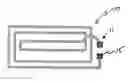
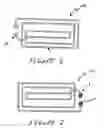
BRIEF DESCRIPTION OF THE DRAWINGSFIG. 1 is a top view of an RFID antenna.
FIG. 2 is a top view of an RFID antenna having adhesive pre-applied to its contact pads.
SUMMARY OF THE INVENTIONThe present invention discloses an RFID antenna having adhesive pre-applied to one or more of its contact pads to allow for high speed attachment of the antenna to the RFID die or die strap. Also disclosed is a method for attaching an RFID antenna having pre-applied adhesive to a die or die strap.
DETAILED DESCRIPTION OF THE PREFERRED EMBODIMENTSDuring assembly of RFID systems, RFID antennas are attached to the die or die strap to form an RFID data carrier. In order to facilitate high speed processing of the systems, it is desirable to utilize pre-applied adhesives on the contact pads of the RFID antennas. While the present application discusses antennas having two contact pads, it is possible for the antenna to have more than two contact pads and such embodiments are also within the scope of this invention. Antennas with pre-applied adhesive will simplify the die attach assembly process and reduce the production cost to the RFID manufacturers. Currently, RFID system manufacturers apply the adhesives to the antenna, resulting in additional steps in the assembly process. Through the use of the antennas with pre-applied adhesive of the present invention, the RFID system production time will not be limited by the ability to apply adhesives at a sufficiently high speed. The RFID system manufacturers will not be exposed to liquid adhesives, resulting in reduced waste, cleanup time and maintenance time, along with a reduced risk of exposure of its personnel to hazardous chemicals. Further, the softened or melted pre-applied adhesives of the present invention will possess a higher green strength than the liquid adhesives currently utilized resulting in a reduction of mis-alignments between the die and antenna contact pads before curing of the adhesive. Overall, the use of the pre-applied adhesives on the antenna will result in less processing variability and better interconnect quality.
Various types of adhesives, including liquid paste, with or without solvent, and films may be utilized as a pre-applied adhesive on the antenna. The adhesives may be based on either thermoset or thermoplastic chemistry and should preferably have quick or snap bond capability. Depending upon the desired use, the adhesive may be either electrically conductive or electrically non-conductive. In the case that the adhesive is electrically conductive, it may be either anisotropic or isotropic.
FIG. 1 illustrates a typical RFID antenna 10. Despite the illustrated configuration of antenna 10, the antenna may be in virtually any desired shape. Contact pads 11 for attachment of the antenna to the die are located at each end of the antenna. FIG. 2 illustrates antenna 10 having pre-applied adhesive 15 on contact pads 11. The pre-applied adhesive would, after application, be in the form of a film that would be capable of reverting to a softened state at a sufficiently high temperature and then bonding the die to the antenna if it is a thermally activated film. One the other hand, if the film is pressure sensitive in nature, then the die can be attached to the antenna with pressure.
In the method of pre-applying the adhesive, an antenna having at least two contact pads is first provided. Antennas are typically prepared with wet processes, such as screen printing of conductive inks or solution etching of copper/aluminum foil. Next, an adhesive is deposited on one or more of the contact pads. The adhesive may be applied to the antenna via conventional printing or dispensing techniques at either room temperature or, if necessary, high temperature. The adhesive may be applied as a film or in a form capable of forming a film on the contact pad and may be either conductive or non-conductive. The adhesive may then be B-staged onto the antenna contact pads or B-staged onto release liner prior to placement on the antenna contact pads. Many types of adhesives, including solvent-based adhesives, hot melt adhesives and also adhesives with dual cure mechanisms are suitable as B-stage adhesives. A solvent-based adhesive, for example, is B-staged onto the antenna contact pad by the evaporation of the solvent. A hot melt adhesive, on the other hand, is B-staged onto the antenna contact pad after cooling back to room temperature. In a further embodiment, a pressure sensitive adhesive may be utilized. Finally, an adhesive with multiple cure mechanisms is B-staged by partially curing the adhesive through the primary cure mechanism. The primary cure mechanism may consist of a thermal cure with a low temperature hardener or a UV cure hardener. Regardless of the method used to B-stage the adhesive, this process results in the formation of an adhesive film, at room temperature, on the antenna contact pads. For bonding of the antenna to the die, the antenna with the pre-applied adhesives is first brought into contact with the die or die strap. If a thermally activated film is used, the assembly is then heated to a temperature sufficiently high to facilitate adhesive wetting. Wetting is crucial for proper bonding. During the heating process, the pre-applied adhesive softens and then adheres the die or die strap to the antenna. If the film is pressure sensitive in nature, then heat is not required. The die is then attached to the antenna with pressure.
The pre-applied adhesive provides the numerous benefits to the manufacture and process of RFID antennas. For example, the pre-applied adhesive allows for fast, simplified processing for tag assemblers. Further, the pre-applied adhesive eliminates the capital expense required for tag assembly companies to apply the adhesive necessary for the attachment of the die or die strap.
Many modifications and variations of this invention can be made without departing from its spirit and scope, as will be apparent to those skilled in the art. The specific embodiments described herein are offered by way of example only, and the invention is to be limited only by the terms of the appended claims, along with the full scope of equivalents to which such claims are entitled.
Claims
We claim:1. A method for preparing a radio frequency identification data carrier antenna comprising the steps of:
providing a radio frequency identification antenna having more than one contact pad; and
applying an adhesive to at least one of the more than one contact pads;
wherein the adhesive forms a film on at least one of the more than one contact pads.
2. The method of claim 1, further comprising the step of B-staging the adhesive on at least one of the more than one contact pads.
3. The method of claim 1 further comprising the step of B-staging the adhesive on a release liner.
4. The method of claim 1, further comprising the step of heating the data carrier to a temperature sufficiently high to cause wetting of the pre-applied adhesive.
5. The method of claim 1, wherein the adhesive is a pressure sensitive adhesive.
6. The method of claim 4, further comprising the step of attaching the more than one contact pads of the antenna to a die or die strap.
7. The method of claim 1, wherein the adhesive consists of a thermoplastic adhesive or a thermoset adhesive.
8. The method of claim 1, wherein the adhesive consists of an electrically conductive adhesive.
9. The method of claim 8, wherein the adhesive is an anisotropic adhesive or an isotropic adhesive.
10. An antenna for use in an radio frequency identification system having more than one contact pads, wherein at least one of the more than one contact pads have a pre-applied adhesive applied thereon.
11. The antenna of claim 10, wherein the pre-applied adhesive is in the form of a film.
Images & Drawings included:
Sources:
- United States Patent and Trademark Office - verify current appl. status at the USPTO↗
Recent applications in this class:
- » 20220414415 2022-12-29
CIRCUIT MODULE AND RFID TAG - » 20220230038 2022-07-21
SELF-ADHESIVE STRAPS FOR RFID DEVICES - » 20210350199 2021-11-11
Wireless communication device and method of manufacturing same - » 20190347534 2019-11-14
Radio frequency integrated circuit operating in multiple modes and wireless communication device including the same - » 20150302290 2015-10-22
Radio communication tag and method for manufacturing the same - » 20150227829 2015-08-13
LAMINATES FOR SECURITY DOCUMENTS - » 20150161502 2015-06-11
Multilayer wiring type double-interface IC card antenna module - » 20140210078 2014-07-31
RFID chip module - » 20080124842 2008-05-29
Method and apparatus for linear die transfer - » 20080012713 2008-01-17
Method for Connecting a Bridge Module to a Substrate and Multi-Layer Transponder
Recent applications for this Assignee:
- » 20090203847 2009-08-13
Hot melt adhesive - » 20090192242 2009-07-30
Dispersion compositions for tile adhesives - » 20090165942 2009-07-02
Insulation and Method of Installing - » 20090159206 2009-06-25
MOISTURE CURABLE HOT MELT ADHESIVE - » 20090159205 2009-06-25
Method for preparing a moisture curable hot melt adhesive - » 20090082485 2009-03-26
UV curable coating composition - » 20090042040 2009-02-12
Reactive hot melt adhesive - » 20090017186 2009-01-15
Hydrocolloid Blend For Innovative Texture - » 20080292801 2008-11-27
Corrosion-Preventive Adhesive Compositions - » 20080250972 2008-10-16
Electrically conductive UV-curable ink