Methods of estimating precipitation characteristics
US20070103359A1
2007-05-10
10/576,374
2004-10-21
✅ Patent granted
US 7,417,577 B2
2008-08-26
WO; PCT/FR2004/002692; 20041021
WO; WO2005/040853; 20050506
Bernarr E Gregory
2024-11-16
Abstract:
A method of estimating precipitation characteristics including acquiring a radar image including at least a vertical plane of a precipitation zone; processing a vertical profile to generate digital signals representative of reflectivity in vertical direction z; integrating the signals representative of reflectivity by assimilation of a reflectivity vertical profile in an aggregation model to generate a signal representative of the profile in the vertical plane of a mean particle diameter weighted by mass of each particle; and determining concentration of the solid particles on the basis of signals previously determined.
Inventors:
- Jacques Testud 4 🇫🇷 Paris, France
- Richard Ney 1 🇫🇷 La Varenne Saint-Hilaire, France
- Erwan Le Bouar 2 🇫🇷 Paris, France
- Erwan LeBouar 1 🇫🇷 Paris, France
Assignee:
- CENTRE NATINAL DE LA RECHERCHE SCIENTIFIQUE CNRS, A CORPORATION OF FRANCE , 1 🇫🇷 PARIS FRANCE, France
- Centre National de la Recherche Scientifique, C.N.R.S. 122 🇫🇷 , France
Interested in similar patents?
Get notified when new applications in this technology area are published.
Classification:
G01S13/951 » CPC further
Systems using the reflection or reradiation of radio waves, e.g. radar systems; Analogous systems using reflection or reradiation of waves whose nature or wavelength is irrelevant or unspecified; Radar or analogous systems specially adapted for specific applications for meteorological use ground based
Y02A90/10 » CPC further
Technologies having an indirect contribution to adaptation to climate change Information and communication technologies [ICT] supporting adaptation to climate change, e.g. for weather forecasting or climate simulation
G01W1/00 IPC
Meteorology
G08B19/02 IPC
Alarms responsive to two or more different undesired or abnormal conditions, e.g. burglary and fire, abnormal temperature and abnormal rate of flow Alarm responsive to formation or anticipated formation of ice
G01S13/95 » CPC further
Systems using the reflection or reradiation of radio waves, e.g. radar systems; Analogous systems using reflection or reradiation of waves whose nature or wavelength is irrelevant or unspecified; Radar or analogous systems specially adapted for specific applications for meteorological use
G01S17/95 » CPC main
Systems using the reflection or reradiation of electromagnetic waves other than radio waves, e.g. lidar systems; Lidar systems specially adapted for specific applications for meteorological use
G01S13/00 IPC
Systems using the reflection or reradiation of radio waves, e.g. radar systems; Analogous systems using reflection or reradiation of waves whose nature or wavelength is irrelevant or unspecified
Description
RELATED APPLICATIONThis is a §371 of International Application No. PCT/FR2004/002692, with an international filing date of Oct. 21, 2004 (WO 2005/040853 A1, published May 6, 2005), which is based on French Patent Application No. 03/12299, filed Oct. 21, 2003.
TECHNICAL FIELDThis invention relates to methods of estimating precipitation characteristics and, in one particular aspect, precipitation rate for solid precipitation.
BACKGROUNDIt is known that the characteristics of a radar image can be used to estimate rainfall characteristics. In particular, EP 1 049 944 describes a technique for estimating rainfall using a radar. In that patent, provision is made for the following steps:
-
- using a dual-polarized radar to measure the differential phase shift (Φdp) and the apparent reflectivity Z in at least one of the H (horizontal) or V (vertical) polarizations and over a given range (ro, ri) of path radii relative to the radar;
- determining an estimate of the value No* representative of the size distribution of the rain drops, on the basis of the differential phase shift difference over the range ro to ri, and on the basis of an integral of a function of the apparent reflectivity Z, over the range (ro, ri); and
- deducing the value of the precipitation rate at a point on the basis of No* and of the apparent reflectivity at the point.
A method of estimating rainfall is also known from WO 03/007016, which describes a method of estimating a precipitation rate by means of a dual-polarized radar, that method being characterized by the following steps:
-
- using a dual-polarized radar to measure the differential phase shift Φdp and attenuated reflectivity Z in at least one of the H or V polarizations and over a given range (r1, r0) of path radii r relative to the radar;
- determining an estimate of the value K(r0) of the specific attenuation at r0 on the basis of the profile of the attenuated reflectivity measured in this way, and on the basis of the differential phase shift difference over the range r0 to r1; determining an estimate K(r) of the specific attenuation at r as a function of the attenuation K(r0) determined in this way and of the attenuated reflectivity profile Z(r); and determining the precipitation rate R(r) once K(r) is known.
Those various solutions make it possible to characterize liquid precipitation and estimate precisely rainfall rate (in millimeters per hour (mm/h), but they do not make it possible to estimate the characteristics of solid precipitation such as snow.
SUMMARYThis invention relates to a method of estimating precipitation characteristics including acquiring a radar image including at least a vertical plane of a precipitation zone, processing a vertical profile to generate digital signals representative of reflectivity in vertical direction z, integrating the signals representative of reflectivity by assimilation of a reflectivity vertical profile in an aggregation model to generate a signal representative of the profile in the vertical plane of a mean particle diameter weighted by mass of each particle, and determining concentration of the solid particles on the basis of signals previously determined.
BRIEF DESCRIPTION OF THE DRAWINGSSelected aspects of the invention will be better understood on reading the following description, given with reference to a non-limiting example and selected graphic representations below:
FIG. 1 is a graph of a vertical profile of Z to be inverted (in this example, the isotherm 0° C. is at ground level);
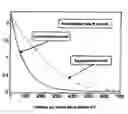
FIG. 2 is a graph of a profile of Dm resulting from Z being inverted by the aggregation model compared with a conventional estimator;
FIG. 3 is a graph of profiles of N0 and of nT resulting from Z being inverted by the aggregation model compared with a conventional hypothesis and observations;
FIG. 4 is a graph of the vertical profile of Z to be inverted;
FIG. 5 is a graph of the profile of Dm resulting from Z being inverted by the aggregation model compared with the conventional estimator;
FIG. 6 is a graph of the profiles of N0 and nT resulting from the Z being inverted by the aggregation model compared with a conventional hypothesis and observations;
FIG. 7 is a graph of the profile of R resulting from Z being inverted by the aggregation model compared with a conventional estimator;
FIG. 8 is a graph of the sensitivity of the retrieval of the equivalent precipitation rate (mm/h) to the particle density law ρ(D)∝D−γ; and
FIG. 9 is a graph of the sensitivity of the retrieval of the vertical Doppler velocity to the particle density law ρ(D)∝D−γ.
DETAILED DESCRIPTIONThis disclosure provides methods of estimating precipitation characteristics and, in a particular selected aspect, a precipitation rate for solid precipitation, the method comprising an acquisition and processing step comprising acquiring a radar image including at least a vertical plane of a precipitation zone, and in processing a vertical profile to deliver digital signals representative of reflectivity in the vertical direction h, an integration step comprising integrating signals representative of reflectivity to deliver a signal representative of the profile in the vertical plane of a mean particle diameter weighted by the mass of each particle, and a determination step comprising determining the concentration of the solid particles on the basis of the signals computed in the preceding steps.
Reference will be made to the drawings below as appropriate. Steps in accordance with selected aspects of the method may be seen in one sense by reference to FIGS. 1-3.
In a preferred aspect, the integration step comprises determining the variable Z(h) of the radar observable in mm6/m3 as a function of the altitude h on the basis of the radar image, and determining the mean diameter Dm(h) of the particles by solving the following equation:
fD
m
fh
=
-
0.25
k
eff
aD
b
-
5
m
10
-
18
Z
+
(
11
fZ
6
Zfh
)
D
m
(
2
)
where:
Z is the radar observable to be inverted in mm6m−3;
Dm is in meters (m);
a and b are coefficients specific to particles of the “aggregate” type; for example, the coefficient a is equal to 35184 and the coefficient b is equal to 3.16;
keff is the coefficient of effectiveness of the aggregation process to be adjusted, said coefficient keff being equal to 0.3.
Integration of (2) uses an integration boundary condition. Advantageously, the integration boundary condition is determined so that the value Dm(h) at the top of the cloud corresponds to the predetermined value for the total number of particles at the top of the cloud.
In an advantageous implementation, the profile of the total number of particles nt(h) is determined by the following equation:
nT(h)=x.Z(h)/Dm(h)6
where x is equal to 25.4 10−18.
In another implementation, the meteorological parameter NO(h) is determined by the following equation:
NO(h)=y.Z(h)/Dm(h)7
where y is equal to 102 10−18.
In another aspect, the meteorological parameter corresponding to the profile of the ice water content IWC(h)(in g/m3) is determined by the following equation:
IWC(h)=wZ(h)/Dm(h)3
where w is equal to 1.25 10−12.
In yet another aspect, the meteorological parameter corresponding to the profile of the solid precipitation rate R(h) (mm/h equivalent melted) is determined by the following equation:
R(h)=r.Z(h)/Dm(h)2.35
wherein r is equal to 4.698 10−10.
The method applies to stratiform precipitation. It considers that ice-forming nuclei are activated at highly negative temperatures, i.e., at the top of the cloud. Ice crystals formed at high altitude settle and grow as they fall, either by sublimation of the ambient saturating water vapor, or by collection and freezing of supermelted cloud water droplets, or by random aggregation of their collisions with other ice crystals. Of the three growth processes, only aggregation changes the ice particle concentration. The characterization method is based on a simplified description of the aggregation mechanism. We use a class of “profiler” methods that inverts the vertical profile of reflectivity measured in the ice to extract therefrom the vertical profile of the solid precipitation rate.
Selected steps include:
-
- 1—Particle size distribution expressed in “equivalent melted diameter” is assumed to be exponential, i.e.:
N(D)=N0 exp(−4D/Dm) (1)
where N(D) is the concentration of particles per cubic meter (m3) and per diameter range, and N0 and Dm are the two parameters that characterize distribution. - 2—The top hmax and the base hmin of the layer of solid precipitation are determined;
- a. hmax is the maximum altitude of the measured reflectivity profile Z(h).
- b. hmin is either the altitude of the isotherm 0° C. if the ground-level temperature is positive, or it is ground level if the ground-level temperature is negative.
- 3—The profile of the parameter Dm(h) in the range hmax to hmin is then determined by resolving the following differential equation: fD m fh = - 0.25 k eff aD b - 5 m 10 - 18 Z + ( 11 fZ 6 Zfh ) D m ( 2 )
- where:
- Z is the radar observable to be inverted in mm6m3;
- Dm is in meters (m);
- a and b are coefficients specific to particles of the “aggregate” type, equal respectively to 35184 and to 3.16 on the basis of the observations of J. D. Locatelli and P. V. Hobbs, Fall speeds and masses of solid precipitation particles, J. Geophys. Res., 79, 2185-2197 (1974), the subject matter of which is incorporated herein by reference;
- keff is the coefficient of effectiveness of the aggregation process to be adjusted (the value keff=0.3 seems correct).
- 4—The integration of (2) takes place from the top, where the boundary condition is expressed by fixing the total number of particles nT (or the number of ice-forming nuclei activated at the top of the cloud). It is possible to take nT (hmax)=106 m−3, which makes it possible to express the boundary condition Dm(hmax) as:
Dm(Hmax)=25.4 10−18(Z(hmax/nT(hmax))1/6 (3) - 5—Once the profile Dm(h) from hmax to hmin has been determined, the profiles of the other parameters of interest are computed by the following expressions:
- a. Profile of N0: N0(h)=102.10−12Z(h)/Dm(h)7
- b. Profile of the total number of particles nT(h) (in m−3): NT(h)=102.10−12Z(h)/Dm(h)6
- c. Profile of the ice water content IWC(h) (in g/m3):
IWC(h)=1.25.10−12Z(h)/Dm(h)3 - d. Profile of the solid precipitation rate R(h) (mm/h equivalent melted). By using the terminal fall velocity determined by Locatelli and Hobbs for aggregates: (vT=107.6 D0.65 (D in m)), R(h) is expressed by:
R(h)=4.698.1−10Z(h)/Dm(h)2.35
- 1—Particle size distribution expressed in “equivalent melted diameter” is assumed to be exponential, i.e.:
The following description relates to another selected aspect of a method of processing for determining the precipitation rate.
For rainfall, the algorithm used is the ZPHI algorithm which is the subject of FR 98/00714 and FR 01/09206, the subject matter of which is incorporated by reference.
For solid precipitation, the following description applies.
The method for estimating the precipitation rate for solid precipitation includes a class of “profiler” algorithms that inverts the vertical profile of reflectivity measured in the ice to extract therefrom the vertical profile of the solid precipitation rate.
The method applies to stratiform precipitation. It considers that the ice-forming nuclei are activated only at highly negative temperatures, i.e., at the top of the cloud. The ice crystals formed at high altitude settle and grow as they fall, either by sublimation of the ambient saturating water vapor, or by collection and freezing of supermelted cloud water droplets, or else by random aggregation of their collisions with other ice crystals. Of the three growth processes, only aggregation changes the ice particle concentration. The algorithm is based essentially on a simplified description of the aggregation mechanism. Selected steps are as follows:
Particle size distribution expressed in “equivalent melted diameter” is assumed to be exponential, i.e.:
N(D)=N0 exp(−4D/Dm (1)
-
- where D is the equivalent melted diameter of the ice particle;
- N(D) is the concentration of particles per m3 and per diameter range; and
- N0 and Dm are the two parameters that characterize distribution.
The top hmax and the base hmin of the layer of solid precipitation are determined;
-
- hmax is the maximum altitude of the measured reflectivity profile Z(h).
- hmin is either the altitude of the isotherm 0° C. if the ground-level temperature is positive, or it is ground level if the ground-level temperature is negative.
The profile of the parameter Dm(h) in the range hmax to hmin is then determined by resolving the following differential equation, whose solution can be determined analytically:
∂
D
m
∂
h
=
-
24
4
d
k
eff
J
(
b
,
d
)
a
Γ
(
4
+
d
)
a
'
(
a
^
-
1
)
ZD
b
-
(
a
^
-
2
)
m
+
1
∂
Z
(
a
^
-
1
)
Z
∂
h
D
m
where
:
J
(
b
,
d
)
=
∫
0
∞
exp
(
-
4
x
)
x
b
∫
0
x
[
x
d
-
x
′
d
]
exp
(
-
4
x
′
)
ⅆ
x
′
ⅆ
x
(
2
)
describes the collision frequency;
-
- Z is the radar observable to be inverted in mm6m−3;
- Dm is in m;
- a, b, c, and d are coefficients dependent on the density law F(D) for ice particles, which law is assumed to vary at D−γ (where γ can take values in the range 0.25 to 1.1 depending on the type of particles). These coefficients are drawn from Mitchell's Theory (Journal of Atmospheric Sciences, 53, 12, 1996), the subject matter of which is incorporated by reference, for representing the following power laws:
- vt(D)=cDd (where vt is the terminal fall velocity of the particle of equivalent melted diameter D):
- A=aDb (where A is the effective cross-section of the particle of equivalent melted diameter D);
- With coefficients depending on frequency and as a function of (D), representing by a power law the relationship between reflectivity (measured parameter), the concentration of the particles, and their mean equivalent diameter:
Z=áN0Dmd - keff is the coefficient of effectiveness of the aggregation process to be adjusted (the value keff=0.3 seems correct immediately above the isotherm 0° C.).
The integration of (2) takes place from the top, where the boundary condition is expressed by fixing the total number of particles nT (or the number of ice-forming nuclei activated at the top of the cloud). It is possible to take nT (hmax)=106 m−3, which makes it possible to express the boundary condition Dm(hmax) as: D m ( h max ) = [ 1 Z ( h max ) 4 a ' n T ( h max ) ] 1 a ^ - 1 ( 3 )
Once the profile Dm(h) from hmax to hmin has been determined, the profiles of the other parameters of interest are computed by the following expressions:
Profile of N0: N 0 ( h ) = Z ( h ) a ' D m ( h ) a ^
-
- Profile of the total number of particles nT(h) (in m−3): nT(h)=0.25N0(h)Dm(h)
- Profile of the ice water content IWC(h) (in g/m3):
IWC(h)=(1.2272)104N0(h)Dm(h)4 - Profile of the solid precipitation rate R(h) (mm/h equivalent melted): R ( h ) = ( 1.885 ) 10 6 c Γ ( 4 + d ) 4 ( 4 + d ) N 0 ( h ) D m ( h ) ( 4 + d )
- Vertical profile of the Doppler velocity VD(h) (in meters per second (m/s)), given by a power law dependent on density _(D):
VD(h)=pDm(h)q
Because of the dependency of the coefficients relative to the density law F(D), the retrieval of the precipitation rate depends critically on the parameter γ, as shown by FIG. 7. The density law thus constitutes a key parameter.
By operating in vertical firing, it is possible to measure the Doppler velocity VD(h), and compare it with VD(h) computed by the algorithm. The Doppler velocity profile is discriminating, as shown by FIG. 8. By successive adjustments, it is thus possible to determine the parameter γ of the law F(D) for which consistency between VD(h) as computed and VD(h) as measured is achieved. FIG. 4 shows an example of a profile inverted by the algorithm (in that example, the isotherm 0° C. is at ground level). FIG. 5 shows curves resulting from application of the aggregation model and a conventional model, making it possible for the profile of DM resulting from the inversion of Z by the aggregation model to be compared with the conventional estimator.
FIG. 6 shows curves of the profiles as a function of altitude (m) above the isotherm 0° C. It enables the profiles of N0 and nT resulting from Z being inverted by the aggregation model to be compared with the conventional hypothesis and observations. FIG. 7 shows the profile of R resulting from Z being inverted by the aggregation model compared with the conventional estimator. FIG. 8 shows the sensitivity of the retrieval of the equivalent participation rate (mm/h) to the particle density law ρ(D)∝D−γ. FIG. 9 shows the sensitivity of the retrieval of the vertical Doppler velocity to the particle density law ρ(D)∝D−γ.
Claims
1-14. (canceled)
15. A method of estimating precipitation characteristics comprising:
acquiring a radar image including at least a vertical plane of a precipitation zone;
processing a vertical profile to generate digital signals representative of reflectivity in vertical direction z;
integrating the signals representative of reflectivity by assimilation of a reflectivity vertical profile in an aggregation model to generate a signal representative of the profile in the vertical plane of a mean particle diameter weighted by mass of each particle; and
determining concentration of the solid particles on the basis of signals previously determined.
16. The method according to claim 15, wherein integrating comprises determining variable Z(h) of the radar image observable in mm6/m3 as a function of altitude h on the basis of the radar image, and determining the mean diameter Dm(h) of the particles with the following equation:
fD m fh = - 0.25 k eff aD b - 5 m 10 - 18 Z + ( 11 fZ 6 Zfh ) D m ( 2 )
where:
Z is the radar image to be inverted in mm6/m−3;
Dm is in meters (m);
a and b are coefficients specific to aggregate particles;
keff is the coefficient of effectiveness of aggregation to be adjusted.
17. The method according to claim 16, wherein the coefficient keff is equal to 0.3.
18. The method according to claim 16, wherein the coefficient a is equal to 35184.
19. The method according to claim 16, wherein the coefficient b is equal to 3.16.
20. The method according to claim 15, wherein the integration constant is determined so that the value Dm(h) at the top of a cloud corresponds to the predetermined value for the total number of particles at the top of the cloud.
21. The method according to claim 15, wherein the profile of the total number of particles nt(h) is determined by the following equation:
nT(h)=x.Z(h)/Dm(h)6.
22. The method according to claim 15, wherein x is equal to 25.4 10−18.
23. The method according to claim 15, wherein meteorological parameter NO(h) is determined by the following equation:
NO(h)=y.Z(h)/Dm(h)7.
24. The method according to claim 15, wherein y is equal to 102 10−18.
25. The method according to claim 15, wherein the meteorological parameter corresponding to the profile of the ice water content IWC(h)(in g/m3) is determined by the following equation:
IWC(h)=wZ(h)/Dm(h)3.
26. A method according to claim 25, wherein w is equal to 1.25 10−12.
27. A profile determined according to claim 15, wherein the meteorological parameter corresponding to a profile of solid precipitation rate R(h) (mm/h equivalent melted) is determined by the following equation:
R(h)=r.Z(h)/Dm(h)2.35.
28. The method according to claim 15, wherein characterized in that r is equal to 4.698 10−10.
29. A method of estimating precipitation rate for solid precipitation comprising:
an acquisition step comprising acquiring a radar image including at least a vertical plane of a precipitation zone and processing a vertical profile to deliver digital signals representative of reflectivity in the vertical direction z;
an integration step comprising integrating signals representative of reflectivity by assimilation of the reflectivity vertical profile in an aggregation model to deliver a signal representative of the profile in the vertical plane of a mean particle diameter weighted by mass of each particle; and
a determination step comprising determining concentration of the solid particles on the basis of the signals determined in the preceding steps.
30. The method according to claim 29, wherein the integration step comprises determining variable Z(h) of the radar image observable in mm6/m3 as a function of the altitude h on the basis of the radar image, and determining the mean diameter Dm(h) of the particles with the following equation:
fD m fh = - 0.25 k eff aD b - 5 m 10 - 18 Z + ( 11 fZ 6 Zfh ) D m ( 2 )
where:
Z is the radar image to be inverted in mm6/m−3;
Dm is in meters (m);
a and b are coefficients specific to aggregate particles;
keff is the coefficient of effectiveness of aggregation to be adjusted.
31. The method according to claim 29, wherein the integration constant is determined so that the value Dm(h) at the top of a cloud corresponds to the predetermined value for the total number of particles at the top of the cloud.
32. The method according to claim 29, wherein the profile of the total number of particles nt(h) is determined by the following equation:
nT(h)=x.Z(h)/Dm(h)6.
33. The method according to claim 29, wherein meteorological parameter NO(h) is determined by the following equation:
NO(h)=y.Z(h)/Dm(h)7.
34. The method according to claim 29, wherein the meteorological parameter corresponding to a profile of ice water content IWC(h)(in g/m3) is determined by the following equation:
IWC(h)=wZ(h)/Dm(h)3.
Images & Drawings included:








Sources:
- United States Patent and Trademark Office - verify current appl. status at the USPTO↗
Recent applications in this class:
- » 20250264616 2025-08-21
MODULAR AIR-DATA SYSTEM - » 20250180752 2025-06-05
Optically Scanning Sensor - » 20250138194 2025-05-01
Aircraft Acceleration Prediction Using Lidar Trained Artificial Intelligence - » 20250123400 2025-04-17
VELOCITY MEASUREMENT BY COMPARISON OF INDEPENDENT LASERS - » 20250052906 2025-02-13
LIDAR HAVING WAVELENGTH LOCKING FUNCTION - » 20250052905 2025-02-13
TIME MULTIPLEX OF LIDAR AIR-DATA OPTICAL CHANNELS - » 20250035794 2025-01-30
OPTICALLY INTEGRATED CHANNEL(S) FOR LASER AIR DATA - » 20250035793 2025-01-30
INTEGRATED VAPOR FILTER WITH BACKGROUND REJECTION - » 20250035792 2025-01-30
AIR-DATA SYSTEM WITH BACKGROUND LIGHT DETECTION USING A BACKGROUND REJECTION FILTER - » 20240427023 2024-12-26
METHOD FOR DETERMINING WIND SPEED BY MEANS OF A LASER REMOTE SENSOR MOUNTED ON A WIND TURBINE
Recent applications for this Assignee:
- » 20230032722 2023-02-02
A Full-Field Optical Coherence Tomography Imaging Method - » 20220266249 2022-08-25
Deformable device for positioning a holder - » 20220044834 2022-02-10
Method and facility for treating aqueouos effluents from the primary circuit of a nuclear power plant comprising boric acid - » 20220040664 2022-02-10
Reactor for the conversion of carbon dioxide - » 20220009269 2022-01-13
Method for vacuum deposition of a coating on the front face of a support, support and corresponding security document - » 20210290142 2021-09-23
System for real-time measurement of the activity of a cognitive function and method for calibrating such a system - » 20210161887 2021-06-03
Hydrazone derivatives for preventing or treating EBV-related cancers - » 20210139447 2021-05-13
Lipophenolic flavonoid derivatives useful to reduce carbonyl and oxidative stresses (COS) - » 20210121983 2021-04-29
Process for nanostructuring the surface of a material by laser - » 20210088483 2021-03-25
Microfluidic asymmetric flow field-flow fractionation device and method of using the same