Multilayered package with barrier properties
US20070110933A1
2007-05-17
11/650,272
2007-01-05
✅ Patent granted
US 7,658,881 B2
2010-02-09
-
-
Khanh Nguyen | Matthew Hoover
2027-01-05
Abstract:
The present invention provides compositions useful as a barrier layer in, for example, packaging products. The compositions generally comprise a blend of (i) a polyester resin, preferably an aromatic polyester resin such as polyethylene terephthalate (PET) and (ii) a polyamide material (e.g., MXD6). The blend optionally may further comprise (iii) an oxygen scavenging material. The present invention also provides containers (e.g., containers formed by expansion of preforms) having a multilayered body-forming portion including: a core layer comprising the aforementioned blend; and inner and outer layers of a formable polymer composition. The present invention also provides methods of making such containers .
Inventors:
- Paul E. Share 17 🇺🇸 Wexford, PA, United States
- Keith R. Pillage 9 🇺🇸 Pittsburgh, PA, United States
Assignee:
- VALSPAR SOURCING, INC. 322 🇺🇸 Minneapolis, MN, United States
Interested in similar patents?
Get notified when new applications in this technology area are published.
Classification:
B29D30/26 IPC
Producing pneumatic or solid tyres or parts thereof; Pneumatic tyres or parts thereof (e.g. produced by casting, moulding, compression moulding, injection moulding, centrifugal casting); Building tyres by the flat-tyre method, i.e. building on cylindrical drums; Drums Accessories or details, e.g. membranes, transfer rings
B29C48/09 » CPC further
Extrusion moulding, i.e. expressing the moulding material through a die or nozzle which imparts the desired form; Apparatus therefor characterised by the shape of the extruded material at extrusion Articles with cross-sections having partially or fully enclosed cavities, e.g. pipes or channels
B29C48/13 » CPC further
Extrusion moulding, i.e. expressing the moulding material through a die or nozzle which imparts the desired form; Apparatus therefor characterised by the shape of the extruded material at extrusion Articles with a cross-section varying in the longitudinal direction, e.g. corrugated pipes
B29C48/21 » CPC further
Extrusion moulding, i.e. expressing the moulding material through a die or nozzle which imparts the desired form; Apparatus therefor; Articles comprising two or more components, e.g. co-extruded layers the components being layers the layers being joined at their surfaces
B29C49/0005 » CPC further
Blow-moulding, i.e. blowing a preform or parison to a desired shape within a mould; Apparatus therefor characterised by the material
B65D1/0215 » CPC further
Containers having bodies formed in one piece, e.g. by casting metallic material, by moulding plastics, by blowing vitreous material, by throwing ceramic material, by moulding pulped fibrous material, by deep-drawing operations performed on sheet material; Bottles or similar containers with necks or like restricted apertures, designed for pouring contents characterised by material, e.g. composition, physical features multilayered
B65D1/28 » CPC further
Containers having bodies formed in one piece, e.g. by casting metallic material, by moulding plastics, by blowing vitreous material, by throwing ceramic material, by moulding pulped fibrous material, by deep-drawing operations performed on sheet material; Boxes or like containers with side walls of substantial depth for enclosing contents; Thin-walled containers, e.g. formed by deep-drawing operations formed of laminated material
B65D81/266 » CPC further
Containers, packaging elements, or packages, for contents presenting particular transport or storage problems, or adapted to be used for non-packaging purposes after removal of contents; Adaptations for preventing deterioration or decay of contents; Applications to the container or packaging material of food preservatives, fungicides, pesticides or animal repellants with provision for draining away, or absorbing, fluids, e.g. exuded by contents ; Applications of corrosion inhibitors or desiccators for absorbing gases, e.g. oxygen absorbers or desiccants
B29B11/08 » CPC further
Making preforms by moulding the material Injection moulding
B29B11/14 » CPC further
Making preforms characterised by structure or composition
B29C48/17 » CPC further
Extrusion moulding, i.e. expressing the moulding material through a die or nozzle which imparts the desired form; Apparatus therefor; Articles comprising two or more components, e.g. co-extruded layers the components having different colours
B29C49/04 » CPC further
Blow-moulding, i.e. blowing a preform or parison to a desired shape within a mould; Apparatus therefor; Combined blow-moulding and manufacture of the preform or the parison Extrusion blow-moulding
B29C49/06 » CPC further
Blow-moulding, i.e. blowing a preform or parison to a desired shape within a mould; Apparatus therefor; Combined blow-moulding and manufacture of the preform or the parison Injection blow-moulding
B29K2023/0633 » CPC further
Use of polyalkenes or derivatives thereof as moulding material; Polymers of ethylene; PE, i.e. polyethylene characterised by its density LDPE, i.e. low density polyethylene
B29K2023/065 » CPC further
Use of polyalkenes or derivatives thereof as moulding material; Polymers of ethylene; PE, i.e. polyethylene characterised by its density HDPE, i.e. high density polyethylene
B29K2023/086 » CPC further
Use of polyalkenes or derivatives thereof as moulding material; Polymers of ethylene; Copolymers of ethylene EVOH, i.e. ethylene vinyl alcohol copolymer
B29K2027/08 » CPC further
Use of polyvinylhalogenides or derivatives thereof as moulding material PVDC, i.e. polyvinylidene chloride
B29K2067/00 » CPC further
Use of polyesters or derivatives thereof , as moulding material
B29K2067/006 » CPC further
Use of polyesters or derivatives thereof , as moulding material PBT, i.e. polybutylene terephthalate
B29K2069/00 » CPC further
Use of PC, i.e. polycarbonates or derivatives thereof , as moulding material
B29K2105/162 » CPC further
Condition, form or state of moulded material or of the material to be shaped containing reinforcements, fillers or inserts; Fillers Nanoparticles
B29K2105/26 » CPC further
Condition, form or state of moulded material or of the material to be shaped Scrap or recycled material
B29K2995/0067 » CPC further
Properties of moulding materials, reinforcements, fillers, preformed parts or moulds; Other properties; Permeability to gases non-permeable
B29L2031/7158 » CPC further
Other particular articles; Containers; Packaging elements or accessories, Packages Bottles
C08K3/01 » CPC further
Use of inorganic substances as compounding ingredients characterized by their specific function
C08K3/08 » CPC further
Use of inorganic substances as compounding ingredients; Elements Metals
C08K5/0008 » CPC further
Use of organic ingredients Organic ingredients according to more than one of the "one dot" groups of -
C08L23/0869 » CPC further
Compositions of homopolymers or copolymers of unsaturated aliphatic hydrocarbons having only one carbon-to-carbon double bond; Compositions of derivatives of such polymers not modified by chemical after-treatment; Homopolymers or copolymers of ethene; Copolymers of ethene; Copolymers of ethene with unsaturated hydrocarbons containing other atoms than carbon or hydrogen atoms Acids or derivatives thereof
C08L51/06 » CPC further
Compositions of graft polymers in which the grafted component is obtained by reactions only involving carbon-to-carbon unsaturated bonds ; Compositions of derivatives of such polymers grafted on to homopolymers or copolymers of aliphatic hydrocarbons containing only one carbon-to-carbon double bond
C08L2201/14 » CPC further
Properties Gas barrier composition
C08L2205/03 » CPC further
Polymer mixtures characterised by other features containing three or more polymers in a blend
C08L2205/035 » CPC further
Polymer mixtures characterised by other features containing three or more polymers in a blend containing four or more polymers in a blend
Y10T428/1352 » CPC further
Stock material or miscellaneous articles; Hollow or container type article [e.g., tube, vase, etc.] Polymer or resin containing [i.e., natural or synthetic]
Y10T428/1383 » CPC further
Stock material or miscellaneous articles; Hollow or container type article [e.g., tube, vase, etc.]; Polymer or resin containing [i.e., natural or synthetic]; Contains vapor or gas barrier, polymer derived from vinyl chloride or vinylidene chloride, or polymer containing a vinyl alcohol unit Vapor or gas barrier, polymer derived from vinyl chloride or vinylidene chloride, or polymer containing a vinyl alcohol unit is sandwiched between layers [continuous layer]
Y10T428/31725 » CPC further
Stock material or miscellaneous articles; Composite [nonstructural laminate] Of polyamide
Y10T428/31736 » CPC further
Stock material or miscellaneous articles; Composite [nonstructural laminate]; Of polyamide Next to polyester
B32B27/08 » CPC main
Layered products comprising synthetic resin as the main or only constituent of a layer, next to another layer of a of synthetic resin
C08L23/08 » CPC further
Compositions of homopolymers or copolymers of unsaturated aliphatic hydrocarbons having only one carbon-to-carbon double bond; Compositions of derivatives of such polymers not modified by chemical after-treatment; Homopolymers or copolymers of ethene Copolymers of ethene
C08L2666/24 » CPC further
Composition of polymers characterized by a further compound in the blend, being organic macromolecular compounds, natural resins, waxes or and bituminous materials, non-macromolecular organic substances, inorganic substances or characterized by their function in the composition; Organic macromolecular compounds, natural resins, waxes or and bituminous materials Graft or block copolymers according to groups , or ; Derivatives thereof
C08L23/0861 » CPC further
Compositions of homopolymers or copolymers of unsaturated aliphatic hydrocarbons having only one carbon-to-carbon double bond; Compositions of derivatives of such polymers not modified by chemical after-treatment; Homopolymers or copolymers of ethene; Copolymers of ethene; Copolymers of ethene with unsaturated hydrocarbons containing other atoms than carbon or hydrogen atoms; Vinylacetate Saponified vinylacetate
C08L77/02 » CPC further
Compositions of polyamides obtained by reactions forming a carboxylic amide link in the main chain ; Compositions of derivatives of such polymers Polyamides derived from omega-amino carboxylic acids or from lactams thereof
C08L29/04 » CPC further
Compositions of homopolymers or copolymers of compounds having one or more unsaturated aliphatic radicals, each having only one carbon-to-carbon double bond, and at least one being terminated by an alcohol, ether, aldehydo, ketonic, acetal or ketal radical; Compositions of hydrolysed polymers of esters of unsaturated alcohols with saturated carboxylic acids; Compositions of derivatives of such polymers; Homopolymers or copolymers of unsaturated alcohols Polyvinyl alcohol; Partially hydrolysed homopolymers or copolymers of esters of unsaturated alcohols with saturated carboxylic acids
C08L2666/14 » CPC further
Composition of polymers characterized by a further compound in the blend, being organic macromolecular compounds, natural resins, waxes or and bituminous materials, non-macromolecular organic substances, inorganic substances or characterized by their function in the composition; Organic macromolecular compounds, natural resins, waxes or and bituminous materials Macromolecular compounds according to - ; Derivatives thereof
C08L2666/02 » CPC further
Composition of polymers characterized by a further compound in the blend, being organic macromolecular compounds, natural resins, waxes or and bituminous materials, non-macromolecular organic substances, inorganic substances or characterized by their function in the composition Organic macromolecular compounds, natural resins, waxes or and bituminous materials
C08L77/06 » CPC further
Compositions of polyamides obtained by reactions forming a carboxylic amide link in the main chain ; Compositions of derivatives of such polymers Polyamides derived from polyamines and polycarboxylic acids
C08L67/02 » CPC further
Compositions of polyesters obtained by reactions forming a carboxylic ester link in the main chain ; Compositions of derivatives of such polymers Polyesters derived from dicarboxylic acids and dihydroxy compounds
C08L2666/20 » CPC further
Composition of polymers characterized by a further compound in the blend, being organic macromolecular compounds, natural resins, waxes or and bituminous materials, non-macromolecular organic substances, inorganic substances or characterized by their function in the composition; Organic macromolecular compounds, natural resins, waxes or and bituminous materials; Macromolecular compounds according to - ; Derivatives thereof Macromolecular compounds having nitrogen in the main chain according to - ; Derivatives thereof
C08L2666/06 » CPC further
Composition of polymers characterized by a further compound in the blend, being organic macromolecular compounds, natural resins, waxes or and bituminous materials, non-macromolecular organic substances, inorganic substances or characterized by their function in the composition; Organic macromolecular compounds, natural resins, waxes or and bituminous materials; Macromolecular compounds according to groups - , or - ; Derivatives thereof Homopolymers or copolymers of unsaturated hydrocarbons; Derivatives thereof
C08L77/00 » CPC further
Compositions of polyamides obtained by reactions forming a carboxylic amide link in the main chain ; Compositions of derivatives of such polymers
C08L2666/18 » CPC further
Composition of polymers characterized by a further compound in the blend, being organic macromolecular compounds, natural resins, waxes or and bituminous materials, non-macromolecular organic substances, inorganic substances or characterized by their function in the composition; Organic macromolecular compounds, natural resins, waxes or and bituminous materials; Macromolecular compounds according to - ; Derivatives thereof Polyesters or polycarbonates according to - ; Derivatives thereof
C08L67/00 » CPC further
Compositions of polyesters obtained by reactions forming a carboxylic ester link in the main chain ; Compositions of derivatives of such polymers
B29D30/00 IPC
Producing pneumatic or solid tyres or parts thereof
B32B27/00 IPC
Layered products comprising synthetic resin
D01F6/00 IPC
Monocomponent artificial filaments or the like of synthetic polymers; Manufacture thereof
D01D5/24 IPC
Formation of filaments, threads, or the like with a hollow structure; Spinnerette packs therefor
Description
BACKGROUNDWithin the packaging industry, there is a progressive change towards the use of containers of plastic material. This relates to both containers for beverages, including carbonated beverages, and containers for foods. As far as foods are concerned, there is an express desire in the art also to be able to employ containers of plastic material for the storage of preserved foods. In all of these fields of application, the insufficient barrier properties of the plastic material-and in particular its insufficient capacity to prevent the passage of gases, for example oxygen and C02, vaporized liquids such as water vapor etc. entail that the shelf-life and durability of the products stored in the containers will be far too short.
A number of proposals have been put forward in the art to solve the above problem, but the proposed techniques have failed to meet established demands of cost in combination with barrier properties in order that containers of plastic material may successfully be employed within the above-outlined sectors. Examples of solutions proposed in the art include:
-
- laminates in which two or more layers of plastic material are combined with one another and in which the material in each layer possesses properties which entail that, for instance, gas penetration, light penetration or moisture penetration are reduced;
- constructions in which, for example, a metal such as aluminum is encapsulated between the plastic materials or, for instance, forms the inner surface of the container; and
- constructions in which a barrier material other than metal is applied interiorly or in layers between the plastic material.
Solutions are also known in the art in which plastic materials of different types are mixed and thereafter molded to form containers. Thus, for example, it is previously known to produce containers of plastic material in which the plastic material consists of a mixture of PET and polyamide. See, e.g., U.S. Pat. Nos. 5,034,252; 5,281,360; 5,641,825; and 5,759,653. Unfortunately, these attempts have yielded commercially unsatisfactory results.
From the foregoing, it will be appreciated that what is needed in the art is improved plastic containers having even greater barrier properties for gases such as oxygen and CO2. Such containers and materials and methods for preparing the same are disclosed and claimed herein.
SUMMARYThe present invention relates to compositions useful as a barrier layer in, for example, packaging products. The compositions generally comprise a blend of (i) a polyester resin, preferably an aromatic polyester resin such as polyethylene terephthalate (PET) and (ii) a polyamide material (e.g., MXD6). The blend optionally may further comprise (iii) an oxygen scavenging material.
The present invention also relates to containers (e.g, containers formed by expansion of preforms) having a multilayered body-forming portion including: a core layer comprising the aforementioned blend; and inner and outer layers of a formable polymer composition. The present invention also relates to methods of making such containers.
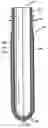
BRIEF DESCRIPTION OF THE DRAWINGSFIG. 1 is a cross-sectional view of a three-layer preform according to this invention;
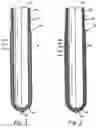
FIG. 2 is a cross-sectional view of a five-layer preform according to this invention;
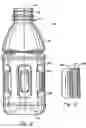
FIG. 3 is an elevational view of a three-layer hot-fill container according to this invention;
FIG. 4 is an enlarged fragmentary sectional view taken through the sidewall of the container of FIG. 3, showing the three-layers;
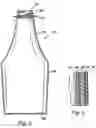
FIG. 5 is an elevational view of a five-layer ketchup container according to this invention; and
FIG. 6 is an enlarged fragmentary sectional view taken through the sidewall of the container of FIG. 5, showing the five layers.
DETAILED DESCRIPTIONIn one embodiment, the present invention relates to compositions useful as a barrier layer in, for example, packaging products. The compositions of this embodiment generally comprise a blend of (i) a polyester resin, preferably an aromatic polyester resin such as polyethylene terephthalate (PET) and (ii) a polyamide material. The blend optionally may further comprise (iii) an oxygen scavenging material.
The blend suitably comprises a formable polyester. Suitable formable polyesters for use in the present invention include PET (e.g., virgin bottle grade PET, post-consumer PET (PC-PET), etc.), cyclohexane dimethanol/PET copolymer (PETG), polyethylene naphthalate (PEN), polybutylene terephthalate (PBT), etc.
Phthalic acid polyesters based on terephthalic or isophthalic acid are commercially available and convenient. Suitable hydroxy compounds for these polymers typically includes ethylene glycol, propylene glycol, butylene glycol and 1,4-di-(hydroxy methyl)cyclohexane.
Suitable polyesters for use in the present invention typically have an intrinsic viscosity in the range of 0.6 to 1.2, and more particularly 0.7 to 1.0 (for a 60/40 blend of phenol/tetrachloroethane solvent). For PET an intrinsic viscosity value of 0.6 corresponds approximately to a viscosity average molecular weight of 36,000, and an intrinsic viscosity value of 1.2 to a viscosity average molecular weight of 103,000.
In general, suitable polyesters may include polymer linkages, side chains, and end groups not related to the formal precursors of the simple polyesters previously specified.
The blend also suitably comprises a polyamide material. Both aromatic and aliphatic polyamides can be used. Copolymers of polyamides and other polymers may also be used.
A preferred aromatic polyamide is a polymer formed by polymerizing metaxylylenediamine (H2NCH2-m—C6H4—CH2NH2) with adipic acid (HO2C(CH2)4CO2H), for example a product manufactured and sold by Mitsubishi Chemicals, Japan, under the designation MXD6 (e.g., grades 6001 and 6007).
Other suitable polyamides include, for example, nylon (e.g., nylon-6,6), GRIVORY (e.g., GRIVORY G16, G21, which are copolyamides having both linear aliphatic units and ring-like aromatic components, available from EMS-Chemie Inc.) and VERSAMID (an aliphatic polyamide typically used as an ink resin and available from Cognis Corporation).
The proportion of polyamide in relation to polyester can be varied mainly in view of the intended use of the container.
In one embodiment of the present invention, the composition comprises a blend of a polyethylene terephthalate material and a polyamide material, wherein the blend preferably comprises less than 70% by weight polyethylene terephthalate material. For this embodiment, the blend more preferably comprises between 10 and 70% by weight polyethylene terephthalate material, and most preferably between 20 and 60% by weight polyethylene terephthalate material. Also for this embodiment, the blend preferably comprises more than 20% by weight of the polyamide material, more preferably between 30 and 60% by weight polyamide material, and most preferably between 40 and 55% by weight polyamide material.
In another embodiment of the present invention, the composition comprises a blend of a polyester and a polyamide, wherein the blend preferably comprises more than 30% by weight polyamide material. For this embodiment, the blend preferably comprises more than 30% by weight polyester, more preferably between 40 and 70% by weight polyester, and most preferably between 45 and 70% by weight polyester.
Also for this embodiment, the blend more preferably comprises between 36 and 60% by weight polyamide material, and most preferably between 40 and 55% by weight polyamide material.
If desired, the blend may optionally also suitably comprise an oxygen scavenging material. While not intending to be bound by theory, it is believed that suitable oxygen scavenging materials form active metal complexes having capacity to bond with oxygen. In this manner, it is believed that the oxygen scavenging material can confer higher oxygen barrier properties to the composition.
A broad variety of metallic and organic compounds are believed to be effective in providing the oxygen scavenging effect, and an appropriate compound may be selected based on cost and compatibility with the polymers of the blend. A preferred embodiment is a transition metal or a complex of metals selected from the first, second and third transition series of the periodic table, such as iron, cobalt, nickel, ruthenium, rhodium, palladium, osmium, iridium, and platinum. In another preferred embodiment, the metal compound comprises copper, manganese, or zinc. Suitable oxygen scavenging materials for use in this invention include: aluminum powder; aluminum carbide; aluminum chloride; cobalt powder; cobalt oxide; cobalt chloride; antimony powder; antimony oxide; antinony tri-acetate; antimony chloride M; antimnony chloride V; iron; electrolytic iron; iron oxide; platinum; platinum on alumina; palladium; palladium on alumina; ruthenium; rhodium; copper; copper oxide; nickel, and mixed metal nanoparticles (e.g., cobalt iron oxide nanoparticles). Suitable nanoparticles have an average particle size of less than about 200 nm, preferably less than about 100 nm, and more preferably between 5 and 50 nm.
While not intending to be bound by theory, it is presently believed that one possible advantage mixed metal nanoparticles might have is that cobalt ferrite undergoes an internal charge transfer from cobalt to iron under the illumination of a tungsten halogen lamp. As part of the commercial bottle blowing process, preforms are sometimes heated under direct irradiation of quartz halogen lamps. Although cobalt ferrite-type scavengers may absorb oxygen upon formation with the polyamide, it is anticipated that the scavenging activity would be substantially increased as a result of the intense illumination during bottle formation. In addition, cobalt ferrite nanoparticles are prepared as a nanocrystalline material. It is expected that the nanometer scale of the particles may render them suitable for use in colorless, optically transparent containers, and that their crystalline structure would give rise to higher activity than solution salts of the same ions.
One skilled in the art can determine without much difficulty which concentration is appropriate in each blend, but in general it will be a range of 50-10,000 ppm by weight, and more preferably 50-1,000 ppm. The upper limit is dictated by factors such as economy, toxicity, clarity and color.
There are numerous multiiayer preform and container constructions possible, each of which may be adapted for a particular product and/or manufacturing process. A few representative examples will be given.
A suitable three-layer construction comprises a core barrier layer disposed between inner and outer layers. For example, the three-layer sidewall construction may comprise inner and outer layers of PET (e.g., substantially virgin PET); and a core layer including a blend of (i) one or more polyesters (e.g., PET, PC-PET, PETG, PEN, PBT), (ii) one or more polyamides (e.g., MXD-6), and (iii) optionally one or more oxygen scavenging materials (e.g., cobalt).
A suitable five-layer structure may have relatively thin inner and outer intermediate layers to provide high oxygen barrier properties without loss of clarity. Relatively thicker inner and outer layers of PET would provide the necessary strength and clarity. A thin core layer as described above provides the necessary barrier effect at a competitive price and with accelerated activation. Suitable inner and outer intermediate layers for this embodiment may comprise oxygen barrier layers such as EVOH, PEN, polyvinyldene chloride (PVDC), nylon 6, MXD-6, LCP (liquid crystal polymer), amorphous nylon, polyacrylonitrile (PAN), styrene acrylonitrile (SAN), and active scavengers such as AMOSORB from BP/AMOCO.
An alternative five-layer structure may have inner and outer layers of PET, inner and outer intermediate layers of PC-PET, and a thin core layer as described above. The advantage of this embodiment is that the PC-PET may be effectively encapsulated in the bottle and not come in direct contact with the product or the user.
In preferred embodiments, the core layer has a thickness of between about 1 and 10, more preferably between about 2 and 8, and most preferably between about 3 and 6 percent of the total wall thickness.
The container of the present invention may be used to provide good gas (e.g., oxygen and/or CO2) barrier properties for products such as carbonated soft drinks. It is particularly useful in packaging products such as beer, because beer rapidly loses its flavor due to oxygen migration into the bottle. This is also true for products such as citrus products, tomato-based products, and aseptically packaged meat.
In preferred embodiments, the blends of the present invention, when formed into three-layer (PET-Blend-PET), ten-ounce (295 ml). beverage bottles having a total wall thickness of 0.051 cm and a core layer of 5% of the total wall thickness, exhibit less than 15% loss of CO2, when tested as described in Examples 1-3, over a 7.5 week period. More preferably the loss of CO2 over that same period is less than 12% and most preferably is less than 10%.
In preferred embodiments, the blends of the present invention, when formed into three-layer (PET-Blend-PET), ten-ounce (295 ml) beverage bottles having a total wall thickness of 0.051 cm and a core layer of 5% of the total wall thickness, exhibit less than 0.02 cc/pkg/day transmission of O2, when tested as described in Examples 1-3. More preferably the transmission of O2 over that same period is less than 0.01 cc/pkg/day, and most preferably is less than 0.005 cc/pkg/day.
FIGS. 1-2 show two alternative multi-layer preform structures, and FIGS. 3-6 show two alternative container structures, useful in the present invention.
FIG. 1 shows a substantially amorphous and transparent three-layer preform 70 having an open upper end 71 with a neck finish including outer threads 72 and a cylindrical flange 73. Below the neck flange there is a substantially cylindrical body portion 74, terminating in a closed hemispherical bottom end 75.
The three-layer sidewall construction includes outer layer 76, core layer 77, and inner layer 78. By way of example, the inner and outer (exterior) layers (78 and 76) may be virgin bottle grade PET, while the core layer 77 comprises the blend composition of this invention. In a lower base-forming portion of the preform, a five-layer structure may optionally be formed by a last shot of virgin PET that clears the injection nozzle of the blend composition (so it is filled with virgin PET for preparation of the next preform). The last shot 79 of virgin PET forms a five-layer structure around the gate, and in this case the virgin PET extends through to the exterior of the preform at the gate region. The dimensions and wall thicknesses of the preform shown in FIG. 1 are not to scale. Any number of different preform constructions may be used.
FIGS. 3-4 show a representative three-layer, container that may be blow molded from a preform similar to that shown in FIG. 1. The container 110 includes an open top end 111, substantially cylindrical sidewall 112, and closed bottom end 113. The container includes the same neck finish 114 and flange 115 of the preform, which are not expanded during blow molding. The sidewall includes an expanded shoulder portion 116 increasing in diameter to a cylindrical panel portion 117, which includes a plurality of vertically-elongated, symmetrically-disposed vacuum panels 118. The vacuum panels are designed to move inwardly to alleviate the vacuum formed during product cooling in the sealed container. Again, this container construction is by way of example only and the invention is not limited to any particular package structure. FIG. 4 shows the three-layer sidewall construction including inner layer 120, core layer 121, and outer layer 122. By way of example, the inner and outer layers (120 and 122) may be virgin bottle grade PET, while the core layer 121 is made of the blend composition of this invention.
FIG. 2 shows an alternative five-layer preform 90. Again, the preform includes an open upper end 91, neck finish with threads 92 and flange 93, and body-forming portion 94 with a closed bottom end 95. The five-layer sidewall construction includes outer layer 96, first intermediate layer 97, core layer 98, second intermediate layer 99, and inner layer 100, disposed in serial order. By way of example, the inner and outer layers 96 and 100 may be virgin bottle grade PET, while the intermediate layers 97 and 99 are a PC-PET material or a high oxygen barrier material such as EVOH, and the core layer 98 is made of the blend composition of this invention. Again in the base, there optionally may be a last shot of virgin PET 101 to clear the nozzle.
FIGS. 5-6 show a representative ketchup container that may be blow molded from a five-layer preform similar to that of FIG. 2. Again, the details of the preform and container construction are not critical, and variations may be required to the preform construction in order to blow mold the container of FIG. 5. The ketchup container 130 includes an open top end 131, neck finish 132 with neck flange 133, a shoulder portion 134 increasing in diameter, and a panel portion 135 connecting to a base 136. The five-layer sidewall construction, as shown in FIG. 6, includes an inner layer 137, first intermediate layer 138, core layer 139, second intermediate layer 140, and outer layer 141. By way of example, the inner and outer layers 137 and 141 may be virgin bottle grade PET, the core layer may be the blend composition of the present invention, and the intermediate layers 138 and 140 may be a PC-PET material or a high oxygen barrier material such as EVOH.
Several different methods are practiced to make the containers of the present invention.
In one method, a multilayered container is prepared by: (i) providing a core layer blend material of the present invention; (ii) providing an inner and outer layer material of a suitable formable polymer; (iii) co-injecting the core layer blend material and the inner and outer layer materials to form a multilayered preform; and (iv) heating and expanding the preform to form a container.
In an alternative method, a multilayered container is prepared by: (i) providing a core layer blend material of the present invention; (ii) providing an inner and outer layer material of a suitable formable polymer; (iii) extruding a multilayer parison tube having inner and outer layers of a suitable formable polymer and a core layer blend material of the present invention; (iv) clamping the parison tube into a hollow cavity mold; (v) blowing the parison against the cavity; and (vi) trimming the molded container.
The following examples are offered to aid in understanding of the present invention and are not to be construed as limiting the. scope thereof. Unless otherwise indicated, all parts and percentages are by weight.
EXAMPLES Example 1-3Examples 1-3 illustrate the barrier properties of various multilayer containers.
Ten-ounce (295 ml) carbonated soft drink (CSD) preforms were coinjected in an Arburg press fitted with a Kortec coinjection unit and stretch blowmolded in a Sidel blowmolding unit.
For the core layer of the preforms, the materials listed in Table 1 were blended at 275-280° C. at 100 rpm in a twin screw extruder model ZSK-25 manufactured by the Werner and Pfleiderer Corporation and pelletized under air cooling. For each formula, approximately 4.5 to 6.8 kg of resin was blended. The PET, PEN, and MXD6 materials used were dried prior to use in a Conair drier at 121° C.
Twenty to fifty preforms were injected and stretch blowmolded. Each preform had a core layer of the composition described in Table 1 and an inner and an outer layer of PET. The thickness of the core layer was about 5% of the total container wall thickness of 0.051 cm.
Examples C1 and C2 were included for comparison purposes.
| TABLE 1 |
| Composition of Materials |
| PET 1 | MXD6 2 | PEN 3 | Cobalt 4 | |
| Example | wt % | wt % | wt % | wt % |
| 1 | 46.00 | 53.95 | 0.05 | |
| 2 | 46.00 | 54.00 | ||
| 3 | 50.00 | 25.00 | 25.00 | |
| C1 | 100.00 | |||
| C2 | 100.00 | |||
1 Eastapak 9663 PET was used as supplied by Eastman Chemical |
||||
2 MXD6 Grade 6007 was used as supplied by the Mitsubishi Gas Corporation |
||||
3 Hypertuf 92004 PEN was used as supplied by Shell Chemical |
||||
4 Cobalt Neodecanoate was used as supplied by OMG Americas |
CO2 transmission measurements were performed on a computer controlled pressure measurement system. The bottles were threaded into a gas manifold and charged with 4 atmospheres of CO2 gas and maintained at ambient temperature and humicity for the 7½ period. Each bottle under test is monitored with an independent pressure transducer, and the pressure is periodically measured and recorded be an automated data acquisition program.
O2 transmission measurements were performed on a Mocon Oxtran 2/20 Model ML and SM that was adapted for use with 10 oz (295 ml) bottles, and were carried out at ambient temperature and humidity. Bottles were conditioned for 24 to 48 hours prior to each measurement.
| TABLE 2 |
| Permeability - 10 oz containers |
| O2 | ||
| Transmission | ||
| Example | % CO2 Loss | (cc/pkg/day) |
| 1 | Not tested | 0.0021 |
| 2 | 7.7 | 0.0096 |
| 3 | 11.1 | 0.0168 |
| C1 | 24.7 | 0.0296 |
| C2 | 7.0 | 0.0085 |
The O2 rate determined for Examples 1 and 2 were identical immediately after the bottles were produced. After approximately 30 days at ambient temperature and humidity, the scavenging effect of Example 1 reduced the O2 transmission rate to the minimum sensitivity level for the Mocon ML system.
As is evident from the data in Table 2, the blends exhibited both O2 and CO2 barrier performance that was significantly higher than would have been expected based upon the proportion of MXD6 alone. In the case of Example 1, the O2 permeability differed from the neat barrier material by 13 percent, whereas the proportion of MXD6 differed by a factor about 2.
Examples 4-6Examples 4-6 illustrate other blends that are believed to be suitable for use in the preforms and containers of the present invention.
| TABLE 3 |
| Composition of Materials |
| 6001- | 6007- | |||
| PET 1 | MXD6 2 | MXD63 | HDPE4 | |
| Sample | wt % | wt % | wt % | wt % |
| 4 | 65 | 15 | 20 | |
| 5 | 60 | 30 | 10 | |
| 6 | 60 | 30 | 10 | |
1 Eastapak 9663 PET was used as supplied by Eastman Chemical |
||||
2 MXD6 Grade 6001 was used as supplied by the Mitsubishi Gas Corporation |
||||
3MXD6 Grade 6001 was used as supplied by the Mitsubishi Gas Corporation |
||||
4Exxon Escorene HDPE was used as supplied by Exxon. |
A solution of 5.40 g FeCl36H2O and 2.38 g CoCl26H2O in 200 ml HPLC grade H2O was prepared and added dropwise over a period of minutes to a stirred solution of 8.0 g NaOH in HPLC grade H2O at ambient temperature. The resulting brown precipitate and solution were covered with a watch glass and heated to boiling for one hour. The solution was cooled to ambient temperature, the supernatant solution was poured from the black precipate, and the precipitate was washed once with water. The cobalt ferrite was annealed for 24 hours at 250° C. in an oven, and the resulting black solid was crushed to a fine powder in a mortar and pestle.
Example 83.78 g of Cobalt Ferrite was mixed vigorously with 5.4 kg Eastman Eastapak 9663 PET which had been previously dried in a Conair Dryer. To this mixture was added 2.72 kg Mitsubishi MXD6 6001 and 0.9 kg Exxon Escorene 6704 HDPE. The mixture was melt blended and pelletized in a Werner and Pfleiderer twin screw extruder at 275° C. at a rate of approximately 13.6 kg/ hour. The resulting material was stored under nitrogen.
Having thus described the preferred embodiments of the present invention, those of skill in the art will readily appreciate that the teachings found herein may be applied to yet other embodiments within the scope of the claims hereto attached. The complete disclosure of all patents, patent documents, and publications are incorporated herein by reference as if individually incorporated.
Claims
1-24. (canceled)
25. A method of making a multilayered container, comprising:
providing a blend material comprising between and 70% by weight of a polyester material, more than 30% by weight of a polyamide material, and 50 to 10,000 ppm of an oxygen scavenging material;
providing a formable polymer;
forming a multilayered preform from the blend material and the formable polymer; and
forming a multilayered container from the preform, wherein the container comprise a blend layer formed from the blend material that comprises between about 2 and about 10% of the total wall thickness of the container.
26. The method of claim 25, wherein the blend layer comprises between about 2 and about 8% of the total wall thickness of the container.
27. The method of claim 25, wherein the blend layer comprises between about 3 and about 6% of the total wall thickness of the container.
28. The method of claim 25, wherein the polyamide material comprises MXD6.
29. The method of claim 25, wherein the oxygen scavenging material comprises a transition metal.
30. The method of claim 25, wherein the oxygen scavenging material comprises a cobalt material.
31. The method of claim 25, wherein the formable polymer comprises polyethylene terephthalate.
32. The method of claim 25, wherein the formable polymer comprises a formable polyester selected from the group consisting of PET, PC-PET, PETG, PEN, PBT, and combinations thereof.
33. The method of claim 25, wherein the polyester material of the blend material comprises a polyethylene terephthalate material.
34. The method of claim 25, wherein blend material comprises between about 10 and 60% by weight of the polyester material and between about 45 and about 60% by weight of the polyamide material.
35. The method of claim 25, wherein forming the multilayered preform comprises:
co-injecting the blend material and the formable polymer to form the multilayered preorm.
36. The method of claim 35, further comprising applying at least one additional layer of a formable polymer about the multilayered preform.
37. The method of claim 25, wherein the multilayered preform and the resulting multilayered container are formed by:
extruding a multilayer parison tube comprising:
inner and outer layers of the formable polymer; and
the blend layer as a core layer;
clamping the parison tube into a hollow cavity mold; and
blowing the parison tube against the cavity to form the multilayered container.
38. The method of claim 37, further comprising applying at least one additional layer of a formable polymer about the multilayered preform.
39. A method of making a multilayered container, comprising:
providing a core layer blend material comprising between 10 and 70% by weight of a polyester material, more than 30% by weight of a polyamide material, and an oxygen-scavenging nano-particulate material; and
molding the core blend material to form a core layer of a multilayered container.
40. A method of making a multilayered container, comprising:
providing a blend material comprising between and 60% by weight of a polyester material, between 45 and 60% by weight of a polyamide material, and 50 to 10,000 ppm of an oxygen scavenging material;
forming a multilayered container that comprises a layer of a formable polymer and a blend layer formed from the blend material, wherein the blend layer comprises between about 3 and 6 percent of the total wall thickness of the container and the percent polyamide material in the entire container is between 1.35 and 3.6% by weight.
41. The method of claim 40, wherein the polyester material comprises a polyethylene terephthalate material.
42. The method of claim 40, wherein the blend layer comprises between about 45 and 60% by weight PET.
43. The method of claim 40, wherein the blend comprises between 20 and 60% by weight PET and wherein the polyamide material comprises MXD6.
44. The method of claim 40, wherein the oxygen scavenging material comprises a cobalt material.
Images & Drawings included:
Sources:
- United States Patent and Trademark Office - verify current appl. status at the USPTO↗
Similar patent applications:
- » 20070275198
Multilayered package with barrier properties - » 10416127
Multilayered package with barrier properties - » 10416135
Multilayered package with barrier properties - » 10215365
Multilayered package with barrier properties - » 20110172363
Multilayered Package with Barrier Properties - » 20230405983
CELLULOSE BASED MULTILAYER PACKAGING WITH BARRIER PROPERTIES FOR 3D-OBJECTS - » 20180170017
Flexible multilayer packaging film with ultra-high barrier properties
Recent applications in this class:
- » 20250289209 2025-09-18
GAS BARRIER FILM - » 20250282126 2025-09-11
MULTILAYER PACKAGING FILM AND PROCESS - » 20250282125 2025-09-11
DECORATIVE SHEET AND DECORATIVE MATERIAL - » 20250282124 2025-09-11
TEMPERED GLASS FOR PREVENTING GENERATION OF RAINBOW PATTERN AND MANUFACTURING METHOD THEREOF - » 20250276507 2025-09-04
RETORTABLE PACKAGING FILM - » 20250269633 2025-08-28
ENGINEERED PLANK AND ITS MANUFACTURING METHOD - » 20250269632 2025-08-28
LOW STATIC DISCHARGE NON-BLOCKING MULTILAYER BARRIER FILM - » 20250269631 2025-08-28
RECYCLABLE PACKAGE WITH FITMENT - » 20250262848 2025-08-21
MULTI-MATERIAL SHEATHING SYSTEM - » 20250262847 2025-08-21
STRUCTURE AND METHOD FOR ENVIRONMENTALLY FRIENDLY BLISTER PACKAGING
Recent applications for this Assignee:
- » 20200010712 2020-01-09
Rheological Methods For High Block, Tack and Scrub Resistant Coating Composition - » 20190338144 2019-11-07
Coating compositions for packaging articles such as food and beverage containers - » 20190161639 2019-05-30
Two-component polyurethane topcoat - » 20190119521 2019-04-25
Two-component epoxy resin paint - » 20190023937 2019-01-24
Formaldehyde-scavenging coating composition - » 20180346196 2018-12-06
Food and beverage containers and methods of coating - » 20180318874 2018-11-08
Method of coating metallic surface with coating having improved sag resistance - » 20180251594 2018-09-06
Silicone-modified polyester coating - » 20180237642 2018-08-23
ANTIMICROBIAL AGENT FOR COATING COMPOSITION - » 20180163074 2018-06-14
Aqueous stain resistant coating composition