Formable laminate of any circumference
US20070116935A1
2007-05-24
10/549,029
2004-03-17
✅ Patent granted
US 7,906,197 B2
2011-03-15
WO; PCT/SE2004/000376; 20040317
WO; WO2004/082544; 20040930
Jennifer C McNeil | Catherine Simone
2024-11-01
Abstract:
As a rule, once they have been fixed in the correct position, fractured bones are supported by a plastic of Paris dressing. Such a dressing is messy and takes time to set. The present invention used a formable laminate to create a dressing that can rapidly be placed around an injury, said dressing becoming rigid on the setting up of an internal vacuum.
Interested in similar patents?
Get notified when new applications in this technology area are published.
Classification:
B32B27/14 » CPC main
Layered products comprising synthetic resin next to a particulate layer
A61F5/05833 » CPC further
Orthopaedic methods or devices for non-surgical treatment of bones or joints ; Nursing devices; Anti-rape devices; Orthopaedic devices, e.g. splints, casts or braces; Devices for stretching or reducing fractured limbs; Devices for distractions; Splints for immobilising; Splints Splints rigidified by vacuum evacuation
A61G1/00 » CPC further
Ambulance service
A61G1/00 » CPC further
Stretchers
B32B3/26 » CPC further
Layered products comprising a layer with external or internal discontinuities or unevennesses, or a layer of non-planar form ; Layered products having particular features of form characterised by a particular shape of the outline of the cross-section of a continuous layer; characterised by a layer with cavities or internal voids ; characterised by an apertured layer
B32B5/16 » CPC further
Layered products characterised by the non- homogeneity or physical structure, i.e. comprising a fibrous, filamentary, particulate or foam layer; Layered products characterised by having a layer differing constitutionally or physically in different parts characterised by features of a layer formed of particles, e.g. chips, powder or granules
B32B27/40 » CPC further
Layered products comprising synthetic resin comprising polyurethanes
A61G7/05753 » CPC further
Beds specially adapted for nursing; Devices for lifting patients or disabled persons; Parts, details or accessories of beds; Arrangements for preventing bed-sores or for supporting patients with burns, e.g. mattresses specially adapted therefor with fluid-like particles, e.g. sand, mud, seeds, gel, beads air-evacuated, e.g. in order to adapt to the form of the patient
B32B2307/7242 » CPC further
Properties of the layers or laminate; Other properties; Permeability to gases, adsorption Non-permeable
B32B2535/00 » CPC further
Medical equipment, e.g. bandage, prostheses, catheter
Y10T428/231 » CPC further
Stock material or miscellaneous articles; Sheet including cover or casing Filled with gas other than air; or under vacuum
Y10T428/234 » CPC further
Stock material or miscellaneous articles; Sheet including cover or casing including elements cooperating to form cells
Y10T428/24628 » CPC further
Stock material or miscellaneous articles; Structurally defined web or sheet [e.g., overall dimension, etc.] Nonplanar uniform thickness material
Y10T428/24661 » CPC further
Stock material or miscellaneous articles; Structurally defined web or sheet [e.g., overall dimension, etc.]; Nonplanar uniform thickness material Forming, or cooperating to form cells
B32B1/00 IPC
Layered products having a general shape other than plane
B32B1/04 IPC
Layered products having a general shape other than plane characterised by feature of form at particular places, e.g. in edge regions
B32B3/02 IPC
Layered products comprising a layer with external or internal discontinuities or unevennesses, or a layer of non-planar form ; Layered products having particular features of form characterised by features of form at particular places, e.g. in edge regions
B32B3/12 IPC
Layered products comprising a layer with external or internal discontinuities or unevennesses, or a layer of non-planar form ; Layered products having particular features of form characterised by a discontinuous layer, i.e. formed of separate pieces of material characterised by a layer of regularly- arranged cells, e.g. a honeycomb structure
Description
The present invention is primarily of use in the area of support dressings. As a rule, such dressings are used for bone fractures and other avulsions. Bandages treated with plaster of Paris are used in both these cases. Applying such a support dressing is very messy and, furthermore, it takes some time for the dressing to set. Using a laminate, the previously mentioned disadvantages can be eliminated.
It has proved appropriate to use a laminate comprising a number of layers. The two it can be used to create any sort of body, which, when a vacuum is set up, can remain in the desired position.
As per the present invention, the laminate can thus be made up of two outside layers that are impervious to gaseous media and a number of intermediary layers, which have to be pervious to gaseous media. In this way, a large number of compartments can be created. When a vacuum is set up in these, a rigid laminate is formed.
Other characteristics of the present invention are contained in the patent claims below.
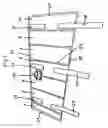
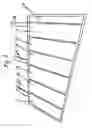
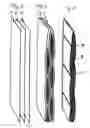
An example of the use of a laminate (as per the present invention) intended to serve as a support dressing is described in connection with an examination of the three attached drawings where;
FIG. 1 shows a four-sided laminate viewed from one side,
FIG. 2 shows the four-sided laminate viewed from the other side, and
FIG. 3 shows a cross section of the laminate shown in FIGS. 1 and 2.
Looking first at FIG. 3, it is plain and clear that the support dressing is built up of 3 layers (1-3). Layers 1 and 3 are of a material that does not allow gaseous media to pass through. The layer designated as 2 in this figure is, on the other hand, of a material that does allow gaseous media to pass through. Layers 1 and 2 are used to create a number of compartments (4-10 in FIG. 1). The edges of these compartments are joined to each other to create pockets for a filler. This can be a granulate, for example polypropylene or any other material with similar properties. The bottom of every such compartment formed by layer 2 is pervious to gaseous media. Provided that it allows gaseous media to pass through, layer 2 can be made of any suitable material whatsoever. Both outside layers may appropriately be made of polyurethane or of any other material that has the same properties. Instead of using a granulate, other fillers having the same properties as a granulate can be used. Thus, materials with fluid or semi-fluid consistancies can be considered. Making use of the intermediary layer (2) and the other outside layer (3), compartments are created by circumferential sealing effected by walding or bonding. Via the intermediary layer (2), these compartments are so arranged that each of them is connected to two compartments on the other side of said layer. Thus, in FIG. 3, compartment 8 is connected to compartments 15 and 16. The laminate, which has four sides (25-28 in FIG. 2, they have been given the identifying numbers 18-23.
The laminate shown in FIG. 1 can be used, for example, to wrap around an arm in which a bone has fractured. When wrapping has finished, the laminate can be fixed in place by bringing the Velcro strips into contact with each other. When this has been done, the valve (24) is used to set up a vacuum inside the laminate. This renders the laminate rigid. Easily, extremely quickly and without any mess, the laminate is now functioning exactly as a plaster of Paris dressing.
If it is made to an appropriate size, a rectangular laminate such as that illustrated in FIG. 1 can also be used as a stretcher. In this case, the laminate should have some form of handle in each of its four corners. A rectangular laminate can even be used as a wall element for covering undesired openings. Furthermore, a laminate as per the present invention can be given any shape whatsoever. By taking the laminate to its rigid condition, a rigid shape is then achieved.
It is clear that the laminate as per the present invention has a good number of uses that are not restricted to medical car alone, but extend to all situations needing a formable laminate capable of being brought to a rigid condition when the required form has been established.
The filling material in each compartment must be of such a nature that it becomes rigid when a vacuum is set up. A wide range of materials satisfying this requirement can be considered. As regards the two types of layer, namely, pervious to gaseous media and impervious to gaseous media, all types of materials having these properties can be used. The use of plastic foils, metal foils and rubber products is imaginable.
Claims
1. Laminate, in which the layers are partially united with each other, the laminate comprising, in order that a unit formable to any circumference is created, at least three layers, it being possible to take this unit from, for example, a flat state and form it into any type of body whatsoever, which can then be made rigid and, as desired, then returned to its formable state. Said laminate is characterised by the intermediary layers or, in the case of a three layer construction, the middle layer, being pervious to gaseous media such as air, and the two outside layers being impervious to gaseous media, a number of wholly closed compartments being created (making use of the layers themselves) between each outside layer and the middle layer, said compartments each being filled, either partially or completely, with a filling material such as granulates, powders or low/high viscosity fluids, and each compartment on each side of the middle layer having, through the common interface with the middle layer, contact with two compartments on the opposing side of the middle layer.
2. Laminate as per patent claim 1,
characterised by each closed compartment being created by two adjacent layers, the periphery of the compartment having the two layers joined so that the compartment is sealed.
3. Laminate as per patent claim 1,
characterised by the compartments being on each side of an intermediary layer and arranged side by side and, in this case, preferably parallel with each other.
4. Laminate as per patent claim 1,
characterised by the laminate being comprised of a number of layers, the two outside layers being impervious to gaseous media, the intermediary layers being pervious to gaseous media.
5. Laminate as per one or more of the preceding patent claims,
characterised by either of the two outside layers having at least one valve assembly so arranged that, working with a vacuum unit, it allows a vacuum to be set up and maintained in each compartment, it being additionally possible to release the vacuum via said valve assembly.
6. Laminate as per one or more of the preceding patent claims,
characterised by the outside layers being made of a plastic (e.g. Polyurethane), rubber or any other suitable material whatsoever.
7. Laminate as per one or more of the preceding patent claims,
characterised by the intermediary layers being made of a suitable, known, pervious material.
8. Laminate as per patent claim 1,
Characterised by the presence of a compartment filling material (e.g. a polypropylene granulate) that a becomes completely rigid when subjected to a vacuum.
9. Laminate as per patent claim 1,
characterised by its having a rectangular surface of such a size that a person can be placed recumbent thereon, the laminate also having some form of handle in each of its corners and, on an internal vacuum being set up, being capable of serving as a stretcher.
10. Laminate as per one or more of the preceding patent claims,
characterised by the laminate being four-sided, two opposing sides having fasteners that allow these two sides to be fastened to each other.
11. Laminate as per patent claim 10,
characterised by its being capable of application around an object (e.g. a limb), the fasteners then being engaged and, on an internal vacuum being set up, the thus positioned laminate forming a rigid dressing that is equal to a plaster of Paris dressing.
Images & Drawings included:
Sources:
- United States Patent and Trademark Office - verify current appl. status at the USPTO↗
Recent applications in this class:
- » 20250083428 2025-03-13
DECORATIVE SHEET AND METHOD OF PRODUCING DECORATIVE SHEET - » 20240051280 2024-02-15
ENGINEERED BOND LAYER FOR METALLIZATION OF POLYMER AND COMPOSITE SUBSTRATES - » 20230347635 2023-11-02
RESIN SHEET HAVING HAIR-LIKE BODIES AND MOLDED ARTICLE OF SAME - » 20220048281 2022-02-17
High performance plastic magnetic materials and preparation method thereof - » 20210339513 2021-11-04
GAS BARRIER LAMINATE - » 20210170731 2021-06-10
LAMINATE INCLUDING SODIUM POLYACRYLATE, AND RELATED SYSTEMS AND METHODS - » 20210154985 2021-05-27
ANTIMICROBIAL ASSEMBLIES - » 20210107264 2021-04-15
Barrier laminate film - » 20210078312 2021-03-18
Easy-to-clean protective film and substrate assembly - » 20210078311 2021-03-18
Antimicrobial layered material