METHOD FOR TREATING A HUMAN'S PAIN
US20070125391A1
2007-06-07
11/564,844
2006-11-30
Abstract:
A method for treating a human's pain has a providing a manikin step being providing a manikin having multiple pain points and multiple treatment points defined on the manikin; a providing at least one contrasted table step being providing at least one contrasted table connecting with the pain points and the treatment points and having a whole nerved-illustration; and a finding a patient's correlative treatment points step being finding the patient's correlative treatment points to at least one of the pain point, Therefore a doctor can heal the patient's treatment points without healing the patient's pain point.
Assignee:
- NEW CHINESE BIOTECHNOLOGY CO., LTD. 1 🇹🇼 Kaohsiung, Taiwan
Interested in similar patents?
Get notified when new applications in this technology area are published.
Classification:
A61H39/02 » CPC main
Devices for locating or stimulating specific reflex points of the body for physical therapy, e.g. acupuncture Devices for locating such points
Description
BACKGROUND OF THE INVENTION1. Field of the Invention
The present invention relates to a method, and especially a method for treating a human's pain.
2. Description of the Related Art
The physiology maintains stable via nervous system and circulatory system that affect each other Therefore, when a patient has a pain on a specific portion of the patient's body, a correlative portion of the body has a reactive symptom due probably to a variation of the function of sympathetic nerve. The symptom on the correlative portion may be a deep pressure pain or a change of the cutaneous blood flow. When the specific portion is injured on a skin, the effectiveness is not very satisfactory if a doctor directly heal the specific portion. Although the treatment of the correlative portion with the reactive symptom can cure the specific portion feeling pain, how to find the correlative portion of the patient is not clear.
To overcome the shortcomings, the present invention provides a method for treating a treatment point to decrease a pain in a pain point on the patient to mitigate or obviate the aforementioned problems.
SUMMARY OF THE INVENTIONThe objective of the present invention is to provide a method for treating as human's pain so that a doctor can directly heal a treatment point to decrease a pain in a pain point on a patient.
To achieve the foregoing objective, the present invention has a method for treating a human's pain in accordance with the present invention has a providing a manikin step being providing a manikin having multiple pain points and multiple treatment points defined on the manikin; a providing at least one contrasted table step being providing at least one contrasted table connecting with the pain points and the treatment points and having a whole nerved-illustration; and a finding a patient's correlative treatment points step being finding the patient's correlative treatment points to at least one of the pain point. Therefore a doctor can heal the patient's treatment points without healing the patient's pain point.
Other objectives, advantages and novel features of the invention will become more apparent from the following detailed description when taken in conjunction with the accompanying drawings.
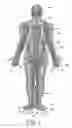
BRIEF DESCRIPTION OF THE DRAWINGSFIG. 1 is a front view of a manikin device in accordance with the present invention with nerve bands and with the human facial and body features omitted;
FIG. 2 is a back view of the manikin device in FIG. 1 with the nerve bands and with the human facial and body features omitted;
FIG. 3 is an enlarged front view of a female patient with one nerve band; and
FIG. 4 is a front view of a female patient with one nerve band.
DETAILED DESCRIPTION OF THE PREFERRED EMBODIMENTSWith reference to FIGS. 1 and 2, a method for treating a human's pain in accordance with the present invention comprises steps of (a) providing a manikin, (b) providing at least one contrasted table and (c) finding correlative treatment points.
The providing a manikin step is providing a manikin having multiple pain points and multiple treatment points defined on the manikin.
The providing at least one contrasted table step is establishing at least one contrasted table connecting with the pain points and the treatment points and having a whole nerved-illustration.
The finding correlative treatment points step is finding correlative treatment points to at least one of the pain points.
The term “at least one contrasted table” including tabs. 2 to 5.
The rule of the present invention is explained after names of the pain points and treatment points are introduced. The manikin with the whole nerved-illustration has twelve pairs of symmetrical nerve bands (1, 2, 3, 4, 5, 6, 7, 8, 9, 10, 11, 12) and four central nerve bands (13, 14, 15, 16). In FIGS. 1 and 2, the nerve bands (1, 2, 3, 4, 5, 6, 7, 8, 9, 10, 11, 12, 13, 14, 15, 16) are marked with different oblique line. The nerve bands of the pairs are first nerve bands (1), second nerve bands (2), third nerve bands (3), fourth nerve bands (4), fifth nerve bands (5), sixth nerve bands (6), seventh nerve bands (7), eighth nerve bands (8), ninth nerve bands (9), tenth nerve bands (10), eleventh nerve bands (11) and twelfth nerve bands (12). The nerve bands (1, 2, 3, 4, 5, 6, 7, 8, 9, 10, 11, 12) of each pair are formed symmetrically on the manikin according to an axis of the manikin. Two central nerve bands (14, 15) correspond respectively to an upper half and a lower half of a governing vessel along a central axis on the manikin and are as called fourteenth and fifteenth nerve bands (14, 15) respectively. The other two central nerve bands (13, 16) correspond respectively to an upper half and a lower half of a conception vessel and are called thirteenth and sixteenth nerve bands (13, 16).
A naming rule of the pain point and the treatment point is introduced as follows.
1. The manikin is divided into two sides, which are a left (L) and a right (R).
2. The entire nerve bands (1, 2, 3, 4, 5, 6, 7, 8, 9, 10, 11, 12, 13, 14, 15, 16) are marked with number showing on following Tab. 1.
3. The manikin is also divided into eight portions according to main joints, which are a head (H), a trunk (T), a pair of arms (Shoulder, S), a pair of forearms (Elbow, E), a pair of Hands (Wrist, W), a pair of thighs (Legs, L), a pair of legs (Knees, K) and a pair of Feet (Ankle, A).
4. Each portions of nerve band (1, 2, 3, 4, 5, 6, 7, 8, 9, 10, 11, 12, 13, 14, 15, 16) is divided into ten equal parts marked with 0 to 10 from an upper end to a lower end of the eight portions such as H, T, S, E, W, L, K or A, which are a zeroth pan, a first part, a second part, a third part, a fourth part, a fifth part, a sixth part, a seventh part, an eighth part, a ninth part and a tenth part. The upper ends of the first to twelfth nerve bands (1, 2, 3, 4, 5, 6, 7, 8, 9, 10, 11, 12) are located at a top of the head or the trunk on the manikin. The upper ends of thirteenth and sixteenth nerve bands (13, 16) are located at the junction of chest and abdomen on the manikin. The upper ends of the fourteenth and the fifteenth nerve bands (14, 15) are located on a middle of a back on the manikin.
| TABLE 1 | ||
| Number | Name | Distribution on the Manikin |
| 1 | First Nerve Band (1) | Distributed Around the Lung Meridian of Hand Taiyin |
| 2 | Second Nerve Band (2) | Distributed Around the Large Intestine |
| Meridian of Hand Yangming | ||
| 3 | Third Nerve Band (3) | Distributed Around the Stomach Meridian |
| of Foot Yangming | ||
| 4 | Fourth Nerve Band (4) | Distributed Around the Spleen Meridian of Foot Taiyin |
| 5 | Fifth Nerve Band (5) | Distributed Around the Heart Mridian of |
| Hand Shaoyin | ||
| 6 | Sixth Nerve Band (6) | Distributed Around the Small Intestine |
| Meridian of Hand-Taiyang | ||
| 7 | Seventh Nerve Band | Distributed Around the Bladder Mridian of |
| (7) | Foot Taiyang | |
| 8 | Eighth Nerve Band (8) | Distributed Around the Kidney Mridian of |
| Foot Shao-yin | ||
| 9 | Ninth Nerve Band (9) | Distributed Around the Pericardium |
| Meridian of Hand-Jueyin | ||
| 10 | Tenth Nerve Band (10) | Distributed Around the Triple Warmer |
| Mridian of Hand Shaoyang | ||
| 11 | Eleventh Nerve Band | Distributed Around the Gall bladder |
| (11) | Mridian of Foot Shaoyang | |
| 12 | Twelfth Nerve Band | Distributed Around the Liver Meridian of |
| (12) | Foot-Jueyin | |
| 13 | Thirteenth Nerve Band (13) | Distributed Around the Upper Half of the |
| Conception Vessel | ||
| 14 | Fourteenth Nerve Band (14) | Distributed Around the Upper Half of the |
| Governing Vessel | ||
| 15 | Fifteenth Nerve Band | Distributed Around the Lower Half of the |
| (15) | Governing Vessel | |
| 16 | Sixteenth Nerve Band (16) | Distributed Around the Lower Half of the |
| Conception Vessel | ||
A displaying rule of the pain points and the treatment points is introduced as follows.
Each of the pain points or treatment points is shown with a set of four symbols that are marked on an outer surface of the manikin. A first symbol, such as H, T, S, E, W, L, K or A, means one of the eight portions of the manikin. A second symbol, such as 1 to 16, means one of the nerve bands (1, 2, 3, 4, 5, 6, 7, 8, 9, 10, 11, 12, 13, 14, 15, 16). A third symbol, such as 0 to 10, means one of the equal parts of one portion of the manikin. The second symbol and the third symbol is divided by a comma “,”. The fourth symbol, such as L, R or B, means the left, right or bilateral on the manikin, For example, T2.8R means a position located at the eighth part of the second nerve band (2) on the right trunk of the manikin.
In addition, “0”, the zeroth part of each portion of each nerve bands (1, 2, 3, 4, 5, 6, 7, 8, 9, 10, 11, 12, 13, 14, 15, 16), can be ignored. For example, E1.0R may be abbreviated to E1R and W2.0R may be abbreviated to W2R. An uppermost portion on the nerve band (1, 2, 3, 4, 5, 6, 7, 8, 9, 10, 11, 12, 13, 14, 15, 16) can also be ignored. For example, T1R may be abbreviated to 1R and H2R may be abbreviated to 2R.
Before looking for the treatment point, a user must know what sex is a patient and know a character of the pain is asthenia syndrome or sthenia syndrome.
The rule of the present invention is explained as follows.
1. The user determines whether character of the pain of the patient's pain point is asthenia syndrome or sthenia syndrome. When the user presses the patient's pain point and the patient feels more pain on the pain point, the pain is sthenia syndrome. When the user presses the patient's pain point and the patient feels less pain on the pain point, and the pain is asthenia syndrome. Then the user determines to apply a straight treatment or a cross treatment to the patient according to the patient's gender, character of a pain and laterality of the pain point, as shown in following Tab. 2.
| TABLE 2 | ||||
| Treatment | ||||
| (treatment | ||||
| point | Treatment | |||
| on the | (treatment point | |||
| ipsilateral | on the | |||
| character of | side of the | contralateral side | ||
| pain | Gender | Laterality | manikin) | of the manikin) |
| sthenia syndrome | Male | Left | Cross | Straight |
| sthenia syndrome | Male | Right | Straight | Cross |
| sthenia syndrome | Female | Left | Straight | Cross |
| sthenia syndrome | Female | Right | Cross | Straight |
| asthenia syndrome | Male | Left | Straight | Cross |
| asthenia syndrome | Male | Right | Cross | Straight |
| asthenia syndrome | Female | Left | Cross | Straight |
| asthenia syndrome | Female | Right | Straight | Cross |
2. The user determines which nerve band (1, 2, 3, 4, 5, 6, 7, 8, 9, 10, 11, 12, 13, 14, 15, 16) is correlative according to above treatment point and pain point, as shown in following Tabs. 3a, 3b, 3c and 3d.
a. The straight treatment means that a pain point and a correlative treatment point to the pain point are arranged in the same column in Tabs. 3a, 3b, 3c and 3d so the user should find the correlative treatment point in the same column where the pain point is located. For example, a pain point is located on the first nerve band (1) and its correlative treatment point is located on the fourth nerve band (4). A pain point is located on the fourth nerve band (4) and its correlative treatment point is located on the first nerve band (1). A pain point is located on the second nerve band (2) and its correlative treatment point is located on the third nerve band (3). A pain point is located on the third nerve band (3) and its correlative treatment is located on the second nerve band (2).
b. The cross treatment means that a pain point and a correlative treatment point to the pain point are diagonally arranged respectively in different columns in Tabs. 3a, 3b, 3c and 3d so the user should find the correlative treatment point in another column different from the column where the pain point is located. For example, a pain point is located on the first nerve band (1) and its correlative treatment point is located on the third nerve band (3). A pain point is located on the third nerve band (3) and its correlative treatment point is located on the first nerve band (1). A pain point is located on the second nerve band (2) and its correlative treatment point is located on the fourth nerve band (4). A pain point is located on the fourth nerve band (4) and its correlative treatment point is located on the second nerve band (2).
In Tab. 3a, the first, second, third and fourth nerve bands (1, 2, 3, 4) are grouped together.
| TABLE 3a | ||
| 1 | 2 | |
| 4 | 3 | |
In Tab. 3b, the fifth, sixth, seventh and eighth nerve bands (5, 6, 7, 8) are grouped together.
| TABLE 3b | ||
| 5 | 6 | |
| 8 | 7 | |
In Tab. 3c, the ninth, tenth, eleventh and twelfth nerve bands (9, 10, 11, 12) are grouped together.
| TABLE 3c | ||
| 9 | 10 | |
| 12 | 11 | |
In Tab. 3d, the thirteenth, fourteenth, fifteenth and sixteenth nerve bands (13, 14, 15, 16) are grouped together.
| TABLE 3d | ||
| 13 | 14 | |
| 16 | 15 | |
4. The user determines where portion of the manikin the correlative treatment point is located according to Tab. 4.
A set of symbol “*.*” includes two symbols “*”. A first symbol “*” means one of the nerve bands (1, 2, 3, 4, 5, 6, 7, 8, 9, 10). A second symbol “*” means one of the equal parts of one portion of the manikin and may be 1 to 10.
| TABLE 4 | |
| Pain point (or treatment paint) | Treatment point (or pain point) |
| at nerve band of upper extremities | at nerve band of lower extremities |
| Origin Upper End | Origin Upper End |
| Head (H) or Trunk(T) | Head (H) or Trunk (T) |
| Trunk (T) | Trunk (T) |
| Arms (S) | Shoulder joint | Thighs (L) | Hip joint |
| Arm*.* | Thigh*.* | ||
| Forearms (E) | Elbow joint | Legs (K) | Knee joint |
| Forearm*.* | Leg*.* | ||
| Hands (W) | Wrist joint | Feet (A) | Ankle joint |
| Hand *.* | Foot*.* |
| Lower End | Lower End |
5. To sum up, Tabs. 5a and 5b are shown.
a. A straight treatment on the ipsilateral side treatment point is implemented as following conditions happen,
(1) The patient is male, the pain point is located a left of the patient's body and the character of the pain on the pain point is asthenia syndrome.
(2) The patient is female, the pain point is located a right of the patient's body and the character of the pain on the pain point is asthenia syndrome.
(3) The patient is male, the pain point is located a right of the patient's body and the character of the pain on the pain point is sthenia syndrome.
(4) The patient is female, the pain point is located a left of the patient's body and the character of the pain on the pain point is sthenia syndrome.
A straight treatment on the contralateral side treatment point is implemented as following conditions happens.
(1) The patient is male, the pain point is located a right of the patient's body and the character of the pain on the pain point is asthenia syndrome.
(2) The patient is female, the pain point is located a left of the patient's body and the character of the pain on the pain point is asthenia syndrome.
(3) The patient is male, the pain point is located a left of the patient's body and the character of the pain on the pain point is sthenia syndrome.
(4) The patient is females the pain point is located a right of the patient's body and the character of the pain on the pain point is sthenia syndrome.
A symbol “*” means one of the equal parts of one portion of the manikin and may be 1 to 10.
| TABLE 5a | ||
| Correlative | ||
| treatment | ||
| Pain point | point | |
| 1 | 4 | |
| T1.* | T4.* | |
| S1 | L4 | |
| S1.* | L4.* | |
| E1 | K4 | |
| E1.* | K4.* | |
| W1 | A4 | |
| W1.* | A4.* | |
| 2 | 3 | |
| H2.* | H3.* | |
| T2 | T3 | |
| T2.* | T3.* | |
| S2 | L3 | |
| S2.* | L3.* | |
| E2 | K3 | |
| E2.* | K3.* | |
| W2 | A3 | |
| W2.* | A3.* | |
| 3 | 2 | |
| H3.* | H2.* | |
| T3 | T2 | |
| T3.* | T2.* | |
| L3 | S2 | |
| L3.* | S2.* | |
| K3 | E2 | |
| K3.* | E2.* | |
| A3 | W2 | |
| A3.* | W2.* | |
| 4 | 1 | |
| T4.* | T1.* | |
| L4 | S1 | |
| L4.* | S1.* | |
| K4 | E1 | |
| K4.* | E1.* | |
| A4 | W1 | |
| A4.* | W1.* | |
| 5 | 8 | |
| S5.* | L8.* | |
| E5 | K8 | |
| E5.* | K8.* | |
| W5 | A8 | |
| W5.* | A8.* | |
| 6 | 7 | |
| H6.* | H7.* | |
| T6 | T7 | |
| T6.* | T7.* | |
| S6 | L7 | |
| S6.* | L7.* | |
| E6 | K7 | |
| E6.* | K7.* | |
| W6 | A7 | |
| W6.* | A7.* | |
| 7 | 6 | |
| H7.* | H6.* | |
| T7 | T6 | |
| T7.* | T6.* | |
| L7 | S6 | |
| L7.* | S6.* | |
| K7 | E6 | |
| K7.* | E6.* | |
| A7 | W6 | |
| A7.* | W6.* | |
| 8 | 5 | |
| T8.* | 5 | |
| L8 | 5 | |
| L8.* | S5.* | |
| K8 | E5 | |
| K8.* | E5.* | |
| A8 | W5 | |
| A8.* | W5.* | |
| 9 | 12 | |
| T9.* | T12.* | |
| S9 | L12 | |
| S9.* | L12.* | |
| E9 | K12 | |
| E9.* | K12.* | |
| W9 | A12 | |
| W9.* | A12.* | |
| 10 | 11 | |
| H10.* | H11.* | |
| T10 | T11 | |
| T10.* | T11.* | |
| S10 | L11 | |
| S10.* | L11.* | |
| E10 | K11 | |
| E10.* | K11.* | |
| W10 | A11 | |
| W10.* | A11.* | |
| 11 | 10 | |
| H11.* | H10.* | |
| T11 | T10 | |
| T11.* | T10.* | |
| L11 | S10 | |
| L11.* | S10.* | |
| K11 | E10 | |
| K11.* | E10.* | |
| A11 | W10 | |
| A11.* | W10.* | |
| 12 | 9 | |
| T12.* | T9.* | |
| L12 | S9 | |
| L12.* | S9.* | |
| K12 | E9 | |
| K12.* | E9.* | |
| A12 | W9 | |
| A12.* | W9.* | |
| 13 | 16 | |
| T13.* | T16.* | |
| H13.* | T16.10 | |
| 14 | 15 | |
| T14.* | T15.* | |
| H14.* | T15.10 | |
| 15 | 14 | |
| T15.* | T14.* | |
| 16 | 13 | |
| T16.* | T13.* | |
b. A cross treatment on the ipsilateral side treatment point is implemented as following conditions happen.
(1) The patient is male, the pain point is located a right of the patient's body and the character of the pain on the pain point is asthenia syndrome.
(2) The patient is female, the pain point is located a left of the patient's body and the character of the pain on the pain point is asthenia syndrome.
(3) The patient is male, the pain point is located a left of the patient's body and the character of the pain on the pain point is sthenia syndrome.
(4) The patient is female, the pain point is located a right of the patient's body and the character of the pain on the pain point is sthenia syndrome.
A cross treatment on the contralateral side treatment point is implemented as following conditions happens,
(1) The patient is male, the pain point is located a left of the patient's body and character of the pain on the pain point is asthenia syndrome.
(2) The patient is female, the pain point is located a right of the patient's body and the character of the pain on the pain point is asthenia syndrome.
(3) The patient is male, the pain point is located a right of the patient's body and the character of the pain on the pain point is sthenia syndrome.
(4) The patient is female, the pain point is located a left of the patient's body and the character of the pain on the pain point is sthenia syndrome.
A symbol “*” means one of the equal parts of one portion of the manikin and maybe 1 to 10.
| TABLE 5b | ||
| Correlative | ||
| treatment | ||
| Pain point | point | |
| 1 | 3 | |
| T1.* | T3.* | |
| S1 | L3 | |
| S1.* | L3.* | |
| E1 | K3 | |
| E1.* | K3.* | |
| W1 | A3 | |
| W1.* | A3* | |
| 2 | 4 | |
| H2.* | 4 | |
| T2 | T4.* | |
| T2.* | T4.* | |
| S2 | L4 | |
| S2.* | L4.* | |
| E2 | K4 | |
| E2.* | K4.* | |
| W2 | A4 | |
| W2.* | A4.* | |
| 3 | 1 | |
| H3.* | 1 | |
| T3 | 1 | |
| T3.* | T1.* | |
| L3 | S1 | |
| L3.* | S1.* | |
| K3 | E1 | |
| K3.* | E1.* | |
| A3 | W1 | |
| A3.* | W1.* | |
| 4 | 2 | |
| T4.* | T2.* | |
| L4 | S2 | |
| L4.* | S2.* | |
| K4 | E2 | |
| K4.* | E2.* | |
| A4 | W2 | |
| A4.* | W2.* | |
| 5 | 7 | |
| S5.* | L7.* | |
| E5 | K7 | |
| E5.* | K7.* | |
| W5 | A7 | |
| W5.* | A7.* | |
| 6 | 8 | |
| H6.* | 8 | |
| T6 | 8 | |
| T6.* | T8.* | |
| S6 | L8 | |
| S6.* | L8.* | |
| E6 | K8 | |
| E6.* | K8.* | |
| W6 | A8 | |
| W6.* | A8.* | |
| 7 | 5 | |
| H7.* | 5 | |
| T7 | 5 | |
| T7.* | 5 | |
| L7 | 5 | |
| L7.* | S5.* | |
| K7 | E5 | |
| K7.* | E5.* | |
| A7 | W5 | |
| A7.* | W5.* | |
| 8 | 6 | |
| T8.* | T6.* | |
| L8 | S6 | |
| L8.* | S6.* | |
| K8 | E6 | |
| K8.* | E6.* | |
| A8 | W6 | |
| A8.* | W6.* | |
| 9 | 11 | |
| T9.* | T11.* | |
| S9 | L11 | |
| S9.* | L11.* | |
| E9 | K11 | |
| E9.* | K11.* | |
| W9 | A11 | |
| W9.* | A11.* | |
| 10 | 12 | |
| H10.* | 12 | |
| T10 | T12.* | |
| T10.* | T12.* | |
| S10 | L12 | |
| S10.* | L12.* | |
| E10 | K12 | |
| E10.* | K12.* | |
| W10 | A12 | |
| W10.* | A12.* | |
| 11 | 9 | |
| H11.* | 9 | |
| T11 | 9 | |
| T11.* | S9 | |
| L11 | S9 | |
| L11.* | S9.* | |
| K11 | E9 | |
| K11.* | E9.* | |
| A11 | W9 | |
| A11.* | W9.* | |
| 12 | 10 | |
| T12.* | T10.* | |
| L12 | S10 | |
| L12.* | S10.* | |
| K12 | E10 | |
| K12.* | E10.* | |
| A12 | W10 | |
| A12.* | W10.* | |
| 13 | 15 | |
| T13.* | T15.* | |
| H13.* | T15.10 | |
| 14 | 16 | |
| T14.* | T16.* | |
| H14.* | T16.10 | |
| 15 | 13 | |
| T15.* | T13.* | |
| 16 | 14 | |
| T16.* | T14.* | |
Therefore, when the user inputs data including character of the pain, gender and laterality of the pain point into the control unit (21), a correlative treatment point is found via that the control unit (21) compares the inputted data with the database inside the control unit (21).
EXAMPLE 1With reference to FIGS. 4 and 5, a female has a pain point on the right elbow of the first nerve band marked with a set of symbols of E1R. The character of the pain is asthenia syndrome. According to the rule of the present invention, the correlative treatment point to the pain point is on the fourth nerve band (4) of the right knee marked with a set of symbols of K4R on the ipsilateral side of the manikin where the pain point is located or the third nerve band (3) of the left knee marked with a set of symbols of K3L on the contralateral side of the manikin where the pain point is located.
EXAMPLE 2With reference to FIGS. 4 and 5, a female has a pain point on the first nerve band (1) of the third part of the right upper arm marked with a set of symbols of S1.3R. The syndrome of the pain on the pain point is asthenia syndrome, According to the rule of the present invention, the correlative treatment point is on the fourth nerve band (4) of the third part of the right thigh marked with a set of symbols of L4.3R on the ipsilateral side of the manikin where the pain point is located or the third nerve band (3) of the third part of the left thigh marked with a set of symbols of L3.3L on the contralateral side of the manikin where the pain point is located.
Therefore, a user determines a character of a pain of a pain point and which side the pain point is located on of the manikin. Then according to the rule, the user can easily find a correlative treatment point,
Even though numerous characteristics and advantages of the present invention have been set forth in the foregoing description, together with details of the structure and features of the invention, the disclosure is illustrative only. Changes may be made in the details, especially in matters of shape, size, and arrangement of parts within the principles of the invention to the full extent indicated by the broad general meaning of the terms in which the appended claims are expressed.
Claims
What is claimed is:1. A method for treating a human's pain comprising
a providing a manikin step being providing a manikin having multiple pain points and multiple treatment points defined on the manikin;
a providing at least one contrasted table step being providing at least one contrasted table connecting with the pain points and the treatment points and having a whole nerved-illustration; and
a finding a patient's correlative treatment points step being finding the patient's correlative treatment points to at least one of the pain point.
2. The method as claimed in claim 1 further comprising a determining a gender and a character of the patient step being determining a gender and a character of the patient before finding the patient's correlative treatment points step.
3. The method as claimed in claim 2, further comprising a determining a straight treatment or a cross treatment step being determining a straight treatment or a cross treatment.
4. The method as claimed in claim 3, wherein the correlative treatment point is indicated in the at least one contrasted table, when the straight treatment is determined.
5. The method as claimed in claim 3, wherein the correlative treatment point is indicated in the at least one contrasted table, when the cross treatment is determined.
Images & Drawings included:



Sources:
- United States Patent and Trademark Office - verify current appl. status at the USPTO↗
Similar patent applications:
- » 20140227287
Method of treating pain with anti-human NGF antibody - » 20120143081
Pure silver device and method for diagnosing and treating pain in the human body - » 20140349946
Methods for treating pain by administering peptides derived from human basic proline-rich lacrimal protein - » 20150110801
Human antibodies to GFR α3 and methods of treating pain associated with osteoarthritis or bone cancer - » 20210198373
Humanized anti-NGF antibodies and methods of treating pain thereof - » 20180147281
Anti-human NGF antibody Fab fragment and methods for treating postoperative pain related to NGF
Recent applications in this class:
- » 20240173207 2024-05-30
METHOD OF DISPLAYING LOCATIONS OF ACUPUNCTURE POINTS IN HUMAN BODY USING ARTIFICIAL INTELLIGENCE - » 20240058210 2024-02-22
Automatic acupuncture robot - » 20220296466 2022-09-22
Stimulating acupuncture meridians through touching images on a smart phone with imprinted acupuncture meridian endogenous frequencies. - » 20220202647 2022-06-30
MASSAGE CONTROL METHOD AND ELECTRONIC DEVICE IMPLEMENTING MASSAGE CONTROL METHOD - » 20220062101 2022-03-03
METHOD FOR CAUSING RELAXATION OF A MUSCLE AND A SYSTEM FOR ASSISTING A PERSON IN EXECUTING THE SAME METHOD - » 20220031565 2022-02-03
DEVICE AND METHOD FOR THREE-DIMENSIONALLY MAPPING ACUPUNCTURE POINTS - » 20210353499 2021-11-18
ELECTROMAGNETIC PHYSIOTHERAPY APPARATUS OF CONCEPTION AND GOVERNOR VESSELS AND PHYSIOTHERAPY METHOD OF CONCEPTION AND GOVERNOR VESSELS - » 20210244613 2021-08-12
STIMULATION METHOD, IN PARTICULAR LASER ACUPUNCTURE - » 20210161761 2021-06-03
Method and device for locating a human target using superficial venous characteristics - » 20200121556 2020-04-23
System and method for generating pressure point maps based on remote-controlled haptic-interactions