Method for molding vehicular wheel rim
US20070143988A1
2007-06-28
11/645,032
2006-12-26
✅ Patent granted
US 7,861,412 B2
2011-01-04
-
-
David P Bryant | Alexander P Taousakis
2029-11-03
Abstract:
There is provided a method for preventing a cylindrical body from buckling in externally curling edges of both side portions by pressing by curling dies in an axial direction after molding the cylindrical body having a drop portion whose outer diameter is small and the both side portions whose outer diameter is large by enlarging a cylindrical material made of aluminum alloy by electromagnetic molding. In curling the edges of the both side portions, a buckling preventing die restrains an outer periphery of the drop portion of the cylindrical body. Because the buckling preventing die receives the axial compression force of the curling dies, it can prevent the cylindrical body from buckling and deforming. The buckling preventing die is what a split die disposed on the side of an outer periphery of the cylindrical material in the electromagnetic molding is used as it is.
Inventors:
- Yoshihaya Imamura 17 🇯🇵 Fujisawa, Japan
- Junichi Sato 1 🇯🇵 Kaga, Japan
- Daigo Masumoto 1 🇯🇵 Kaga, Japan
- Katsuhiro Motode 1 🇯🇵 Kaga, Japan
Assignee:
- Daido Kogyo Co., Ltd. 9 🇯🇵 Ishikawa Pref., Japan
Interested in similar patents?
Get notified when new applications in this technology area are published.
Classification:
B21D53/30 » CPC main
Making other particular articles wheels or the like wheel rims
B21D19/12 » CPC further
Flanging or other edge treatment, e.g. of tubes Edge-curling
Y10T29/49375 » CPC further
Metal working; Method of mechanical manufacture; Heat exchanger or boiler making; Tube joint and tube plate structure including conduit expansion or inflation
Y10T29/49524 » CPC further
Metal working; Method of mechanical manufacture; Wheel making; Land wheel Rim making
Y10T29/49531 » CPC further
Metal working; Method of mechanical manufacture; Wheel making; Land wheel; Rim making Roller forming
Y10T29/49803 » CPC further
Metal working; Method of mechanical manufacture Magnetically shaping
Y10T29/4994 » CPC further
Metal working; Method of mechanical manufacture; Assembling or joining; Joining by deforming; Radially expanding part in cavity, aperture, or hollow body Radially expanding internal tube
Y10T29/53083 » CPC further
Metal working; Means to assemble or disassemble with control means energized in response to activator stimulated by condition sensor; Responsive to work or work-related machine element including means to apply magnetic force directly to position or hold work
B23P21/00 IPC
Machines for assembling a multiplicity of different parts to compose units, with or without preceding or subsequent working of such parts, e.g. with programme control
B23Q15/00 IPC
Measuring; Indicating; Controlling
B23Q15/00 IPC
Automatic control or regulation of feed movement, cutting velocity or position of tool or work
B21F43/00 IPC
Making bands, e.g. bracelets, or wire
B23P13/04 IPC
Making metal objects by operations essentially involving machining but not covered by a single other subclass involving slicing of profiled material
A61C3/08 IPC
Dental tools or instruments Tooth pluggers or hammers
Description
BACKGROUND OF THE INVENTION1. Field of the Invention
The present invention relates to a method for molding a vehicular wheel rim made of a metal plate or protruded member.
2. Related Art
Japanese Patent Laid-Open No. 2005-95982 Gazette (US2005091850A1) for example describes a method for manufacturing a wheel for use in passenger cars, trucks, buggies and the like. It then discloses a method for molding a wheel rim by disposing an electromagnetic molding die whose inner face serves as a molding face at an outer peripheral side of a cylindrical material made of aluminum alloy, disposing an electromagnetic molding coil at an inner peripheral side of the cylindrical material, charging electrical energy to the electromagnetic molding coil in this state to enlarge and press the cylindrical material against the molding face of the molding die to mold a cylindrical body having a drop portion whose outer diameter is small and both side portions whose outer diameter is larger than that of the drop portion and by curling edges of the both side portions.
It is noted that the electromagnetic molding refers to a technology of molding a workpiece into a predetermined shape by making use of a phenomenon that an electromagnetic molding coil produces a strong magnetic field in a very short time when electric energy (electric charge) accumulated at high voltage is instantaneously charged (discharged) into the electromagnetic molding coil and that the workpiece placed in the magnetic field is subjected to a strong enlarging force or contraction force caused by a repulsive force (Lorentz force according to Fleming's left-hand rule) of the magnetic field and there by under goes fast plastic deformation. In case of this example, the cylindrical material enlarges in a direction of the outer diameter by receiving the strong enlarging force and is pressed against the molding face of the electromagnetic molding die.
Because an extruded member having an equal thickness or a plate member in a cylindrical shape formed by bending and welding edge portions thereof is used as the cylindrical material and the both side portions are enlarged more than the drop portion, the above-mentioned method allows the wheel rim having the thicker drop portion (thickness decreases less in enlarging the diameter thereof) and the thinner both side portions (thickness decreases more in enlarging the diameter) to be molded. Therefore, when a disk is fixed to the drop portion, the wheel rim hardly causes welding distortion and can support a large load corresponding to its thickness. Still more, if the thickness of the drop portion is supposed to be equal, weight of the entire wheel rim may be lightened due to the thin both side portions. It should be noted that Japanese Patent Laid-Open No. 2004-224292 Gazette also describes a curling of edges of the wheel rim.
However, there has been a problem in pressing a curling die against the edges of the both side portions to bend and curl the edges in an external direction (external curling process) in a curling process after the electromagnetic molding that the drop portion of the cylindrical body buckles due to the pressure in the axial direction of the curling die.
Accordingly, it is an object of the invention to solve the above-mentioned problem in molding the wheel rim from the cylindrical material by applying the electromagnetic molding method and the curling method by pressing. This object may be achieved through the combination of features described in an independent claim of the invention. Dependent claims thereof specify preferable embodiments of the invention.
SUMMARY OF THE INVENTIONAccording to the invention, there is provided a method for molding a vehicular wheel rim by disposing an electromagnetic molding die whose inner face serves as a molding face on the side of an outer periphery of a metallic cylindrical material, disposing an electromagnetic molding coil on the side of an inner periphery of the cylindrical material, charging electrical energy to the electromagnetic molding coil in this state to enlarge and press the cylindrical material against the molding face of the molding die to mold a cylindrical body having a drop portion whose outer diameter is small and both side portions whose outer diameter is larger than that of the drop portion and by externally curling edges of the both side portions by pressing by curling dies in the axial direction while restraining the outer periphery of the drop portion of the cylindrical body by a buckling preventing die.
An extruded material having an equal thickness or a plate material in a cylindrical shape obtained by bending and welding end portions thereof maybe used as the cylindrical material. It is preferable to be aluminum (including aluminum alloy), copper (including copper alloy) and the like having a high electrical conductivity and it is particularly preferable to be aluminum (including aluminum alloy).
A die having molding faces in the shapes corresponding to the drop portion and the both side portions of the cylindrical body after molding may be used as the electromagnetic molding die. Beside that, an electromagnetic molding die having no molding face corresponding to part of or entire both side portions and having a molding face whose axial length is short as compared to an axial length of the cylindrical body to be molded, i.e., whose inner peripheral face is composed of the molding face in the shape corresponding to the drop portion of the cylindrical body or whose inner peripheral face is composed of the molding face in the shape corresponding to the drop portion and to part of the both side portions of the cylindrical body.
The external curling process by pressing is carried out in a manner of pressing curling dies against edges of the both side portions. A known arc-like tool (a semi-arc or a quarter-arc tool) or a cone-like tool may be used as the curling die.
The buckling preventing die has an inner peripheral face corresponding at least to the drop portion of the cylindrical body. Still more, the both side portions that are subject to the curling process must be exposed out of the die so that the die will not hamper the curling process. Although a dedicated die may be used as the buckling preventing die, the electromagnetic molding die used in the electromagnetic molding step may be used as it is.
A roll-forming process is carried out as necessary after the curling process. The roll-forming process is a processing method carried out by pinching inner and outer sides of the cylindrical body by rollers and is used in finishing a sectional shape of the cylindrical body into a final shape of the wheel rim.
The invention allows the wheel rim to be molded efficiently from the cylindrical material by successively applying the electromagnetic molding step and the curling step and prevents the buckling from occurring at the drop portion of the cylindrical body by restraining the outer periphery of the drop portion by the buckling preventing die in the curling step carried out by pressing. Then, as for the cylindrical material having the equal thickness, while the thickness relatively thick at the drop portion, it is thin at the both side portions by the enlargement of the electromagnetic molding step. The thin both side portions may be readily curled by relatively low compression force in the axial direction, allowing the vehicular wheel rim to be manufactured at high precision in combination with the restraint of the outer periphery of the drop portion by the buckling preventing fixture.
Still more, when the electromagnetic molding die is used as it is as the buckling preventing die, it becomes possible to cut the equipment costs and to simplify the molding steps because it is not necessary to replace the electromagnetic molding die to the buckling preventing die.
The wheel rim manufactured by the manufacturing method of the invention has the thick drop portion that junctions with the disk and the relatively thin both side portions, so that it becomes possible to lighten its weight, even though it bears the large load, and to cut the number of processing steps and to improve product performance because the rim has no junction. Further, because the disk is fixed to the drop portion by welding or the like, it becomes possible to design the disk solely and to have an excellent decorative design. Still more, it allows highly accurate products to be obtained.
It is noted that the summary of the invention described above does not necessarily describe all necessary features of the invention. The invention may also be a sub-combination of the features described above.
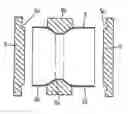
BRIEF DESCRIPTION OF THE DRAWINGSFIG. 1 is a section view for explaining a step of electromagnetically molding a cylindrical material.
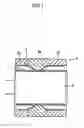
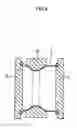
FIG. 2 is a section view of the electromagnetically molded cylindrical body.
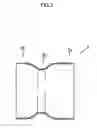
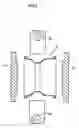
FIG. 3 is a section view for explaining a step of curling the cylindrical material.
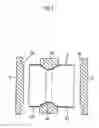
FIG. 4 is another section view for explaining the step of curling the cylindrical material.
FIG. 5 is a still other section view for explaining the step of curling the cylindrical material.
DETAILED DESCRIPTION OF THE INVENTIONThe invention will be explained below more specifically with reference to FIGS. 1 through 5. Although the invention will be explained below based on a preferred embodiment, which does not intend to limit the scope of the invention, but exemplify the invention. All of the features and the combinations thereof described in the embodiment are not necessarily essential to the invention.
FIG. 1 shows an electromagnetic molding step of molding a cylindrical body 2 (see FIG. 2) having a drop portion 2a whose outer diameter is small and both side portions 2b and 2c whose outer diameter is larger than that of the drop portion 2a by enlarging a cylindrical material 1 indicated by imaginary lines by means of an electromagnetic molding method.
The cylindrical material 1 is an extruded member made of aluminum alloy having a circular section and an equal thickness. An electromagnetic molding die 3 whose inner face serves as a molding face is disposed on the side of an outer periphery of the cylindrical material 1 and an electromagnetic molding coil 4 is disposed on the side of an inner periphery of the cylindrical material 1. Center axes of the cylindrical material 1, the electromagnetic molding die 3 and the electromagnetic molding coil 4 almost coincide from each other. The electromagnetic molding die 3 is composed of three split dies 3a, 3b and 3c split in a longitudinal direction as shown in FIG. 1. The center split die 3a corresponds to the drop portion 2a of the cylindrical body 2 and the split dies 3b and 3c on both sides have inner peripheral faces in the shapes (molding faces) corresponding to the both side portions 2b and 2c of the cylindrical body 2. Each of the split dies 3a through 3c may be divided into two pieces in a radial direction.
In the electromagnetic molding die 3, a center part of the molding face of the split die 3a corresponding to the drop portion 2a of the cylindrical body 2 is cylindrical and has a smallest inner diameter and both sides thereof have an inner diameter that gradually increases toward the outsides (toward the split die 3b and 3c). The molding faces of the split dies 3b and 3c corresponding to the both side portions 2b and 2c of the cylindrical body 2 have an inner diameter that gradually increases only at parts close to the split die 3a and is almost cylindrical other than that. There is a slight gap between the outer peripheral face of the cylindrical material 1 and the molding face of the split die 3a at the center part of the molding face of the split die 3a. There is also a gap of adequate size between the inner peripheral face of the cylindrical material 1 and the electromagnetic molding coil 4.
It should be noted that preferably the electromagnetic molding die 3 is made of a metal having a low electrical conductivity such as stainless steel. If it is not used as a buckling preventing die as described later, a material other than the metal such as a structural material having no electrical conductivity such as fiber reinforced plastic and bakelite for example may be used for the electromagnetic molding die 3. The electromagnetic molding coil 4 is what a molding coil is embedded within an electrical insulator.
A moldable material having a high electrical conductivity such as O material (modification: annealing) of aluminum alloy of JIS 6000 such as 6063, 6061 and 6N01 is preferable as the material of the cylindrical material 1.
When the cylindrical material 1 is placed within the electromagnetic molding die 3 and the electromagnetic molding coil 4 is inserted into the cylindrical material 1 as indicated by the imaginary lines in FIG. 1 and when electrical energy is charged to the electromagnetic molding coil 4, the cylindrical material 1 causes magnetic repulsion force, instantly enlarges and hits against the molding face of the die 3. It is then molded into the shape corresponding to the molding faces and becomes the cylindrical body 2 having the drop portion 2a whose outer diameter is small and the both side portions 2a and 2b whose outer diameter is large (see FIG. 2). Because the rate of enlargement is close to zero at the center part of the drop portion 2a, increases on the sides closer to the outside and becomes largest on the both side portions 2b and 2c, the thickness of the both side portions 2b and 2c is thin as compared to the drop portion 2a (specifically to the center part thereof).
After the electromagnetic molding, the split dies 3b and 3c are split and are removed, the electromagnetic molding coil 4 is pulled out and an external curling process by pressing is carried out to edges of the both side portions 2b and 2c of the cylindrical body 2 (curling step).
FIG. 3 explains the curling step, wherein the split die 3a that is a part of the electromagnetic molding die 3 is continuously disposed around the cylindrical body 2 in a manner of restraining the outer periphery of the drop portion 2a. The split die 3a corresponds to the buckling preventing die of the invention.
When curling dies 5 that are well-known per se are advanced in the same time and pressed against the edges of the both side portions 2b and 2c of the cylindrical body 2, the edges cause external curling deformation along almost semi-circular grooves 5a as shown in FIG. 4. Because the cylindrical body 2 is axially compressed by strong pressure of the press, the cylindrical body 2 normally tends to cause buckling deformation at the drop portion 2a. However, because the split die 3a restrains the outer periphery of the drop portion 2a and receives the pressure of the axial compression, it can prevent the buckling deformation.
After the curling process, it becomes possible to obtain a cylindrical body (wheel rim) 6 by moving back the curling dies 5 and splitting and removing the split die 3a as shown in FIG. 5. A rolling process may be implemented on the cylindrical body 6 as necessary to produce as a wheel rim product.
It should be noted that although the electromagnetic molding die 3 (3a through 3c) that covers entire length of the cylindrical material 1 has been used in the electromagnetic molding step in the example described above, it is also possible to adopt a method of disposing only the electromagnetic molding die (i.e., the split die 3a) that covers not the entire length but a range corresponding to the drop portion 2a of the cylindrical body 2 for example around the cylindrical material 1 to mold the drop portion 2a into the shape corresponding to the molding face of the die and of freely deforming the both side portions corresponding to the electromagnetic molding force.
Still more, although the split die 3a composing the electromagnetic molding die 3 is used as the buckling preventing die in the curling step in the example described above, it is also possible to use a dedicated buckling preventing die separately.
EMBODIMENTS
- (1) Standard Name: Wheel Rim specified by JATMA (Japan Automobile Tyre Manufacturers Association)
- (2) Nominal Size of Rim : 10×5.5 AT
- (3) Material : A6063-O material
- (4) Workpiece: Cylindrical material molded by extrusion molding
- Outer Diameter: φ198.8 [mm]
- Thickness (plate thickness): 2.5 [mm]
- (5) State of Cylindrical Body caused by Electromagnetic Molding Step
- Diameter of Edge of Enlarged Tube (both side portions):
- φ250 [mm]
- Thickness of Edge of Enlarged Tube : 2.1 [mm]
- Rate of Enlargement of Tube: about 25%
- (6) Processing Conditions in Curling Step
- Example 1: Maximum Load 95 [KN]
- Machining Speed 20 [mm/min.]
- Example 2: Maximum Load 100 [KN]
- Machining Speed 10 [mm/min.]
<Comparison with Other Manufacturing Method>
(a) Present Invention - Composition of Parts: 2 pieces (cylindrical body+disk)
- Thickness of Plate Member (drop portion): about 2.5 [mm]
- Weight of Wheel: about 1450 [g]
(b) Spinning - Composition of Parts: 2 pieces
- Thickness of Plate Member: about 3.0 [mm]
- Weight of Wheel: about 1850 [g]
(c) Pressing - Composition of Parts: 3 pieces (two cup-like members +disk)
- Thickness of Plate Member: about 2.5 [mm]
- Weight of Wheel: about 1550 [g]
Although the invention has been described by way of the exemplary embodiment, it should be understood that those skilled in the art might make many changes and substitutions without departing from the spirit and scope of the invention. It is obvious from the definition of the appended claims that the embodiments with such modifications also belong to the scope of the invention.
Claims
1. A method for molding a vehicular wheel rim, comprising:
an electromagnetic molding step of molding a cylindrical body having a drop portion whose outer diameter is small and both side portions whose outer diameter is larger than that of said drop portion by disposing an electromagnetic molding die whose inner face serves as a molding face on the side of an outer periphery of a metallic cylindrical material, disposing an electromagnetic molding coil on the side of an inner periphery of said cylindrical material and by charging electrical energy to said electromagnetic molding coil in this sate to enlarge and press said cylindrical material against said molding face of said molding die; and
a curling step of externally curling edges of said both side portions carried out in succession to said electromagnetic molding step by pressing said edges of said both side portions in an axial direction by curling dies while restraining an outer periphery of said drop portion of said cylindrical body by a buckling preventing die.
2. The method for molding the vehicular wheel rim as set forth in claim 1, wherein said electromagnetic molding die is used as it is as said buckling preventing die in said curling step.
3. The method for molding the vehicular wheel rim as set forth in claim 2, wherein said electromagnetic molding die is dividable in an axial direction into a plurality of dies of a center die corresponding to said drop portion and both side dies corresponding to said both side portions; and
said center die is used as said buckling preventing die as it is in said curling step and external curling is implemented to said both side portions by pressing said curling dies from both ends of said both side portions axially in the same time in a state when said both side dies are removed.
4. The method for molding the vehicular wheel rim as set forth in claim 1, further comprising a roll-forming step for implementing a roll-forming process by pinching inside and outside of said cylindrical body by rollers after said curling step.
5. The method for molding the vehicular wheel rim as set forth in claim 1, wherein said cylindrical material is made of aluminum molded by extrusion molding.
6. The method for molding the vehicular wheel rim as set forth in claim 2, further comprising a roll-forming step for implementing a roll-forming process by pinching inside and outside of said cylindrical body by rollers after said curling step.
7. The method for molding the vehicular wheel rim as set forth in claim 3, further comprising a roll-forming step for implementing a roll-forming process by pinching inside and outside of said cylindrical body by rollers after said curling step.
8. The method for molding the vehicular wheel rim as set forth in claim 2, wherein said cylindrical material is made of aluminum molded by extrusion molding.
9. The method for molding the vehicular wheel rim as set forth in claim 3, wherein said cylindrical material is made of aluminum molded by extrusion molding.
10. The method for molding the vehicular wheel rim as set forth in claim 4, wherein said cylindrical material is made of aluminum molded by extrusion molding.
Images & Drawings included:
Sources:
- United States Patent and Trademark Office - verify current appl. status at the USPTO↗
Recent applications in this class:
- » 20230036242 2023-02-02
Method for producing a motor vehicle rim from aluminium or an aluminium alloy for a wheel of a motor vehicle, and corresponding motor vehicle rim - » 20230022011 2023-01-26
Method for producing a motor vehicle rim made of aluminium or aluminium alloy for a wheel of a motor vehicle and a corresponding device for producing a motor vehicle rim - » 20220297178 2022-09-22
A PROCESS FOR MANUFACTURING TUBELESS VEHICLE WHEEL MADE FROM A SINGLE PIECE INPUT MATERIAL - » 20210370386 2021-12-02
VEHICLE WHEEL DISC AND MANUFACTURING METHOD OF VEHICLE WHEEL DISC - » 20210220900 2021-07-22
DEVICE FOR SHAPING AND CLAMPING RIM EXTRUDING STRIP - » 20210107052 2021-04-15
Method and device for producing a wheel rim - » 20210107051 2021-04-15
Manufacturing methods for wheel rim, spoke and steel wheel and steel wheel formed by methods - » 20200188985 2020-06-18
Single piece vehicle wheel manufacturing process - » 20200147670 2020-05-14
MANUFACTURING METHOD AND STRUCTURE OF WHEEL RIM - » 20200108435 2020-04-09
Vehicle wheel disc and manufacturing method of vehicle wheel disc
Recent applications for this Assignee:
- » 20180031075 2018-02-01
Chain and manufacturing method of a chain - » 20150111676 2015-04-23
Chain bearing, chain pin, and chain - » 20140141914 2014-05-22
Silent chain and silent chain transmission - » 20140141912 2014-05-22
Chain and manufacturing method of sliding member of the chain - » 20130038117 2013-02-14
Spoke wheel - » 20110023679 2011-02-03
Punching unit - » 20090301842 2009-12-10
Seal chain having greaser - » 20060284483 2006-12-21
Seal chain and manufacturing method thereof