Composite paper for embroidering, printing, foil coating and embossing on a same surface
US20070144419A1
2007-06-28
11/299,554
2005-12-13
✅ Patent granted
US 7,541,301 B2
2009-06-02
-
-
Norca L Torres-Velazquez
2027-07-26
Abstract:
A composite paper for embroidering, printing, foil coating and embossing on a same surface is provided. The composite paper is comprised of a top layer of printable paper, a middle layer of non-woven polyester felt coated with anhydrous thermoplastic glue, and a bottom layer of paper. The three layers of materials are overlapped and pressed up to 1.5 atm at 150° C. for 5 sec to form a composite paper. The composite paper of the current application is tear resistant. It is especially useful as an embroidering substrate and useful in the manufacture of cards and packaging materials that require various decorations of printing, embossing, foil coating and embroidery on a same surface.
Interested in similar patents?
Get notified when new applications in this technology area are published.
Classification:
D05C17/00 » CPC main
Embroidered or tufted products; Base fabrics specially adapted for embroidered work; Inserts for producing surface irregularities in embroidered products
B32B5/022 » CPC further
Layered products characterised by the non- homogeneity or physical structure, i.e. comprising a fibrous, filamentary, particulate or foam layer; Layered products characterised by having a layer differing constitutionally or physically in different parts characterised by structural features of a layer Non-woven fabric
B32B7/12 » CPC further
Layered products characterised by the relation between layers; Layered products characterised by the relative orientation of features between layers, or by the relative values of a measurable parameter between layers, i.e. products comprising layers having different physical, chemical or physicochemical properties; Layered products characterised by the interconnection of layers; Interconnection of layers using interposed adhesives or interposed materials with bonding properties
D21H27/34 » CPC further
Special paper not otherwise provided for, e.g. made by multi-step processes; Multi-ply with materials applied between the sheets Continuous materials, e.g. filaments, sheets, nets
B32B2250/03 » CPC further
Layers arrangement 3 layers
B32B2250/40 » CPC further
Layers arrangement Symmetrical or sandwich layers, e.g. ABA, ABCBA, ABCCBA
B32B2262/0276 » CPC further
Composition or structural features of fibres which form a fibrous or filamentary layer or are present as additives; Synthetic macromolecular fibres Polyester fibres
B32B2307/5825 » CPC further
Properties of the layers or laminate having particular mechanical properties; Tearability Tear resistant
B32B2307/75 » CPC further
Properties of the layers or laminate; Other properties Printability
B32B2425/00 » CPC further
Cards, e.g. identity cards, credit cards
D21H27/10 » CPC further
Special paper not otherwise provided for, e.g. made by multi-step processes Packing paper
Y10T442/2738 » CPC further
Fabric [woven, knitted, or nonwoven textile or cloth, etc.]; Coated or impregnated woven, knit, or nonwoven fabric which is not [a] associated with another preformed layer or fiber layer or, [b] with respect to woven and knit, characterized, respectively, by a particular or differential weave or knit, wherein the coating or impregnation is neither a foamed material nor a free metal or alloy layer Coating or impregnation intended to function as an adhesive to solid surfaces subsequently associated therewith
Y10T442/674 » CPC further
Fabric [woven, knitted, or nonwoven textile or cloth, etc.]; Nonwoven fabric [i.e., nonwoven strand or fiber material] Nonwoven fabric with a preformed polymeric film or sheet
Y10T442/693 » CPC further
Fabric [woven, knitted, or nonwoven textile or cloth, etc.]; Nonwoven fabric [i.e., nonwoven strand or fiber material] Including a paper layer
D05C9/04 IPC
Appliances for holding or feeding the base fabric in embroidering machines in machines with vertical needles Work holders, e.g. frames
B32B29/02 » CPC further
Layered products comprising a layer of paper or cardboard next to a fibrous or filamentary layer
Description
1. FIELD OF THE INVENTIONThis invention relates generally to a composite paper, and more particularly to a thermoplastic glue coated polyester felt reinforced composite paper enabling an embroidering on a paper surface.
2. BACKGROUND OF THE INVENTIONEmbroidery is traditionally done on a textile with needle and threads. Paper is not used as substrates for embroidery due to its property of puncture and tears propagation. The only use of paper in embroidering process is embroidering paper, a scaled paper on which the design of embroidery is drawn. But, embroidery gives an impression of more elegant or more courteous when used in an invitation card. As of now, embroidered card is prepared by attaching an embroidered textile to a paper card frame. In this procedure, embroidering on a textile and embossing/printing paper card frame is executed in a separate process. Therefore, the process needs larger space than a simple paper card preparation process or a simple embroidering process. It is the purpose of the current application to provide a composite paper that can be used as a substrate for embroidering, printing, and embossing on the same surface. And finally used in conventional embroidering machine to produce an embroidery card directly.
DESCRIPTION OF THE PRIOR ARTU.S. Pat. No. 6,588,172 to Porter illustrates a planar, structural insulated panel for building construction includes a pair of outer facings disposed on opposed surfaces of a plastic foam core.
U.S. Pat. No. 5,525,176 to Higa illustrates crimped paper articles reinforced by rolling a piece of paper around a sleeve and pressing one end of the paper and sleeve against a hard surface.
U.S. Pat. No. 5,494,735 to Nitta illustrates a composite synthetic paper comprising (A) plain weave fabric and (B) synthetic paper comprising a stretched resin film having an opacity of not less than 85%, a void volume of from 10 to 60%, and a thickness of from 30 to 500 μm, with or without (C) opacifying layer interposed between (A) and (B), in which synthetic paper (B) may be composed of a biaxially stretched thermoplastic resin film as a base layer and a uniaxially stretched thermoplastic film containing 8 to 65% by weight of an inorganic fine powder as a paper-like layer.
U.S. Pat. No. 5,401,557 to Inomata, et al. illustrates a thread-reinforced paper sheet comprises upper and lower paper layers and a reinforcing thread interposed there between.
U.S. Pat. No. 5,161,829 to Detrick, et al. illustrates a security paper includes at least two layers of paper each having inner and outer surfaces and predetermined mechanical properties, color and optical density.
U.S. Pat. No. 4,946,372 to Avni illustrates a composite paper which is comprised of a paper substrate, a continuous thermoplastic film formed on at least one surface of the paper substrate, and a layer of an ink absorbent composite bonded to the outer surface of the thermoplastic film.
U.S. Pat. No. 4,945,952 to Vohringer illustrates a composite paper making wire (a generic term for a paper making fabric) as a sheet forming part of a paper-making machine includes an upper fabric layer and a lower fabric layer which are interconnected by longitudinally directed or cross directed connecting yams of synthetic material.
U.S. Pat. No. 4,863,537 to Sadri illustrates a method of tracing graphic material present on an underlying substrate onto an overlying tracing paper.
U.S. Pat. No. 4,731,276 to Manning, et al. illustrates a method of making a quilted cloth-like composite laminate.
U.S. Pat. No. 4,726,977 to Goldstein, et al. illustrates a laminated web for use as a roll towel comprises a sheet of plastics scrim 2 between two layers of tissue paper 1.
U.S. Pat. No. 4,053,339 to Story, et al. illustrates a composite dry process hardboard includes a hardboard panel consisting of pressed defibrated and refined wood chips, plus a surface layer of paper cemented to the hardboard by a cured resin made from phenolic resin mixed with water and ethylene glycol.
None of the prior art illustrates a composite paper strong enough to do embroidery thereon and enabling various decoration of printing, embossing, foil coating and embroidery on a same surface.
SUMMARY OF THE INVENTIONEmbroidery is traditionally done on a textile with needle and threads. Papers are not used as substrates for embroidery due to its property of puncture and tear propagation. The only use of paper in embroidering process is embroidering paper, a scaled paper on which the design of embroidery is drawn. But, embroidery gives an impression of more elegant or more courteous when used in an invitation card. As of now, an embroidered card is prepared by attaching an embroidered textile to a paper card frame. In this procedure, embroidering on a textile and embossing/printing paper card frame is executed in a separate process. Therefore, the process needs larger space than a simple paper card preparation process and a simple embroidering process. It is the purpose of the current application to provide a composite paper that can be used as a substrate for embroidering. And finally used in conventional embroidering machine to produce an embroidery card. A composite paper for such purpose is provided. The composite paper is comprised of a printable paper substrate, a non-woven polyester felt coated with anhydrous thermoplastic glue, and a paper substrate. The three layers of materials are overlapped and pressed up to 1.5 atm at 150° C. for 5 sec to form a composite paper. The composite paper of the current application is tear resistant. It is especially useful as a substrate for embroidering, printing and embossing on a same surface. Cards for greetings and invitation are the best example.
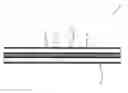
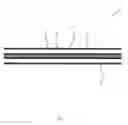
BRIEF DESCRIPTION OF THE DRAWINGFIG. 1 is a cross-sectional view of the composite paper of the current application.
FIG. 2 is a photograph of a surface of a conventional card paper, 0.3 mm thickness, embroidered with threads.
FIG. 3 is a photograph of a surface of an embroidered composite paper, 0.3 mm thickness, of the current application.
FIG. 4 is a surface of a card having a surface decorated with embroidery, printing, and embossing on a same surface.
DETAILED DESCRIPTION OF PREFERRED EMBODIMENTFIG. 1 is a cross-sectional view of the composite paper (1) of the current application. The composite paper (1) comprised of a top layer (2) of printable paper of color copy paper from Corporate Office product number 1058A, a middle layer (3) of machine cut non-woven polyester felt, coated with anhydrous thermoplastic glue (3-1), from Kunin Rainbow™, and a bottom layer (4) of the same copy paper used for the top layer (2). The three layers of materials are overlapped and pressed up to 1.5 atm at 150° C. for 5 sec to form a composite paper. The plastic glue on the non-woven polyester felt adheres the felt and the papers on both sides strongly. The polyester felt structure renders tear resistance to the adhered papers on both sides thereof.
The strong point of the composite paper of the current application is that embroidering thereon is as easy as conventional fabrics.
FIG. 2 is a photograph of a conventional card paper of 0.3 mm thickness embroidered with threads. For comparison, the number ‘11’ was threaded on a conventional card paper. The photograph of FIG. 2 was taken by placing the conventional card paper, embroidered, on a light source of electric lamp. As shown in the photograph, white spaces are developed along the brim of the embroidery, the number ‘11’. Those white spaces are developed by the light from the electric lamp placed behind of the conventional card paper embroidered. The conventional card paper is easily torn out by the puncturing force of a sewing machine's needle. It is very hard to hold the embroidery on the paper due to the torn-outs, white parts, developed along the embroidery.
FIG. 3 is a photograph of a surface of an embroidered composite paper (1), 0.3 mm thickness, of the current application. Size of the needle, the speed of sewing, and number of puncture per centimeter are the same for both of the FIGS. 2 and 3. Photograph of FIG. 3 was taken by the same method as the FIG. 2. But, no torn-outs, white spaces that are observed in FIG. 2, are found along the embroidery on the composite paper (1) of the current application. Printing, foil coating, embossing are applied on the same surface of the top layer (2), which is already embroidered.
FIG. 4 is a surface of a card (5) having a surface decorated with embroidery (6), printing (7), foil coating (8) and embossing (9) on a same surface (10). As shown in the FIG. 4, the composite paper (1) of the current application is applied to an embroidery card, envelop, packaging bag, notebook cover page, book binder, etc. Continuous production of the composite paper of the current application is easily imaginable for experienced personnel of this field of endeavor.
Claims
What is claimed is:1. A composite paper for embroidering, printing, foil coating and embossing on a same surface is comprised of:
a top layer of printable paper of color copy paper, and
a middle layer of machine cut non-woven polyester felt coated with anhydrous thermoplastic glue, and
a bottom layer of the same copy paper used for the top layer.
2. A composite paper for embroidering, printing, foil coating and embossing on a same surface of claim 1, wherein the top layer material of printable paper of color copy paper from Corporate Office product number 1058A, the middle layer material of machine cut non-woven polyester felt from Kunin Rainbow™ that is coated with anhydrous thermoplastic glue, and the bottom material of printable paper of color copy paper from Corporate Office product number 1058A are overlapped and pressed up to 1.5 atm at 150° C. for 5 sec to form a composite paper.
Images & Drawings included:


Sources:
- United States Patent and Trademark Office - verify current appl. status at the USPTO↗
Recent applications in this class:
- » 20250019880 2025-01-16
LIGHT-REFLECTIVE PATTERN - » 20240368814 2024-11-07
METHOD OF IMBEDDING FIBERS INTO A TEXTILE - » 20240247420 2024-07-25
TEXTILE COMPONENT WITH EMBROIDERED EMBLEM - » 20230160120 2023-05-25
Textile component with embroidered emblem - » 20230070422 2023-03-09
ARTICLE WITH INTEGRAL LOOPS AND METHOD OF MANUFACTURING - » 20220316121 2022-10-06
Emblem Member - » 20220090306 2022-03-24
EMBROIDERED LEATHER PATCHES - » 20210102323 2021-04-08
Article with integral loops and method of manufacturing - » 20200318276 2020-10-08
ARTICLES AND DESIGNS WITH NEEDLEPOINT AND OTHER INTERCHANGEABLE INSERT ELEMENTS - » 20200115835 2020-04-16
Embroidered article