Circuit for supplying oxygen to aircraft passengers
US20070144597A1
2007-06-28
10/565,712
2004-07-21
✅ Patent granted
US 9,272,786 B2
2016-03-01
WO; PCT/FR2004/050348; 20040721
WO; WO2005/016750; 20050224
John Fox
Christopher J. Cronin
2029-07-17
Abstract:
The invention relates to a circuit for supplying oxygen to aircraft passengers. According to the invention, the line (5) used to supply pressurised oxygen to the passenger masks (6) comprises a motorised pressure regulator (8) which can be actuated in response to a pressure control signal (10) provided by an electronic control unit (9) according to a signal (11) that is representative of the cabin pressure (12).
Inventors:
- Jean-Michel CAZENAVE 9 🇫🇷 Seyssins, France
- Stephane Lessi 4 🇺🇸 Newark, DE, United States
- Nicolas Schmutz 2 🇫🇷 Paris, France
- Jean Dehayes 2 🇫🇷 Lumbin, France
- Didier Gaget 2 🇫🇷 Sassenage, France
Assignee:
- L'AIR LIQUIDE, SOCIETE ANONYME A DIRECTOIRE ET CONSEIL DE SURVEILLANCE POUR L'ETUDE 1 🇫🇷 Paris Cedex, France
- L'Air Liquide, Société Anonyme pour l'Étude et l'Exploitation des Procédés Georges Claude 92 🇫🇷 Paris, France
Applicant:
Interested in similar patents?
Get notified when new applications in this technology area are published.
Classification:
Y02T50/40 » CPC further
Aeronautics or air transport Weight reduction
Y02T50/40 » CPC further
Aeronautics or air transport Weight reduction
A01G25/09 IPC
Watering gardens, fields, sports grounds or the like Watering arrangements making use of movable installations on wheels or the like
B64D11/00 » CPC main
Passenger or crew accommodation; Flight-deck installations not otherwise provided for
B64D25/00 » CPC further
Emergency apparatus or devices, not otherwise provided for
A62B7/14 » CPC further
Respiratory apparatus for high-altitude aircraft
B64D2231/02 » CPC further
Emergency oxygen systems Supply or distribution systems
Y10T137/6906 » CPC further
Fluid handling; With casing, support, protector or static constructional installations; Vehicle Aerial or water-supported [e.g., airplane or ship, etc.]
Description
The present invention relates to circuits for supplying oxygen to aircraft passengers in case of cabin decompression.
Aeronautics regulations (for example FAR) require, in commercial aircraft, the presence of an emergency oxygen system for passengers that can deliver a predetermined pure oxygen flow to each passenger according to the altitude of the aircraft in case of accidental cabin decompression.
Currently available systems use a calibrated hole determining the oxygen flow rate supplied to the passenger mask, a pneumatic pressure reducer, sensitive to the ambient pressure, regulating the oxygen pressure upstream of the calibrated orifices.
These purely pneumatic systems have poor accuracy and response times, giving rise to the supply of oxygen with a flow rate higher than the minimum regulation flow rate required, entailing the need to carry oversized oxygen tanks, which affect the commercial performance of the aircraft.
Moreover, these systems, which require many pipes and fittings., are sources of potential leaks, and demand lengthy and difficult maintenance operations.
It is the object of the present invention to propose a simple, efficient circuit for supplying oxygen, eliminating most of the above drawbacks, in particular concerning the load carried, and offering greater safety.
For this purpose, according to one feature of the invention, the circuit comprises, in a line supplying oxygen connected to a pressurized oxygen source, a servocontrolled pressure regulator that can be actuated in response to a pressure control signal supplied by an electronic control unit.
According to a more particular feature of the invention:
-
- the circuit comprises a cabin pressure sensor delivering an absolute pressure signal to the electronic control unit for the generation of the control signal of the regulator.
Other features and advantages of the invention will appear from the following description of one embodiment, provided for illustration but nonlimiting, in relation to the appended drawing, in which:
-
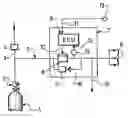
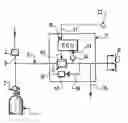
- the single figure shows schematically an oxygen supply circuit according to the invention.
The single figure shows a pressurized oxygen tank, in this case, a cylinder 1 containing oxygen under a nominal pressure of between 120 and 200 bar, provided with a pressure reducer 2 delivering oxygen at a gage pressure of typically between 5 and 8 bar to a line 3, comprising a pressure regulator 4, for supplying oxygen to the crew, and at least to a line 5 supplying oxygen to the masks 6 of the cabin passengers.
According to one aspect of the invention, a regulation unit 7 is inserted into the line 5, essentially comprising a servocontrolled solenoid valve 8, controlled, according to external parameters, by an electronic control unit 9.
More precisely, the servocontrolled valve 8 is advantageously of the type of that described in document EP-A-499 505 (Arnault/Zapata), in the name of the Applicant, of which the content is incorporated here for reference, capable of regulating the pressure downstream of the line 5 by following a setpoint signal 10 generated by the electronic control unit 9 particularly according to a cabin pressure signal 11 provided by an absolute pressure sensor 12, and also a regulated pressure signal 13 provided by a pressure sensor 14 in the line 5 downstream of the regulator 8.
Advantageously, the valve 8 can be locked at least temporarily in the closed position, automatically and/or manually, isolating the passenger circuit to the masks 6 in order to assign oxygen supply priority from the cylinder 2 to the crew line 3.
Depending on the choice of the aircraft manufacturer and/or operator, the electronic control unit 9 can also trigger the opening of the boxes of the passenger masks 6. Similarly, a connection 15 can be provided downstream of the regulator 8 for independently supplying oxygen to an onboard oxygen therapy system, particularly to assist patients with breathing problems.
In the embodiment shown in the figure, the unit 7 comprises a bypass line 16 provided with a safety solenoid valve 17 for shortcircuiting the regulator 8 in case of failure thereof.
As previously mentioned, the system according to the invention permits the accurate monitoring of the minimum flow rates imposed by the regulatory standards, according to the various altitudes reached by the aircraft, thereby avoiding systematic oxygen overconsumption and hence allowing the size or number of the oxygen cylinders 1, and hence their weight, to be reduced.
The system according to the invention serves to reduce the number and length of the oxygen pipes, and hence the risk of leaks, particularly in the cabin, while moreover facilitating their accommodation in the fuselage structures.
Since the connections. between the sensors, the electronic control units and the regulator 8 are exclusively electrical, their monitoring and tracking are considerably easier, thereby avoiding arduous maintenance operations and particularly regular disassembly.
Although the invention has been described in relation to particular embodiments, it is not limited thereto but susceptible to modifications and variants that will appear to a person skilled in the art in the context of the claims below.
Claims
1-5. (canceled)
6: A circuit for supplying oxygen to aircraft passengers, comprising, in a line supplying oxygen connected to a pressurized oxygen source, a servocontrolled pressure regulator that can be actuated in response to a pressure control signal supplied by an electronic control unit. cm 7: The circuit as claimed in claim 6, characterized in that it comprises a cabin pressure sensor delivering an absolute pressure signal to the electronic control unit for the generation of said control signal of the regulator.
8: The circuit as claimed in claim 6, characterized in that it comprises a line bypassing the regulator and provided with a safety solenoid valve.
9: The circuit as claimed in claim 6, characterized in that the oxygen supply line comprises a downstream connection to an oxygen therapy system.
10: The circuit as claimed in claim 6, characterized in that the oxygen source comprises at least one pressurized oxygen cylinder.
Images & Drawings included:
Sources:
- United States Patent and Trademark Office - verify current appl. status at the USPTO↗
Similar patent applications:
- » 20090277449
RESPIRATORY GAS SUPPLY CIRCUIT TO FEED CREW MEMBERS AND PASSENGERS OF AN AIRCRAFT WITH OXYGEN - » 20090301489
RESPIRATORY GAS SUPPLY CIRCUIT TO FEED CREW MEMBERS AND PASSENGERS OF AN AIRCRAFT WITH OXYGEN - » 20100065056
Arespiratory gas supply circuit to feed crew members and passengers of an aircraft with oxygen
Recent applications in this class:
- » 20250256846 2025-08-14
CABIN SECTION OF A PASSENGER CABIN OF A PASSENGER AIRCRAFT HAVING A BED SUPPORTED AGAINST A FLIGHT ATTENDANT SEAT - » 20250250007 2025-08-07
EMERGENCY EGRESS IN A BLENDED WING BODY AIRCRAFT - » 20250242913 2025-07-31
ECONOMICAL SOLUTION FOR INFLIGHT MEDICAL EMERGENCIES AND SLEEPING NEEDS - » 20250236390 2025-07-24
Aircraft Side Ledge Table Deployment System - » 20250229896 2025-07-17
VIRTUAL WINDOW SYSTEMS AND METHODS - » 20250171150 2025-05-29
Passenger Service Unit Passenger Assist Apparatus - » 20250145291 2025-05-08
AIRCRAFT MONUMENT - » 20250115355 2025-04-10
SYSTEMS AND METHODS FOR PRINTING ON A SUBSTRATE - » 20250108920 2025-04-03
INTERIOR AIRCRAFT LIGHTING ASSEMBLY, AIRCRAFT PASSENGER SERVICE UNIT WITH AN INTERIOR AIRCRAFT LIGHTING ASSEMBLY, AND METHOD OF OPERATING AN INTERIOR AIRCRAFT LIGHTING ASSEMBLY - » 20250100683 2025-03-27
SMART WINDOW SYSTEM
Recent applications for this Assignee:
- » 20200318744 2020-10-08
Valve and reservoir(s) for pressurized fluid - » 20160313058 2016-10-27
Process and apparatus for separating NOfrom a COand NO-containing fluid - » 20160184769 2016-06-30
Three stage membrane separation with partial reflux - » 20160169449 2016-06-16
Gas filling method and station - » 20160153615 2016-06-02
Station and method for filling gas tanks - » 20160137568 2016-05-19
Process for producing fatty alcohols from fatty acid methyl ester - » 20160047546 2016-02-18
Burner assembly and method of combustion - » 20160023194 2016-01-28
Method of treatment for a catalytic reactor - » 20150353450 2015-12-10
Process and plant for the production of olefins - » 20150353406 2015-12-10
Energy recovery from fumes from a melting furnace using a gas turbine and heat exchangers