Bicycle frame composed with convoluted curves
US20070145710A1
2007-06-28
11/593,943
2006-11-08
✅ Patent granted
US 7,862,063 B2
2011-01-04
-
-
Kevin Hurley
2028-10-30
Abstract:
The invention is a frame for a bicycle or other two wheeled vehicle that utilizes convoluted curves in its structure providing function in utility and manufacture as described here with this disclosure, as well as ornamental form as described by the subject complementing disclosure by design patent application number 29/243,986. The specific utility that is offered by this invention is a suspension quality inherent to the frame itself. The frame serves as a suspension system isolating the vehicle rider from the displacements of the vehicle wheels forced by the irregularities that may exist in a road over which the vehicle may travel. The specific quality of manufacture offered by this invention is a frame that avoids the necessity of tubes and tube joints, and likewise the otherwise necessary welding or fusion of such tube joints.
Inventors:
- Maria Susan Stumm 1 🇺🇸 Hampton, VA, United States
- Robert Ernest Stumm 1 🇺🇸 Hampton, VA, United States
Interested in similar patents?
Get notified when new applications in this technology area are published.
Classification:
B62K3/04 » CPC main
Bicycles; Frames having a substantially horizontal top bar
B62K25/04 » CPC further
Axle suspensions for mounting axles resiliently on cycle frame or fork
B62K2025/041 » CPC further
Axle suspensions for mounting axles resiliently on cycle frame or fork the cycle frame being made of a flexible material
B62K9/00 IPC
Children's cycles
B62K19/04 IPC
Cycle frames characterised by material or cross-section of frame members the material being wholly or mainly metallic, e.g. of high elasticity
Description
The following applications relate to the invention claimed herein:
-
- Provisional Patent, Application No. 60,742,167; Bicycle Frame Composed with Convoluted Curves, Filed Dec. 5, 2005 by Maria Stumm et. al.
- Design Patent, Application Number 29/243,986, Group Number 2911, Filed Dec. 5, 2005 by Maria Stumm et. al. Examiner: Linda Brooks.
The invention claimed herein was first disclosed by the cited patent applications. The cited provisional patent discloses the utility offered by the art like that of the ornamental form disclosed by the cited design patent application.
BACKGROUND Prior ArtMuch prior art exists that aims at reducing the vibrations of a bicycle and its rider caused by transversing over road irregularities. Mitigating vibrations induced by the road permits faster travelling speed and reduces material fatigue in addition to providing for rider comfort. This mitigation is hence fundamental to smart bicycle design.
Racing type road bicycles intended for use on smooth road surfaces where major pavement irregularities do not much exist, isolation from road vibrations is significantly provided for by gel or foam within the rider's clothing. These bicycles may also incorporate carbon fiber as a damping material in their front wheel forks and in all or part of their frames that also absorb road vibrations. Curved seat stays are sometimes incorporated into the bicycle frame to provide further vibration absorbing flexibility. The amount of road irregularity that may be absorbed by the means just described is limited to those of relatively high frequency and small amplitude. This limitation not withstanding as they are meant to be ridden on smooth roads, racing type road bicycles are fitted with light, small tube diameter, and hard highly pressurized tires for minimum rotating inertia and minimum rolling resistance to achieve high speed. Bicycles intended for somewhat more irregular then smooth road surfaces are often fitted with heavier, larger tube diameter, and softer less pressurized tires to absorb the greater road vibrations.
-
- Lund in U.S. Pat. No. 6,702,399 describes an open ended cylindrical shock absorber housing mounted concentrically within a wheel hub for absorbing road vibrations at the wheels.
The ability to absorb vibrations of lower frequency and greater amplitude by these means about the wheels comes at the expense of greater rotating inertia and rolling resistance. Vehicle speed is compromised.
- Lund in U.S. Pat. No. 6,702,399 describes an open ended cylindrical shock absorber housing mounted concentrically within a wheel hub for absorbing road vibrations at the wheels.
Road vibration transmission to the rider is also addressed with various types of seat suspensions as exemplified:
-
- Wang in U.S. Pat. No. 6,176,476 describes a the suspension seat post.
- Sinyard in U.S. Pat. No. 6,848,701 describes a bicycle seat post assembly having a cavity in which vibration damping material is placed.
- Allsop in U.S. Pat. No. 5,415,423 describes a bicycle seat suspended off a cantilever beam used a spring to provide the vibration isolating effect.
These means effectively isolate the majority of the weight in travel which exists as the vehicle rider himself The bicycle may be fitted with respective lighter, smaller tube diameter and harder higher pressure tires to achieve faster speeds. Vibration isolation at the seat post however does not provide isolation to the bicycle itself which resides below the seat post. The bicycle and also a portion of the rider through his legs are still subjected to the stress of road vibration. Also, quality seat posts that can effectively absorb low frequency higher amplitude vibrations can be complex in manufacture and costly to assemble.
Suspension systems utilizing coiled springs and shock absorber components are incorporated into bicycles such as of the mountain bike type to accommodate the low frequency high amplitude deflections that are found in off road terrain:
-
- Schmider in U.S. Pat. No. 7,104,562 describes a rear wheel suspension for a bicycle having a swing arm holding the rear wheel with a shock absorbing element connected between the swing arm and the frame.
- Soucek in U.S. Pat. No. 7,066,481 describes a bicycle rear suspension with pivoting upper and lower links connected to both a front frame and a fear frame member with a shock absorber providing the vibration damping effect.
- Chamberlain in U.S. Pat. No. 7,059,620 describes a bicycle frame assembly composed of a main frame and a sub frame with a shock absorber in between.
These are examples of bicycle designs of the type incorporating what is commonly known as active suspension systems. Such active suspension systems dictate heavy and complex bicycle frame designs. Their use is usually intended for rough terrain where speed like of a road bike is not expected.
Art exists that incorporates significant spring and damping qualities into the bicycle frame itself:
-
- Raco in U.S. Pat. No. 6,659,487?? describes a flexible bike frame that uses a shock absorber as a frame member and a plurality of flexible joints throughout the remainder of the frame.
- Castellano in U.S. Pat. No. 6,406,048 describes a pivotless rear suspension system for bicycles utilizing a planer truss chain stay member with a wide lateral side and a thin verticle side so as to be laterally rigid and vertically flexible in conjunction with a seat stay member composed with a shock absorber.
Art also exists that moves away from the use of active shock absorber components by integrating spring and damping qualities directly into the passive members of the frame:
-
- Kirk in U.S. Pat. No. 6,109,637 moves away from active shock absorber components by describing an elastomeric damper affixed to well curved seat stays for enhanced vibration absorption.
- Schober in U.S. Design Patent D520411 displays an ornamental bicycle suspension member that replaces the chain and seat of a common bicycle frame with a one piece formed chain and seat stay member that can be made of flexible plastic material.
- Peraz in U.S. Pat. No. 6,932,371 describes a bicycle frame with a rear passive suspension configured to elastically deflect in the vertical direction while maintaining rigidity in other directions. The frame utilizes a pair of upper chain stays that control rear wheel motion while removing the seat stays found on common bicycles.
Art of this type appears for bicycles envisioned to absorb road vibrations greater then afforded by those of the road racing type albeit not as great as that of bicycles with active suspension systems designed for off road terrain. The vibrations desired to be absorbed appear of the frequency and amplitude encountered when transversing many city streets. The limitation that exist in this type of art comes from the materials of the frame members, but also from the frame member's lengths as dictated by common bicycle frame forms.
The present invention pertains to the type of art that integrates spring and damping qualities directly into the bicycle frame itself Like the prior art of this type described, the invention moves away from the use of active shock absorber components, but overcomes the limits of the prior art, distinguishes itself from the prior art in general, and distinguishes itself the patents referenced in particular, by making the entire frame an active spring manifested as an elegant novel form of convoluted curves that have substantially more length then frame members of bicycle forms of the prior art. The result is greater frame flexibility and thus a greater ability to absorb road vibrations of lower frequency and greater amplitude. Bicycles incorporating the present invention may be fitted with lighter, smaller tube diameter, and harder higher pressure tires allowing for faster practical speeds in city commutes.
The present invention also offers application to two wheeled motorized vehicles like mopeds and motorcycles in that an engine can easily be situated within the form. Hence the present invention is referred to as being a two wheeled vehicle frame.
The invention is a frame for a bicycle or other two wheeled vehicle that utilizes convoluted curves in its structure providing function in utility and manufacture as described here with this disclosure, as well as ornamental form as described by the subject complementing disclosure by design patent application number 29/243,986. The specific utility that is offered by this invention is a suspension quality inherent to the frame itself. The frame serves as a suspension system isolating the vehicle rider from the displacements of the vehicle wheels forced by the irregularities that may exist in a road over which the vehicle may travel. The specific quality of manufacture offered by this invention is a frame that avoids the necessity of tubes and tube joints, and likewise the otherwise necessary welding or fusion of such tube joints.
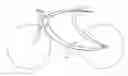
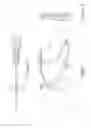
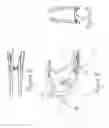
BRIEF DESCRIPTION OF THE DRAWINGS(1) The design of the frame is shown as three embodiments as FIGS. 1 through 9. FIGS. 1 through 3 present the first embodiment. An arrangement of curved frame members convoluting upon one another form a frame having a spring quality also configured to hold bicycle or other vehicle components, like seat, wheel forks, handlebar arrangement for steering, and pedal crank. The vehicle components are shown in broken lines on the figures and do not form part of the claimed invention.
(2) FIG. 1 is a left hand elevation of the first embodiment.
(3) FIG. 2 is a top elevation of the first embodiment.
(4) FIG. 3 is a back elevation of the first embodiment.
(5) FIGS. 4 through 6 show a second embodiment having the same fundamental qualities as the first embodiment. The basic convoluted curve design is cast as two frame halves that are then brought together to form the total frame. The vehicle components are shown in broken lines on the figures and do not form part of the claimed invention.
(6) FIG. 4 is a left hand elevation of the second embodiment.
(7) FIG. 5 is a back elevation of the second embodiment.
(8) FIG. 6 is a top elevation of the second embodiment.
(9) FIGS. 7 through 9 show yet a third embodiment being like the second embodiment described, but with the frame halves set further apart and an engine with an accompanying fuel tank situated within it as may be used in a moped or motorcycle application. This embodiment includes a rigid chain stay with one end pivoted to the engine, and the other end pivoted to the rear wheel attachment that assures chain tension while the rest of the frame is flexing. The engine and other vehicle components shown in broken lines do not form part of the claimed invention.
(10) FIG. 10 shows components of spring material strips and binding spacers arranged in a set of fore and aft convoluted curves that when all brought together make the claimed invention.
DESCRIPTION OF THE INVENTION(11) The invention is a frame for a bicycle or other two wheeled vehicle that utilizes convoluted curves in its structure providing function in utility and manufacture described here with this disclosure as well as ornamental form as described by the subject disclosure for a design patent application. The invention distinguishes itself from prior art by its frame in its entirety being an active spring manifested as an elegant novel form of convoluted curves that have substantially more length then frame members of bicycle forms of the prior art providing spring and vibration damping quality.
(12) In all three embodiments shown by the respective drawings, the frame consists of curved strips of metal, or molded plastic and fiber composite material that together produce a suspension effect. The curves have generally large radii and thus the frame may be analyzed as an arrangement of cantilever beams to establish the frame's stress and deflection characteristics. The curved strips of metal or plastic and fiber composite material are grouped and bound together like shown in FIG. 10 to increase inertia and thus stiffness of the frame. As an example, in FIG. 10, parts (1a), (1b), (1c), & (1d) are spring material strips and parts (2a), (2b), (2c), (2d), & (2e) are spacers that tie the strips together. The volume between the spring strips may be filled with a binding plastic material. The plastic material serves to dampen the spring effect to the frame as well as acting as a separator between the spring strips with or without the spacers. By adjusting the size and the placement of the spacers thus changing the frame's inertia, stiffness, or geometric proportions, the frame may be tuned to the rider's weight and physique.
(13) With the flexing of the frame when forming part of a bicycle, the relative distance from where the pedal sprocket is attached to where the rear wheel is attached changes. Tension on the chain running across the pedal sprocket and the sprocket of the rear wheel is maintained while the frame flexes by the bicycle's derailleur system on the rear wheel. In the case when the frame forms part of a motorcycle where a chain deraileur system or some belt tensioning system does not exist, chain tension is maintained by a rigid chain stay (3) like shown in FIG. 7 that maintains a fixed relative distance between the two sprockets. The chain stay (3) is pivoted to the engine on one end, and on the other end is pivoted to the rear wheel attachment.
(14) The frame may be constructed using strips of suitable steel, aluminum, or plastic and fiber composite material. The frame hence is not constructed of tubing, and thus has no tubular joints. Welding or fusion of tubular joints otherwise commonly done in bicycle frame construction is avoided. Manufacture is thus simplified. The frame can be substantially assembled with fasteners.
(15) The frame may also be constructed of plastic and fiber composite material, and thus can be formed by pouring or injecting the material into a mold.
(16) This invention has been developed independent of any federally sponsored research or development.
Claims
What is claimed is:1.) a two wheeled vehicle frame;
comprised of metal composite material or other suitable spring material strips, bent into convoluted curves and held in shape with spacers, placed between the vehicle's rider seat, the steering fork of the vehicle's front wheel, and rear wheel, as a frame to which ancillary vehicle components are attached acting as a spring that mitigates the transmission of deflections of the wheels.
2.) a two wheeled vehicle frame;
comprised of plastic material poured or injected into a mold having the shape of convoluted curves placed between the vehicle's rider seat, the steering fork of the vehicle's front wheel, and rear wheel, as a frame to which ancillary vehicle components are attached acting as a spring that mitigates the transmission of deflections of the wheels.
Images & Drawings included:


Sources:
- United States Patent and Trademark Office - verify current appl. status at the USPTO↗
Recent applications in this class:
- » 20240336323 2024-10-10
REAR TRIANGLE OF A TUBULAR BICYCLE FRAME - » 20230257054 2023-08-17
BICYCLE FRAME WITH CANTILEVERED SEATMAST AND SEATPOST SECURING ASSEMBLY - » 20230076224 2023-03-09
VEHICLE BODY FOR TWO-WHEELED VEHICLE, TWO-WHEELED VEHICLE, AND SHOCK ABSORBER FOR SAME - » 20180009499 2018-01-11
Bicycle Frame - » 20140084564 2014-03-27
Universal frame for electric bikes and human powered bicycles - » 20140049022 2014-02-20
ADJUSTABLE AND EXTENSIBLE BICYCLE FRAME - » 20120261896 2012-10-18
Modular trailing edge for bicycle stem - » 20120112429 2012-05-10
Detachable Top Tube Apparatus for a Bicycle - » 20120013099 2012-01-19
COMBINATION OF A SHOE, A FRAME AND A PEDAL FOR RACING BICYCLES - » 20110198823 2011-08-18
Airfoil shape for bicycle