Iron set
US20070149305A1
2007-06-28
11/645,741
2006-12-27
✅ Patent granted
US 7,442,130 B2
2008-10-28
-
-
Stephen L. Blau
2026-12-27
Abstract:
An iron set has plural iron golf clubs, in which loft angles of heads are larger as the number is increased, each golf club including the head having a sole that includes a front sole on a front side and a rear sole adjacent to the front sole. A bounce angle θ2 of the rear sole is smaller than a bounce angle θ1 of the front sole, and a width L2 of the rear sole in a front-rear direction is greater than or equal to a width L1 of the front sole in the front-rear direction. The width L1 is from 5 to 12 mm in any of the golf clubs, the bounce angle of the front sole for the number n club is greater than or equal to the bounce angle of the front sole for the number (n-1) club and greater than the bounce angle of the front sole for the number (n-2) club.
Inventors:
- Wataru BAN 71 🇯🇵 Chichibu-shi, Japan
- Koki Motoyoshi 1 🇯🇵 Minamiooi, Japan
- Wataru Ban 52 🇯🇵 Chichibu, Japan
Assignee:
- BRIDGESTONE SPORTS CO., LTD. 1,089 🇯🇵 Tokyo, Japan
- BRIDGESTONE SPORTS CO., LTD. 22 🇯🇵 Shinagawa-ku, Japan
Interested in similar patents?
Get notified when new applications in this technology area are published.
Classification:
A63B53/047 » CPC further
Golf clubs; Heads iron-type
A63B60/00 » CPC further
Details or accessories of golf clubs, bats, rackets or the like
A63B53/005 » CPC further
Golf clubs Club sets
A63B53/0408 » CPC further
Golf clubs; Heads characterised by specific dimensions, e.g. thickness
A63B53/0433 » CPC further
Golf clubs; Heads with special sole configurations
A63B53/00 » CPC main
Golf clubs
Description
BACKGROUND OF THE INVENTION1. Field of the Invention
The present invention relates to an iron set composed of a plurality of irons (iron golf clubs) of different numbers, and more particularly to an iron set, in which a sole of each iron has a front sole with a relatively large bounce angle and a rear sole with a relatively small bounce angle and a width of the rear sole in a front-rear direction is greater than or equal to a width of the front sole in the front-rear direction.
2. Description of the Related Art
JP-A-8-257179 discloses an iron set, in which a sole of each iron has a front sole with a relatively large bounce angle and a rear sole with a relatively small bounce angle, and a width of the rear sole in the front rear direction is greater than or equal to a width of the front sole in the front-rear direction. In FIG. 3 and Table 1 of this publication, it is described that the number 1 to 3 irons have a bounce angle of 20° on the front sole and a width of 3.1 mm (0.123 inches), the number 4 to 7 irons have a bounce angle of 25° on the front sole and a width of 3.9 mm (0.154 inches), and the number 8 and 9 irons have a bounce angle of 30° on the front sole and a width of 3.9 mm, and the number 1 to 8 irons have a width of 12.4 mm (0.487 inches) on the rear sole.
SUMMARY OF THE INVENTIONThe iron disclosed in JP-A-8-257179 is designed so as not to dig the ground in hitting the ball.
An object of the present invention is to provide an iron set in which any of irons ranging from a small number iron to a large number iron has less resistance received from the lawn surface in the golf course and can be swung smoothly, and is more adaptable to every person who has any swing type and head speed.
According to a first aspect of the invention, there is provided an iron set comprising: a plurality of iron golf clubs, in which loft angles of heads are larger as the number is increased, each golf club including the head having a sole that includes a front sole on a front side and a rear sole adjacent to the front sole, wherein a bounce angle θ2 of the rear sole smaller than a bounce angle θ1 of the front sole, and a width L2 of the rear sole in a front-rear direction is greater than or equal to a width L1 of the front sole in the front-rear direction, and the width L1 is from 5 to 12 mm in any of the golf clubs, the bounce angle of the front sole for the number n club is greater than or equal to the bounce angle of the front sole for the number (n-1) club and greater than the bounce angle of the front sole for the number (n-2) club.
According to a second aspect of the invention, the bounce angle of the rear sole for the number n club is greater than or equal to the bounce angle of the rear sole for the number (n-1) club and greater than the bounce angle of the rear sole for the number (n-2) club.
According to a third aspect of the invention, the bounce angle of the front sole for the number six iron is from 6 to 9°, and the bounce angle of the rear sole is from 2 to 5°.
In the iron set, the bounce angle of the front sole is almost constantly increased as the number is increased. That is, the clubs differing by one club number have the same bounce angle or the club with larger number has a larger bounce angle of the front sole. Also, of the clubs differing by two club number, the club with larger number necessarily has the larger bounce angle of the front sole. In this way, the bounce angle of the front sole is set to be necessarily larger for the club with larger number, whereby the same swing feeling (swing sense) can be acquired for each number.
For not only the front sole but also the rear sole, the club with larger number has an almost larger bounce angle. That is, the clubs differing by one club number may have the same bounce angle of the rear sole, but of the clubs differing by two club number, the club with larger number necessarily has the larger bounce angle, whereby the swing sense is similar for each number.
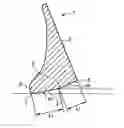
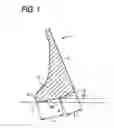
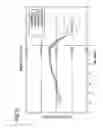
BRIEF DESCRIPTION OF THE DRAWINGSFIG. 1 is a cross-sectional view of a head according to an embodiment of the present invention;
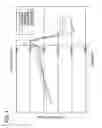
FIG. 2 is a trajectory diagram of the head by subjects;
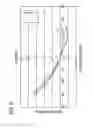
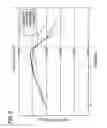
FIG. 3 is a diagram of the head speed by the subjects;
FIG. 4 is a diagram of the head speed by the subjects;
FIG. 5 is a diagram of the head speed by the subjects; and
FIG. 6 is a diagram of the head speed by the subjects.
DETAILED DESCRIPTION OF THE PREFERRED EMBODIMENTSEmbodiments of the present invention will be described below with reference to the drawings. FIG. 1 is a longitudinal cross-sectional view, taken along a direction orthogonal to a face, showing one example of an iron head for an iron set according to an embodiment of the invention. A front face of this head 1 is a face 2 for hitting the ball. The face 2 is provided with a plurality of parallel grooves (score lines) extending in a toe-heel direction of the head. The length of each score line is identical, and each score line is aligned at both ends. The center of the score line in a longitudinal direction is the center of the face in the toe-heel direction.
FIG. 1 is a longitudinal cross-sectional view taken through the center in the toe-heel direction. The bounce angle and the width of a front sole and a rear sole refer to the bounce angle and the width on the longitudinal cross-section passing through the center in the toe-heel direction. The bounce angle is measured in a state where the club is normally soled on the horizontal plane. Normally soled means a state where the score line is horizontal, and when the vertical plane parallel to that including the score line and passing though a hosel is supposed, a club shaft is included within this vertical plane.
The sole of the head 1 comprises a front sole 3 on the face side, and a rear sole 4 on the back side adjacent to the front sole 3.
The bounce angle θ1 and the width L1 of the front sole 3 and the bounce angle θ2 and the width L2 of the rear sole are shown in the figure.
In FIG. 1, the front sole 3 and the rear sole 4 are planar, and an intersection portion between both forms a peaked, convex portion 5, but this convex portion 5 may be roundish. In the later case, supposing that the point at which the imaginary planes extending from the front sole 3 and the rear sole 4 intersect is the intersection portion of the front sole 3 and the rear sole 4, the widths L1 and L2 are measured.
L1 is the distance from the convex portion 5 or the intersection portion to the face 2.
A leading edge that is the intersection portion between the front sole 3 and the face may be roundish or obliquely faceted, in which the width of the front sole 3 is measured as the distance from the convex portion 5 or the intersection portion to the face 2.
In FIG. 1, a rear edge 7 where the rear sole 4 and a head rear face 6 are crossed also forms a convex portion. L2 is measured as the distance from the rear edge to the convex portion 5 or the intersection portion. However, the rear edge 7 may be roundish or obliquely faceted. In this case, L2 is the distance from the imaginary plane parallel to the face and passing through the trailing edge of the head to the convex portion 5 or the intersection portion.
The iron set may include the number 3 to number 10 irons (pitching wedge), the number 4 or 5 to number 10 irons, or the number 6 to number 10 irons. Of course, the iron set may include the number 11 iron (usually called a pitching or approach wedge) or a sand wedge (number 12 iron in this embodiment), and a lob wedge (number 13 iron). Also, the iron set may include the number 2 iron or number 1 iron.
The bounce angle θ1 of the front sole for the number n iron is greater than or equal to the bounce angle θ1 of the front sole for the number (n-1) club, and greater than the bounce angle θ1 of the front sole for the number (n-2) club. Preferably, the bounce angle θ2 of the rear sole for the number n iron is greater than or equal to the bounce angle θ2 of the rear sole for the number (n-1) club, and greater than the bounce angle θ2 of the rear sole for the number (n-2) club.
For the number 3 iron, it is preferred that θ1 is from 5 to 8°, and θ2 is from 2 to 4°. For the number 6 iron, it is preferred that θ1 is from 6 to 9°, and θ2 is from 2 to 5°. For the number 9 iron, it is preferred that θ1 is from 8 to 10°, and θ2 is from 4 to 7°. In any of the clubs, it is preferred that (θ1-θ2) is from 2 to 7°, particularly from 3 to 6°.
The width L2 of the rear sole is greater than the width L1 of the front sole in any of the clubs. Preferably, L2 is one to twice L1, particularly one to 1.5 times. In any of the clubs, L1 is from 5 to 12 mm. In the case of the number 3 iron, it is preferred that L1 is from 5 to 9 mm, particularly from 6 to 8 mm. In the case of the number 6 iron, it is preferred that LI is from 6 to 10 mm, particularly from 7 to 9 mm. In the case of the number 9 iron, it is preferred that L1 is from 8 to 12 mm, particularly from 9 to 11 mm.
Preferably, L1 of the number n iron is greater than or equal to L1 of the number (n-1) iron, and greater than L1 of the number (n-2) iron. Also, preferably, L2 of the number n iron is greater than or equal to L2 of the number (n-1) iron, and greater than L2 of the number (n-2) iron.
Preferable examples of L1, θ1, L2 and θ2 are shown in Table 1 below.
| TABLE 1 | ||||
| L1 | θ1 | L2 | θ2 | |
| Number | (mm) | (°) | (mm) | (°) |
| 3 | 7 | 5 | 8 | 2 |
| 4 | 7 | 6 | 9 | 2 |
| 5 | 8 | 6 | 9 | 3 |
| 6 | 8 | 7 | 9 | 3 |
| 7 | 9 | 7 | 10 | 4 |
| 8 | 9 | 8 | 10 | 4 |
| 9 | 10 | 9 | 10 | 5 |
| 10 (P) | 10 | 10 | 11 | 5 |
(P is pitching) |
The material of the iron is preferably iron such as steel, soft iron or pure iron, or iron alloy, but may be a dissimilar material such as titanium alloy or copper alloy for the face.
EXAMPLESExamples 1, 2 and comparative examples 1 to 8
The values of L1, L2, θ1 and θ2 for the number 3, 6 and 9 irons are shown in Table 2. An iron club was produced by making the iron head of soft iron, and attaching a carbon shaft. The length of shaft was 38.5 inches (about 97.8 cm) for the number 3 iron, 37 inches (about 94 cm) for the number 6 iron, and 35.5 inches (about 90.2 cm) for the number 9 iron.
In order to find the sole shape conformable to any person of various swing types, four subjects who were different in the head speed and the swing trajectory were selected.
The subject A is the person of the type in which the swing trajectory at impact is acute angle and the head speed is fast.
The subject B is the person of the type in which the swing trajectory at impact is obtuse angle and the head speed is fast.
The subject C is the person of the type in which the swing trajectory at impact is acute angle and the head speed is slow.
The subject D is the person of the type in which the swing trajectory at impact is obtuse angle and the head speed is slow.
The acute angle of the swing trajectory means that the head is entered from relatively upwards immediately before the impact, namely, like an upright swing. The obtuse angle means that the head is entered relatively along the ground, namely, like a flat swing (swinger type).
FIG. 2 shows the X-Y coordinates of a swing trajectory for the subject. FIGS. 3 to 6 show the head speed of each subject for every club with different bounce angle.
The four subjects swing each club on the fairway lawn in the golf course, and the results of evaluating the swing sense at four stages are shown in Table 2.
Minus of θ2 in comparative example 8 indicates that the sile is convex.
| TABLE 2 | |||||
| L1 | θ1 | L2 | θ2 | Subject |
| No. | (mm) | (°) | (mm) | (°) | A | B | C | D | |
| Example 1 | 3 | 5 | 8 | 10 | 4 | ∘ | ∘ | ∘ | ∘ |
| 6 | 7 | 9 | 10 | 5 | ∘ | ∘ | ∘ | ∘ | |
| 9 | 10 | 10 | 10 | 6 | ∘ | ∘ | ∘ | ∘ | |
| Example 2 | 3 | 7 | 5 | 8 | 2 | ∘∘ | ∘ | ∘∘ | ∘ |
| 6 | 8 | 7 | 9 | 3 | ∘ | ∘ | ∘ | ∘ | |
| 9 | 10 | 9 | 10 | 5 | ∘ | ∘ | ∘ | ∘∘ | |
| Comparative | 3 | 15 | 2 | 0 | — | x | Δ | x | ∘ |
| Example 1 | 6 | 17 | 2 | 0 | — | x | Δ | x | ∘ |
| 9 | 20 | 2 | 0 | — | x | ∘ | Δ | ∘ | |
| Comparative | 3 | 15 | 5 | 0 | — | ∘∘ | ∘ | ∘ | x |
| Example 2 | 6 | 17 | 5 | 0 | — | ∘ | ∘ | Δ | x |
| 9 | 20 | 5 | 0 | — | ∘ | ∘ | x | ∘ | |
| Comparative | 3 | 15 | 10 | 0 | — | ∘ | x | x | x |
| Example 3 | 6 | 17 | 10 | 0 | — | ∘ | Δ | Δ | x |
| 9 | 20 | 10 | 0 | — | ∘ | Δ | ∘ | Δ | |
| Comparative | 3 | 15 | 15 | 0 | — | x | x | x | x |
| Example 4 | 6 | 17 | 15 | 0 | — | Δ | x | x | x |
| 9 | 20 | 15 | 0 | — | ∘ | Δ | Δ | x | |
| Comparative | 3 | 15 | 5 | 0 | — | ∘∘ | ∘ | ∘∘ | x |
| Example 5 | 6 | 17 | 7 | 0 | — | ∘ | ∘ | ∘ | x |
| 9 | 20 | 9 | 0 | — | ∘ | Δ | ∘ | Δ | |
| Comparative | 3 | 15 | 2 | 0 | — | x | Δ | x | ∘ |
| Example 6 | 6 | 17 | 3 | 0 | — | Δ | ∘ | Δ | ∘ |
| 9 | 20 | 5 | 0 | — | ∘ | ∘ | ∘ | ∘ | |
| Comparative | 3 | 5 | 4 | 10 | 8 | ∘ | x | x | x |
| Example 7 | 6 | 7 | 5 | 10 | 9 | ∘ | Δ | Δ | x |
| 9 | 10 | 6 | 10 | 10 | ∘ | Δ | ∘ | Δ | |
| Comparative | 3 | 5 | 4 | 10 | −4 | ∘∘ | ∘ | ∘ | x |
| Example 8 | 6 | 7 | 5 | 10 | −5 | ∘ | ∘ | Δ | x |
| 9 | 10 | 6 | 10 | −6 | ∘ | ∘ | x | Δ | |
∘∘: Very good; |
|||||||||
∘: Good; |
|||||||||
Δ: Neither good nor bad; |
|||||||||
x: Bad |
As shown in Table 2, every subject has a good swing sense in the examples of the invention. That is, an iron golf club head that changes the bounce angle at two stages is more adaptable to every person of any swing type and head speed.
Claims
What is claimed is:1. An iron set comprising:
a plurality of iron golf clubs, in which loft angles of heads are larger as the number is increased, each golf club including the head having a sole that includes a front sole on a front side and a rear sole adjacent to the front sole,
wherein a bounce angle θ2 of the rear sole is smaller than a bounce angle θ1 of the front sole, and a width L2 of the rear sole in a front-rear direction is greater than or equal to a width L1 of the front sole in the front-rear direction, and
the width L1 is from 5 to 12 mm in any of the golf clubs, the bounce angle of the front sole for the number n club is greater than or equal to the bounce angle of the front sole for the number (n-1) club and greater than the bounce angle of the front sole for the number (n-2) club.
2. The iron set according to claim 1, wherein the bounce angle of the rear sole for the number n club is greater than or equal to the bounce angle of the rear sole for the number (n-1) club and greater than the bounce angle of the rear sole for the number (n-2) club.
3. The iron set according to claim 1, wherein the bounce angle of the front sole for the number six iron is from 6 to 9°, and the bounce angle of the rear sole is from 2 to 5°.
4. The iron set according to claim 2, wherein the bounce angle of the front sole for the number six iron is from 6 to 9°, and the bounce angle of the rear sole is from 2 to 5°.
Images & Drawings included:

Sources:
- United States Patent and Trademark Office - verify current appl. status at the USPTO↗
Similar patent applications:
- » 20150038251
Golf club iron set producing flight having consistent angle of descent - » 20140357397
Progressive iron set - » 20060283334
Multipurpose waffle iron set - » 20140073447
GOLF CLUB IRON SET PRODUCING FLIGHT HAVING CONSISTENT ANGLE OF DESCENT - » 20080235934
Custom milled iron set - » 20140329614
Progressive iron set - » 14675050
Iron set groove progression - » 15467644
Weighted iron set - » 20100318211
Custom milled iron set - » 20150165281
Progressive iron set
Recent applications in this class:
- » 20230075318 2023-03-09
Golf club head customization - » 20210245017 2021-08-12
Golf club head customization - » 20200139205 2020-05-07
Putter Type Golf Club - » 20200030668 2020-01-30
Golf club head customization - » 20180311538 2018-11-01
Golf club head customization - » 20170246515 2017-08-31
BALANCED SET OF IRON TYPE GOLF CLUBS - » 20170232309 2017-08-17
Golf club head customization - » 20170225046 2017-08-10
Golf shaft flex connection - » 20170173408 2017-06-22
Golf club - » 20170087422 2017-03-30
Golf club with improved weighting
Recent applications for this Assignee:
- » 20250281801 2025-09-11
MULTI-PIECE SOLID GOLF BALL - » 20250269244 2025-08-28
MULTI-PIECE SOLID GOLF BALL - » 20250269243 2025-08-28
MULTI-PIECE SOLID GOLF BALL - » 20250205558 2025-06-26
GOLF BALL - » 20250186841 2025-06-12
GOLF BALL - » 20250170455 2025-05-29
GOLF BALL - » 20250161760 2025-05-22
GOLF BALL - » 20250121256 2025-04-17
GOLF BALL - » 20250121255 2025-04-17
GOLF BALL - » 20250108267 2025-04-03
MULTI-PIECE SOLID GOLF BALL