Disposable Freezable Drink Cup
US20070169506A1
2007-07-26
11/161,889
2005-08-21
Abstract:
A “single-use disposable”, non-toxic, freezable beverage container that is comprised of an inner cup-shaped portion for receiving a beverage and an outer cup-shaped portion used for handling and advertising. The portions are bonded together using adhesive and sealant. When assembled together, the inner and outer cup-shaped portions form a void for holding a refrigerant. The beverage container is constructed from inexpensive foam/plastic/paper and can be reusable.
Interested in similar patents?
Get notified when new applications in this technology area are published.
Classification:
F25D3/08 » CPC main
Devices using other cold materials; Devices using cold-storage bodies using ice, e.g. ice-boxes; Movable containers portable, i.e. adapted to be carried personally
A47G19/2288 » CPC further
Table service; Drinking vessels or saucers used for table service with means for keeping liquid cool or hot
F25D31/008 » CPC further
Other cooling or freezing apparatus specially adapted for cooling receptacles, e.g. tanks Drinking glasses
F25D2303/0831 » CPC further
Details of devices using other cold materials; Details of devices using cold-storage bodies; Devices using cold storage material, i.e. ice or other freezable liquid using cold storage material disposed in closed wall forming part of a container for products to be cooled the liquid is disposed in the space between the walls of the container
F25D2303/0841 » CPC further
Details of devices using other cold materials; Details of devices using cold-storage bodies; Devices using cold storage material, i.e. ice or other freezable liquid; Position of the cold storage material in relationship to a product to be cooled external to the container for a beverage, e.g. a bottle, can, drinking glass or pitcher
F25D2331/808 » CPC further
Details or arrangements of other cooling or freezing apparatus not provided for in other groups of this subclass; Type of cooled receptacles Glasses
Description
REFERENCES CITEDU.S. Patent Documents:
- U.S. Pat. No. 5,284,028 Feb. 8, 1994 Stuhmer
- U.S. Pat. No. 5,090,213 Feb. 25, 1992 Glassman
- RE37,213 Jun. 12, 2001 Staggs
- U.S. Pat. No. 5,044,173 Sep. 3, 1991 Cheng
- U.S. Pat. No. 6,895,763 May 24, 2005 Seymour
This invention relates primarily to novelty, party, bar, restaurant, home, concession supplies and in particular to a frozen drink cup, used to consume beverages.
BACKGROUND OF THE INVENTION
-
- Sporting events, restaurants, bars, and social events often offer beverages that are recommended served and consumed cold. Many of these drinks are not compatible with ice cubes for chilling. Carbonated drinks, like malt liquors, are one such example.
- It is a common complaint that without ice, cold drinks become warm too quickly.
- It is a common complaint that drinks, served with ice, become diluted.
- It is a common complaint that drinks, served with ice, are reduced in the amount of “actual” beverage sold to the consumer.
- For economic reasons, sporting events, restaurants, bars, and social events generally serve beverages in very cheap, mass-produced, disposable foam, plastic or paper cups.
Many patented cooler cup designs are currently available. However, a majority of these are constructed in manner that is incompatible with a “single-use disposable” item. In addition, most prior art is also too complex in design to be cost effective as a “single-use disposable” product. Therefore, there is a need for a container comprised of minimal components that is “single-use disposable”, reusable, and non-toxic.
Applicant considers U.S. Pat. No. 5,284,028 to Stuhmer, where the invention is a beverage container, with an ice filled pouch liner, which keeps the beverages chilled for an extended period of time. Stuhmer states, “One such embodiment could be a disposable or recyclable drinking cup made of paper, plastic or other molding materials and sold at fast food restaurants, sporting events, bars, night clubs, etc. with beer, wine, soft drinks, or other beverages which are consumed cold.” While disposability is presented in Stuhmer's design, the Applicant's construction is much simpler and requires no initial preparation outside of freezing. Given Stuhmer's design, the individual preparation of each cup, prior to each sale, would be both time—consuming and costly. Applicant also considers U.S. Pat. No. 6,895,763 to Seymour. While Seymour's invention is also stated to be disposable the complexity, costly chemicals, and toxicity make this impractical. The above designs may share the Applicant's intent, however there are significant design differences that make the Applicant's product easier and safer to use in a busy service environment. Further examples of similar, yet more complex, iterations can also be seen in U.S. Patent No. RE37,213 to Skaggs and U.S. Pat. No. 5,044,173 to Cheng. However, consistent with prior art these clearly lack the design simplicity required of “single-use disposable” product.
Applicant has found U.S. Pat. No. 5,090,213 to Glassman, to be the simplest iteration. However, Glassman's construction requires more physical pieces to construct and is more complex in design, requiring a formed flange, a formed projection for refrigerant, and a cover plate. The Applicant's simplified design removes the need for custom molded pieces and features. In the Applicant's simplified design, simply press fitting the two cups together creates both the refrigerant “void” and the bond area between cups. The Applicant's design greatly increases the cost effectiveness by removing the need for custom-sized cover-plates, caps, and pre-made rubber gaskets. These costly pieces are replaced with an inexpensive adhesive and a cheap, flexible, waterproof sealant.
In general, prior art has been too complex in design and too costly in materials to be considered a perishable “single-use” item. Applicant's design improves prior art by using cost effective simplicity (required of a “single-use disposable” item) to form a cheap, simple and safe design. So far as it is known to the Applicant, no one to date has successfully developed a non-toxic, “single-use disposable” frozen cup construction of such simplistic design that, outside of freezing, requires no initial preparation on the users part. Given this, Applicant feels that his design is unique.
SUMMARY OF THE INVENTION
-
- It is therefore the primary object of the Applicant's invention to provide a “single-use disposable” beverage container designed to maintain a desired beverage temperature, for a period of time.
- It is an object of the Applicant's invention to provide a beverage container that is also reusable.
- It is also an object of the Applicant's invention to provide a beverage container that is simplified in construction.
- It is also an object of the Applicant's invention to provide a beverage container that requires no assembly or preparation, outside of freezing, by the user.
- It is also an object of the Applicant's invention to be safe and non-toxic.
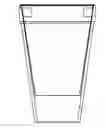
FIG. 1 is an exploded cross-sectional view of the beverage container.
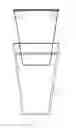
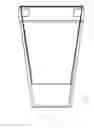
FIG. 2 is a cross-sectional view of the assembled beverage container.
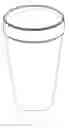
FIG. 3 is a perspective view of the assembled beverage container.
DETAILED DESCRIPTION OF DRAWINGBefore explaining the present invention in detail, it is to be understood that the invention is not limited to the size and shape illustrated in the accompanying drawings.
FIG. 1 shows an exploded cross-sectional view of a preferred embodiment. Container (1) is considered the “outer cup”. Container (1) holds the refrigerant. This cup can be manufactured from any material that is generally used in the art of mass-producing drinking cups. Best results were obtained with a standard foam material. Container (2) is considered the “inner cup”. Container (2) holds the beverage, for drinking. This cup can also be manufactured from any material that is generally used in the art of mass-producing drinking cups. Best results were obtained with a thin, standard plastic material. The size and shape of the cups used may vary, depending on fit and form of various sizes. However, it is required that when fitting the cups together they be close enough in size so that at some point the outer wall of container (2) comes into contact with the inner-wall of container (1). Both cups should then taper down at a ratio that when joined form an enclosed void (6).
Label (3) represents a very aggressive adhesive. The adhesive is used to permanently anchor the two cups together. This iteration shows two areas of adhesive positioned onto container (2), slightly below the opening/rim/lip. Best results were achieved with a thin polyethylene double-sided tape and a spacing of 180 degrees. Other quick adhesives, amounts, and spacing can be used, however the end result should be a permanent bond. Label (4) represents a molded lip on container (2). This lip is commonly found on standard plastic drinking cups and may or may not be present, on container (1) or (2), depending on fit and form of various cup sizes.
FIG. 2 shows that when joined together a void (6) is formed between the two cups. This void (6) is the cavity in which the refrigerant is held. Prior to the assembly, a refrigerant is added to container (1 ) so that only about 80% of the void is filled when the two cups are joined. This will allow room for frozen expansion and avoid overflows on assembly. The refrigerant should be non-toxic and anything generally accepted in the art (brine, freezer-gels, etc). This embodiment uses saltwater brine. In order for the assembled cup to work as intended, a watertight seal must be established between container (1) and container (2). This watertight seal ensures that there will be no leakage of refrigerant from in-between the “assembled” pieces. Label (5) indicates a bead of viscous sealant, applied prior to assembly. For this embodiment, an FDA approved silicone sealant is placed below the lip Oust above the adhesive), around the entire diameter. Depending on fit and form of various sizes, sealant can also be brushed onto the contact area between container (1) and container (2). Only a small amount is needed to form a watertight seal.
On assembly, container (2) is lowered into container (1) until firm contact is made between both cups and the desired depth is achieved. A firm pressing at the areas of adhesive anchors the two cups together. The sealant, now sandwiched between the two cups, forms a watertight seal (7). Any sealant that is squeezed out during assembly is wiped clean from all surfaces. After assembly, cup must be allowed to cure according to sealant requirements. FIG. 3 shows a fully assembled cup.
Claims
What is claimed is:1. A container for the cooling of a beverage placed therein comprised of:
(a) an inner container for holding the beverage,
(b) an outer container enclosing said inner container, thus forming a “void”.
2. The container of claim 1, wherein container is made of plastic.
3. The container of claim 1, wherein container is made of foam.
4. The container of claim 1, wherein container is made of paper.
5. The container of claim 1, wherein container is constructed to be “single-use disposable”.
6. The container of claim 1, wherein container is constructed to be “reusable”.
7. The container of claim 1, wherein no initial preparation is required, outside of freezing.
8. The container of claim 1, wherein an aggressive adhesive, anchors the assembly.
9. The container of claim 1, wherein a non-toxic sealant forms a watertight seal.
10. The container of claim 1, wherein the containers “void” holds a non-toxic refrigerant.
Images & Drawings included:
Sources:
- United States Patent and Trademark Office - verify current appl. status at the USPTO↗
Recent applications in this class:
- » 20250146729 2025-05-08
Floating Cooler Device - » 20250123045 2025-04-17
INSULATED CONTAINER WITH A DRAWER - » 20250093088 2025-03-20
INSULATED CONTAINER WITH A DRAWER - » 20250093087 2025-03-20
INSULATED CONTAINER WITH A DRAWER - » 20250035360 2025-01-30
PORTABLE COOLER - » 20250003664 2025-01-02
PORTABLE CONTAINER WITH COOLING OR HEATING UNIT - » 20240418430 2024-12-19
MULTI-FUNCTION COOLER - » 20240369281 2024-11-07
COOLER WITH RETENTION STRAP - » 20240369280 2024-11-07
Portable Cooler Assembly - » 20240369279 2024-11-07
Beverage Cooler Assembly