Tube amp simulator
US20070177745A1
2007-08-02
11/345,770
2006-02-02
Abstract:
The following components are connected in parallel: a capacitor, a resistor and a diode. In a typical application, to one end of the combination one may connect the signal from an electric guitar's pickup. The other end of the combination is connected to the input of a guitar amp, generally a transistor (solid-state) amp which it is desired to make sound like a tube amp.
Interested in similar patents?
Get notified when new applications in this technology area are published.
Classification:
G10H3/187 » CPC main
Instruments in which the tones are generated by electromechanical means using mechanical resonant generators, e.g. strings or percussive instruments, the tones of which are picked up by electromechanical transducers, the electrical signals being further manipulated or amplified and subsequently converted to sound by a loudspeaker or equivalent instrument using mechanically actuated vibrators with pick-up means using a string, e.g. electric guitar; Means for processing the signal picked up from the strings for distorting the signal, e.g. to simulate tube amplifiers
G10H5/12 » CPC further
Instruments in which the tones are generated by means of electronic generators using generation of non-sinusoidal basic tones, e.g. saw-tooth using semiconductor devices as active elements
H03F1/327 » CPC further
Details of amplifiers with only discharge tubes, only semiconductor devices or only unspecified devices as amplifying elements; Modifications of amplifiers to reduce non-linear distortion using predistortion circuits in audio amplifiers to emulate discharge tube amplifier characteristics
G10H2210/311 » CPC further
Aspects or methods of musical processing having intrinsic musical character, i.e. involving musical theory or musical parameters or relying on musical knowledge, as applied in electrophonic musical tools or instruments; Musical effects Distortion, i.e. desired non-linear audio processing to change the tone color, e.g. by adding harmonics or deliberately distorting the amplitude of an audio waveform
G10H1/00 IPC
Details of electrophonic musical instruments
Description
FIELD OF THE INVENTIONThis invention relates to the field of circuit modifications and accessories for use with audio amplifiers, in particular those for electric musical instruments such as electric guitar.
PRIOR ARTIt is highly desirable to play an electric guitar through a tube amplifier, due to the characteristic tube tone that results. Transistorized amplifiers sound cold and sterile in comparison, in the opinion of many players. However, a tube amp is heavy, expensive and fragile, so there are disadvantages to using one. Hence many attempts have been made to simulate a tube amp with a solid-state device, such as the “fuzz box”. Such devices simulate tube amps to a degree, but they also introduce annoying artifacts into the guitar tone, such as buzzing. Hence, there is a long-felt need for a simple, inexpensive and realistic way to simulate a tube amp with a solid-state device.
SUMMARY OF THE INVENTIONThe invention meets that need with a novel combination of elements: a capacitor, a resistor and a diode connected to each other in parallel and inserted within the signal chain. In accordance with the invention, the following components are connected in parallel: a capacitor, a resistor and a diode. To one end of the combination, one may connect the signal from an electric guitar's pickup. The other end of the combination is connected to the input of a guitar amp, generally a transistor (solid-state) amp which it is desired to make sound like a tube amp.
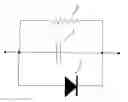
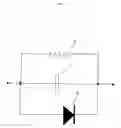
DESCRIPTION OF THE DRAWINGSFIG. 1 is a schematic of typical components employed in a circuit according to the invention.
DETAILED DESCRIPTION OF THE INVENTION EXAMPLE 1Connect the signal cable from an electric guitar (e.g., BORN TO ROCK Model F4c guitar having two KENT ARMSTRONG rails humbucking pickups) to a mono phone jack. To the signal terminal of the jack, connect in parallel a .001 uF capacitor 1, a 2.2M resistor 2, and a 1N4003 diode 3 (see FIG. 1). Diode polarity is not significant; it may be reversed from that shown; moreover, it should be understood that a “diode” is a means capable in principle of differentiating current flows directionally.
Attach the other ends of the aforesaid components 1, 2 and 3 to the signal terminal of another mono phone jack. Connect the ground terminals of the two jacks, to each other. Connect a signal cable from the second jack, to the input jack of a guitar amp, such as a MARSHALL Valvestate 8080. Use the “clean” channel of that amp, which has a solid-state signal path (no tubes). Play the guitar and listen. Instead of the typical modern MARSHALL clean-channel tone produced by the stock 8080 model, the tone is modified to resemble a highly-desirable tube amp tone, such as that of the “blackface” FENDER Twin Reverb model amp of the 1960's.
This embodiment may be realized within the housing of a “stomp-box” footpedal, optionally equipped with a bypass switch and/or adjustable controls for the component values. For example, the value of the resistor in the three-part combination may range from about 220 k, to 2.2 M or more.
EXAMPLE 2In another embodiment of the invention, the foregoing three-part combination is inserted within the feedback loop of a solid-state IC amp, such as one using National Semiconductor's LM3886. It is inserted in parallel with the standard manufacturer-recommended feedback circuit resistor. The effect of the inserted combination of the invention may be limited as desired, by placing a resistor in series with the combination to reduce its effect in the feedback loop. This embodiment may be used to permit an LM3886 IC to simulate the tone of a tube HiFi amp, such as the popular (and expensive) MACINTOSH tube amp; or a GRUNDIG tube console radio from the 1950's.
EXAMPLE 3The foregoing three-part combination is attached internally within a guitar amp, between the input jack of the guitar amp, and the pre-amp section thereof (which may be the input of an LM3886 IC). In this instance, the operation is similar to Example 1, except the combination is not removable by unplugging. It may, however, be provided with a bypass switch, including if desired a footpedal (or the like) for remote operation.
The invention is not limited to the embodiments described, but also includes such variations as would be apparent to one skilled in the art in view of the disclosure, including without limitation variations in the selected component values.
Claims
I claim:1. A capacitor, a resistor and a diode connected to each other in parallel and inserted within the signal chain of a solid-state audio-frequency amplifier.
2. A capacitor, a resistor and a diode connected to each other in parallel and inserted within the feedback loop of a solid-state audio-frequency amplifier.
3. Means for simulating a tube amplifier by a solid-state audio-frequency amplifier circuit, said means comprising a first means for storing electricity, a second means for reducing the flow of electricity of any polarity, and a third means for modifying the flow of electricity of substantially only one polarity; said three means being connected to each other in parallel and adapted to modify the audio signal of said amplifier.
Images & Drawings included:
Sources:
- United States Patent and Trademark Office - verify current appl. status at the USPTO↗
Recent applications in this class:
- » 20230306944 2023-09-28
SOUND PROCESSING DEVICE AND METHOD OF OUTPUTTING PARAMETER OF SOUND PROCESSING DEVICE - » 20210201879 2021-07-01
Amplifier for music signal and method of outputting waveform of music signal - » 20210043179 2021-02-11
Longitudinally Divided Pickup Structure and Switching Apparatus - » 20200279546 2020-09-03
Amplifier matching in a digital amplifier modeling system - » 20190325855 2019-10-24
Inductive distortion system and method - » 20180342232 2018-11-29
ELECTRONIC SIGNAL PROCESSOR - » 20170169808 2017-06-15
Electronic signal processor - » 20170132996 2017-05-11
Inductive distortion system and method - » 20160111073 2016-04-21
Electronic signal processor - » 20130329900 2013-12-12
Audio signal distortion using a secondary audio signal for enhanced control of psycho-acoustic and musical effects