FOAMED FLUOROELASTIC GASKET MATERIAL
US20070190307A1
2007-08-16
11/539,664
2006-10-09
Abstract:
A metal rubber composite includes a metal layer and a foamed fluoroelastomer layer. The foamed fluoroelastomer layer is a cured FKM elastomer. The FKM elastomer includes expanded thermoplastic beads that cause the FKM to foam. The product is formed by applying the uncured FKM product in combination with the elastomeric beads onto a substrate. Any solvent is removed and the beads are heated to cause them to expand. Subsequently, the elastomer is cured at a higher temperature, causing vulcanization.
Inventors:
- Hongwei Li 1 🇺🇸 Livonia, MI, United States
- Ayaz A. Sheikh 2 🇺🇸 Farmington Hills, MI, United States
- Alan Wesley 1 🇺🇸 Dunnellon, FL, United States
Interested in similar patents?
Get notified when new applications in this technology area are published.
Classification:
B32B5/18 » CPC main
Layered products characterised by the non- homogeneity or physical structure, i.e. comprising a fibrous, filamentary, particulate or foam layer; Layered products characterised by having a layer differing constitutionally or physically in different parts characterised by features of a layer of foamed material
B32B15/046 » CPC further
Layered products comprising a layer of metal comprising metal as the main or only constituent of a layer, next to another layer of a of foam
B32B15/08 » CPC further
Layered products comprising a layer of metal comprising metal as the main or only constituent of a layer, next to another layer of a of synthetic resin
B32B15/18 » CPC further
Layered products comprising a layer of metal comprising iron or steel
B32B15/20 » CPC further
Layered products comprising a layer of metal comprising aluminium or copper
B32B27/06 » CPC further
Layered products comprising synthetic resin as the main or only constituent of a layer, next to another layer of a
B32B27/20 » CPC further
Layered products comprising synthetic resin characterised by the use of special additives using fillers, pigments, thixotroping agents
B32B27/28 » CPC further
Layered products comprising synthetic resin comprising synthetic resins not wholly covered by any one of the sub-groups -
B32B27/322 » CPC further
Layered products comprising synthetic resin comprising polyolefins comprising halogenated polyolefins, e.g. PTFE
F16J15/0818 » CPC further
Sealings between relatively-stationary surfaces with solid packing compressed between sealing surfaces with exclusively metal packing Flat gaskets
F16J15/122 » CPC further
Sealings between relatively-stationary surfaces with solid packing compressed between sealing surfaces with non-metallic packing with metal reinforcement or covering with metal reinforcement generally parallel to the surfaces
B32B2266/0235 » CPC further
Composition of foam; Organic; Materials belonging to; Vinyl resin Vinyl halide, e.g. PVC, PVDC, PVF, PVDF
B32B2305/022 » CPC further
Condition, form or state of the layers or laminate; Cellular or porous Foam
B32B2305/08 » CPC further
Condition, form or state of the layers or laminate Reinforcements
B32B2307/56 » CPC further
Properties of the layers or laminate having particular mechanical properties Damping, energy absorption
B32B2311/24 » CPC further
Metals, their alloys or their compounds Aluminium
B32B2311/30 » CPC further
Metals, their alloys or their compounds Iron, e.g. steel
B32B2327/18 » CPC further
Polyvinylhalogenides containing fluorine PTFE, i.e. polytetrafluoroethylene
B32B2581/00 » CPC further
Seals; Sealing equipment; Gaskets
F16J2015/0856 » CPC further
Sealings between relatively-stationary surfaces with solid packing compressed between sealing surfaces with exclusively metal packing; Flat gaskets with a non-metallic coating or strip
Y10T428/249958 » CPC further
Stock material or miscellaneous articles; Web or sheet containing structurally defined element or component; Composite having voids in a component [e.g., porous, cellular, etc.]; Void-containing component partially impregnated with adjacent component Void-containing component is synthetic resin or natural rubbers
Y10T428/249978 » CPC further
Stock material or miscellaneous articles; Web or sheet containing structurally defined element or component; Composite having voids in a component [e.g., porous, cellular, etc.] Voids specified as micro
Y10T428/249979 » CPC further
Stock material or miscellaneous articles; Web or sheet containing structurally defined element or component; Composite having voids in a component [e.g., porous, cellular, etc.]; Voids specified as micro Specified thickness of void-containing component [absolute or relative] or numerical cell dimension
Y10T428/24998 » CPC further
Stock material or miscellaneous articles; Web or sheet containing structurally defined element or component; Composite having voids in a component [e.g., porous, cellular, etc.]; Voids specified as micro Composite has more than two layers
Y10T428/249981 » CPC further
Stock material or miscellaneous articles; Web or sheet containing structurally defined element or component; Composite having voids in a component [e.g., porous, cellular, etc.] Plural void-containing components
B32B3/26 IPC
Layered products comprising a layer with external or internal discontinuities or unevennesses, or a layer of non-planar form ; Layered products having particular features of form characterised by a particular shape of the outline of the cross-section of a continuous layer; characterised by a layer with cavities or internal voids ; characterised by an apertured layer
B32B5/14 IPC
Layered products characterised by the non- homogeneity or physical structure, i.e. comprising a fibrous, filamentary, particulate or foam layer; Layered products characterised by having a layer differing constitutionally or physically in different parts characterised by a layer differing constitutionally or physically in different parts, e.g. denser near its faces
B32B3/00 IPC
Layered products comprising a layer with external or internal discontinuities or unevennesses, or a layer of non-planar form ; Layered products having particular features of form
Description
RELATED APPLICATIONThis application is related to and claims the benefit of U.S. Provisional Patent Application Ser. No. 60/725,788, filed on Oct. 12, 2005. The entire disclosure of this application is incorporated herein by reference.
BACKGROUND OF THE INVENTIONRubber metal composites are used in a wide variety of different applications, particularly as gaskets in automotive and fluid applications. They are also used as noise, vibration and heat insulators in a variety of applications. In certain situations, it is desirable for the rubber or polymeric material to be foamed. One such highly successful product is a NBR foamed product. This has been used in automotive applications as well as noise, vibration and heat insulation applications.
These foamed NBR products are made by incorporating blowing agents into the rubber formulation. During the cure process the blowing agents expand, foaming the product.
Such NBR foamed composites are useful up to a temperature of about 175° C. Once such temperatures are exceeded, the NBR tends to break down.
SUMMARY OF THE INVENTIONThe present invention is premised on the realization that a high temperature rubber metal composite can be formed having at least one layer of a foamed fluoroelastomer. Preferably, the present invention utilizes a foamed FKM rubber formulation. The FKM product is a terpolymer of tetrafluoroethylene, propylene and vinylidene fluoride. Such a product, when foamed, produces a composite that can withstand in excess of 200° C.
In a preferred embodiment of the present invention, the FKM polymer is foamed using thermoplastic beads incorporating a blowing agent such as isopentene. These provide for very precise control of the foaming reaction and also ensure that the foaming reaction occurs at a temperature below the cure temperature for the FKM polymer and occurs during the cure process of the FKM polymer.
The foamed FKM metal composition of the present invention is useful as automotive gasket material as well as vibration absorbing material, noise dampening material and heat insulation.
The objects and advantages of the present invention will be further appreciated in light of the following detailed descriptions and drawings, in which:
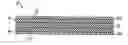
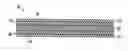
BRIEF DESCRIPTION OF THE DRAWINGThe FIGURE is a cross sectional view of a rubber metal composite according to the present invention.
DETAILED DESCRIPTIONAs shown in the FIGURE, a rubber metal composite 10 includes a central metal layer 12 and either one or two layers of a foamed FKM rubber 14,16 on the two surfaces 19 and 20 of metal layer 12. The outer surfaces of each FKM rubber layer 14 and 16 are preferably coated with a fluorinated polymer release agent 22 such as polytetrafluoroethylene.
FKM polymers are fluororubbers of the polymethylene type that utilize vinylidene fluoride as a comonomer. The FKM polymer for use in the present invention is a terpolymer of tetrafluoroethylene, propylene and vinylidene fluoride. Such polymers are commercially available. One supplier of the FKM polymer is 3M.
The FKM polymer for use in the present invention is applied to a cleaned metal substrate and cured. In particular, the metal substrate can be any metal substrate typically used in gasket material. Such metals include aluminum, stainless steel, and cold rolled steel. The metal will generally be 0.25 to 0.75 mm thick.
To apply the FKM polymer and foam the polymer on the metal substrate, the FKM polymer is dissolved in an appropriate solvent typically a ketone such as methylethyl ketone, or the like. The dissolved polymer is then blended with 15 to 45 phr of carbon black filler, or other acceptable fillers, along with 10 to 20 parts of a metal oxide activator such as MgO or CaO. The preferred activator is magnesium oxide.
Generally, 5-20 phr, preferably 15 phr, blowing agent is blended into the mixture. The preferred blowing agent comprises unexpanded thermoplastic microspheres. One such product is sold by Akzo Nobel. The blowing agent comprises polymeric beads formed from an acrylonitrile methacrylonitrile copolymer filled with isopentene blowing agent. The beads provide void volumes of 90 to 120 microns when expanded and have a blowing temperature of 200° C. plus or minus 50° C.
This blend is then applied to the metal substrate by well known coating techniques onto the metal substrate. Typically a blade coater is used to apply the coating composition onto the metal substrate. The solvent is removed at low temperature, around 100° C., and the coated substrate is heated in hot air ovens, causing the blowing agent to expand at about 200° C. The heating continues curing the FKM polymer.
If two FKM foamed layers are desired, as shown in the FIGURE, the opposite side 20 of the metal surface is coated again, utilizing the same procedure as above. This provides the structure as shown in the FIGURE. If desired, one side of the metal can be coated with a nonfoaming layer of FKM polymer in place of the foamed layer.
The thickness of the expanded FKM layer 12 is preferably about 0.2-0.4 mm with about 0.2 mm preferred.
Subsequent to curing of the product, two layers 22,29 of PTFE are reverse roll coated over the upper and lower surfaces of the FKM layer. Generally, this will form less than 0.1% by weight of the layers 12. Alternately, graphite can be applied to the FKM layers.
A product made according to the above procedure with a thickness of 0.66 mm, with a metal core thickness of 0.24 mm and a rubber coating layer of 0.203 mm per side, was formed (see Table 1). This product was then tested for fluid resistance and mechanical properties. The results of these tests are shown in the following Tables 2 and 3, respectively.
| TABLE 1 |
| MATERIAL CONSTRUCTION DETAIL |
| ITEM | MATERIAL | THICKNESS, In (mm) |
| 1 | Composite | 0.026 nominal (0.66) |
| 2 | Metal Core Nominal | 0.010 nominal (0.254 |
| 3 | Rubber Coating Nominal | 0.0080 nominal (0.203) |
| (per side) | ||
| TABLE 2 |
| FLUID RESISTANCE |
| ITEM | PROPERTY/PROCEDURE | SPECIFICATION |
| 1 | Rubber/Metal Bond | MEK Resistance, WTM-118 | No loss of bond |
| Integrity | Coolant Resistance, WTM-122 | No loss of bond | |
| 50/50 Water/Coolant at boiling for 200 Hrs. | |||
| 2 | IRM 903 Oil | % Weight Change, max., ASTM F-146 | 10 |
| At 300° F. (150° C.) for 5 Hrs. | |||
| % Thickness Change, max., ASTM F-146 | 15 | ||
| At 300° F. (150° C.) for 5 Hrs. | |||
| 3 | Automatic Transmission | % Weight Change, max., ASTM F-146 | 15 |
| Fluid | At 300° F. (150° C.) for 100 Hrs. | ||
| Thickness Change, max., ASTM F-146 | −15 | ||
| At 300° F. (150° C.) for 100 Hrs. | |||
| TABLE 3 |
| MECHANICAL PROPERTIES |
| ITEM | PROPERTY/PROCEDURE | SPECIFICATION |
| 1 | Maximum Creep Relaxation, ASTM F-38 | 50 |
| At 212° F. (100° C.) |
| 2 | Compression and Recovery, ASTM F-36 | % Compressibility, min. | 20 |
| 400 PSI, 5 pound preload, 1.129″ diameter | % Recovery, min. | 50 | |
| indenter; room temperature or after heat | (See explanation; Gasket | ||
| aging at 212° F. (100° C.) for 5 Hrs. | Manual, Section 2.70) | ||
Based on the above, the Composite 10 is suitable for use in high temperature environments as gaskets that will contact various fluids, such as engine coolants, oils and transmission fluids. This product is stable at temperatures greater then 200° C. and exhibits a uniform surface structure, as required for gasket applications. Further, the composite 10 can be used as a noise or vibration dampener. It can also be stamped to conform to various shapes, if desired.
Further, the use of the thermoplastic beads incorporating the blowing agent greatly facilitates manufacture of the blown FKM layer with a uniform surface. This, in turn, allows the use of this product in sealing applications.
This has been a description of the present invention along with the preferred method of practicing the present invention. However, the invention itself should only be defined by the appended claims.
Claims
What is claimed is:1. A rubber metal composite material comprising a metal layer having a first and second surface and a first polymeric layer on said first surface, said first polymeric layer comprising a foamed FKM fluoroelastomer.
2. The composite claimed in claim 1 wherein said foamed FKM elastomer comprises a vulcanized FKM polymer in combination with expanded thermoplastic beads.
3. The composite claimed in claim 1 further comprising at least about 15 to about 45 percent reinforcing filler.
4. The composite claimed in claim 1 further comprising an exterior layer of polytetrafluoroethylene.
5. The composite claimed in claim 1 further comprising foam cells of from 90 to 120 microns.
6. The composite claimed in claim 1 wherein said foamed FKM elastomer layer is from 0.2 to 0.4 mm thick.
7. The composite claimed in claim 1 having a second polymeric layer comprising a foamed FKM polymer on a second surface of said metal layer.
8. The composite claimed in claim 1 wherein said metal is selected from the group consisting of steel, stainless steel and aluminum.
Images & Drawings included:
Sources:
- United States Patent and Trademark Office - verify current appl. status at the USPTO↗
Recent applications in this class:
- » 20250121581 2025-04-17
FOAMED BODY, FOAMED FILM, AND LAMINATED FILM - » 20250115024 2025-04-10
DECORATIVE PANEL AND METHOD FOR PRODUCING A PANEL - » 20250065596 2025-02-27
REINFORCED-ELASTOMER ARTICLE WITH MICROPOROUS POLYMERIC FILM - » 20250050617 2025-02-13
COMPOSITE INSULATION BOARD - » 20250001723 2025-01-02
SANDWICH PANEL OF THERMOPLASTIC POLYMERS - » 20240399703 2024-12-05
INTERNALLY REINFORCED AEROGEL AND USES THEREOF - » 20240391210 2024-11-28
LAMINATES COMPRISING REINFORCED AEROGEL COMPOSITES - » 20240391209 2024-11-28
BUFFER STRUCTURE AND PREPARATION METHOD FOR SAME, AND DISPLAY APPARATUS - » 20240383225 2024-11-21
COMPOSITE STRUCTURES WITH EMBEDDED SENSORS - » 20240367411 2024-11-07
ROOM TEMPERATURE FOAMED AND CURED CARRIERS