System for fixing a grip handle to a container of an item of cookware
US20070194031A1
2007-08-23
10/582,073
2004-12-02
Abstract:
The invention relates to a system for fixing a grip handle to a container belonging to an item of cookware. The inventive system consists of: a stud comprising a body that is to be fixed to the container, and a flame guard which surrounds the stud and which comprises a lateral wall and an annular shoulder. According to the invention, the stud comprises a flange ring, and the distance separating the flange ring from the end of the body to be fixed to the container and the distance separating the shoulder from the end of the wall that is intended to be in contact with the container are such that, as the handle is moved towards the container, the shoulder abuts against the flange ring just before the end of the wall abuts against the container.
Interested in similar patents?
Get notified when new applications in this technology area are published.
Classification:
A47J45/061 » CPC main
Devices for fastening or gripping kitchen utensils or crockery; Handles for hollow-ware articles Saucepan, frying-pan handles
B65D25/10 IPC
Details of other kinds or types of rigid or semi-rigid containers; Internal fittings Devices to locate articles in containers
Description
BACKGROUND OF THE INVENTION1. Field of the Invention
The present invention relates to a system for fixing a grip handle to a container of an item of cookware, such as a casserole, a saucepan, a stockpot, a frying pan.
2. Prior Art
Such a system is known of the type comprising a stud which comprises a body adapted to be fixed to the container, and a flame guard which is adapted to surround the stud and which comprises a side wall and an annular shoulder projecting from the side wall to the interior and defining an opening through which the stud extends.
The document GB 1 555 031 divulges such a system for fixing. As the handle is brought closer and fixed by the tightening of a screw (passing through an opening of the handle) into a threaded orifice of the stud, the flame guard is drawn along by the handle and abuts against the container. In the event where excessive tightening torque is applied to the screw, the pressure exerted by the end of the side wall of the flame guard adjacent to the container on the side wall of the container can be such that the latter deforms. Also, deliberately, the tightening torques applied to the fastening screw are fairly weak (of the order of 2 Nm), which can lead in the long term to unscrewing.
The problem posed is to provide a system for fixing which can support considerable tightening torque without there being any risk of deformation to the container.
SUMMARY OF THE INVENTIONAccording to the present invention, in the system for fixing of the type hereinabove, the stud comprises a flange ring which projects from the body to the exterior, the distance separating the flange ring from the end of the body adapted to being fixed to the container and that separating the annular shoulder from the end of the side wall adapted to come into contact with the container are such that, when the handle approaches the container, the annular shoulder abuts against the flange ring just before the end of the side wall of the flame guard abuts against the container.
Accordingly, when the handle is moved closer to the container, the flame guard abuts against the stud prior to coming in contact with the container, and because of this the side wall of the latter is not deformed. So that the flame guard plays its part, when the shoulder abuts against the flange ring, the end of the side wall of the flame guard is almost in contact with the container, and by imposing greater screwing torque the shoulder deforms slightly such that the end of the side wall of the flame guard comes into contact with the container. As a consequence, the side wall of the container is not deformed, even if considerable tightening torque is applied to the screw (up to 8 Nm).
Other advantages and particularities of the present invention will emerge from the description of the particular embodiment given by way of example and illustrated by the attached diagrams.
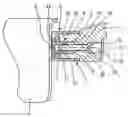
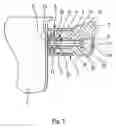
BRIEF DESCRIPTION OF THE DRAWINGThe sole figure represents a partial sectional view of a culinary utensil at the level of the system for fixing according to the present invention.
DETAILED DESCRIPTION OF THE PREFERRED EMBODIMENTAs is evident from FIG. 1, an item of cookware comprises a container 1, a grip handle 2 and a system for fixing 3 the handle 2 to the container 1.
The system for fixing 3 comprises a stud 4 and a flame guard 5. The stud 4 is adapted to be fixed to the container 1 by a first end 6 and comprises, at a second end 7, opposite the first end 6, an orifice 8 enabling the handle 2 to be moved towards and fixed to the container 1 by cooperation with tightening means 9 (in this instance, a tightening screw 9). The flame guard 5 comprises a side wall 10, which is adapted to surround the stud 4, and which helps protect the end of the handle 2 near the container 1 of the flames.
As is evident from the figure, the flame guard 5 likewise comprises an annular shoulder 11 which is solid with the side wall 10 and which projects radially therefrom to the interior, defining an opening 12 through which the stud 4 extends. In the present example, the annular shoulder 11 is monobloc with the side wall 10.
In the present example, the stud 4 comprises a body 13 bearing the first end 6 by which it is welded to the container 1. It likewise comprises a flange ring 14, which is solid with the body 13 and which projects radially therefrom to the exterior. In the present example, the flange ring 14 is monobloc with the body 13. Further, the flange ring 14 extends from the first end 6 of the stud 4.
In addition, the handle 2 comprises a first end 15, which is adapted to be disposed inside the side wall 10 of the flame guard 5 when it is fixed to the container 1.
The screw 9 is introduced from an opening 16 passing through the first end 15 then the threaded orifice 8 of the stud 4. The opening 16 presents a first part 17 having a certain diameter enabling the head 18 of the screw 9 to pass through, then, in the extension, a second part 19 whereof the diameter corresponds substantially to the cylinder 20 of the screw 9, and finally, still in the extension, a third part 21 whereof the diameter is greater than that of the second part 19 and receives the stud 4. Under the effect of screwing, the handle 2 is brought closer to the container 1 and the part of the stud 4 bearing the orifice 8 penetrates into the third part 21 until the annular shoulder 11 abuts against the flange ring 14.
When the annular shoulder 11 abuts against the flange ring 14, the end of the side wall 10 opposite the handle is very close to the container 1, and by continuing screwing, the annular shoulder 11 deforms such that this end comes into contact with the container 1. It is thus possible to apply a tightening torque to the screw of the order of 8 Nm.
The rigidity of the flame guard 5 is a function of the material constituting the shoulder and its thickness.
Of course, the present embodiment is one example only and numerous modifications can originate therefrom.
It would thus be possible for the annular shoulder and the side wall to be two distinct pieces, which could be assembled on one another. The same applies for the flange ring and the body of the stud.
It would also be possible for the flange ring not to extend from the first end of the body.
Claims
1-5. (canceled)
6. A system for fixing a grip handle to a container of an item of cookware comprising a stud which comprises a body adapted to be fixed to the container, and a flame guard which is adapted to surround the stud and which comprises a side wall and an annular shoulder projecting from the side wall to the interior and defining an opening through which extends the stud, wherein the stud comprises a flange ring which projects from the body to the exterior, a distance separating the flange ring from an end of the body adapted to be fixed to the container and a distance separating the annular shoulder from an end of the side wall adapted to come into contact with the container are such that, when the handle approaches the container, the annular shoulder abuts against the flange ring just before the end of the side wall of the flame guard abuts against the container.
7. The system of fixing as claimed in claim 6, wherein the annular shoulder is monobloc with the side walls of the flame guard.
8. The system of fixing as claimed in claim 6, wherein the flange ring is monobloc with a body of the stud.
9. The system of fixing as claimed in claim 6, wherein the flange ring is located at an end of the stud adapted to be fixed to the container.
10. An item of cookware comprising a container, a grip handle and a system for fixing the handle to the container as claimed in claim 1.
Images & Drawings included:
Sources:
- United States Patent and Trademark Office - verify current appl. status at the USPTO↗
Recent applications in this class:
- » 20250134319 2025-05-01
COOKWARE SYSTEM SUITABLE FOR COOKING, SMOKING AND/OR BAKING - » 20240197118 2024-06-20
Cookware handle - » 20240172896 2024-05-30
Cooking Vessel With Handle Attached By Two Superimposed Rivets - » 20230277010 2023-09-07
Detachable handle system for pots - » 20230087271 2023-03-23
Frying Pan Device with Repositionable Handle - » 20230048491 2023-02-16
COOKING VESSEL AND KITCHEN UTENSIL ASSEMBLY - » 20220053979 2022-02-24
Cookware Handle for Housing Electronic Components - » 20220000316 2022-01-06
Cooking Vessel Provided With An Improved Tubular Handle - » 20210030210 2021-02-04
STACKABLE COOKWARE - » 20190000277 2019-01-03
HANDGRIP FOR COOKING VESSELS AND RESPECTIVE FIXING SYSTEM