VOICE ACTIVITY DETECTION METHOD AND APPARATUS FOR VOICED/UNVOICED DECISION AND PITCH ESTIMATION IN A NOISY SPEECH FEATURE EXTRACTION
US20070198251A1
2007-08-23
11/672,106
2007-02-07
Abstract:
The present invention is related to a method and apparatus for voice activity detection (VAD) in which a set of measurements are made over the interval of a processed frame, and which are used to determine if segments of the frame contain voiced or unvoiced signals. The proposed measurements include the mean of the log energy of noise over the time, the zero crossing count, and the autocorrelation coefficient. The present invention may be used in speech enhancement or signal de-noising applications.
Assignee:
- JABER ASSOCIATES, L.L.C. 5 🇺🇸 Wilmington, DE, United States
Interested in similar patents?
Get notified when new applications in this technology area are published.
Classification:
G10L25/78 » CPC main
Speech or voice analysis techniques not restricted to a single one of groups - Detection of presence or absence of voice signals
G10L21/00 IPC
Processing of the speech or voice signal to produce another audible or non-audible signal, e.g. visual or tactile, in order to modify its quality or its intelligibility
Description
CROSS REFERENCE TO RELATED APPLICATIONThis application claims the benefit of U.S. Provisional Application No. 60/771,167, filed Feb. 7, 2006 which is incorporated by reference as if fully set forth.
FIELD OF INVENTIONThe present invention is related to a method and apparatus for voiced/unvoiced decision and pitch estimation.
BACKGROUNDSpeech detection is a crucial issue in adaptive speech enhancement algorithms. The need for deciding whether a given segment of a voiced noisy signal should be classified as voiced or unvoiced arises in many speech enhancement or signal de-noising applications. A variety of approaches have been described in the prior art for making this decision. The success of a hypothesis testing depends, to a considerable extent, upon the measurements or features which are used in the decision criterion. The basic problem addressed by the present invention is of selecting features or measurements which are simple to derive from speech and yet are highly effective in differentiating between voiced and unvoiced segments.
SUMMARYThe present invention is related to a method and apparatus for detecting voice activity in a voiced noisy signal, which may be applied in speech enhancement or signal de-noising applications. The present invention can use any of the following speech measurements in deciding if a segment of a signal is voiced or unvoiced: the mean of the log energy of noise over the time, the zero crossing count, and the autocorrelation coefficient.
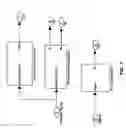
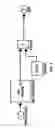
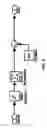
BRIEF DESCRIPTION OF THE DRAWINGSFIG. 1 is an example of a voice activity detector (VAD) module in accordance with the present invention.
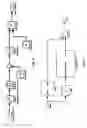
FIG. 2 illustrates preferred embodiments of the measurement computation module and the speech detection decision module in accordance with the present invention.
FIG. 3 is a block circuit diagram of a measurement module in accordance with the present invention.
FIG. 4 is a block circuit diagram mean of a zero crossing count module in a noise segment in accordance with the present invention.
FIG. 5 is a block circuit diagram of a threshold computation module in accordance with the present invention.
FIG. 6 is a block circuit diagram of a log energy computation module in accordance with the present invention.
FIG. 7 is a block circuit diagram of an autocorrelation function computation module in accordance with the present invention.
FIG. 8 is a block circuit diagram of an energy computation module in accordance with the present invention.
FIG. 9 is a block circuit diagram of a first decision rule module in accordance with the present invention.
FIG. 10 is a block circuit diagram of a second decision rule module in accordance with the present invention.
FIG. 11 is a block circuit diagram of a third decision rule module in accordance with the present invention.
FIG. 12 is a block circuit diagram of a fourth decision rule module in accordance with the present invention.
FIG. 13 is a block circuit diagram of a fifth decision rule module in accordance with the present invention.
FIG. 14 is a block circuit diagram of a sixth decision rule module in accordance with the present invention.
FIG. 15 illustrates simulation result in which the first plot is a plot of a noisy signal, the second plot is the plot of the output of the proposed voice activity detection (VAD) algorithm of the present invention and the third plot is the simulation result.
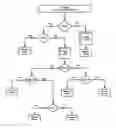
FIG. 16 is a flowchart of the software implementation of a voice activity detector (VAD) module in accordance with the present invention.
DETAILED DESCRIPTION OF THE PREFERRED EMBODIMENTSThe present invention provides a method and apparatus for deciding whether a given segment of a voiced noisy signal should be classified as voiced or unvoiced, as used in speech enhancement or signal de-noising applications. The present invention proposes to use the following speech measurements for the voiced/unvoiced decision:
-
- the mean of the log energy over the time,
- zero crossing count, and/or
- the autocorrelation coefficient R[1].
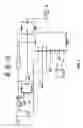
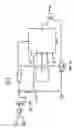
The various components associated with different embodiments of the present invention are illustrated in FIGS. 1 through 14. The proposed speech measurement techniques are discussed below.
Log Energy Speech Measurement
According to the present invention, a novel strategy is developed in which the noise characteristics are tracked more reliably and used to set a speech threshold adaptively. The method is called dynamic detection. Dynamic detection can work in real time and with minimal processing delay. It computes the speech threshold Ts from the estimated mean and variance of the log-energy of the noise, according to Equation 1.
Ts=μn+ασn Equation 1
A noise threshold Tn is calculated where the log energy E is defined as: E = 10 log 10 ( ɛ + ∑ n = 1 N S 2 ) Equation 2
Zero Crossing Count Speech Measurement
The zero crossing count is an indicator of the frequency at which the energy is concentrated in the signal spectrum. Voiced speech is produced as a result of excitation of the vocal tract by the periodic flow of air at the glottis and usually shows a low zero crossing count. The front point speech is produced due to excitation of the vocal tract by the noise-like source at a point of constriction in the interior of the vocal tract and shows a high zero crossing count. The zero crossing of the end point speech shows is expected to be lower than the front-point speech, but quite comparable to that for voiced speech.
The Autocorrelation Coefficient R[1] Speech Measurement
This measurement is a useful tool to distinguish between sonorant and fricative segment of speech at beginning or end of utterances. Sonorant speech usually shows a big value of R.
The present invention includes a fairly general framework based on voice activity detection (VAD) in which a set of measurements are made on the interval of the processed frame, such as the types of measurements discussed above. Simulation results presented in FIG. 15 show the accuracy of our VAD in detecting the speech segment from the front point to the end point.
Software Implementation
The proposed voice activity detection (VAD) algorithm may be implemented in software as shown in the flow chart of FIG. 16 in which
-
- Ts is the threshold in the speech segment,
- Tn is the threshold in the noise segment,
- E is the mean of the log energy of the current processed frame,
- ZC is the mean of the zero crossing count of the current processed frame,
- ZCS is the mean of the zero crossing count of the speech segment,
- ZCN is the mean of the zero crossing count of the noise segment,
- R[1] is the autocorrelation in the noise segment, and
- C is a comparative constant.
Although the features and elements of the present invention are described in the preferred embodiments in particular combinations, each feature or element can be used alone without the other features and elements of the preferred embodiments or in various combinations with or without other features and elements of the present invention.
Claims
What is claimed is:1. A method for voice activity detection (VAD) comprising:
taking a set of measurements over an interval of a processed frame; and
differentiating between voiced and unvoiced segments of the processed frame based on said measurements.
2. The method of claim 1 wherein the measurements are based on a mean of log energy of noise over the time.
3. (canceled)
4. (canceled)
Images & Drawings included:




Sources:
- United States Patent and Trademark Office - verify current appl. status at the USPTO↗
Recent applications in this class:
- » 20250174246 2025-05-29
VOICE DETECTION METHOD, VOICE DETECTION DEVICE, AND COMPUTER DEVICE - » 20250104730 2025-03-27
VOICE DETECTION APPARATUS, VOICE DETECTION METHOD, AND RECORDING MEDIUM - » 20250087231 2025-03-13
SPEECH DIALOG SYSTEM AND RECIPROCITY ENFORCED NEURAL RELATIVE TRANSFER FUNCTION ESTIMATOR - » 20250046336 2025-02-06
MULTI-SPEAKER OVERLAPPING VOICE DETECTION METHOD AND SYSTEM THEREOF - » 20250029632 2025-01-23
PROCESSING OF AUDIO DATA IN MULTI-SPEAKER MULTI-CHANNEL ENVIRONMENTS - » 20250006219 2025-01-02
VOICE ONSET DETECTION - » 20240420728 2024-12-19
DETECTING INTER-PERSON CONVERSATIONS USING A SMART WEARABLE DEVICE - » 20240420727 2024-12-19
RESPONSIVE NOISE CANCELATION OVERRIDE - » 20240412754 2024-12-12
AUDIO SYSTEM FOR SPATIALIZING VIRTUAL SOUND SOURCES - » 20240412753 2024-12-12
VOICE ACTIVITY DETECTION DEVICE AND VOICE ACTIVITY DETECTION METHOD
Recent applications for this Assignee:
- » 20070195968 2007-08-23
NOISE SUPPRESSION METHOD AND SYSTEM WITH SINGLE MICROPHONE - » 20060041403 2006-02-23
Method and apparatus for enhancing processing speed for performing a least mean square operation by parallel processing - » 20050278405 2005-12-15
Fourier transform processor - » 20050278404 2005-12-15
Method and apparatus for single iteration fast Fourier transform