Dispenser for delivering foam and mist
US20070228085A1
2007-10-04
11/395,603
2006-03-31
Abstract:
A dispenser for dispensing a mist or a foam includes a solution in the dispenser, a foaming nozzle on the dispenser for dispensing the foam from the solution and a misting nozzle on the dispenser for dispensing the mist from the solution. The solution can include hydrogen peroxide. Preferably, instructions are provided to foam the solution onto a contaminated surface of a medical instrument prior to cleaning of the instrument and to maintain the foam in contact with the surface until such time as the instrument is cleaned, and to apply the mist of the hydrogen peroxide solution into a lumen of the instrument prior to cleaning of the instrument.
Inventors:
- Szu-Min Lin 36 🇺🇸 Irvine, CA, United States
- Robert C. Platt 26 🇺🇸 Laguna Niguel, CA, United States
- Chun-Chieh J. Tseng 8 🇺🇸 Irvine, CA, United States
Interested in similar patents?
Get notified when new applications in this technology area are published.
Classification:
C11D17/041 » CPC main
Detergent materials or soaps characterised by their shape or physical properties combined with or containing other objects Compositions releasably affixed on a substrate or incorporated into a dispensing means
A61L2/22 » CPC further
Methods or apparatus for disinfecting or sterilising materials or objects other than foodstuffs or contact lenses; Accessories therefor using chemical substances Phase substances, e.g. smokes, aerosols or sprayed or atomised substances
A61L2/235 » CPC further
Methods or apparatus for disinfecting or sterilising materials or objects other than foodstuffs or contact lenses; Accessories therefor using chemical substances; Solid substances, e.g. granules, powders, blocks, tablets cellular, porous or foamed
B08B3/003 » CPC further
Cleaning by methods involving the use or presence of liquid or steam Cleaning involving contact with foam
C11D3/0094 » CPC further
Other compounding ingredients of detergent compositions covered in group; Other compounding ingredients characterised by their effect High foaming compositions
C11D3/3942 » CPC further
Other compounding ingredients of detergent compositions covered in group; Organic or inorganic per-compounds Inorganic per-compounds
C11D3/48 » CPC further
Other compounding ingredients of detergent compositions covered in group Medical, disinfecting agents, disinfecting, antibacterial, germicidal or antimicrobial compositions
A61B90/70 » CPC further
Instruments, implements or accessories specially adapted for surgery or diagnosis and not covered by any of the groups - , e.g. for luxation treatment or for protecting wound edges Cleaning devices specially adapted for surgical instruments
B05B7/0018 » CPC further
Spraying apparatus for discharge of liquids or other fluent materials from two or more sources, e.g. of liquid and air, of powder and gas with devices for making foam
B05B11/0005 » CPC further
Single-unit, i.e. unitary, hand-held apparatus , in which flow of liquid or other fluent material is produced by the operator at the moment of use Components or details
B67D3/00 IPC
Apparatus or devices for controlling flow of liquids under gravity from storage containers for dispensing purposes
B65D83/14 IPC
Containers or packages with special means for dispensing contents for delivery of liquid or semi-liquid contents by internal gaseous pressure, i.e. aerosol containers comprising propellant for a product delivered by a propellant
Description
BACKGROUND OF THE INVENTIONThe present application relates to a dispenser for delivering selectively either a foam or a mist and more particularly such a dispenser useful in delivering foams and mists for pretreatment of instruments prior to a washing and sterilization process.
Medical instruments after use are typically contaminated with blood and other body matter as well as potentially contaminated with infectious microorganisms. Before being reused in a future medical procedure these instruments must be washed and sterilized. The process of washing and sterilization becomes complicated when blood and other matter are allowed to dry onto the instruments. Blood in particular becomes much more difficult to remove once it has dried.
It has been suggested that after use instruments be placed into a liquid filled container to maintain moisture and prevent foreign matter thereon from drying and becoming more difficult to remove. However, such containers can be quite heavy and difficult to move-and the liquid therein can become contaminated and it is not desirable to spill this liquid. One solution that has been proposed is an enzymatic foam which is prayed onto instruments after use and prior to eventual sterilization. The foam weighs less than a liquid and purports to enhance cleaning by initiating some degree of cleaning at the early stage when the foam is placed upon the instrument. Such foams provide little or no antimicrobial activity.
SUMMARY OF THE INVENTIONA dispenser, according to the present invention, provides for dispensing a mist or a foam. It comprises a solution in the dispenser, a foaming nozzle on the dispenser for dispensing the foam from the solution and a misting nozzle on the dispenser for dispensing the mist from the solution.
Preferably, the solution comprises hydrogen peroxide, preferably in a range of from 0.1% to 15% by weight, more preferably 2% to 10% by weight and most preferably 3% to 8% by weight. It can also comprise peracetic acid.
Preferably, instructions are including instructing a user to foam the solution onto a contaminated surface of a medical instrument prior to cleaning of the instrument and to maintain the foam in contact with the surface until such time as the instrument is cleaned. Further preferable instructions include instructions to apply the mist into a lumen of the instrument prior to cleaning of the instrument.
In one aspect of the invention, the dispenser includes a propellant therein for dispensing the foam and mist under pressure of the propellant. This includes typical aerosol propellants such as chlorofluorocarbons (CFCs) and more preferably more environmentally acceptable propellants such as volatile hydrocarbons (i.e. propane, n-butane and isobutane, dimethyl ether, methylethyl ether, nitrous oxide and hydrofluoroalkanes (HFA).
In one aspect of the invention, each of the foaming nozzle and misting nozzle are of a manually pumping type.
The solution further preferably comprises a surfactant, a foam booster, a thickening agent and a pH adjustor.
An accessory spray tube is preferably provided which is adapted to the nozzle for spraying mist into smaller opening or area.
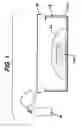
BRIEF DESCRIPTION OF THE DRAWINGSFIG. 1 is a block diagram of a system according to the present invention;
FIG. 2 is a block diagram of an enhanced system of FIG. 1;
FIG. 3 is a front elevation view of a foam dispenser for use in the system of FIG. 1;
FIG. 4 is a front elevation view of an alternative foam dispenser for use in the system of FIG. 1;
FIG. 5 is a front elevation view in cross-section of a container for use in the system of FIG. 1;
FIG. 6 is a front elevation view in cross-section of an alternative container for use in the system of FIG. 1; and FIG. 7 is a front elevation view in cross-section of a further alternative container for use in the system of FIG. 1.
DETAILED DESCRIPTIONDuring a medical procedure, one or more medical instruments may be employed. These instruments become contaminated with blood, tissue and potentially contaminating microorganisms. Typically the instruments are set aside after use to await washing and sterilization. This waiting period can be several hours or much longer. During this waiting period blood and other matter which dries upon the instrument becomes much more difficult to remove during the subsequent cleaning procedure. This can be a particular problem when a procedure lasts many hours and uses many different instruments or when due to limited personnel time, it is difficult to process the instruments in a timely fashion.
Turning to the drawings, and in particular to FIG. 1, according to the present invention, after use and prior to a complete washing and sterilization procedure the instruments 10 are placed into a container 12 and covered with a foam 14. The foam comprises hydrogen peroxide. The hydrogen peroxide foam 14 acts to dissolve blood, even dried on blood, and to initiate antimicrobial activity against microorganisms on the instrument. The foam 14 encapsulates the instruments 10 and maintains a moist state thereon to inhibit drying of blood and other matter on the instrument. Keeping the blood and other matter from drying promotes superior washing in a subsequent washing and sterilization process.
One method of dispensing the hydrogen peroxide foam 14 would be to spray the foam 14 from a foaming aerosol spray can 16. Such cans employing a propellant are well known to those of skill in the art. Also, the container 12 preferably includes an insert or tray 18 having a plurality of apertures therethrough to allow easy rinsing of the instruments 10 and for efficient diffusion of vapor sterilants into contact with the instruments 10 when the container 12 is used in a sterilization procedure. A lid 20 is also preferably provided.
Instruments 10 are placed into the container 12 as they are finished being used in a procedure. A quantity of foam 14 is sprayed over the instruments 10 to keep them moist and inhibit drying of blood thereon, to start dissolving the blood thereon and to disinfect the instruments. The foam 14 preferably contains between 1 to 15 percent hydrogen peroxide by weight and more preferably between about 3 to 8 percent. Such concentration may not achieve a level of sterilization sufficient for immediate reuse on a patient, but will substantially reduce the load of microorganisms on the instrument surfaces so as to minimize the chances that personal handling the instruments, especially during cleaning, will get infected from them. The lid 20 is preferably placed on the container 12 prior to transporting the instruments from the location of the procedure, such as an operating room, to the location of the washing. When the instruments 10 are ready for washing, the insert 18 can be lifted out and the foam 14 rinsed off while the instruments 10 are still in the insert 18. Normal washing and sterilization may then occur. Washing may comprise treatment with enzymatic cleansers, detergents or other cleaning agents, preferably in combination with mechanical scrubbing or agitation, including optionally treatment with water jets, ultrasonic vibration or the like. Following washing the instrument should be sterilized, preferably in the container 12, such as by chemical vapor or steam autoclaving.
It is particularly convenient if the container 12 with the insert 18 is adapted for use in the terminal sterilization such as a STERRAD® hydrogen peroxide/gas plasma system or a steam system. Suitable materials, such as liquid crystal polymers, and construction details for such containers, especially containers adaptable to either steam or hydrogen peroxide, are shown in US Patent Nos. 6,379,631 and 6,692,693 to Wu incorporated herein by reference. Such containers are typically wrapped with CSR wrap or incorporate semi-permeable membrane filters to allow sterilization of instruments therein with vapor sterilants while protecting the against ingress of potentially contaminating microorganisms after sterilization.
Turning also now to FIG. 2, in addition to covering an exterior surface of the instrument 10 with the hydrogen peroxide foam 14, if the instrument 10 has a lumen 22, a liquid or mist 24 comprising hydrogen peroxide is preferably sprayed into the lumen 22 prior to placing the instrument 10 into the container 12 and covering the instrument 10 with foam 14. The mist is also preferably dispensed from a pressurized container 26 employing a propellant as is known in the art.
Turning also now to FIG. 3, to enhance convenience, a dispenser 28 can be provided with a foaming nozzle 30 and misting nozzle 32. A foamable hydrogen peroxide solution and a propellant are in the dispenser 28 and when distributed through the misting nozzle 32 the solution comes out as a mist 34 appropriate for squirting into a lumen and when dispensed through the foaming nozzle 30 the solution comes out as a foam 36 appropriate for covering exterior surfaces of an instrument.
Turning also now to FIG.4, rather than employ a propellant, a dispenser 38 having a foamable solution of hydrogen peroxide therein may employ manually operated misting nozzle 40 and foaming nozzle 42. A particularly useful foaming nozzle 42 is the Airspray F2-L11 available from Airspray NV, Alkamar, The Netherlands.
Turning also now to FIG. 5, a container 44 is illustrated having a mesh insert 46 and lid 48. A lower portion of the container has a well 50 into which a quantity of foamable hydrogen peroxide solution 52 may be placed. A port 54 and valve 56 connect to the well 50 through an air bubbler or hydrophobic membrane 58. A supply of compressed air or other gas attached to the port 54 percolates through the bubbler 58 to foam the hydrogen peroxide solution 52 and fill the container 44 with the hydrogen peroxide foam. Preferably, the lid 48 contains a viewing window 60 to view the progress of foam filling the container 44 and one or more vents 62 to allow gases in the container 44 to escape and allow the foam to fill the container 44. The vent 62 may be a simple opening, or be covered with a semi-permeable membrane or employ a one-way valve.
Turning also to FIG. 6, an alternative container 64 as structured similarly to the container 44 with an insert 66 well 68 with a hydrophobic membrane 70 and a lid 72 with a window 74 rather than a port for compressed air or gas, a port 76 is provided on an upper location of the container 64 and has a valve 78 and an additional hydrophobic membrane 79. By attaching the port 76 to a source of vacuum and drawing gases out of the container 64, air will percolate into the container through the hydrophobic membrane 70 providing a foaming action to hydrogen peroxide solution 52 in the well 68. In either this container 64 or the previous container 44, if the foam dissipates, it can be refoamed by employing the vacuum or compressed gas as the case may be.
Turning also now to FIG. 7, a container 80 having an insert 82 and lid 84 with a window 86 has a well 88. An agitator 90 sits within the well 88 and is attached to a motor 92 and power source, such as a battery 94, which is controlled via a switch 96. Engaging the agitator 90 foams a hydrogen peroxide solution 52 in the well 88 to fill the container 80.
EXAMPLES
| Formulation 1 |
| Type of foam | Mousse-Like Thick | |
| Foams | ||
| Application | Spray | |
| Ingredients | Wt (g) | |
| Deionized Water | 60.0 | |
| Carbopol Aqua SF-1 | 3.4 | |
| Polymer | ||
| Tween 80 | 2.0 | |
| Glycerol | 2.0 | |
| NaOH (1.0N) | As needed | |
| H2O2 | As needed | |
| Preservative(s) | As needed | |
| Formulation 2 |
| Type of foam | Mousse-Like Thick | |
| Foams | ||
| Application | Spray | |
| Ingredients | Wt (g) | |
| Deionized Water | 120.0 | |
| Carbopol Aqua SF-1 | 6.8 | |
| Polymer | ||
| Tween 80 | 4.0 | |
| Glycerol | 1.0 | |
| NaOH (1.0N) | As needed | |
| H2O2 | As needed | |
| Preservative(s) | As needed | |
| Formulation 3 |
| Type of foam | High Foaming | |
| Application | Aeration/Vacuum/Spray | |
| Ingredients | Wt (g) | |
| Deionized Water | 78.0 | |
| Fixate G-100 Polymer | 6.0 | |
| Tween 80 | 1.0 | |
| SilSense Copolyol-1 | 1.0 | |
| Silicone | ||
| Glycerin | 4.0 | |
| H2O2 | As needed | |
| Preservative(s) | As needed | |
Formulation 4
| Formulation 4 |
| Type of foam | High Foaming | |
| Application | Aeration/Vacuum/Spray | |
| Ingredients | Wt (g) | |
| Deionized Water | 85.0 | |
| SilSense Q-Plus | 1.0 | |
| Silicone | ||
| Tween 80 | 2.0 | |
| Glycerol | 3.0 | |
| 59% H2O2 | 5.0 | |
| Preservative(s) | As needed | |
Formulation 5
| Formulation 5 |
| Type of foam | High Foaming | |
| Application | Aeration/Vacuum/Spray | |
| Ingredients | Wt (g) | |
| Deionized Water | 91.0 | |
| Fixate G-100 Polymer | 6.0 | |
| Tween 80 | 1.0 | |
| SilSense Q-Plus | 1.0 | |
| Silicone | ||
| 59% H2O2 | 5.0 | |
| Preservative(s) | As needed | |
| Formulation 6 (for ˜6% peroxide) |
| Type of foam | High Foaming | |
| Application | Aeration/Vacuum/Spray | |
| Ingredients | Wt (g) | |
| Deionized Water | 150.0 | |
| Tween 80 | 8.0 | |
| SilSense Copolyol-1 | 2.0 | |
| Silicone | ||
| 59% H2O2 | 18.0 | |
| Formulation 7 (for ˜3% peroxide) |
| Type of foam | High Foaming | |
| Application | Aeration/Vacuum/Spray | |
| Ingredients | Wt (g) | |
| Deionized Water | 150.0 | |
| Tween 80 | 8.0 | |
| SilSense Copolyol-1 | 2.0 | |
| Silicone | ||
| 59% H2O2 | 9.0 | |
| Formulation 8 (Defoaming and neutralizing solution) |
| De-foaming agent (Rug Doctor | 1% | |
| water-based silicone emulsion) | ||
| Catalase | ˜1000 units/ml | |
| Water | Remainder | |
| Formulation 9 (Foaming Mousse (3% H2O2)) |
| Amount | Weight | Material | ||
| Ingredient | (g) | % | Function | Type |
| Deionized Water | 120 | 83.3 | Solvent | Aqueous |
| Phase | ||||
| Carbopol | 10 | 6.9 | Thickener | Acrylic |
| AQUA SF-1 | Polymer | |||
| (35%) | ||||
| Tween 80 | 4 | 2.8 | Foaming Agent | Surfactant |
| SilSense Q-Plus | 1 | 0.7 | Foam Booster | Modified |
| Silicone | Tack Reducer | Silicone | ||
| Liquid | ||||
| Hydrogen Peroxide | 9 | 6.3 | Disinfecting agent | Oxidizer |
| (59%) | Decontaminating | |||
| agent | ||||
| Sodium Hydroxide | As needed | <1.0 | pH Modifier | Basic |
| (0.1N) | solution | |||
| Citric Acid (50%) | As needed | <1.0 | pH Modifier | Acidic |
| solution | ||||
Final pH = 6.1 |
| Modified formulation 7 (with pH adjustor) |
| High-Foaming (3% H2O2) |
| Amount | Material | |||
| Ingredient | (g) | Weight % | Function | Type |
| Deionized Water | 150 | 88.8 | Solvent | Aqueous |
| Phase | ||||
| Tween 80 | 8 | 4.7 | Foaming Agent | Surfactant |
| SilSense Copolyol-1 | 2 | 1.2 | Foam Booster | Modified |
| Silicone | Tack Reducer | Silicone | ||
| Liquid | ||||
| Hydrogen Peroxide | 9 | 5.3 | Disinfecting agent | Oxidizer |
| (59%) | Decontaminating | |||
| agent | ||||
| Sodium Hydroxide | As | <1.0 | pH Modifier | Basic |
| (0.1N) | needed | solution | ||
| Citric Acid (50%) | As | <1.0 | pH Modifier | Acidic |
| needed | solution | |||
Final pH = 6.0 |
| Modified formulation 6 (with pH adjustor) |
| Hi-Foaming (6% H2O2) |
| Amount | Weight | Material | ||
| Ingredient | (g) | % | Function | Type |
| Deionized Water | 150 | 84.3 | Solvent | Aqueous |
| Phase | ||||
| Tween 80 | 8 | 4.5 | Foaming Agent | Surfactant |
| SilSense Copolyol-1 | 2 | 1.1 | Foam Booster | Modified |
| Silicone | Tack Reducer | Silicone | ||
| Liquid | ||||
| Hydrogen Peroxide | 18 | 10.1 | Disinfecting agent | Oxidizer |
| (59%) | Decontaminating | |||
| agent | ||||
| Sodium Hydroxide | As needed | <1.0 | pH Modifier | Basic |
| (0.1N) | solution | |||
| Citric Acid (50%) | As needed | <1.0 | pH Modifier | Acidic |
| solution | ||||
Final pH = 5.6 |
| Preferred formulation |
| More | Most | ||
| Preferred | preferred | Preferred | |
| Hydrogen | 0.1-15% | 2-10% | 3-8% | |
| peroxide | ||||
| Surfactant | 0.5-20% | 1-10% | 2-6% | |
| Foam booster | 0.1-10% | 0.3-5% | 0.5-3% | |
| (Modified | ||||
| silicone) | ||||
| Thickening | 0.5-20% | 1-10% | 1.5-5% | |
| agent | ||||
| (Acrylic | ||||
| polymer) | ||||
| pH | 4.5-7.5 | 5-7 | 5.5-6.5 | |
(A) Test with fresh blood
A drop of fresh blood, approximately four millimeters in diameter was applied to a Petri dish. One was left untreated and the other treated with a peroxide foam of formulation 7 generated with Airspray F2-L11 Finger Pump Foamer. Within ten minutes the untreated blood had dried whereas the treated blood had reacted and dissolved in the peroxide foam.
(B) Tests with dried blood
A drop of dried blood was treated with room temperature tap water for ten minutes and another drop of dried blood was treated with a 3% hydrogen peroxide foam of formulation 7 generated with Airspray F2-L11 Finger Pump Foamer. The drop of dried blood treated with tap water remained after ten minutes. After ten minutes, the drop of dried blood treated with the hydrogen peroxide foam had dissolved.
An additional test was conducted comparing a commercially available enzyme foam, Prepzyme XF enzyme foam, available from Ruhof Corporation of Mineola, N.Y. A drop of dried blood was treated with the Prepzyme XF and another drop of dried blood was treated with a 6% hydrogen peroxide foam of formulation 6. After ten minutes the blood treated with the Prepzyme XF remained whereas the blood treated with the hydrogen peroxide foam was dissolved within five minutes.
(C) Foam stability test
A foam prepared according to formulation 9 was placed into a Petri dish of dimensions 150 mm diameter and 15 mm deep. Prepzyme XF was placed into a similar Petri dish. The foams were allowed to rest for one hour whereupon they were inspected. The foam of formulation 9 maintained substantially all of its volume over the period of one hour. The Prepzyme foam had fallen to the extent that a portion of the lower surface of the Petri dish was no longer covered by foam. After four hours the foam of formulation 9 still covered the bottom surface of the Petri dish.
(D) Tests against microorganisms
Tests of efficacy in killing microorganisms were conducted comparing both a 3% hydrogen peroxide foam prepared according to formulation 7 and 6% hydrogen peroxide foam prepared according to formulation 6 against the Prepzyme XF enzymatic foam using the following test procedure:
-
- Step 1: Place microorganism suspension onto sterile filter
- Step 2: Allow the suspension to dry
- Step 3: Add either peroxide foam or enzyme foam to cover filter
- Step 4: Allow foam to set on microorganism for pre-determined time
- Step 5: Rinse filter with 10 mL sterile neutralizing/defoaming solution (formulation 8)
- Step 6: Rinse filter with three times of 100 mL sterile water
- Step 7: Place filter on TSA agar and incubate© 32 C for 48 hours
- Step 8: Determine the number of survivors (TNTC=Too Numerous to Count)
Efficacy Results with Duplicated Samples:
| Staphylococcus Aureus | Pseudomonas aeruginosa | |
| Control | TNTC & TNTC | TNTC & TNTC |
| (Average: 1.64 × 10⁵) | (Average: 2.49 × 10⁵) | |
| Exposure | |||
| Time | Staphylococcus | Pseudomonas | |
| (Minutes) | Foam | aureus | aeruginosa |
| 5 | No foam | TNTC & TNTC | TNTC & TNTC |
| with | |||
| catalase/de- | |||
| foaming | |||
| agent | |||
| (Control) | |||
| Enzyme foam | TNTC & TNTC | TNTC & TNTC | |
| (Ruhof | |||
| Prepzyme XF) | |||
| 3% hydrogen | TNTC & TNTC | 16 & 37 | |
| peroxide | |||
| foam | |||
| 6% hydrogen | ˜500 & ˜500 | 0 & 0 | |
| peroxide | |||
| foam | |||
| 10 | Enzyme foam | TNTC & TNTC | TNTC & TNTC |
| (Ruhof | |||
| Prepzyme XF) | |||
| 3% hydrogen | ˜1000 & ˜1000 | 0 & 1 | |
| peroxide | |||
| foam | |||
| 6% hydrogen | 46 & 22 | 0 & 0 | |
| peroxide | |||
| foam | |||
The invention has been described with reference to the preferred embodiments. Obviously, modifications and alterations will occur to others upon reading and understanding the preceding detailed description. It is intended that the invention be construed as including all such modifications and alterations insofar as they come within the scope of the appended claims or the equivalents thereof.
Claims
What is claimed is:1. A dispenser for dispensing a mist or a foam comprising:
a solution in the dispenser;
a foaming nozzle on the dispenser for dispensing the foam from the solution; and
a misting nozzle on the dispenser for dispensing the mist from the solution.
2. A dispenser according to claim 1 wherein the solution comprises hydrogen peroxide.
3. A dispenser according to claim 1 which includes instructions to foam the solution onto a contaminated surface of a medical instrument prior to cleaning of the instrument and to maintain the foam in contact with the surface until such time as the instrument is cleaned.
4. A dispenser according to claim 3 and further comprising instructions to apply the mist into a lumen of the instrument prior to cleaning of the instrument.
5. A dispenser according to claim 1 and further comprising a propellant therein.
6. A dispenser according to claim 1 wherein each of the foaming nozzle and misting nozzle are of a manually pumping type.
6. A dispenser according to claim 1 wherein the solution comprises hydrogen peroxide in a range of from 0.1% to 15% by weight.
7. A dispenser according to claim 6 wherein the percentage of hydrogen peroxide in the solution is from 2% to 10% by weight.
8. A dispenser according to claim 7 wherein the percentage of hydrogen peroxide in the solution is from 3% to 8% by weight.
9. A dispenser according to claim 2 wherein the solution further comprising peracetic acid
10. A dispenser according to claim 2 wherein the solution further comprising a surfactant.
11. A dispenser according to claim 2 wherein the solution further comprising a foam booster.
12. A dispenser according to claim 2 wherein the solution further comprising a foam thickening agent
13. A dispenser according to claim 2 wherein the solution further comprising a pH adjustor.
14. A dispenser according to claim 1 and further comprising a tube such that the tube can be adapted to the nozzle for spraying mist into smaller opening or area.
Images & Drawings included:



Sources:
- United States Patent and Trademark Office - verify current appl. status at the USPTO↗
Recent applications in this class:
- » 20250027014 2025-01-23
WATER-SOLUBLE UNIT DOSE ARTICLES COMPRISING WATER-SOLUBLE FIBROUS STRUCTURES AND PARTICLES - » 20250019624 2025-01-16
Rapid Dispersing Wet Wipe - » 20240287424 2024-08-29
VEHICLE CLEANING COMPOSITIONS - » 20230392100 2023-12-07
Rapid dispersing wet wipe - » 20230100594 2023-03-30
Rapid dispersing wet wipe - » 20220243152 2022-08-04
DYE-CAPTURING NON-WOVEN FABRIC AND METHOD FOR PRODUCING THE SAME - » 20220033745 2022-02-03
Method and Apparatus for Cleaning Printing Cylinders - » 20210348088 2021-11-11
Multi-Component Cleaning System - » 20210032577 2021-02-04
Cleaning product comprising an inverted container assembly and a viscous cleaning composition - » 20200071643 2020-03-05
Rapid dispersing wet wipe