Method for the clarification of sludge
US20080017587A1
2008-01-24
10/590,018
2005-02-17
✅ Patent granted
US 7,691,273 B2
2010-04-06
WO; PCT/JP2005/002962; 20050217
WO; WO2005/080275; 20050901
Matthew O Savage | Paul J Durand
2026-03-17
Abstract:
A method for clarifying a sludge, characterized in that a raw waste water is subjected to a solid-liquid separator and then to a primary filtration device, to separate it into a solid material and liquid material, and the resultant liquid treated material is then treated by a process comprising an ozone treatment and a special light ray treatment.
Inventors:
- Seishiro Murakami 2 🇯🇵 Kumamoto, Japan
- Seishiro Murakami 1 🇯🇵 Kamimashiki-gun, Kumamoto, 861-3203, Japan
Interested in similar patents?
Get notified when new applications in this technology area are published.
Classification:
C02F1/78 » CPC further
Treatment of water, waste water, or sewage by oxidation with ozone
C02F9/00 » CPC main
Multistage treatment of water, waste water, or sewage
C02F1/001 » CPC further
Treatment of water, waste water, or sewage Processes for the treatment of water whereby the filtration technique is of importance
C02F1/38 » CPC further
Treatment of water, waste water, or sewage by centrifugal separation
C02F2103/20 » CPC further
Nature of the water, waste water, sewage or sludge to be treated from animal husbandry
C02F2103/22 » CPC further
Nature of the water, waste water, sewage or sludge to be treated from the processing of animals, e.g. poultry, fish, or parts thereof
Y02A40/20 » CPC further
Adaptation technologies in agriculture, forestry, livestock or agroalimentary production in agriculture Fertilizers of biological origin, e.g. guano or fertilizers made from animal corpses
Y02P20/145 » CPC further
Technologies relating to chemical industry; Feedstock the feedstock being materials of biological origin
Y02P20/145 » CPC further
Technologies relating to chemical industry; Feedstock the feedstock being materials of biological origin
C05F5/004 » CPC further
Fertilisers from distillery wastes, molasses, vinasses, sugar plant or similar wastes or residues, e.g. from waste originating from industrial processing of raw material of agricultural origin or derived products thereof Liquid waste from mechanical processing of material, e.g. wash-water, milling fluid, filtrate
C05F7/00 » CPC further
Fertilisers from waste water, sewage sludge, sea slime, ooze or similar masses
C02F1/32 » CPC further
Treatment of water, waste water, or sewage by irradiation with ultra-violet light
C02F11/06 IPC
Treatment of sludge; Devices therefor by oxidation
C05F3/00 » CPC further
Fertilisers from human or animal excrements, e.g. manure
C09K17/32 IPC
Soil-conditioning materials or soil-stabilising materials containing organic compounds only; Prepolymers; Macromolecular compounds of natural origin, e.g. cellulosic materials
C02F1/48 IPC
Treatment of water, waste water, or sewage with magnetic or electric fields
Description
FIELD OF THE INVENTIONThe present invention relates to a method for clarification of sludge, for example, wash water from a pigshed, a cowshed or a chicken house, or waste wash water from a butchery, or waste water from a foods processing factory, and a clarification equipment thereof.
DESCRIPTION OF THE PRIOR ARTIn Japan, from approximately 10 years ago, pollution of ground water is becoming very serious. Further, pollution of river is also becoming worth. By river environment improving campaign of some volunteer party, several polluted river is becoming to be improved, however, the environmental improvement of river is so limited and is not progress as we please.
In particular, pollution of ground water is a serious problem at present time. Nitrogen compound is penetrated into ground water and spontaneously decomposed and forms nitric nitrogen, and we are using the ground water as life water.
When nitric nitrogen invades into human body, it spontaneously decomposed and forms nitrous nitrogen, and the formed nitrous nitrogen invades into human's blood, hinders the movement of hemoglobin in blood and causes a problem of lack of oxygen for a human, further forms a carcinogenic compound. W. H. O. (World Health Organization) regulated a standard value of 1 mgNO3—N/L. Further, standard value of Japan is settled to same value as W.H.O., however, in Japan, there are fairly numbers of regions where the value of ground water excess the standard. The main reason of the pollution of the ground water is considered to be caused by agricultural environment.
Agriculture of Japan today is summarized to a problem of excess of nitrogen. Among the agricultural field, a treatment of excrements of domestic animals is the biggest problem. Since the improvement of ground water pollution is the fundamental object to keep our daily life, it is the most urgent business for us to develop the most suited means which can dissolve said object.
As the conventional method for treatment of excrements of domestic animals, underground infiltration method, biological treatment and penetration membrane treatment can be mentioned as main methods. The underground infiltration method is same as discharge and is a main origin of the ground water pollution. Regarding the biological treatment, funges do not always work through a year. Further, color of urine does not discolored. Especially, people working in domestic animals breeding fields, feeds fodder by mixing medicines in it. For the purpose to protect against infection, water with disinfectant is used as washing water for cattle shed. Since chemicals are mixing with excrements, biological treatment can not be a dissolving method. And, regarding the treating method by a penetration membrane, the treating amount is low and cost for treatment becomes too high, therefore, this method can not be used as an actual method. Accordingly, now a day, excrements of domestic animals and waste water after cattle shed washing are discharged on the ground.
In a food processing factory, treatment of waste water has a problem. For example, treatment of waste fluid with coffee dregs which is a by-product of coffee production process or treatment of canned coffee after relishing period are not dissolved problems. Especially, in canned coffee after relishing period, sugar, antioxidant or flavor are contained and a method for treatment of these compounds is not accomplished. Samely, treatment of canned or bottles green tea, red tea or cola are also serious problems. Further, regarding treatment for waste fluid from Shochu (Japanese spirits) production process, method for treatment is quite in the dark. Waste fluid from Sake production process is similar. Some of them are treated by a digestion tank method, which is popular in treatment of waste water from a butchery, however, the capacity of the method is full and can not satisfy demands entirely.
SUMMARY OF THE INVENTIONThe present invention is to provide a method for clarification of waste fluid from a cattle shed containing excrements of domestic animals or from a food processing process, which are the main origins of ground water pollution, by a physical method without using chemicals or biological treatment, further cost for equipment and cost for treatment can be reduced.
The essential point of the present invention is a method for clarification of sludge comprising, separating waste fluid-raw solution to solid and liquid by a solid-liquid separator and a first filtration apparatus, then treating obtained liquid state treated product by a process containing an ozone treatment and a specific ray treatment.
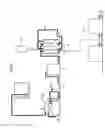
BRIEF ILLUSTRATION OF DRAWINGSFIG. 1 and FIG. 2 are illustrating views of a treatment of excrements from a pigshed.
FIG. 3 and FIG. 4 are illustrating views of ozone treatment and
FIG. 5 is an illustration view of a ray treating chamber, wherein, (a) is an upright style chamber and (b) is a lateral style chamber.
DESCRIPTION OF THE PREFERRED EMBODIMENTThe present invention will be illustrated more in detail.
In the present invention, the terms of waste fluid and raw solution indicate a liquid which can be a ringleader of sludge or pollution, specifically said terms indicate waste wash water from cattle-shed, urine of domestic animals, waste water from foods processing or waste water from a butchery. Further, said terms indicate waste canned coffee of over relishing period, waste fluid from Shochu production process, waste fluid from Sake production process or waste fluid from all other beverage production process. The present invention is a method for clarification of these waste fluid-raw solution to the admitted environmental standard value level.
In the present invention, waste fluid-raw solution is separated to solid and liquid by a solid-liquid separator, and separated solid is used as organic fertilizer or as soil conditioner.
The separated liquid is treated by an ozone treatment by following conditions. That is, ozone is added to waste fluid-raw solution by 3.ONm3/H flow rate at normal temperature. The flow rate of ozone to be added can be changed according to shape or capacity of a tank. For example, by 1.2 Nm3/H, 1.5 Nm3/H-8.0 Nm3/H or by 0.3 Nm3/H-9.0 Nm3/H. For the purpose to improve the effect of ozone reaction, the shape of reaction tank is designed so as the raw solution to be easily flown by convection. Further, ozone is added from lower position of the reaction tank, and for the purpose to improve reaction effect, an ozone discharging nozzle is processed to have star like shape. By processing the discharging nozzle to have star like shape, ozone bubbles are granulated more finely and enter between particles of the solution so as to accelerate the ozone reaction. Although the time necessary for ozone treatment changes according to the amount of the solution to be treated, however, is approximately from 30 to 90 minutes.
Specific ray is irradiated to waste fluid-raw solution which is treated by ozone treatment. The wavelength of specific ray differs slightly according to power of source, and the irradiation of ultraviolet ray of 165 nm-225 nm wavelength or near-ultraviolet ray of 225 nm-350 nm is carried out. Although irradiation time differs according to the kind of waste fluid-raw solution, approximately is from 60 minute to 90 minutes. By this irradiation, various fungi contained in stock solution are sterilized and pigments contained in stock solution are decomposed.
Either ozone treatment or specific ray treatment can be carried out first, or ozone treatment or specific ray treatment can be carried out alternatively and repeatably. As a method for specific ray irradiation treatment, Raw urine liquid is sprayed misty or foggy, or wet wall method can be used too. Or, raw urine liquid can be introduced from lower position of a specific ray treatment tank, which is specially processed, and can be reacted with irradiation by flowing to upper side by back eddy method using flowing water of 40 L/min. Further, ozone treatment or specific ray treatment can be carried out simultaneously by using a specially processed reaction tank. Aiming to remove decomposed product or extracted product formed by ozone treatment or specific ray treatment, liquid after ozone treatment or specific ray treatment is passed through a filtering apparatus. As a filter, activated carbon, clay, zeolite or sand can be used.
Above mentioned process is shown by a flow sheet in Table 1, and is illustrated more in detail.
| TABLE 1 |
- 1. Introduce liquid (waste fluid) which contains solids.
- 2. As the first step, said liquid is separated to liquid part and solid part. As a method for separation, any kind of a centrifuge, a screen separator or a separation by difference of specific gravity can be used. By a separator, since complete separation of 100% is impossible, liquid after separation (waste fluid) is filtrated. As the method for filtration, filter press, screw press, natural filtration, suction filtration or vacuum filtration can be used. Solid part is used as a soil conditioner.
- 3. Liquid after solids are removed (waste fluid) is transferred to a treatment tank. By passing through a specially processed liquid•ozone gas mixing device, which is equipped to the lower position of the treatment tank, fine granulation of liquid and ozone is carried out (refer to FIG. 3). Make the liquid form a suited state to be decomposed easily by ozone reaction and by next process. During the reaction, the liquid is stirred by a stirrer equipped to the top of the tank. When the rotating speed of the stirrer is fixed to 150 -300 r.p.m., good reaction effect can be accomplished.
- 4. Liquid (waste fluid) which is treated by ozone treatment is transferred to a specific ray treatment chamber. Upright style chamber or lateral style chamber can be mentioned as a specific ray treatment chamber, and easier type for use can be selected according to the place where the chamber is set (refer to FIG. 5). Spiral shape liquid guide plate of 50 pitches from entrance to exit is set up to inside of the chamber and the liquid (waste fluid) to be treated is discharged by rotating. A ray source lamp is set up in the inside of the chamber. Numbers of the ray source lamp can be changed according to the quantity of liquid (waste fluid). For example, when quantity of liquid to be treated is 10 t/day, numbers of the ray source lamp are 12, when quantity of liquid to be treated is 20 t/day, numbers of the ray source lamp are 21, that is, can meet from small quantity to large quantity. The liquid is decomposed by the ray having specific wavelength mentioned above by rotating and becomes harmless and is discharged from an outlet.
- 5. Liquid (waste fluid) after ray treatment is filtrated. As a method for filtration, filter press, screw press, natural filtration or vacuum filtration can be used. As a filter, activated carbon, activated clay, zeolite or diatomaseous earth can be used.
- 6. After all of these processes are over, all standards based on “Water Pollution Control Law” are cleared and it becomes possible to discharge the liquid from an outlet. Further, the liquid (waste fluid) after treated can be used as washing water in a factory.
As an Example of the present invention, treatment of excrements from a pigshed shown in FIG. 1 and FIG. 2 is illustrated. This example is characterized that ozone treatment and specific ray treatment are carried out simultaneously (end parts of pipe a, b, c and d of FIG. 1 are joined with a, b, c and d of FIG. 2).
(1) Raw Excrements Tank
Excrements of a pigshed and wash water from a pigshed are gathered together in a raw excrements tank (1), which is buried in underground. The gathered raw excrements are pumped up and transferred to a solid-liquid separator (2).
(2) Solid-Liquid Separating Apparatus
Liquid transferred from underground stock tank is separated to solid part and liquid part by a solid-liquid separator (2) which rotates by high speed. The solid part is discharged from an outlet (2-1) and is recovered as a soil conditioner whose nitrogen content is small by a separated process. The liquid part is discharged from an outlet (2-2) and transported to No. 1 tank (3).
(3) No. 1 Tank
No.1 tank is a tank to be used as a stocker in which liquid part after solid-liquid separation is stored.
(4) No. 1 Filtering Apparatus
Aiming to remove small solids which can not be separated by solid-liquid separating apparatus (2), liquid is passed through No.1 filtering apparatus. The filter used in No. 1 filtering apparatus (4) is zeolite.
(5) No.2 Tank
After passed through No. 1 filtering apparatus, liquid part of excrements is recovered in No.2 stock tank (5).
(6) First Treatment Apparatus
Recovered liquid part of excrements in No.2 stock tank (5) is transported to first treatment apparatus (6). First treatment apparatus carries out ozone treatment and specific ray irradiation treatment simultaneously. This first treatment apparatus (6) is consisting of two reaction tanks which are formed to have an inclination of 35 degrees from 3/1 position of the tank to the bottom of tank. Liquid part of increments transported from tank No.2 is poured into these 2 tanks and full the tanks. Specific ray irradiation is carried out simultaneously with ozone blowing in. Aiming to improve the effect, the liquid part of excrements is stirred. A stirrer is equipped a propeller or a wire blush which are processed to have sawteeth shape at a pointed end of it, and granulate the liquid part of excrements to fine particles. At the bottom of the reaction tank, there is a nozzle to blow in ozone, which is processed to have star shape, and ultra fine bubbles of ozone is blown in from the nozzle and is mixed with ultra fine particles of liquid part of excrements. Thus ultra fine bubbles of ozone are mixed with ultra fine particles of liquid part of excrements and thus the reaction is accelerated.
The purpose of this process is to clarify the raw excrements by 60-70%.
(7) No.2 filtering apparatus (this process and after this process are shown in FIG. 2)
After first treatment is over, the liquid part of raw excrements is transported to No.2 filtering apparatus (7). Impurities which are separated and extracted at the first treatment (for example, nitrogen compound, phosphorus compound or particles of pigment) are removed. Filter which is used in this process is fine powder of activated carbon. As the other filters which can be used, clay or calcined zeolite can be mentioned.
(8) Second treatment apparatus
Liquid part of excrements (7) which have passed through No.2 filtering apparatus is transferred to second treatment apparatus. The shape of reaction tank of this apparatus is same as that of the first treatment apparatus. The purpose of this process is to clarify balanced 30-40% of raw excrements which is not clarified by the first treatment apparatus. Further, the method for treatment is same as that of first treatment. Time for treatment of this process is approximately 60 minutes.
Treating process of first treatment and second treatment are same, however, if the first treatment covers the second treatment, time for treatment becomes 6 hours longer and clarification ratio is not so good. By dividing to first treatment and second treatment, reaction can be carried out surely, time for treatment can be shortened and treating capacity can be improved.
(9) No.3 Filtering Apparatus
After second treatment is over, the liquid part of excrement is filtrated by No.3 filtering apparatus (9). In this process, impurities which is decomposed and extracted at second treatment is removed. Filter which is used in this process is 50% of fine powder of activated carbon and 50% of calcined zeolite. Further, clay or others can be used.
(10) No.3 tank
Tank No.3 (10) is a tank to store the liquid part of excrements which passed through No.3 filtering apparatus (9). Since the treated water stored in this tank is water which satisfies environmental standard value, it is possible to discharge the water to river. In the present invention, this treated water is reused as washing water for pigshed.
In drawings, (11) indicates an ozone generating device and (12) indicates oxygen generating device. Ozone which is generated in the ozone generating device is supplied to first treating apparatus and second treating apparatus. Further, (13) is a specific ray device and by ray generated in this device, raw excrements in first treating device and second treating device are irradiated.
Results after treated by above mentioned treatments are shown in Table 2.
| TABLE 2 | |||
| Water | |||
| Pollution | before | after | |
| Items | Control Law | treatment | treatment |
| hydrogen ion conc. pH | 5.8-8.6 pH | 5.1 (18° C.) pH | 5.1 (18° C.) pH |
| amount of suspended | 200 | mg/L | 150 mg/L | 4.9 mg/L |
| solid mg/L | ||||
| biological oxygen | 160 | mg/L | 8000 mg/L | 30 mg/L |
| demand mg/L | ||||
| chemical oxygen demand | 160 | mg/L | 2700 mg/L | 20 mg/L |
| mg/L | ||||
| nitrogen content mg/L | 120 | mg/L | 2200 mg/L | 60 mg/L |
| phosphorous content | 16 | mg/L | 240 mg/L | 10 mg/L |
| mg/L | ||||
| escherichia coli Mg/L | 3000 | /L | not measured | not detected |
Secondary, one example of ozone treating apparatus to be used in the present invention is illustrated according to FIG. 3. As shown in FIG. 3, a stirrer 35 is equipped at the center of inside of tank 31, object to be treated is introduced from lower position of the tank through a pipe 33 for example from a ray treatment apparatus and lead to top of the tank. Ozone, which is lead through pipe 32 from ozone generating device, is introduced to lower position of the tank and contacts with said object to be treated by countercurrent and is treated. And the treated object is introduced to next second treatment apparatus through pipe 34.
FIG. 4 shows another example of ozone treating apparatus used in the present invention. (a) is front view and (b) is side view. From an inlet 41 equipped to one end of cylindrical lateral style tank, object to be treated is introduced and flows in the tank drawing spiral locus toward another end. In the center of another end there is ozone inlet 42, from where ozone is introduced, contacts with the object to be treated and treated product 43 is discharged from outlet 43 located at the center of the tank.
FIG. 5 is an illustration view of a ray treating chamber, wherein, (a) is an upright style chamber and (b) is a lateral style chamber. As shown in FIG. 5, in the chamber, ray lamps 51 are arranged parallel and among each ray lamps a guide plate 53 is arranged spirally. Object liquid to be treated is introduced from entrance 52, flown along with the guide plate 53 and irradiated by ray lamp 51 and is discharged from outlet 54. Then is transported to next process.
APPLICABILITY FOR INDUSTRIAL USEAs mentioned above, since the present invention does not use chemicals at all, secondary waste product is not formed. Further, sludge is clarified by physical treatment, that is, ozone treatment and specific ray treatment, equipment investment and treatment cost can be reduced.
Claims
1. A method for clarification of sludge comprising, separating waste fluid-raw solution to solid and liquid by a solid-liquid separator and a first filtration apparatus, and treating the obtained liquid state product by an ozone treatment and a specific ray treatment simultaneously.
2. The method for clarification of sludge of claim 1, wherein the specific ray is a ray which has wavelength of the range from ultraviolet ray region to near-ultraviolet ray region.
3. The method for clarification of sludge of claim 1, wherein waste fluid-raw solution is wash water from a pigshed, a cowshed or a chicken house, or waste wash water from a butchery, or processed foods liquid of over relishing period, such as coffee, Sake or Shochu.
4. The method for clarification of sludge according to claim 1, wherein solid obtained by a solid-liquid separator and a first filtration apparatus is used as a soil conditioner.
5. An apparatus for clarification of sludge comprising, a clarification equipment of sludge consisting of a solid-liquid separator and a first filtration apparatus which separates waste fluid-raw solution, an ozone treating apparatus which carry out ozone treatment of the obtained liquid state product and a specific ray treatment apparatus which irradiates specific ray, wherein, said specific ray treatment apparatus comprises a guide plate so as the liquid state treated product to flow spirally between specific ray lamps arranged in parallel.
Images & Drawings included:



Sources:
- United States Patent and Trademark Office - verify current appl. status at the USPTO↗
Recent applications in this class:
- » 20250289744 2025-09-18
Treatment of Azoles - » 20250289743 2025-09-18
A WATER PURIFICATION SYSTEM AND A PROCESS THEREOF - » 20250276927 2025-09-04
Extracting Carbon Dioxide from Seawater Using Substrate-Induced Nucleation - » 20250270127 2025-08-28
System and Method for Recovering Waste Energy at Treatment Plants - » 20250263323 2025-08-21
WASTEWATER AND SLUDGE TREATMENT DEVICE AND METHOD - » 20250263322 2025-08-21
Methods and Systems of PFAS Destruction using UV Irradiation at 222 Nanometers - » 20250263321 2025-08-21
METHOD AND APPARATUS FOR TREATING NATURAL GAS AND OIL WELL WASTE WATERS FOR REMOVAL OF CONTAMINANTS AND DISSOLVED SOLIDS - » 20250256998 2025-08-14
THE CONTROL OF CONTINUOUS WATER TREATMENT - » 20250243097 2025-07-31
INTEGRATION OF WET AIR OXIDATION AND ELECTRO-OXIDATION METHODS FOR THE DESTRUCTION OF PER- AND POLYFLUORINATED ALKYL SUBSTANCES (PFAS) - » 20250243096 2025-07-31
Microfluidic Synthesis and Crystallization of Pollutants