Remote forcible entry tool
US20080105447A1
2008-05-08
11/593,201
2006-11-03
Abstract:
The present invention provides a device which will provide a remotely activated forcible entry device. The device has retractable parts to reduce bulk of the device when in transit. The Device is lighter than traditional battering rams and is used to breach a conventional door without putting emergency personnel in the line of fire. The device uses traditional cartridges to apply force to the doorway without any specialist training.
Interested in similar patents?
Get notified when new applications in this technology area are published.
Classification:
A62B3/005 » CPC main
Devices or single parts for facilitating escape from buildings or the like, e.g. protection shields, protection screens; Portable devices for preventing smoke penetrating into distinct parts of buildings Rescue tools with forcing action
B25D17/28 IPC
Details of, or accessories for, portable power-driven percussive tools Supports; Devices for holding power-driven percussive tools in working position
Description
CROSS REFERENCE TO RELATED APPLICATIONS
This application claims the priority benefit of U.S. Provisional patent application Ser. No. 60/695,813, filed Jul. 1, 2005.
| CROSS-REFERENCE TO RELATED APPLICATIONS: |
| 2490684 | April, 1946 | Gosselin. | |
| 3219316 | May, 1964 | Fried. | |
| 4657225 | April 1987 | Hoehn et al. | |
| 4681171 | July 1987 | Kee et al. | 173/90 |
| 4783053 | November 1988 | Yirmiyahu | |
| et al. | |||
| 4960265 | October 1990 | Nichols | |
| 5088174 | February, 1992 | Hull | 29/275. |
| 5167043 | December 1992 | Lopez et al. | 29/254 |
| 5177850 | January, 1993 | Hull et al. | 29/254 |
| 5415241 | May, 1995 | Ruffu et al. | 173/212 |
| 6035946 | March 2000 | Studley, et al. | 173/90, 173/91, 173/128 |
STATEMENT REGARDING FEDERALLY SPONSORED RESEARCH OR DEVELOPMENT
Not Applicable
BACKGROUND OF THE INVENTION
In emergency situations where access into a building or room is critical, such as to save lives or property, for example, gaining access through locked, jammed, or otherwise secured doors must be accomplished as rapidly as possible in order to protect human life and to preserve evidence for use in prosecuting unlawful acts. Currently, the procedures in use to gain entry through locked or jammed doors that open inward is to use a battering ram or heavy hammer to destroy the door. In certain circumstances the use of explosives are sanctioned. Current procedures in use today take too much time and place personnel in the direct line of fire when the door is breached or require specialists trained in explosives. Thus, it is desirable to have a tool that can be remotely operated and will enable emergency personnel faster entry and egress through such doors without the use of explosive specialists.
Current devices fail in 6 major areas:
-
- 1) Place personnel in the line of fire.
- 2) Unacceptable weight and complexity.
- 3) Unacceptable size.
- 4) Time consuming setup/installation.
- 5) Too expensive.
- 6) Require specialists training for use.
BRIEF SUMMARY OF THE INVENTION
The Remote forcible entry tool is a remote activated device to assist in the forced entry of commercial and residential doors for the emergency services. An explosive cartridge with a primer is used to power a hammer to strike key points on a conventional door. The device is place with its foot under the door and the hammerhead placed perpendicular to the door and aligned to strike the lock or hinges. The device is actuated by the mechanical striking of the cartridge primer via a pull cord from a remote location.
BRIEF DESCRIPTION OF THE SEVERAL VIEWS OF THE DRAWING
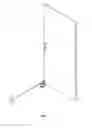
FIG. 1. front isometric view of door with battering ram in passive mode
FIG. 2. front isometric view of battering ram in active mode showing hammer striking a door.
FIG. 3. close up plan view of battering ram footplate.
FIG. 4 Section A-A.
FIG. 5. Isometric view of battering ram in the striking position showing the barrel assembly removed for insertion of explosive charge
DETAILED DESCRIPTION OF THE INVENTION
An apparatus for providing the ability to remotely breach a regular door whilst keeping personnel out of the line of fire. The device consisting of a footplate whereas the front of the plate is placed under a door. A telescoping pivoting arm connected to the center of the footplate perpendicular to the door with a weighted mass at the far end from the footplate. A removable sleeve arrangement perpendicular to the footplate and to the rear of the pivot arm. A rod running underneath and perpendicular of the pivot arm and in a position as to be inserted into the sleeve arrangement when the pivot arm is lowered. The sleeve arrangement consisting of a sleeve with a piston inside, topped by a cap with center hole of smaller diameter than the sleeve so as to maintain placement of the piston within the sleeve. A static firing pin protruding perpendicular to the foot plate central to the sleeve.
The leading edge of the footplate of the device is placed under a door. An explosive cartridge is placed within the sleeve with the primer facing downwards. The device can be activated by dropping the pivoting hammer, which in turn strikes the piston forcing the explosive cartridge onto the firing pin. The resulting explosion will force the piston and the pivoting hammer in an upward direction. This upwards force will be resisted by the pivot point thus directing the hammerhead in a circular trajectory and striking the door. The device is capable of being disassembled for transportation.
Claims
What I claim as my invention is:1. Remote forcible entry tool, comprising:
a) a footplate to be placed underneath a conventional door;
b) a pivot point connected to the footplate;
c) A hammer head connected to a telescopic handle;
d) a hammer connected to the pivot point on the footplate at the end of the handle;
e) a perpendicular rod connected to the telescopic handle pointing downwards;
f) a screw on barrel seated perpendicular to the footplate;
g) a static firing pin perpendicular to the footplate and central to the barrel;
Images & Drawings included:



Sources:
- United States Patent and Trademark Office - verify current appl. status at the USPTO↗
Recent applications in this class:
- » 20250065156 2025-02-27
MULTI-PURPOSE WEDGE TOOL - » 20250058152 2025-02-20
TOOL FOR CUTTING SHEET METAL - » 20250050140 2025-02-13
Vehicle Seat Belt Fastening Device - » 20250001220 2025-01-02
PORTABLE TOOL FOR MOBILE USE - » 20240278043 2024-08-22
GLASS BREAKER - » 20240216720 2024-07-04
Glass breaking tool - » 20230330447 2023-10-19
RESCUE ACCESS WEDGE - » 20230330446 2023-10-19
Multi-use rescue access bar - » 20230211188 2023-07-06
Portable electric rescue tool - » 20230129231 2023-04-27
Attachment for hydraulic ram rescue tool