Tethered iso-kicker
US20080108485A1
2008-05-08
11/592,840
2006-11-03
Abstract:
An isokinetic device for exercising the leg of a kicker, the device comprising a static member and an elastic member removably attached to the kicker's leg. The static member provides a reactive force in opposition to leg motion of the kicker, the elastic member transmitting the reactive force to the leg of the kicker, thereby providing exercise to the kicker's leg.
Interested in similar patents?
Get notified when new applications in this technology area are published.
Classification:
A63B69/0086 » CPC main
Training appliances or apparatus for special sports; Means for releasably holding a ball in position; Balls constrained to move around a fixed point, e.g. by tethering; Balls tethered to a line or cord the line or cord being attached to the user
A63B21/0552 » CPC further
Exercising apparatus for developing or strengthening the muscles or joints of the body by working against a counterforce, with or without measuring devices using resilient force-resisters extension element type Elastic ropes or bands
A63B21/4011 » CPC further
Exercising apparatus for developing or strengthening the muscles or joints of the body by working against a counterforce, with or without measuring devices; Interfaces with the user related to strength training; Details thereof; Arrangements for attaching the exercising apparatus to the user's body, e.g. belts, shoes or gloves specially adapted therefor to the lower limbs
A63B23/04 » CPC further
Exercising apparatus specially adapted for particular parts of the body for limbs, i.e. upper or lower limbs, e.g. simultaneously for lower limbs
A63B21/00069 » CPC further
Exercising apparatus for developing or strengthening the muscles or joints of the body by working against a counterforce, with or without measuring devices; Mechanical means for varying the resistance Setting or adjusting the resistance level; Compensating for a preload prior to use, e.g. changing length of resistance or adjusting a valve
A63B21/002 » CPC further
Exercising apparatus for developing or strengthening the muscles or joints of the body by working against a counterforce, with or without measuring devices isometric or isokinetic, i.e. substantial force variation without substantial muscle motion or wherein the speed of the motion is independent of the force applied by the user
A63B21/0442 » CPC further
Exercising apparatus for developing or strengthening the muscles or joints of the body by working against a counterforce, with or without measuring devices using resilient force-resisters attached to static foundation, e.g. a user Anchored at one end only, the other end being manipulated by the user
A63B21/285 » CPC further
Exercising apparatus for developing or strengthening the muscles or joints of the body by working against a counterforce, with or without measuring devices; Devices for two persons operating in opposition or in cooperation in cooperation
A63B2071/026 » CPC further
Games or sports accessories not covered in groups - for large-room or outdoor sporting games; Supports, e.g. poles stabilised by weight
A63B2208/0204 » CPC further
Characteristics or parameters related to the user or player posture Standing on the feet
A63B2243/007 » CPC further
Specific ball sports not provided for in -; Rugby; American football American football
A63B21/02 IPC
Exercising apparatus for developing or strengthening the muscles or joints of the body by working against a counterforce, with or without measuring devices using resilient force-resisters
Description
FIELD
The present invention comprises an exercise and strengthening device for a kicker; more specifically, the present invention comprises an anchored, elastic device that is tethered to a kicker's leg.
BACKGROUND
In many sports, such as American or Canadian football, rugby and “soccer” (European football), a ball is used as the object of play. In these sports, kicking the ball, when in play, either advances play or scores points for the team of the ball's kicker.
A punt is a play in Canadian football and American football in which the football is kicked downfield to the opposing team. In contrast, a drop punt in Australian Rules Football is a precise kick downfield, usually to a player on the same team. A punt involves kicking the ball from a standing position after it has been snapped (usually a long snap). The purpose is to increase the distance that the opposing team must advance the ball in order to score a touchdown or a field goal.
A field-goal is a different type of ball-kicking. A field-goal is a scoring play worth three points that involves a kicker kicking the ball through the uprights of the goalpost in the opponent's end zone from anywhere on the field. Generally, teams will attempt field goals on fourth down when they feel they are within reasonable distance of the goalpost in the opponent's end zone.
SUMMARY
Herein is disclosed an isokinetic device for exercising and strengthening the leg of a kicker. The device comprises a static member and an elastic member removably attached to the kicker's leg. The static member, resting upon the kicking surface, comprises a mass that generates a force in opposition to the kicking force produced by the kicker, the opposition force transmitted from the static member through the elastic member to the leg of the kicker.
In a preferred embodiment, the device comprises: (1) a container for containing mass, the container resting upon a kicking surface behind the kicker; (2) an elongated elastic tether, the tether having a strap or the like serving as a means for attachment, the strap attached to the kicker's leg, whereby the container with mass transmits a force in opposition to the kicking motion of the kicker's leg.
The isokinetic device has several desirable objectives and benefits deriving from its use, the first of which is the device thoroughly and completely exercises the leg of the kicker, exercising precisely those muscles used to kick a ball.
A second benefit is the device can be used by a kicker alone, or the elastic tether can be held by someone cooperating with the kicker.
A third benefit is the container may be emptied and filled as required to ease carrying to and from a practice field.
A fourth benefit is the device is compact and lightweight and may be transported easily.
The benefits and advantages of the invention will appear from the disclosure to follow. In the disclosure reference is made to the accompanying drawing, which forms a part hereof and in which is shown by way of illustration a specific embodiment in which the invention may be practiced. This embodiment will be described in sufficient detail to enable those skilled in the art to practice the invention, and it is to be understood that other embodiments may be utilized and that structural changes may be made in details of the embodiments without departing from the scope of the invention.
BRIEF DESCRIPTION OF DRAWING
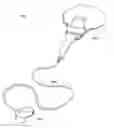
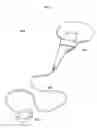
FIG. 1 shows the isokinetic device comprising the static member and the elastic member having a strap, loop or the like for attaching to the kicker's leg.
FIG. 2A shows the static member for anchoring the isokinetic kicking exercise device.
FIG. 2B illustrates the static member showing facilities for adding and subtracting mass.
FIG. 3 is another view of the static member showing a traction pad for increasing drag.
DETAILED DESCRIPTION
An Exemplary Embodiment
With reference to FIG. 1, an isokinetic device 1000 for exercising a kicker's leg. The device comprises a static member 1100, attached thereto an elastic member 1200, the elastic member 1200 attached to the kicker's leg by a strap 1300, loop or an attachment means of the like.
Referring to FIG. 1, the static member 1100 is placed on the kicking surface behind the kicker. When the kicker executes a kicking motion, an opposing force is transmitted from the static member 1100 though the elastic member 1200, as a tether, to the kicker's leg. The opposing force resists action by the kicker's leg muscles, thereby exercising the kicker's leg. The elastic member 1200 is configured to provide a counter-force of magnitude sufficient to provide useful exercise, yet will not cause improper kicking motion. In one embodiment, the tether 1100 is attached to a kicker's leg by means of a strap 1250, band or the like.
Optionally, the tether 1200 may be detached from the static member 1100 and held by someone, or may be attached to another static object.
FIG. 2A shows the static member 2100 as it will lay on the kicking surface. The static member 2100 may be a solid or composite object, or may comprise a sack, holder, container 2120 or the like for holding mass, which may, optionally, be added and removed, as needed.
As an example, with reference to FIG. 2B, the essential part of the static member 2100 comprises a container 2120, in the form of a sack, or the like and a plenum 2140. The plenum 2140 accepts or releases mass, in the form of fluids, sand, dirt, or any other materials that are granular and may be poured. The plenum 2140, may optionally, have a port 2160 through which mass may be added or released. The port 2160 has a removable plug or the like, wherein the plug seals the port 2160 and prevents passage of mass from the plenum 2140.
FIG. 3 shows the static member 3100 with the bottom surface 3180 having a strap 3182 and a traction pad 3284 for increasing frictional forces between the static member 3100 and the kicking surface. The traction pad 3184 may comprise a rough surface, or a surface having projections, or cleats. The strap 3182 may be unstrapped in order to expose the rough surface of the traction pad 3184.
In one use, with reference to FIG. 3, the strap 3182 is left in place to provide resistance that is consistent with the resistance a kicker encounters when kicking a ball. When the strap 3182 is removed to expose the traction pad 3184, and to provide the kicker with more resistance and a different exercise.
DISCLOSURE SUMMARY
A single exemplary embodiment of the invention has been disclosed. It will be appreciated that the embodiment and its variant are directed to an isokinetic device for exercising a kicker's leg. Given the exemplary embodiment and variants of the embodiment that may be construed, the full scope and description of the invention is given by the claims that follow.
Claims
1. An isokinetic device for exercising the leg of a kicker, the device comprising:
a static member providing a reactive force in opposition to leg motion of the kicker;
an elastic member attached to the static member for transmitting the reactive force to the leg of the kicker, wherein the elastic member is removably tethered to the kicker's leg.
2. The device of claim 1, wherein the static member comprises a mass that rests upon the kicking surface behind the kicker.
3. The device of claim 2, wherein the static member comprises an enclosure containing material particles.
4. The device of claim 3, wherein the enclosure has an opening so that the material particles may be added to or removed from the enclosure.
5. The device of claim 2, wherein the static member comprises an enclosure to which a liquid may be added or removed.
6. An elastic tether for attaching to a kicker's leg, the tether having a static member resting behind the kicker, whereby the force of the kicker's leg is transmitted through the tether to the static member, the tether and static member opposing the force of the kicker's leg.
7. The elastic tether of claim 6, wherein the static member may be moved to cause differing opposition forces to be transmitted to the kicker's leg.
8. (canceled)
9. An exercise device for a kicker, wherein the device is attached to the kicker's leg, the device comprising:
an elastic tether, the tether having at one end a strap or the like, the strap removably attached to the kicker's leg; and
a static anchor placed behind the kicker, the static anchor attached to the tether;
whereby the anchor creates an opposing force to a kick, the opposing force transmitted to the kicker's leg through the tether.
10. The device of claim 9, wherein the static anchor comprises a handle or the like that is held by a person standing behind the kicker.
Images & Drawings included:


Sources:
- United States Patent and Trademark Office - verify current appl. status at the USPTO↗
Recent applications in this class:
- » 20210031090 2021-02-04
Football Practice Apparatus - » 20200384332 2020-12-10
Dribbling Practice Assembly - » 20180071607 2018-03-15
Training apparatus for ball-playing sports - » 20180028889 2018-02-01
Training equipment comprising harness for ball training - » 20160375336 2016-12-29
CATCH AND THROW BALL TRAINING DEVICE - » 20160310815 2016-10-27
ELASTIC TETHERED PRACTICE BALLS - » 20140329622 2014-11-06
Tethered Ball Trainer - » 20120100966 2012-04-26
Ball-hitting glove assembly for boxing training - » 20110319202 2011-12-29
Football training device system - » 20100210426 2010-08-19
TRAINING DEVICE FOR SPORTSMEN AND CHILDREN