Shoe
US20080110046A1
2008-05-15
11/795,058
2005-01-11
Abstract:
Shoe with slipper function both open and closed, of the type realised by means of perimetrical sewing (3) of the upper (2) on the sole (1), having the following characteristic: I—use of an elastically yielding flexible expanded plastic material sheet with alternatively variable thickness >2 mm and <8 mm, pierced (F) and bossed on its surface (e) and ribbed (i) on the opposite surface, the piercings being made in the thinness zones and then alternated by bossings (e); II—punching of said sheet in soles (1) and uppers (2); III—perimetrical sewing at the sole edge (3) of the upper (2) to the sole (1); IV—with the characteristic that said bossings (c) are placed towards the outside of the shoe both for the sole (1), thus toward the, floor, and for the upper, thus towards outside.
Interested in similar patents?
Get notified when new applications in this technology area are published.
Classification:
A43B5/08 » CPC main
Footwear for sporting purposes Bathing shoes ; Aquatic sports shoes
A43B3/101 » CPC further
Footwear characterised by the shape or the use; Low shoes, e.g. comprising only a front strap ; Slippers Slippers, e.g. flip-flops or thong sandals
A43B3/12 IPC
Footwear characterised by the shape or the use Sandals; Strap guides thereon
A43C13/00 IPC
Wear-resisting attachments
Description
OBJECT
This invention refers to a shoe according to the preamble of the main claim.
USE
The destination is that of footwear, substantially though not exclusively for household use.
BACKGROUND ART
In the present state of the art the use of footwear for household use e.g. slippers is known, both open and closed (e. g. full-foot). For domestic use, the use at home, in hotels like for bedrooms, etc.
Not excluding however the use in surroundings with smooth comfort floor e.g. in swimming pools etc.
These shoes or slippers (with slippers in this description not only open-back ones - heel - are meant, but also closed-back ones, like full-foot shoes), are generally made of fabric, both for putting them on easily and for perspiration.
DRAWBACKS
The existing types of slippers solve their problems but are expensive and their destination of use is limited. For example those in cloth cannot be used in swimming pools, etc.
AIM OF THIS INVENTION
The aim of this invention is not only to realize an inexpensive slipper, but also a comfortable, breathable, light, anti-skid, anti-mould one (germs easily take root in tissues or clothes).
The problem is solved with the characteristics of main claim.
The subclaims represent preferred solutions.
ADVANTAGES
In this way the following advantages are obtained:
-
- Low cost together with acceptable quality for the destination;
- Breathable, thanks to the multi-perforation both on the sole and on the outsole;
- Anti-sweat, thanks to the presence of the internal light undulation (deriving from ribs of the polyester net) that precludes full contact with the leather;
- Flexible and yielding, thanks to the sponginess of the expanded plastic material;
- Resistance, thanks to the used material expanded PVC with polyester net.
- Non-skid, thanks to the external bossing, extended also to the sole in its underlying surface;
- Anti-mould thanks to the type of material and antibacterial treatment;
- Heat-resisting, thanks to the type of used material, up to 80° C.
- Ecologic, thanks to the non-polluting material;
- Elastic, thanks to the sponginess of the material.
DETAILED DESCRIPTION OF AN EMBODIMENT
The invention will be now explained in greater detail with the help of the enclosed figures wherein:
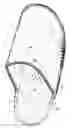
FIG. 1 represents a perspective view of an open-back slipper;
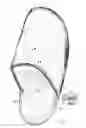
The FIG. 1A represents a section in enlarged section of the single material that constitutes the slipper and that when sewn forms the slipper both as sole and as upper, as there is no differentiation of the same between sole and upper.
DETAILED DESCRIPTION OF THE FIGURES
As can be seen in the figures, that represent the open slipper (but obviously it could be also closed to contain the heel), only one PVC expanded sheet material with polyester net is used, pierced (F) and bossed (e) on one surface and undulated (i) on. the opposite one (FIG. 1A), as base material obtained according to the realization technical notes of pierced expanded flexible materials and bossed non-tissues.
The sheet is cut in the form of a sole (1) and in outsole form (2) and the upper (2) is sewn (3) on the sole (1) as from known art but minding that the bossed surface (and) is placed outwards, is therefore under the sole (1 ) and above the upper (2).
In this way in a very simple and inexpensive form the slipper is obtained, that results consequently pierced (F) both on the upper (2) and on the sole (1 ) and therefore perfectly breathable, non-skid etc. as mentioned above.
The perimetrical seam (3) is extended to the whole border of the sole (1) also beyond the upper (2). In this way a greater strength and resistance of the slipper is obtained.
Advantageously the sewing is carried out also along the free edge of the upper (21). In this way greater resistance is provided to the slipper, avoiding the enlarging of the material by forcing the instep.
Advantageously before the perimetrical sewing, a slice of tissue is applied to cover over and under the edge or edges to be joined or the only edge to be strengthened. In this way there is the advantage of having to be strengthened. In this way there is the advantage of having a better rounded off slipper and robust by means of the perimetrical framework of the slice with respective seam (solution not illustrated but clearly intuitable and known to those skilled in the art of reinforcing the sewing and edges of yielding and flexible non woven materials).
Advantageously the material is treated superficially with known art anti-mould protection.
To obtain the desired material section the following parameters will be applied: thickness alternatively variable >2 mm and <8 mm. Advantageously max thickness 5-6 mm.
Claims
1: Shoe with slipper function both open and closed, of the type realized by means of perimetrical sewing (3) of the upper (2) on the sole (1), comprising the following characteristics:
I—use of an elastically yielding flexible expanded plastic material sheet with alternatively variable thickness >1 mm and <8 mm, pierced (F) and bossed on its surface (e) and ribbed (i) on the opposite surface, the piercings being made in the thinness zones and then alternated by bossings (e);
II—punching of said sheet in soles (1) and uppers (2);
III—perimetrical connection at the sole edge (3) of the upper (2) to the sole (1);
IV—with the characteristic that said bossings (e) are placed towards the outside of the shoe both for the sole (1), thus toward the floor, and for the upper, thus towards outside.
2: Shoe according to claim 1, wherein said thickness is min >2 and max 5-6 mm.
3: Shoe according to claim 1, wherein the perimetrical sewing is extended to the whole edge of the sole (3).
4: Shoe according to claim 1, wherein the sewing is carried out also along the free edge of the upper (21).
5: Shoe according to claim 1, wherein before the perimetrical sewing, a slice of tissue to cover over and under the edge/s to be joined or not is applied.
Images & Drawings included:
Sources:
- United States Patent and Trademark Office - verify current appl. status at the USPTO↗
Similar patent applications:
- » 20190070529
Filling shoe, a filling shoe arrangement having such a filling shoe, a filter medium assembly having such filling shoe arrangements, and a method for providing a filter medium with such a filling shoe - » 20190328085
Method for fastening a shoe, in particular, a sports shoe, and shoe, in particular sports shoe - » 20140230278
Ankle Flexi System for Soccer shoes, Football shoes, Baseball Shoes, Speed skates skateboard, Ice skates and Hockey shoes. - » 20060201011
Foot tilt angle measuring method, method of selecting shoe or insole for shoe method of manufacturing shoe or insole for shoe, and foot unit tilt angle measuring device - » 20070056189
Ankle protection system for soccer shoes, football shoes, baseball shoes, speed skates skateboard and ice skates shoes - » 20190327950
ANIMAL SHOE, IN PARTICULAR AN ORTHOPEDIC SHOE FOR ANIMAL FEET FOR THE RELIEF OF LAME CLOVEN-HOOFED ANIMALS, AND SHOE BASE AND KIT FOR SUCH AN ANIMAL SHOE - » 20170006962
Shoe sole, insole of shoe, main sole of shoe, and shoe - » 20150013194
Shoe sole, shoe with such a shoe sole and method for the production of such a shoe sole - » 20190082787
Shoe sole, insole of shoe, main sole of shoe, and shoe - » 20220333305
METHOD FOR OPERATING A SHOE PRESS, SHOE PRESS, MACHINE COMPRISING A SHOE PRESS, AND USE OF AN INK IN A LUBRICANT FOR A SHOE PRESS
Recent applications in this class:
- » 20220338594 2022-10-27
Shoe drainage system - » 20200275733 2020-09-03
Shoe drainage system - » 20200196702 2020-06-25
AQUA SHOE HAVING ANTI-SLIP STRUCTURE - » 20200085137 2020-03-19
Water and Pool Sock - » 20190350305 2019-11-21
Watersport boot - » 20180027920 2018-02-01
AQUA SHOE HAVING ANTI-SLIP STRUCTURE - » 20160302515 2016-10-20
Article of footwear for rowing - » 20160051005 2016-02-25
Nozzle shoe - » 20150264996 2015-09-24
Water Shoe - » 20150164177 2015-06-18
Nozzle shoe