Method for producing hydrogen and power from a synthesis gas
US20080134686A1
2008-06-12
11/793,315
2005-12-21
✅ Patent granted
US 8,257,452 B2
2012-09-04
WO; PCT/EP2005/013765; 20051221
WO; WO2006/066892; 20060629
Matthew Merkling
2028-07-08
Abstract:
The invention relates to a method for producing hydrogen and power from a synthesis gas that contains CO, H2 and H2S. The synthesis gas is separated into two partial streams, vapor is added to the first partial stream of synthesis gas, out a CO conversion is carried out at a temperature of 220° C. to 500° C., pure hydrogen is obtained from the converted synthesis gas in a pressure swing absorption device and a residual PSA gas is produced. The second partial stream of synthesis gas is fed to a power-generating gas turbine for combustion, H2S and optionally other sulfur-containing components are removed in one or more separators that are arranged in any position in the process, however, before entry into the gas turbine, the residual PSA gas is mixed with nitrogen, the gas mixture so obtained is compressed and the compressed gas mixture is admixed to the partial stream of synthesis gas that is fed to the power-generating gas turbine.
Assignee:
- KATHREIN-WERKE KG 180 🇩🇪 Rosenheim, Germany
- Uhde GmbH 162 🇩🇪 Dortmund, Germany
Interested in similar patents?
Get notified when new applications in this technology area are published.
Classification:
C01B6/24 IPC
Hydrides of metals including fully or partially hydrided metals, alloys or intermetallic compounds ; Compounds containing at least one metal-hydrogen bond, e.g. (GeH)S, SiH GeH ; Monoborane or diborane; Addition complexes thereof Hydrides containing at least two metals; Addition complexes thereof
C01B13/0248 » CPC main
Oxygen; Ozone; Oxides or hydroxides in general; Preparation of oxygen; Purification or separation processes Physical processing only
C01B2203/0283 » CPC further
Integrated processes for the production of hydrogen or synthesis gas; Processes for making hydrogen or synthesis gas containing a CO-shift step, i.e. a water gas shift step
C01B2203/043 » CPC further
Integrated processes for the production of hydrogen or synthesis gas containing a purification step for the hydrogen or the synthesis gas; Purification by adsorption on solids Regenerative adsorption process in two or more beds, one for adsorption, the other for regeneration
C01B2203/047 » CPC further
Integrated processes for the production of hydrogen or synthesis gas containing a purification step for the hydrogen or the synthesis gas; Composition of the impurity the impurity being carbon monoxide
C01B2203/0475 » CPC further
Integrated processes for the production of hydrogen or synthesis gas containing a purification step for the hydrogen or the synthesis gas; Composition of the impurity the impurity being carbon dioxide
C01B2203/048 » CPC further
Integrated processes for the production of hydrogen or synthesis gas containing a purification step for the hydrogen or the synthesis gas; Composition of the impurity the impurity being an organic compound
C01B2203/0485 » CPC further
Integrated processes for the production of hydrogen or synthesis gas containing a purification step for the hydrogen or the synthesis gas; Composition of the impurity the impurity being a sulfur compound
C01B2203/145 » CPC further
Integrated processes for the production of hydrogen or synthesis gas; Details of the flowsheet At least two purification steps in parallel
C01B2203/84 » CPC further
Integrated processes for the production of hydrogen or synthesis gas; Aspect of integrated processes for the production of hydrogen or synthesis gas not covered by groups - Energy production
C01B2210/0046 » CPC further
Purification or separation of specific gases; Impurity removed Nitrogen
C10J2300/093 » CPC further
Details of gasification processes; Details of the feed, e.g. feeding of spent catalyst, inert gas or halogens; Carbonaceous raw material Coal
C10J2300/0959 » CPC further
Details of gasification processes; Details of the feed, e.g. feeding of spent catalyst, inert gas or halogens; Gasifying agents Oxygen
C10J2300/16 » CPC further
Details of gasification processes Integration of gasification processes with another plant or parts within the plant
C10J2300/1618 » CPC further
Details of gasification processes; Integration of gasification processes with another plant or parts within the plant with gas treatment Modification of synthesis gas composition, e.g. to meet some criteria
C10J2300/165 » CPC further
Details of gasification processes; Integration of gasification processes with another plant or parts within the plant with conversion of synthesis gas; Conversion of synthesis gas to energy integrated with a gas turbine or gas motor
C10J2300/1668 » CPC further
Details of gasification processes; Integration of gasification processes with another plant or parts within the plant with conversion of synthesis gas; Conversion of synthesis gas to chemicals to urea ; to ammonia
C10J2300/1678 » CPC further
Details of gasification processes; Integration of gasification processes with another plant or parts within the plant with air separation
C10J2300/1846 » CPC further
Details of gasification processes; Details of the gasification process, e.g. loops, autothermal operation Partial oxidation, i.e. injection of air or oxygen only
Y02E20/16 » CPC further
Combustion technologies with mitigation potential Combined cycle power plant [CCPP], or combined cycle gas turbine [CCGT]
Y02E20/16 » CPC further
Combustion technologies with mitigation potential Combined cycle power plant [CCPP], or combined cycle gas turbine [CCGT]
Y02E20/18 » CPC further
Combustion technologies with mitigation potential; Combined cycle power plant [CCPP], or combined cycle gas turbine [CCGT] Integrated gasification combined cycle [IGCC], e.g. combined with carbon capture and storage [CCS]
Y02E20/18 » CPC further
Combustion technologies with mitigation potential; Combined cycle power plant [CCPP], or combined cycle gas turbine [CCGT] Integrated gasification combined cycle [IGCC], e.g. combined with carbon capture and storage [CCS]
C01B3/56 » CPC further
Hydrogen; Gaseous mixtures containing hydrogen; Separation of hydrogen from mixtures containing it ; Purification of hydrogen; Separation of hydrogen or hydrogen containing gases from gaseous mixtures, e.g. purification by contacting with solids; Regeneration of used solids
C01B3/48 » CPC further
Hydrogen; Gaseous mixtures containing hydrogen; Separation of hydrogen from mixtures containing it ; Purification of hydrogen; Production of hydrogen or of gaseous mixtures containing a substantial proportion of hydrogen by reaction of gaseous or liquid organic compounds with gasifying agents, e.g. water, carbon dioxide, air by reaction of hydrocarbons with gasifying agents followed by reaction of water vapour with carbon monoxide
C01B13/02 IPC
Oxygen; Ozone; Oxides or hydroxides in general Preparation of oxygen
C10J3/00 IPC
Production of combustible gases containing carbon monoxide from solid carbonaceous fuels
F02C3/28 IPC
Gas-turbine plants characterised by the use of combustion products as the working fluid using a special fuel, oxidant, or dilution fluid to generate the combustion products the fuel or oxidant being solid or pulverulent, e.g. in slurry or suspension using a separate gas producer for gasifying the fuel before combustion
C01B3/36 IPC
Hydrogen; Gaseous mixtures containing hydrogen; Separation of hydrogen from mixtures containing it ; Purification of hydrogen; Production of hydrogen or of gaseous mixtures containing a substantial proportion of hydrogen by reaction of gaseous or liquid organic compounds with gasifying agents, e.g. water, carbon dioxide, air by reaction of hydrocarbons with gasifying agents using oxygen or mixtures containing oxygen as gasifying agents
C01B3/24 IPC
Hydrogen; Gaseous mixtures containing hydrogen; Separation of hydrogen from mixtures containing it ; Purification of hydrogen; Production of hydrogen or of gaseous mixtures containing a substantial proportion of hydrogen by decomposition of gaseous or liquid organic compounds of hydrocarbons
B01J7/00 IPC
Apparatus for generating gases
Description
The invention relates to a process for generation of hydrogen and energy from synthesis gas. Processes of this type are suitable for chemical complex requirements, i.e. plants in which hydrogen is obtained as feedstock and which have a large number of consumers of electric power. A further application is specific to plants for ammonia production, which require large quantities of hydrogen for the ammonia production and which have a major requirement for mechanical energy needed for the compression of large gas amounts to a high pressure level.
Processes for a coupled generation of hydrogen and energy from synthesis gas using the conventional state of technology are known already; document DE 196 51 282 A1, for example, describes a process for the generation of raw hydrogen and electric energy from a hydrocarbon-bearing feedstock and/or coal in the IGCC process (IGCC—Integrated Gasification Combined Cycle) by means of a gas turbine. In this case, synthesis gas is first quenched with water, then at least a part stream of it undergoes a shift conversion and the gas obtained is split up if this was not done before, both part streams being subsequently subjected to a separate physical scrubbing. High-purity hydrogen can then be produced from the generated raw hydrogen in accordance with known processes.
This process, however, has the disadvantage that waste gases obtained by the high-purity hydrogen production cannot be exploited in this process. The objective of the invention, therefore, is to overcome the said disadvantage and to provide an efficient and energetically enhanced process.
The objective of the invention is achieved by performing the following procedure:
- The synthesis gas stream is split up into two part streams;
- Steam is added first to one of the synthesis gas part streams and the said part stream then undergoes a CO conversion at a temperature ranging from 220° C. to 500° C.;
- A pressure swing adsorption unit (PSA) is subsequently used to produce high-purity hydrogen from the converted synthesis gas, a PSA residual gas being obtained, too;
- The other synthesis gas part stream is fed to a gas turbine for being burned and generating energy;
- H2S and further sulphurous components, if any, are separated in one or several separation devices arranged at any point of the process configuration, but in any case upstream of the gas turbine inlet;
- The PSA residual gas is mixed with nitrogen;
- The gas mixture obtained is subsequently compressed and
- The compressed gas mixture is added to the synthesis gas part stream then fed to the energy-generating gas turbine.
In accordance with a particularly beneficial embodiment of the process, the portion of nitrogen added to the PSA residual gas preferably amounts to 80% of the mixture thus obtained.
Synthesis gas normally with the following contents is used as feed gas: approx. 60% CO, approx. 20% H2 and furthermore 20% N2, H2S, COS, H2O, HCN, CH4 and higher hydrocarbons which, however, were freed from noxious traces such as dust, HCl and NH3 or the said matter was removed in a wet scrubbing system. If the synthesis gas originates from partial oxidation and/or from a plant for gasification of liquid or solid feedstock, the said portions may vary depending on the feedstock, CO being in the range of 30 to 60% and H2 in the range of 20 to 50%. As a rule, synthesis gas is fed at a pressure of 20 to 80 bars upon having passed a thorough cooling operation directly after synthesis gas production normally taking place at temperatures ranging from 800 and 1600° C., thereby performing energy generation.
In a further embodiment of the process in accordance with the invention, the synthesis gas containing CO, H2 and H2S is produced from coal or hydrocarbons or carbon-bearing residues or mixtures thereof, in a partial oxidation with the aid of high-purity oxygen or oxygen-rich air.
In a further embodiment of the process in accordance with the invention, the oxygen to be used in the partial oxidation is supplied by an air fractionation unit and the nitrogen thus obtained as by-product is partially added to the PSA residual gas which originates from hydrogen separation.
At least the synthesis gas part stream intended to be directly used for electric power generation must be desulphurised prior to the power generation, the COS contained in the synthesis gas first being converted by catalytic COS hydrolysis to form H2S and C02. The major part of HCN is also converted. The process gas stream leaving the COS hydrolysis is normally cooled to ambient temperature. Subsequently the H2S contained in the process gas is removed by a selectively acting scrubbing process leaving a few ppm only.
The said desulphurisation of the part stream required for hydrogen generation can take place either upstream or downstream of the CO conversion. A process suitable for desulphurisation is described in document DE 42 06 943 A1. If, however, the desulphurisation is carried out downstream of the CO conversion, i.e. after branching off the part stream intended for hydrogen generation, at least two desulphurisation units will be required, at least one unit for each of the two part streams.
A further embodiment of the process in accordance with the invention, therefore, provides for a desulphurisation to be performed prior to splitting up into two part streams, one being required for hydrogen generation and the other one for energy generation in a gas turbine.
The ratio of the two streams after branching off may range from 1:2 to 2:1. However, it may also be variable in order to achieve the best ratio satisfying the market requirements.
The portion serving for hydrogen generation is mixed with steam in order to subsequently carry out a CO conversion also designed as CO shift, hence as Sweet Shift if desulphurisation has taken place before, or as Sour Shift if desulphurisation has not taken place. The quantity depends on the CO content of the synthesis gas and the amount to be added must be such that the process gas leaving the CO conversion unit has a minimum concentration of water vapour, e.g. 0.3 mol water vapour per mol gas.
In the CO conversion, CO is converted to H2 according to the following formula:
CO+H2OC02+H2 (1),
the temperature ranging from 220° C. to 500° C. The process fluid obtained is, for example, a gas with approx. 45% CO2, 50% H2 and a residual content of CO and N2, or a gas with 60% H2 and 35% C02 and a residual content of 3% CO and 2% N2.
The converted synthesis gas is subsequently fed to a pressure swing adsorption unit (termed PSA—Pressure Swing Adsorption) to generate high-purity H2 at a degree of purity of, for example, 99.8%. The PSA off-gas obtained is, for example, a gas with approx. 19% H2, 72% CO2, 7% CO and 1% of other gas components at low pressure, approx. 1.3 bar abs., for example.
The PSA off-gas is subsequently mixed with N2, the obtained mixture is compressed to the gas turbine pressure and upstream of the turbine, it is added to the synthesis gas part stream branched off before. This admixture serves to reduce the calorific value of the burning gas fed to the gas turbine, which helps to avoid temperature peaks during the burning of the gas in the gas turbine so that formation of NOx is minimised to the effect that this at least complies with the legal requirements.
This moderation is performed in accordance with the conventional state of technology, using nitrogen also obtained by the air fractionation process, oxygen being for example required in the gasification units. Nitrogen which is pressurised to the value of the gas turbine, is normally sent to a specific nitrogen compressor and the flow rate can be controlled such that in a given load range, the gas turbine can be operated in a work range favourable to ensure minimal NOx formation.
If, contrary to the method described above, the PSA off-gas is used with a substantially reduced portion of additional nitrogen to control the gas turbine moderation—compared to the turbine moderation exclusively with the aid of nitrogen, the following benefits can be achieved:
- The re-compression of PSA off-gas and nitrogen can be carried out by a single compressor. Compared to the gas turbine moderation with the aid of pure nitrogen, no extra costs are incurred with regard to the investment required nor operational costs.
- The calorific value of the PSA off-gas is perfectly converted at low energy in the gas turbine on account of the residual H2 and CO. The conversion is by far more efficient than, for example, an atmospheric post-combustion with integrated steam generation such as it is used in plants operated according to the conventional state of technology. Finally this leads to savings in feedstock for synthesis gas generation (coal, gas petroleum), which need not be off-set against any other expenditure such as in respect of an additional compressor or against higher operational costs for additional compression energy, which otherwise—as an option to PSA off-gas for the compression—would necessitate an accordingly larger amount of nitrogen.
- The air fractionation unit can be of the economical low-pressure type, the nitrogen simultaneously obtained by air fractionation being suitable for export at a pressure of approx. 1.3 bars, which equals the feed pressure of the PSA off-gas.
- If nitrogen is intended to be used for NH3 production, the lower N2 consumption permits savings in the overall production costs because more N2 becomes available for NH3 production.
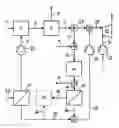
The invention is hereinafter illustrated on the basis of flowsheet FIG. 1 which shows the process in accordance with the invention, i.e. in a very simplified block diagram, encompassing the gasification, scrubbing, hydrogen generation and energy production; it is pointed out that the process described in the invention is not restricted to the typical embodiment shown here.
Partial oxidation 2 is used to produce synthesis gas 4 from coal 1 and oxygen 3, the synthesis gas 4 subsequently being treated in purification process 6 to remove undesired components, in particular sulphurous components 5. Purified synthesis gas 7 is then split up into two part streams in branch section 8.
Part stream 9 is mixed with steam 11 at feed point 10. Steam-enriched synthesis gas 12 is then fed to CO conversion unit 13 in which a hydrogen-rich synthesis gas is generated. After cooling of the gas downstream of the CO conversion, gas condensate 34 is separated from the process in condensate separator 34. Downstream pressure swing adsorption unit 15 is used to produce high-purity hydrogen 16 from hydrogen-rich synthesis gas 14, the said hydrogen 16 becoming available, for example, for an optional ammonia production unit 17 or for hydrocarbon hydrogenation in a refinery.
PSA off-gas 18 is mixed with a part of nitrogen 20 in mixer 19, the nitrogen being generated from air 23 in air fractionation unit 21, which even after a pressure rise in oxygen compressor 22 can supply oxygen 3 for partial oxidation 2. Replacing nitrogen by PSA off-gas permits, for example, a supply of additional nitrogen 24 to optional ammonia production unit 17.
Gas mixture 25 consisting of PSA off-gas 18 and nitrogen 20 first undergoes a pressurisation by nitrogen compressor 26 and is then added in mixer 28 to the other part stream 27 of the purified synthesis gas. Burning gas 29 thus obtained and air 31 compressed in air compressor 30 are burned in gas turbine 32, thereby generating energy. The mechanical shaft energy thus obtained is suitable for generating electric power and for driving the individual compressors needed and if there is an interconnected system of plant units, including an optional ammonia production unit 17, the compression energy required can be supplied by gas turbine 32, too.
The following design calculation example serves for further illustration, the stream numbers comply with FIG. 1 and all quantities involved are indicated in mol/h.
| Stream |
| 7 | 11 | 12 | 14 | 16 | |
| CO | 5186.4 | 0.0 | 3140.9 | 284.5 | 0.0 | |
| H2 | 4340.7 | 0.0 | 2628.7 | 5485.2 | 4662.4 | |
| CO2 | 398.4 | 0.0 | 241.3 | 3097.8 | 1.8 | |
| CH4 | 23.8 | 0.0 | 14.4 | 14.4 | 0.0 | |
| N2 | 32.3 | 0.0 | 19.6 | 19.6 | 0.0 | |
| Ar | 12.0 | 0.0 | 7.3 | 7.3 | 0.0 | |
| H2S | 0.4 | 0.0 | 0.3 | 0.3 | 0.0 | |
| COS | 0.2 | 0.0 | 0.1 | 0.1 | 0.0 | |
| NH3 | 0.0 | 0.0 | 0.0 | 0.0 | 0.0 | |
| HCN | 0.0 | 0.0 | 0.0 | 0.0 | 0.0 | |
| H2O | 21.5 | 9916.9 | 9930.2 | 10.2 | 0.0 | |
| Total | 10015.8 | 9916.9 | 15982.8 | 8919.3 | 4664.2 | |
| Stream |
| 18 | 20 | 25 | 27 | 29 | |
| CO | 284.4 | 0.00 | 284.4 | 2045.5 | 2330.0 | |
| H2 | 822.8 | 0.00 | 822.8 | 1712.0 | 2534.8 | |
| CO2 | 3096.0 | 0.00 | 3096.0 | 157.1 | 3253.1 | |
| CH4 | 14.4 | 0.00 | 14.4 | 9.4 | 23.7 | |
| N2 | 19.6 | 1800.00 | 1819.6 | 12.8 | 1832.3 | |
| Ar | 7.3 | 0.00 | 7.3 | 4.7 | 12.0 | |
| H2S | 0.3 | 0.00 | 0.3 | 0.2 | 0.5 | |
| COS | 0.1 | 0.00 | 0.1 | 0.1 | 0.2 | |
| NH3 | 0.0 | 0.00 | 0.0 | 0.0 | 0.0 | |
| HCN | 0.0 | 0.00 | 0.0 | 0.0 | 0.0 | |
| H2O | 10.2 | 0.00 | 10.2 | 8.19 | 18.4 | |
| Total | 4255.1 | 1800.0 | 6055.1 | 3949.9 | 10005.0 | |
| Stream | 34 | |
| CO | 0.0 | |
| H2 | 0.0 | |
| CO2 | 0.0 | |
| CH4 | 0.0 | |
| N2 | 0.0 | |
| Ar | 0.0 | |
| H2S | 0.0 | |
| COS | 0.0 | |
| NH3 | 0.0 | |
| HCN | 0.0 | |
| H2O | 7063.6 | |
| Total | 7063.6 | |
KEY TO REFERENCED ITEMS
- 1 Coal
- 2 Partial oxidation
- 3 Oxygen
- 4 Raw synthesis gas
- 5 Sulphurous components
- 6 Purification process
- 7 Purified synthesis gas
- 8 Branch section
- 9 Part stream
- 10 Feed point
- 11 Steam
- 12 Steam-enriched synthesis gas
- 13 CO conversion unit
- 14 Hydrogen-rich synthesis gas
- 15 Pressure swing adsorption unit
- 16 High-purity hydrogen
- 17 Optional ammonia production unit
- 18 PSA off-gas
- 19 Mixer
- 20 Nitrogen
- 21 Air fractionation unit
- 22 Oxygen compressor
- 23 Air
- 24 Nitrogen
- 25 Gas mixture
- 26 Nitrogen compressor
- 27 Part stream
- 28 Mixer
- 29 Burning gas
- 30 Air compressor
- 31 Compressed air
- 32 Gas turbine
- 33 Condensate separator
- 34 Gas condensate
Claims
1-5. (canceled)
6. A process for generation of hydrogen and energy from synthesis gas which contains at least CO, H2 and H2S, with the following procedure being performed:
the synthesis gas stream is split up into two part streams;
steam is added first to one of the synthesis gas part streams and the said part stream then undergoes a CO conversion at a temperature ranging from 220° C. to 500° C.;
a pressure swing adsorption unit (PSA) is subsequently used to produce high-purity hydrogen from the converted synthesis gas, a PSA residual gas being obtained, too;
the other synthesis gas part stream is fed to a gas turbine for being burned and generating energy;
H2S and further sulphurous components, if any, are separated in one or several separation devices arranged at any point of the process configuration, but in any case upstream of the gas turbine inlet;
the PSA residual gas is mixed with nitrogen;
the gas mixture obtained is subsequently compressed and
the compressed gas mixture is added to the synthesis gas part stream then fed to the energy-generating gas turbine.
7. A process according to claim 6, wherein the portion of nitrogen added to the PSA residual gas amounts to 80% of the mixture thus obtained.
8. A process according to claim 6, wherein the synthesis gas containing CO, H2 and H2S is produced from coal or hydrocarbons or carbon-bearing residues or mixtures thereof, in a partial oxidation with the aid of high-purity oxygen or oxygen-rich air.
9. A process according to claim 8, wherein the oxygen to be used in the partial oxidation is supplied by an air fractionation unit and the nitrogen thus obtained as by-product is partially added to the PSA residual gas which originates from hydrogen separation.
10. A process according to claim 6, wherein H2S and other sulphurous components, if any, are separated by means of just one separation device arranged in the process configuration upstream of the point where the splitting up into two part streams takes place.
Images & Drawings included:

Sources:
- United States Patent and Trademark Office - verify current appl. status at the USPTO↗
Recent applications in this class:
- » 20210300758 2021-09-30
System for preparing deeply subcooled liquid oxygen based on mixing of liquid oxygen and liquid nitrogen and then vacuum-pumping - » 20190169026 2019-06-06
Apparatus and method for separating liquid oxygen from liquified air - » 20090211443 2009-08-27
Self-serviceable filter for an oxygen generating device - » 20080011015 2008-01-17
System and apparatus for providing low pressure and low purity oxygen - » 20050137810 2005-06-23
Method of controlling production of a gaseous product
Recent applications for this Assignee:
- » 20190051974 2019-02-14
Shaft antenna system for mobile communication - » 20190036195 2019-01-31
High-frequency filter having a coaxial structure - » 20180262228 2018-09-13
Device for transmitting and receiving mobile radio signals by means of a stationary antenna - » 20180212298 2018-07-26
Threadless tuning elements for coaxial resonators, and method for tuning same - » 20180156919 2018-06-07
Device and method for generating and providing position information - » 20180062281 2018-03-01
Plug connector for making solder-free contact with a coaxial cable - » 20180041234 2018-02-08
Method for detecting and handling oscillations in a signal booster device, a signal booster device and a means of transportation comprising a signal booster device - » 20180034199 2018-02-01
Anti-kink protection assembly and method for installing the anti-kink protector - » 20170271764 2017-09-21
Multiband antenna - » 20170264021 2017-09-14
Dipole-shaped antenna element arrangement