Blocking device for preventing board connector mismating
US20080139010A1
2008-06-12
11/945,863
2007-11-27
✅ Patent granted
US 7,503,766 B2
2009-03-17
-
-
Tho D Ta
2027-11-27
Abstract:
In order to prevent the mismating of several daughterboards (2) that are combined into a plug-in unit (20) with corresponding board connectors (3) on a motherboard (1), it is proposed that the mating of the plug-in unit (20) is effectively prevented by means of a blocking block (10) that is inserted into an intermediate space between two board connectors (3) that are spaced apart from one another by a regular connector spacing and snapped into window-like recesses (4) of the board connectors (3).
Assignee:
- HARTING Electronics GmbH & Co. KG 3 🇩🇪 Espelkamp, Germany
Interested in similar patents?
Get notified when new applications in this technology area are published.
Classification:
H01R13/6456 » CPC main
Details of coupling devices of the kinds covered by groups or -; Means for preventing incorrect coupling by exchangeable elements on case or base comprising keying elements at different positions along the periphery of the connector
H01R12/7005 » CPC further
Structural associations of a plurality of mutually-insulated electrical connecting elements, specially adapted for printed circuits, e.g. printed circuit boards [PCBs], flat or ribbon cables, or like generally planar structures, e.g. terminal strips, terminal blocks; Coupling devices specially adapted for printed circuits, flat or ribbon cables, or like generally planar structures; Terminals specially adapted for contact with, or insertion into, printed circuits, flat or ribbon cables, or like generally planar structures; Coupling devices Guiding, mounting, polarizing or locking means; Extractors
H01R12/716 » CPC further
Structural associations of a plurality of mutually-insulated electrical connecting elements, specially adapted for printed circuits, e.g. printed circuit boards [PCBs], flat or ribbon cables, or like generally planar structures, e.g. terminal strips, terminal blocks; Coupling devices specially adapted for printed circuits, flat or ribbon cables, or like generally planar structures; Terminals specially adapted for contact with, or insertion into, printed circuits, flat or ribbon cables, or like generally planar structures; Coupling devices for rigid printing circuits or like structures co-operating with the surface of the printed circuit or with a coupling device exclusively provided on the surface of the printed circuit Coupling device provided on the PCB
H01R12/7082 » CPC further
Structural associations of a plurality of mutually-insulated electrical connecting elements, specially adapted for printed circuits, e.g. printed circuit boards [PCBs], flat or ribbon cables, or like generally planar structures, e.g. terminal strips, terminal blocks; Coupling devices specially adapted for printed circuits, flat or ribbon cables, or like generally planar structures; Terminals specially adapted for contact with, or insertion into, printed circuits, flat or ribbon cables, or like generally planar structures; Coupling devices Coupling device supported only by cooperation with PCB
H01R12/00 IPC
Structural associations of a plurality of mutually-insulated electrical connecting elements, specially adapted for printed circuits, e.g. printed circuit boards [PCBs], flat or ribbon cables, or like generally planar structures, e.g. terminal strips, terminal blocks; Coupling devices specially adapted for printed circuits, flat or ribbon cables, or like generally planar structures; Terminals specially adapted for contact with, or insertion into, printed circuits, flat or ribbon cables, or like generally planar structures
Description
BACKGROUND OF THE INVENTION
1. Field of the Invention
The invention pertains to a blocking device for preventing the mismating of daughterboards on a motherboard, particularly when several daughterboards are combined into a plug-in unit and at least two board connectors contact the motherboard.
A device of this type is required for preventing one or more daughterboards that are combined into a plug-in unit from being mated with a motherboard fitted with a large number of identical board connectors in regions of the motherboard which are not intended for this configuration and possibly causing system failures.
2. Description of the Related Art
Two different types of modular connectors can be mated with comprehensive backplane systems—i.e., large motherboards—that are fitted with identical board connectors assigned to a MicroTCA-system. One system is known under the name “Advanced Mezzanine Card” (AMCs) while another system is known as “Mezzanine with Auxiliary Connections” (Multitongue-AMCs) that also accommodates Micro-TCA-Carrier-Hub-Modules (MCHs).
The Multitongue-AMC-Modules are edge connectors with attached circuit boards, on which such a large number of signaling contacts is provided on the circuit card that at least two separate mating areas are required on the motherboard for the transmission of the signals.
Furthermore, if two daughterboards are combined, it may be necessary to provide three or four mating areas that transmit their signals to the backplane via an identical number of board connectors.
In this case, the combined daughterboards may be directly connected via their strip conductor ends in the form of edge connectors or mated with the board connectors on the motherboard by means of a so-called multi-board connector attachment.
This multi-board connector attachment is manufactured separately, connected to the circuit boards and contacts the board connectors on the backplane. Since the board connectors for the AMCs and the Multitongue-AMCs on the motherboard are identical but have different contact configurations, it needs to be ensured that mismating or the mating in impermissible board connector areas is prevented.
SUMMARY OF THE INVENTION
The invention therefore is based on the objective of preventing a plug-in unit consisting of several daughterboards from being mated in regions on the motherboard which are not intended for this plug-in unit.
This objective is attained in that a blocking block is inserted between two board connectors arranged within a regular connector spacing, in that snap-in tabs are provided on the blocking block, and in that the longitudinal sides of the board connectors feature window-like recesses, into which the snap-in tabs of the blocking block engage, wherein the blocking block prevents the mating of the plug-in unit in the form of combined daughterboards on the motherboard.
Two contacting options, in principle, are available for realizing the transmission of a large quantity of signals from one or more plug-type daughterboards to a motherboard, namely the direct mating between the strip conductor ends of the daughterboard with a board connector on the motherboard and the mating by means of an additional connector that is rigidly connected to the daughterboard and then mated with the board connector.
Once the number of signaling contacts that are arranged adjacent to one another or on top of one another in sandwich cards no longer suffices for realizing the transmission via one connector, one utilizes an interconnection of several staggered connectors that is also referred to as a multi-board connector attachment in this context.
Since identical board connectors on larger motherboards also have different contact configurations in many applications, it is possible that mismated daughterboards lead to complete system failures.
In order to block such mating areas, it is proposed to insert a blocking element that prevents the mismating of the plug-in daughterboard unit into the intermediate spaces of the regular connector spacing between the board connectors.
To this end, the longitudinal sides of the board connectors on the backplane or motherboard are preferably provided with window-like recesses that are formed by longitudinal ribs and intersecting cross-ribs.
Furthermore, the blocking elements advantageously feature flexible snap-in tabs that engage on the longitudinal ribs during the insertion between two board connectors and thusly prevent the mating of the plug-in unit.
In this case, the coding blocks could be provided in two different sizes that can also be inserted between board connectors that are spaced apart from one another by different distances.
BRIEF DESCRIPTION OF THE DRAWINGS
One embodiment of the invention is illustrated in the figures and described in greater detail below. The figures show:
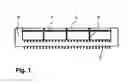
FIG. 1 a board connector;
FIG. 2a an isometric representation of the blocking block;
FIG. 2b a top view of the blocking block;
FIG. 3 a top view of several board connectors with blocking blocks arranged in between;
FIG. 4 a section through FIG. 3, and
FIG. 5 the coding of a plug-in unit by means of the blocking block.
DESCRIPTION OF THE PREFERRED EMBODYMENTS
FIG. 1 shows a side view of one longitudinal side of a board connector 3 which features four window-like recesses 4 in this case.
The window-like recesses 4 are realized in the form of depressions formed by several vertically extending cross-ribs 6 and intersecting, horizontally extending longitudinal ribs 5.
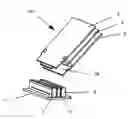
FIGS. 2a, 2b show an inventive blocking block. In this case, FIG. 2a shows an isometric representation and FIG. 2b shows a top view of the blocking block.
The blocking block 10 essentially has a cuboid shape and is realized in the form of a hollow body. Two outwardly protruding snap-in tabs 15 that are exposed on three sides and separated by a central brace 13 are respectively realized to both sides of its longitudinal sides 11.
In addition, a partially wedge-shaped recess 16 is provided on each of the snap-in tabs 15 to both sides of the central brace 13.
In this region, the central brace 13 is recessed relative to the remainder of the longitudinal side 11 by a step 14.
In addition, projections 17 are integrally formed onto the four corner sides and remain positioned above the horizontally extending longitudinal ribs 5 during the insertion of a blocking block between two board connectors 3 while the snap-in tabs 15 engage into one of the window-like recesses 4 underneath the longitudinal ribs 5 (in this context, see also FIG. 3).
In order to remove an engaged blocking block, part of the two snap-in tabs 15 that adjoin the central brace 13 is recessed in a wedge-shaped fashion. Since the central brace 13 is recessed at this location, a slot 18 is formed into which a corresponding tools such as, e.g., the point of a screwdriver can be inserted up to the step 14 in order to respectively bend back two adjacent snap-in tabs 15 and subsequently remove the blocking block.
FIG. 3 shows a top view of several board connectors 3 that are arranged parallel to one another and between which a blocking block 10 was respectively inserted. In this case, it is essentially unimportant into which of the four possible window-like recesses a blocking block 10 is inserted in order to prevent the mismating of a certain version of plug-in board.
FIG. 4 shows a section through several board connectors 3 according to FIG. 3 that are arranged adjacent to one another on a motherboard 1 and correspondingly spaced apart from one another, wherein blocking blocks 10 are inserted between the connectors.
One can clearly ascertain how the ends of the snap-in tabs 15 are engaged on the horizontally extending longitudinal ribs 5.
This makes it clear how an inserted blocking block 10 effectively prevents the mating of a plug-in unit 20 that comprises several daughterboards.
In this case, the daughterboards 2 may be realized in the form of an edge connector in order to be directly mated or combined into a multi-board connector attachment 22.
In this case, an individual daughterboard naturally can also be easily mated.
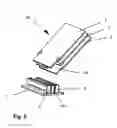
However, the windows 4 realized in the board connectors 3 and at least one blocking block 10 also make it possible to realize the coding of a plug-in unit 20 shown in FIG. 5.
In this case, the plug-in unit 20 shown consists of three combined daughterboards 2 that are designed for being directly mated with the board connectors 3, wherein the central daughterboard features a recess 24.
The schematically illustrated motherboard 1 features two board connectors 3 and a blocking block 10 snapped in between the board connectors.
This plug-in unit can be easily mated because the blocking block 10 exactly fits into the recess 24 of the central daughterboard. In this plug-in unit, it is ensured that the central daughterboard transmits its signals via the two adjacent boards.
Consequently, only this plug-in unit can be mated—despite the actual blocking function of the blocking block that would be fulfilled if the central daughterboard would not feature a recess.
Claims
What is claimed is:1. A blocking device for preventing the mismating of daughterboards on a motherboard, particularly when several daughterboards are combined into a plug-in unit and at least two board connectors contact the motherboard, wherein
a blocking block is inserted between two board connectors arranged within a regular connector spacing, in that snap-in tabs are provided on the blocking block, and in that the longitudinal sides of the board connectors feature window-like recesses, into which the snap-in tabs of the blocking block engage, wherein the blocking block prevents the mating of the plug-in unit in the form of combined daughterboards on the motherboard.
2. The blocking device according to claim 1, wherein
the window-like recesses on the longitudinal sides of the board connectors are formed by longitudinal ribs and intersecting cross-ribs.
3. The blocking device according to claim 1, wherein
regions of the snap-in tabs of the blocking block feature a wedge-shaped recess.
4. The blocking device according to claim 1, wherein
a central brace with a step is provided between the snap-in tabs.
5. The blocking device according to claim 1, wherein
an engaged blocking block can be disengaged from the longitudinal ribs of the board connectors by means of a flat tool that is inserted into the wedge-shaped recesses of the two snap-in tabs in order to bent back the snap-in tabs.
6. The blocking device according to claim 1, wherein
the blocking block is provided for coding a plug-in unit in connection with one or more recesses on the mating side of at least one of the daughterboards of the plug-in unit.
Images & Drawings included:


Sources:
- United States Patent and Trademark Office - verify current appl. status at the USPTO↗
Recent applications in this class:
- » 20250260199 2025-08-14
CONFIGURABLE INTERFACE FOR MODULAR ELECTRONIC COMPONENTS - » 20240364054 2024-10-31
KEYED ELECTRIC CONNECTOR - » 20240297462 2024-09-05
SECURITY CONNECTOR FOR A SINGLE TWISTED PAIR OF CONDUCTORS - » 20240213720 2024-06-27
Heated hose electrical connectors - » 20240162660 2024-05-16
Rack mount - » 20230155326 2023-05-18
CONTACT ARRANGEMENT FOR A COAXIAL PLUG AND MUTLIPLE CONTACT ARRANGEMENT - » 20230124701 2023-04-20
CONTROL BOX - » 20230069853 2023-03-09
Connector keying device, connector system, and method for using same - » 20230049750 2023-02-16
High power electrical connector - » 20220399685 2022-12-15
Mistake-proof electrical connectors for HVAC systems
Recent applications for this Assignee:
- » 20130137310 2013-05-30
Plug connector for differential data transmission - » 20070141884 2007-06-21
Card edge connector with a guide spring for precise contact guidance of a PCB