Paper Folding Puzzle With Secondary Image
US20080143050A1
2008-06-19
11/958,611
2007-12-18
Abstract:
A paper folding puzzle comprised of at least one piece of paper having a primary image disposed thereon, such that when the paper is folded into a three-dimensional origami shape, a secondary image comprised of multiple portions of the primary image is visible. The paper folding puzzle may include instructions and/or clues, either with the paper or on a website, for folding the paper into the three-dimensional origami shape. In one embodiment, the paper can be folded in multiple orientations to form the three-dimensional origami shape.
Interested in similar patents?
Get notified when new applications in this technology area are published.
Classification:
A63F9/08 » CPC main
Games not otherwise provided for; Patience; Other games for self-amusement Puzzles provided with elements movable in relation, i.e. movably connected , to each other
Description
CROSS-REFERENCE TO RELATED APPLICATION
This application claims the benefit of and priority to U.S. provisional application Ser. No. 60/870,779, filed on 19 Dec. 2006 and incorporated herein in its entirety.
FIELD OF INVENTION
This invention relates generally to the field of origami, and in particular to a paper folding puzzle that transforms a paper with a 2-dimensional image into a 3-dimensional shape through the use of origami techniques with secondary image
BACKGROUND
The art of origami dates back for many years and are well-known among practitioners. Traditionally, this Japanese paper folding technique uses a single sheet of paper folded in clever ways to create artistic or useful shapes. For example, animal shapes such as birds, frogs, horses, etc., can be formed. Alternatively, useful shapes such as functional cups, trays, balloons, etc., may be created.
As used herein, the term “origami” refers to the process of folding paper into shapes, and can include cutting the paper. The present invention should not be limited to any particular type of paper used, the shape of the starting paper, or the shape of the finished product.
As used herein, the term “primary image” refers to any graphical representation of person(s), animal(s), thing(s), or other graphical representation(s) on a paper when flattened, whether photographed, painted, or otherwise made visible.
As used herein, the term “secondary image” refers to any graphical representation of person(s), animal(s), thing(s), or other graphical representation(s), whether photographed, painted, or otherwise made visible, and comprising at least a portion of the primary image(s).
SUMMARY OF THE INVENTION
The present invention is a paper folding puzzle comprised of at least one piece of paper having a primary image disposed thereon, such that when the paper is folded into a three-dimensional origami shape, a secondary image is visible on the three-dimensional origami shape in which the secondary image is comprised of multiple portions of the primary image. The paper folding can further include instructions and/or clues for folding the puzzle and can further include a link to a web address for retrieving the instructions and/or clues to increase traffic to the web site. In another embodiment, the puzzle can be folded in multiple orientations to form the resulting three-dimensional origami shape. In one embodiment, the resulting three-dimensional origami shape is an airplane.
BRIEF DESCRIPTION OF DRAWINGS
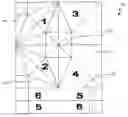
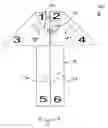
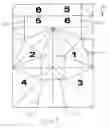
FIG. 1 shows one embodiment of a paper that can be folded to form an origami shape, specifically an airplane.
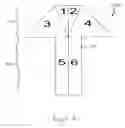
FIG. 2 shows the resulting origami shape, specifically an airplane.
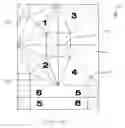
FIG. 3 shows the embodiment of the paper shown in FIG. 1, further including a primary image.
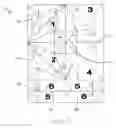
FIG. 4 shows the paper folded into an airplane in which portions of the primary image form a secondary image.
FIG. 5 shows an alternate embodiment of a paper in which a primary image can be placed.
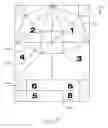
FIG. 6 shows an alternate embodiment of a paper in which a primary image can be placed.
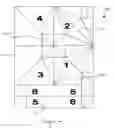
FIG. 7 shows an alternate embodiment of a paper in which a primary image can be placed.
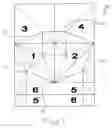
FIG. 8 shows an alternate embodiment of a paper in which a primary image can be placed.
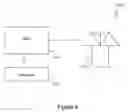
FIG. 9 shows one embodiment of a system for folding a piece of paper into a three-dimensional origami shape.
DETAILED DESCRIPTION OF EMBODIMENTS OF THE INVENTION
For the purpose of promoting an understanding of the present invention, references are made in the text hereof to embodiments of a paper folding puzzle that transforms a primary image on a 2-dimensional piece of paper into a 3-dimensional origami shape having a visible secondary image, consisting of at least a portion of the primary image, through the use of origami techniques, only some of which are described herein. It should nevertheless be understood that no limitations on the scope of the invention are thereby intended. One of ordinary skill in the art will readily appreciate that modifications such as the type of paper used, the size and shape of the starting paper, the resulting origami shape, the primary image contained on the starting page, and the secondary image shown on the resulting origami shape, and the inclusion of additional elements are deemed readily apparent and obvious to one of ordinary skill in the art, and all equivalent relationships to those described in the written description do not depart from the spirit and scope of the present invention. Some of these possible modifications are mentioned in the following description. Therefore, specific details disclosed herein are not to be interpreted as limiting, but rather as a basis for the claims and as a representative basis for teaching one of ordinary skill in the art to employ the present invention in virtually any appropriately detailed apparatus or manner.
It should be understood that the drawings are not necessarily to scale, emphasis instead being placed upon illustrating the principles of the invention. In addition, in the embodiments depicted herein, like reference numerals in the various drawings refer to identical or near identical structural elements.
Moreover, the term “substantially” or “approximately” as used herein may be applied to modify any quantitative representation that could permissibly vary without resulting in a change in the basic function to which it is related. For example, one embodiment of the starting paper with a primary image disposed thereon is disclosed herein as having regions 1, 2, 3, and 4 oriented at substantially ninety degrees (90°) clockwise as compared to another embodiment. The regions may be oriented at less than or greater than this value and still be within the scope of the invention if its functionality is not materially altered.
Referring now to the drawings, FIG. 1 shows one embodiment of paper 100 that can be folded to form an origami shape (not shown). In the embodiment shown, paper 100 is folded along solid lines 110 and cut along dashed lines 120 to form an airplane (not shown). It should be understood, that the invention is not limited to a specific folding pattern and can be used with any size, shape, or type of paper.
When folded, paper 100 forms an airplane. FIG. 2 shows airplane 200, comprised of wing portion 210 and tail portion 220, which has been formed by folding paper 100. However, it should be understood that the instant invention should not be limited by the resulting origami shape. That is, paper 100 can be folded and/or cut along in any pattern or according to any instructions to form any type of origami shape, including but not limited to a bird, a frog, a horse, a cup, a tray, and a balloon. In addition, airplane (or another origami shape) can further include additional elements. For example, in another embodiment of airplane 200, airplane 200 can further include wood splints for support and/or a weight at the front end to facilitate flying.
In one (1) embodiment, paper 100 includes instructions as to how to fold paper 100 to form airplane 200. In another embodiment, paper 100 does not include instructions, and the user must determine how to fold paper 100 to achieve the desired resulting origami shape. In such an embodiment, paper 100 may contain clues or instructions that information as to how to fold paper 100 to form airplane 200 on a webpage (not shown). Such an embodiment can be used as a tool to increase traffic to a particular website. In addition, there need not be a single solution to the proper way to fold paper 100 to achieve airplane 200 or another origami shape.
Referring to FIGS. 1 and 2 collectively, also visible are numerals 1, 2, 3, 4, 5, and 6. Numerals 1, 2, 3, 4, 5, and 6 each indicate a specific region of paper 100. Each region on paper 100 (in FIG. 1) corresponds to the same region on paper 100 when folded into airplane 200 when folded (in FIG. 2). For example, the triangularly-shaped section, as indicated by numeral 1 in FIG. 1, is in the top left area of paper 100 before folding and also the top left portion of wing portion 210, also as indicated by numeral 1 in FIG. 2, after paper 100 is folded to achieve airplane 200.
FIG. 3 shows the embodiment of paper 100 shown in FIG. 1, further including primary image 130. In the embodiment shown, primary image includes thirteen (13) rabbits. However, it should be understood that any number of rabbits, any number of other animals, or any number of any graphical representation can be positioned on paper to form primary image 130. Primary image 130 can be any existing graphical representation or one (1) created specifically for paper 100. Thus, the invention should not be limited to any graphical image. In addition, paper 100 can further include another primary image on the other side (not shown) of paper 100.
FIG. 4 shows paper 100 folded into airplane 200 in which portions of primary image 130 form secondary image 140. As can be appreciated, portions of primary image from regions 1, 2, and 4, when airplane 200 is properly folded, form secondary image 140. As provided supra, primary image 130 on paper 100 is multiple rabbits, and secondary image 140 on airplane 200 is also multiple rabbits. In alternate embodiments, primary image 130 and secondary image 140 need not be the same graphical representation. For example, in one (1) specific alternate embodiment, primary image 140 can be what appears to be an abstract drawing, that, when folded into airplane 200, forms a picture of a human face.
Referring to FIGS. 3 and 4 collectively, in order to create secondary image 140 formed from portions of primary image 130, secondary image 140 is drawn, printed, painted, or otherwise disposed on airplane 200 (or another resulting origami shape) when in the completed stage (i.e., FIG. 4). Airplane 200 (or other resulting origami shape) is then unfolded and the unfolded portion of paper 100 is placed alongside the cut portion (i.e., regions 5 and 6 as shown in FIG. 3) and those spaces not including secondary image 140 disposed thereon (i.e., the regions other than regions 1, 2, 3, 4, 5, and 6) have the remaining portions of primary image 130 added to complete primary image 130.
FIG. 5 shows an alternate embodiment of paper 100 in which regions 1, 2, 3, and 4 are oriented substantially ninety degrees (90°) clockwise as compared to the embodiment shown in FIG. 1. In addition, regions 5 and 6 remain in the same location. In such an embodiment, some or all of the portions of the primary image (not shown) on regions 1, 2, 3, 4, 5, and 6 would differ as compared to the embodiment shown in FIG. 1, but the resulting secondary image (not shown) on the airplane (not shown) when paper 100 is properly folded, would be the same.
FIGS. 6 and 7 each show alternate embodiments of paper 100 in which regions 1, 2, 3, and 4 are oriented substantially ninety degrees (90°) and one hundred eighty degrees (180°) clockwise, respectively, as compared to the embodiment of paper 100 shown in FIG. 5. In addition, regions 5 and 6 remain in the same location. In such embodiments, some or all of the portions of the primary image (not shown) on regions 1, 2, 3, 4, 5, and 6 would differ as compared to the embodiment shown in FIG. 1, but the resulting secondary image (not shown) on the airplane (not shown) when paper 100 is properly folded, would be the same.
FIG. 8 shows still another alternate embodiment of paper 100 in which regions 1, 2, 3, 4, 5, and 6 are arranged differently as compared to the embodiment of paper 100 shown in FIG. 5. In such an embodiment, some or all of the portions of the primary image (not shown) on regions 1, 2, 3, 4, 5, and 6 would differ as compared to the other embodiments of paper 100, but the resulting secondary image (not shown) on the airplane (not shown) when paper 100 is properly folded, would be the same.
FIG. 9 shows one (1) embodiment of system 300 for folding paper 100 into three-dimensional origami shape 200. In the embodiment shown, paper 100 is rectangular and includes a primary image (not shown) disposed thereon. As provided supra, any type of primary image can be used. Also shown are instructions 150. Instructions 150 can be detailed instructions as to how to fold paper 100 to obtain origami shape 200, less complete instructions as to how to fold paper 100 thereby requiring more skill by the user, or can be clues as to how to fold paper 100. Furthermore, instructions 150 can be included with paper 100 or can be provided only on a website such that the user must access the website in order to find the instructions, thereby increasing traffic on the website. Also visible in FIG. 9 is origami shape 200. In the embodiment shown, origami shape 200 is an airplane, but can be any three-dimensional shape commonly known and used in the art. Once folded, portions of the primary image align to form a secondary image (not shown) on origami shape 200. As provided supra, the secondary image can be of any type and need not be the same as the primary image.
While the paper folding puzzle has been shown and described with respect to several embodiments and uses in accordance with the present invention, it is to be understood that the same is not limited thereto, but is susceptible to numerous changes and modifications as known to a person of ordinary skill in the art, and it is intended that the present invention not be limited to the details shown and described herein, but rather cover all such changes and modifications obvious to one of ordinary skill in the art.
Claims
What is claimed is:1. A paper folding puzzle comprised of:
at least one piece of paper, said at least one piece of paper having a primary image disposed thereon;
wherein when said piece of paper is folded into a three-dimensional origami shape, a secondary image is visible on said three-dimensional origami shape, said secondary image comprised of multiple portions of said primary image.
2. The paper folding puzzle of claim 1, wherein said three-dimensional origami shape is an airplane.
3. The paper folding puzzle of claim 1, wherein said paper folding puzzle further includes instructions for folding said paper folding puzzle into said three-dimensional origami shape.
4. The paper folding puzzle of claim 1, wherein said paper folding puzzle further includes a web address for retrieving instructions for folding said paper folding puzzle into said three-dimensional origami shape.
5. The paper folding puzzle of claim 1, wherein said paper can be folded in multiple orientations to form said three-dimensional origami shape.
6. A paper folding puzzle comprised of:
a paper, said paper having a top side and a bottom side and having a primary image disposed on said top side;
wherein when said paper is folded into an origami shape, a secondary image is visible on said origami shape, said secondary image comprising multiple portions of said primary image.
7. The paper folding puzzle of claim 6, wherein said origami shape is an airplane.
8. The paper folding puzzle of claim 6, wherein said paper folding puzzle further includes instructions for folding said paper into said origami shape.
9. The paper folding puzzle of claim 6, wherein said paper folding puzzle further includes a web address for retrieving instructions for folding said paper into said origami shape.
10. The paper folding puzzle of claim 6, wherein said paper can be folded in multiple orientations to form said origami shape.
11. A paper folding puzzle comprised of:
at least one piece of paper, said piece of paper having a primary image disposed thereon;
wherein when said piece of paper is folded into an airplane shape, portions of said primary image align to form a secondary image.
12. The paper folding puzzle of claim 11, wherein said paper folding puzzle further includes instructions for folding said at least one piece of paper into said airplane shape.
13. The paper folding puzzle of claim 11, wherein said paper folding puzzle further includes a web address for retrieving instructions for folding said paper folding puzzle into said airplane shape.
14. The paper folding puzzle of claim 11, wherein said at least one piece of paper can be folded in multiple orientations to form said airplane shape.
15. A system of providing a paper folding puzzle comprised of:
at least one piece of paper, said piece of paper having a primary image disposed thereon;
at least one instruction as to how to fold said at least one piece of paper to form an origami shape, wherein when said at least one piece of paper is folded into said origami shape, portions of said primary image align to form a secondary image.
16. The system of claim 15, wherein said at least one instruction is provided on an internet website.
17. The system of claim 15, wherein said at least one instruction is at least one clue as to how to fold said at least one piece of paper.
18. The system of claim 15, wherein said origami shape is an airplane.
19. The system of claim 11, wherein said at least one piece of paper can be folded in multiple orientations to form said airplane shape.
Images & Drawings included:
Sources:
- United States Patent and Trademark Office - verify current appl. status at the USPTO↗
Recent applications in this class:
- » 20210086065 2021-03-25
Puzzle Book - » 20190151750 2019-05-23
Puzzle book - » 20190070489 2019-03-07
PUZZLES INCLUDING ELEMENT FRAGMENTS - » 20150238852 2015-08-27
Handheld multi-stage puzzle-solving game device - » 20140138909 2014-05-22
Modular Tile and Block Kit - » 20110266749 2011-11-03
Push button puzzle with internal locking mechanism - » 20110084445 2011-04-14
Logic game of the three-dimensional brain teaser type - » 20110012304 2011-01-20
Educational bath puzzle toy - » 20100253000 2010-10-07
METHOD OF PLAYING A GAME TO IMPROVE A RELATIONSHIP - » 20100194040 2010-08-05
DISSECTION PUZZLE