Method for the redistribution of polyorganosiloxanes
US20080146751A1
2008-06-19
11/885,298
2006-03-15
✅ Patent granted
US 7,612,222 B2
2009-11-03
WO; PCT/US2006/009252; 20060315
WO; WO2006/124106; 20061123
Randy Gulakowski | Robert Loewe
2026-04-26
Abstract:
Linear hydroxy endblocked linear polyorganosiloxanes, linear chloro-endblocked polyorganosiloxanes, and mixtures thereof, are redistributed in a process by contacting the linear polyorganosiloxanes, with a diorganodichlorosilane having the formula R′2SiCl2, wherein R′ is an alkyl group containing 1-8 carbon atoms; in the presence of an aqueous hydrochloric acid catalyst; to form a redistributed mixture containing cyclic polyorganosiloxanes and chloro-endblocked polyorganosiloxanes. The process generates less amounts of undesired branched siloxane species than processes which utilize an alumina catalyst.
Assignee:
- DOW CORNING CORPORATION 738 🇺🇸 MIDLAND, MI, United States
Interested in similar patents?
Get notified when new applications in this technology area are published.
Classification:
C08G77/24 » CPC further
Macromolecular compounds obtained by reactions forming a linkage containing silicon with or without sulfur, nitrogen, oxygen or carbon in the main chain of the macromolecule; Polysiloxanes containing silicon bound to organic groups containing atoms other than carbon, hydrogen and oxygen halogen-containing groups
C08G77/10 » CPC main
Macromolecular compounds obtained by reactions forming a linkage containing silicon with or without sulfur, nitrogen, oxygen or carbon in the main chain of the macromolecule; Polysiloxanes; Preparatory processes Equilibration processes
C07F7/0874 » CPC further
Compounds containing elements of Groups 4 or 14 of the Periodic System; Silicon compounds; Compounds having one or more C—Si linkages; Compounds having one or more O-Si linkage; Compounds with one or more Si-O-Si sequences; Preparation and treatment thereof Reactions involving a bond of the Si-O-Si linkage
C08G77/045 » CPC further
Macromolecular compounds obtained by reactions forming a linkage containing silicon with or without sulfur, nitrogen, oxygen or carbon in the main chain of the macromolecule; Polysiloxanes containing less than 25 silicon atoms
C07F7/02 IPC
Compounds containing elements of Groups 4 or 14 of the Periodic System Silicon compounds
C07F7/21 IPC
Compounds containing elements of Groups 4 or 14 of the Periodic System; Silicon compounds Cyclic compounds having at least one ring containing silicon, but no carbon in the ring
C08G77/08 IPC
Macromolecular compounds obtained by reactions forming a linkage containing silicon with or without sulfur, nitrogen, oxygen or carbon in the main chain of the macromolecule; Polysiloxanes; Preparatory processes characterised by the catalysts used
Description
FIELD OF THE INVENTION
This invention is directed to a process for the redistribution of high molecular weight linear hydroxy endblocked polyorganosiloxanes, high molecular weight linear chloro-endblocked polyorganosiloxanes, or mixtures thereof, with diorganodichlorosilanes to produce cyclic polyorganosiloxanes and chloro-endblocked polyorganosiloxanes of low molecular weight using aqueous hydrochloric acid as a catalyst. The reaction is promoted with good mixing to contact the two phases. The process has the advantage of generating less undesired branched siloxane species than a process which utilizes an alumina catalyst.
BACKGROUND OF THE INVENTION
Current industrial processes for the manufacture of silicone fluids, resins and rubbers typically require as starting materials either linear hydroxy endblocked polyorganosiloxanes or cyclic polyorganosiloxanes. These polysiloxanes can be produced by the hydrolysis of diorganodihalosilanes. This process results in a mixture of cyclic polyorganosiloxanes and linear hydroxy endblocked polyorganosiloxanes. Separation of this mixture to isolate a desired linear fraction or cyclic fraction results in an excess of linear materials or cyclic materials, as well as materials of undesired molecular weight. Therefore, a process which allows for converting the linear hydroxy endblocked polyorganosiloxanes and/or the linear chloro-endblocked polyorganosiloxanes to cyclic polyorganosiloxanes and that allows for adjusting the molecular weight of the polyorganosiloxane chains is desirable to allow recovery of these excess siloxanes.
Known methods for enhancing the production of cyclic polyorganosiloxanes include cracking of the linear hydroxy endblocked polyorganosiloxanes, which is capital intensive; vacuum hydrolysis, which has poor enhancement capabilities; and aqueous hydrolysis, which tends to sacrifice chloride recovery. Other methods for enhancing the production of cyclic polyorganosiloxanes require the addition of solvents and/or surfactants which makes recovery of the product more difficult and can compromise product purity. Other catalysts, such as alumina, generate undesired branched siloxane species such as CH3SiO3/2 through cleavage of organic groups from silicon.
The present process offers advantages over previously described processes as noted above. In addition, the present process can be used not only to enhance the production of cyclic polyorganosiloxanes, but also to control the cyclic polyorganosiloxane content from about zero to greater than 90 percent by weight of the product. The aqueous HCl catalyst used herein improves the rate of redistribution while minimizing organic cleavage. The linear hydroxy endblocked polyorganosiloxanes and/or the linear chloro-endblocked polyorganosiloxanes can easily be redistributed to more desirable cyclic polyorganosiloxanes, and chloride-end terminated polyorganosiloxanes typically having 2-8 siloxane units. In addition, no solvents or surfactants are required, and the aqueous HCl catalyst is readily available.
BRIEF SUMMARY OF THE INVENTION
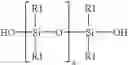
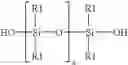
The invention relates to a process for the redistribution of linear hydroxy endblocked polyorganosiloxanes and/or linear chloro-endblocked polyorganosiloxanes. The process is carried out by contacting a linear hydroxy endblocked polyorganosiloxane having Formula I:
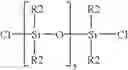
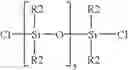
and/or a linear chloro-endblocked polyorganosiloxane having Formula II:
with a diorganodichlorosilane having the formula R′2SiCl2; in the presence of a catalyst which facilitates the redistribution of polyorganosiloxanes. The catalyst is aqueous hydrochloric acid and it is typically used in an amount of 0.1-70 percent by weight based on the weight of the linear hydroxy endblocked polyorganosiloxane and/or chloro-endblocked polyorganosiloxane and diorganodichlorosilane. The aqueous catalyst may contain saturated concentrations of HCl at the temperature and pressure conditions at which the redistribution is conducted. A redistributed mixture is formed containing cyclic polyorganosiloxanes and linear chloro-endblocked polyorganosiloxanes having Formula II.
In Formulas I and II, x and y have a value of 1-5,000; and R′, R1, and R2 represent alkyl groups containing 1-8 carbon atoms. The alkyl group can be, for example, methyl, ethyl, propyl, isopropyl, n-butyl, isobutyl, tert-butyl, or sec- butyl. Most typically, the alkyl groups R′, R1 and R2 will comprise the methyl group.
The preferred diorganodichlorosilane is dimethyldichlorosilane. The cyclic polyorganosiloxane in the redistributed mixture are typically cyclic polymers containing 3-8 silicon atoms. Chloro-endblocked polyorganosiloxanes in the redistributed mixture are predominately polymers having a degree of polymerization (DP) of 2-8. These and other features of the invention will become apparent from a consideration of the detailed description.
DETAILED DESCRIPTION OF THE INVENTION
According to the invention, linear hydroxy endblocked polyorganosiloxanes, linear chloro-endblocked polyorganosiloxanes, or mixtures thereof, are redistributed with a diorganodichlorosilane using aqueous hydrochloric acid as catalyst. The process results in the formation of cyclic polyorganosiloxanes and chloro-endblocked polyorganosiloxanes of low molecular weight, i.e., short chain length.
The linear hydroxy endblocked polyorganosiloxanes and the linear chloro-endblocked polyorganosiloxanes that are redistributed according to the method of the invention are polymers having Formulas I and II.
Diorganodichlorosilanes corresponding to the above formula R′2SiCl2 include, for example, compounds such as dimethyldichlorosilane (CH3)2SiCl2, ethylmethyldichlorosilane (CH3)(C2H5)SiCl2, diethyldichlorosilane (C2H5)2SiCl2, di-n-propyldichlorosilane (n-C3H7)2SiCl2, di-i-propyldichlorosilane (i-C3H7)2SiCl2, hexylmethyldichlorosilane (CH3)(CH3)(CH2)4(CH2)SiCl2, di-n-butyldichlorosilane (n-C4H9)2SiCl2, di-i-butyldichlorosilane (i-C4H9)2SiCl2, di-t-butyldichlorosilane (t-C4H9)2SiCl2, and n-butylmethyldichlorosilane CH3(n-C4H9)SiCl2. The preferred diorganodichlorosilane is dimethyldichlorosilane (DMDCS).
The catalyst used herein comprises aqueous hydrochloric acid, which is typically used in the redistribution reaction in an amount of from 0.1-70 percent by weight, based on the weight of the linear hydroxy endblocked polyorganosiloxanes, the linear chloro-endblocked polyorganosiloxanes, or mixtures thereof, and the diorganodichlorosilanes used in the reaction. The aqueous catalyst may contain saturated concentrations of HCl at the temperature and pressure conditions at which the redistribution is conducted.
The cyclic polyorganosiloxanes formed as a result of the redistribution generally consist of mixtures of cyclic polyorganosiloxanes containing 3-8 silicon atoms including, for example, hexaalkylcyclotrisiloxanes such as hexamethylcyclotrisiloxane, octaalkylcyclotetrasiloxanes such as octamethylcyclotetrasiloxane, decaalkylcyclopentasiloxanes such as decamethylcyclopentasiloxane, dodecaalkylcyclohexasiloxanes such as dodecamethylcyclohexasiloxane, tetradecaalkylcycloheptasiloxanes such as tetradecamethylcycloheptasiloxane, and hexadecaalkylcyclooctasiloxanes such as hexadecamethylcyclooctasiloxane. The chloro-endblocked polyorganosiloxanes that are produced according to the redistribution method of the invention are polymers having Formula II. In one embodiment, a majority of these redistributed chloro-endblocked polyorganosiloxanes have a DP of 1-10, alternatively 2-8.
The linear hydroxy endblocked polyorganosiloxanes, linear chloro-endblocked polyorganosiloxanes, or mixtures thereof, and diorganodichlorosilanes are contacted with the aqueous HCl catalyst which facilitates their redistribution to a mixture of cyclic polyorganosiloxanes and chloro-endblocked polyorganosiloxanes of low molecular weight. Contact of the catalyst with the linear polyorganosiloxanes and the diorganodichlorosilanes can be affected by standard means for contacting liquids, for example, by a batch process or by a continuous-flow process. The process can be conducted in any standard reactor suitable for mixing corrosive materials.
The required contact time for the linear hydroxy endblocked polyorganosiloxanes, the linear chloro-endblocked polyorganosiloxanes, the mixtures thereof and the diorganodichlorosilanes with the catalyst to effect redistribution will depend upon such factors as temperature, type of linear polyorganosiloxanes and diorganodichlorosilanes, and concentration of the catalyst. In general, contact times up to 3 hours have been found useful. The preferred contact time is generally less than 30 minutes, most preferably less than 5 minutes. The process can be carried out at a temperature between 0-100° C., but it is preferably conducted at ambient or room temperature, i.e., 20-25° C. (68-77° F.).
The amount of the linear hydroxy endblocked polyorganosiloxanes and/or the linear chloro-endblocked polyorganosiloxanes and the amount of the diorganodichlorosilanes that can be used in the redistribution reaction is the volume ratio necessary to generate the desired molecular weight distribution of linear chloro-endblocked polyorganosiloxanes. The determination of such volume ratios is within the scope of knowledge of those skilled in the art.
EXAMPLES
The following examples are set forth in order to illustrate the invention in more detail. The method of analysis used in the examples was Gel Permeation Chromatography (GPC) and Gas Chromatography (GC). Since GC is not able to measure higher molecular weight peaks, siloxane species of higher molecular weight that were present in the samples analyzed, are not included in the analysis results. For that reason, the percents by weight Before and After do not total 100 percent. The Before analysis results show values obtained on the mixture before it was added to the Teflon vessel. The After analysis results show values obtained after adding the mixture to the Teflon vessel, pressurizing the vessel with HCl, agitating the vessel by hand-shaking, allowing the contents to sit, relieving the pressure, opening the vessel, and sampling the siloxane mixture.
In Tables 1-3, D3 to D8 represent cyclic siloxanes comprising, respectively, difunctional D units of the formula [(CH3)SiO]3-8. D3 to D8 are, respectively, hexamethylcyclotrisiloxane, octamethylcyclotetrasiloxane, decamethylcyclopentasiloxane, dodecamethylcyclohexasiloxane, tetradecamethylcycloheptasiloxane, and hexadecamethylcyclooctasiloxane. CEB2 to CEB8 represent chloro-endblocked polyorganosiloxanes having chain lengths of 2-8, respectively.
Example 1
A mixture was formed by mixing together 98 grain of a linear hydroxy endblocked polydimethylsiloxane and 140 gram of dimethyldichlorosilane Me2SiCl2. To a Teflon vessel was added 12.72 gram of 37 percent by weight aqueous hydrochloric acid, and 43.13 gram of the mixture of linear hydroxy endblocked polydimethylsiloxane and dimethyldichlorosilane. The vessel was sealed and pressurized to 100 psig with gaseous hydrogen chloride. The vessel was agitated by hand shaking for 5 minutes to achieve saturation concentrations of aqueous hydrochloric acid at these new conditions and facilitate contact between the two phases. The pressure was released and a sample of a chlorosilane/siloxane phase was removed and analyzed. GPC analysis showed that the siloxane chains were shortened. Analysis of the chlorosilane/siloxane mixture Before and After by GC is shown in Table 1.
| TABLE 1 |
| Redistribution of Me2SiCl2/Siloxane Mixture |
| Sample Composition, | |||
| Weight Percent | Before | After | |
| D3 | 0.14 | 0.08 | |
| D4 | 0.43 | 4.14 | |
| D5 | 0.30 | 1.00 | |
| D6 | 0.19 | 0.18 | |
| D7 | 0.10 | 0.04 | |
| D8 | 0.07 | 0.02 | |
| Me2SiCl2 | 48.60 | 6.37 | |
| CEB2 | 0.25 | 9.88 | |
| CEB3 | 0.09 | 7.96 | |
| CEB4 | 0.07 | 4.64 | |
| CEB5 | 0.06 | 3.4 | |
| CEB6 | 0.07 | 3.08 | |
| CEB7 | 0.07 | 2.66 | |
| CEB8 | 0.11 | 2.43 | |
| Branching (ppm) | 40.0 | 45.2 | |
Example 2
A mixture was formed by mixing together 98 gram of a linear hydroxy endblocked polydimethylsiloxane and 140 gram of dimethyldichlorosilane Me2SiCl2. To a Teflon vessel was added 11.5 gram of 37 percent by weight aqueous hydrochloric acid and 58.18 gram of the mixture of linear hydroxy endblocked polydimethylsiloxane and dimethyldichlorosilane. The vessel was sealed and pressurized to 100 psig with gaseous hydrogen chloride. The vessel was agitated by hand shaking periodically for 30 minutes, to achieve saturation concentrations of aqueous hydrochloric acid at these new conditions and facilitate contact between the two phases. The pressure was released and a sample of a chlorosilane/siloxane phase was removed and analyzed. GPC analysis showed that the siloxane chains were shortened. Analysis of the chlorosilane/siloxane mixture Before and After by GC is shown in Table 2.
| TABLE 2 |
| Redistribution of Me2SiCl2/Siloxane Mixture |
| Sample Composition, | |||
| Weight Percent | Before | After | |
| D3 | 0.07 | 0.12 | |
| D4 | 0.90 | 1.94 | |
| D5 | 1.25 | 0.92 | |
| D6 | 0.78 | 0.22 | |
| D7 | 0.21 | 0.07 | |
| D8 | 0.11 | 0.04 | |
| Me2SiCl2 | 43.98 | 12.58 | |
| CEB2 | 0.16 | 5.74 | |
| CEB3 | 0.11 | 6.68 | |
| CEB4 | 0.08 | 7.08 | |
| CEB5 | 0.10 | 7.08 | |
| CEB6 | 0.13 | 6.63 | |
| CEB7 | 0.17 | 5.99 | |
| CEB8 | 0.24 | 5.30 | |
| Branching (ppm) | 38.7 | 43.4 | |
Example 3
A mixture was formed by mixing together 103.61 gram of a hydroxy endblocked linear polydimethylsiloxane and 120.02 gram of dimethyldichlorosilane Me2SiCl2. To a Teflon vessel was added 10.37 gram of 37 percent by weight aqueous hydrochloric acid and 50.96 gram of the mixture of linear hydroxy endblocked polydimethylsiloxane and dimethyldichlorosilane. The vessel was sealed and pressurized to 100 psig with gaseous hydrogen chloride. The vessel was agitated by hand shaking initially to achieve saturation concentrations of aqueous hydrochloric acid at these new conditions, and facilitate contact between the two phases. The vessel was then allowed to sit for three hours. The pressure was released and a sample of a chlorosilane/siloxane phase was removed and analyzed. GPC analysis showed that the siloxane chains were shortened. Analysis of the chlorosilane/siloxane mixture Before and After by GC is shown in Table 3.
| TABLE 3 |
| Redistribution of Me2SiCl2/Siloxane Mixture |
| Sample Composition, | |||
| Weight Percent | Before | After | |
| D3 | 0.13 | 0.12 | |
| D4 | 0.43 | 1.99 | |
| D5 | 0.29 | 0.98 | |
| D6 | 0.15 | 0.31 | |
| D7 | 0.10 | 0.15 | |
| D8 | 0.09 | 0.11 | |
| Me2SiCl2 | 45.45 | 3.08 | |
| CEB2 | 0.22 | 6.03 | |
| CEB3 | 0.08 | 11.03 | |
| CEB4 | 0.05 | 12.18 | |
| CEB5 | 0.04 | 11.26 | |
| CEB6 | 0.03 | 9.66 | |
| CEB7 | 0.05 | 7.93 | |
| CEB8 | 0.05 | 6.35 | |
| Branching (ppm) | 37 | 39 | |
In Tables 1-3, the apparent increase in branching is due to the loss of chloride mass from the mixture of the linear hydroxy endblocked polydimethylsiloxane and the dimethyldichlorosilane due to hydrolysis of the dimethyldichlorosilane.
Other variations may be made in compounds, compositions, and methods described herein without departing from the essential features of the invention. The embodiments of the invention specifically illustrated herein are exemplary only and not intended as limitations on their scope except as defined in the appended claims.
Claims
I Claim:1. A process for the redistribution of linear hydroxy endblocked polyorganosiloxanes, linear chloro-endblocked polyorganosiloxanes, and mixtures thereof, comprising: contacting (i) a linear hydroxy endblocked polyorganosiloxane having Formula I:
(ii) a chloro-endblocked polyorganosiloxane having Formula II:
or (iii) a mixture of (i) and (ii)
with (iv) a diorganodichlorosilane having the formula R′2SiCl2 in the presence of a catalyst which facilitates the redistribution of polyorganosiloxanes to form a redistributed mixture comprising cyclic polyorganosiloxanes and chloro-endblocked polyorganosiloxanes having Formula II;
wherein x and y represent integers having a value of 1-5,000 and R′, R1, and R2 represent alkyl groups containing 1-8 carbon atoms;
and wherein the catalyst comprises aqueous hydrochloric acid and it is present in an amount of 0.1-70 percent by weight based on the weight of the linear hydroxy endblocked polyorganosiloxanes, the linear chloro-endblocked polyorganosiloxanes, and the diorganodichlorosilanes; and the aqueous HCl catalyst contains saturated concentrations of HCl at the temperature and pressure conditions at which the redistribution is conducted.
2. The process according to claim 1 wherein the diorganodichlorosilane is selected from the group consisting of dimethyldichlorosilane, ethylmethyldichlorosilane, diethyldichlorosilane, di-n-propyldichlorosilane, di-i-propyldichlorosilane, hexylmethyldichlorosilane, di-n-butyldichlorosilane, di-i-butyldichlorosilane, di-t-butyldichlorosilane, and n-butylmethyldichlorosilane.
3. The process according to claim 2 wherein the diorganodichlorosilane is dimethyldichlorosilane.
4. The process according to claim 1 wherein the cyclic polyorganosiloxane in the redistributed mixture are selected from the group consisting of hexamethylcyclotrisiloxane, octamethylcyclotetrasiloxane, decamethylcyclopentasiloxane, dodecamethylcyclohexasiloxane, tetradecamethylcycloheptasiloxane, and hexadecamethylcyclooctasiloxane.
5. The process according to claim 1 wherein the linear chloro-endblocked polyorganosiloxanes in the redistributed mixture comprise predominantly polymers wherein the degree of polymerization is 2-8.
6. The process according to claim 1 wherein the process is carried out at a temperature of 20-25° C.
7. The process according to claim 1 wherein the contact time for the linear hydroxy endblocked polyorganosiloxanes, linear chloro-endblocked polyorganosiloxanes, or mixtures thereof, and diorganodichlorosilanes with the catalyst to effect redistribution is less than 3 hours.
8. The process according to claim 7 wherein the contact time is less than 30 minutes.
Images & Drawings included:
Sources:
- United States Patent and Trademark Office - verify current appl. status at the USPTO↗
Similar patent applications:
- » 20050239987
Method for preparing functionalised polyorganosiloxane resins by redistribution in the presence of at least one triflic acid derivative - » 20080255322
METHOD FOR PREPARING FUNCTIONALIZED POLYORGANOSILOXANE RESINS BY REDISTRIBUTION IN THE PRESENCE OF AT LEAST ONE TRIFLIC ACID DERIVATIVE - » 20080097064
Method for preparing PolyOrganoSiloxanes (POS) by ring (S)—opening polymerization and/or POS redistribution in the presence of carbene (S) and POS compounds produced by said method
Recent applications in this class:
- » 20250206885 2025-06-26
Organopolysiloxane Depolymerization - » 20210221956 2021-07-22
Method for condensation polymerization of hydroxyl-terminated polydiorganosiloxanes - » 20210179785 2021-06-17
METHOD FOR PRODUCING SPHERICAL POLYSILSESQUIOXANE PARTICLES - » 20210163687 2021-06-03
Linear polydimethylsiloxane-polyoxyalkylene block copolymers of the structure type ABA - » 20170306097 2017-10-26
METHOD FOR PRODUCING ORGANOFUNCTIONAL SILICONE RESINS - » 20110287267 2011-11-24
Solventless Cured Release Coating-Forming Organopolysiloxane Composition And Sheet-Form Substrate Having A Cured Release Coating - » 20110172373 2011-07-14
Equilibration of siloxanes on water-containing sulphonated cation exchange resins - » 20110152421 2011-06-23
Polysiloxane redistribution process - » 20100311922 2010-12-09
System and method for manufacturing organopolysiloxane - » 20090198033 2009-08-06
Alkoxyamines containing unsaturated groups
Recent applications for this Assignee:
- » 20210002532 2021-01-07
Dual cure adhesive composition and methods for its preparation and use - » 20200208033 2020-07-02
DUAL CURE ADHESIVE COMPOSITION AND METHODS FOR ITS PREPARATION AND USE - » 20190308996 2019-10-10
Catalysis of dehydrocoupling reactions between amines and silanes - » 20190048652 2019-02-14
Panelized shadow box - » 20180299705 2018-10-18
Smart optical materials, formulations, methods, uses, articles, and devices - » 20180244851 2018-08-30
Method and composition for hydrosilylation of carboxylic acid alkenyl esters and hydrogen terminated organosiloxane oligomers with an iridium complex catalyst - » 20180211842 2018-07-26
Method for fabricating semiconductor device including forming a dielectric layer on a structure having a height difference using ALD - » 20180195232 2018-07-12
Coated fabric products - » 20180163001 2018-06-14
Polyorganosiloxane compositions with metal based N-heterocyclic carbene condensation reaction catalysts and methods for the preparation thereof - » 20180155371 2018-06-07
Process for preparing an acryloyloxysilane