Method For Triggering and Controlling the Lateral Buckling In Underwater Pipelines
US20080152433A1
2008-06-26
10/589,989
2005-02-04
Abstract:
A method for triggering and controlling lateral bucking in underwater pipelines by installation of supporting systems, positioned in certain points of the seabed. Upper surfaces of the supports, on which the pipelines rest, are tilted with respect to the horizontal plane, and transversally with respect to the direction of the pipelines.
Inventors:
- Paolo Monti 1 🇮🇹 Milano, Italy
- Floriano Casola 1 🇮🇹 Gazzada Schianno-Varese, Italy
- Luc a Branduardi 1 🇮🇹 San Colombano Al Lambro-Milano, Italy
Assignee:
- Saipem Enery International S.P.A. 1 🇮🇹 San Donato Milanese, Italy
Interested in similar patents?
Get notified when new applications in this technology area are published.
Classification:
F16L1/16 » CPC main
Laying or reclaiming pipes; Repairing or joining pipes on or under water; Laying or reclaiming pipes on or under water on the bottom
F16L1/123 » CPC further
Laying or reclaiming pipes; Repairing or joining pipes on or under water; Laying or reclaiming pipes on or under water Devices for the protection of pipes under water
F16L1/18 » CPC further
Laying or reclaiming pipes; Repairing or joining pipes on or under water; Laying or reclaiming pipes on or under water on the bottom the pipes being S- or J-shaped and under tension during laying
F16L1/20 » CPC further
Laying or reclaiming pipes; Repairing or joining pipes on or under water; Laying or reclaiming pipes on or under water Accessories therefor, e.g. floats, weights
Description
The present invention relates to a method for triggering and controlling the lateral buckling in underwater pipelines.
The analysis of the lateral buckling and thermal expansion of a pipeline carrying hot or very hot fluids, can represent a primary restriction during the design stage, particularly when large diameter pipes and/or high temperatures and/or pressures are involved.
In practice, it is extremely difficult to reliably estimate the localization, shape and extent of the response, after the triggering of a lateral buckling of a pipeline subjected to compression.
Uncertainties as to the ground friction parameters, together with the “a priori” unknown level of defects associated with the pipe conditions on the seabed after its laying, are key factors which condition detailed design and require particular sensitivity analyses. These factors determine the acceptability of the pipe configurations in which the buckling is triggered.
The installation of specific supporting systems for pipelines has already been proposed as a solution during the design of a pipeline; the design of supports can in fact be aimed at locally obtaining lower friction forces between the pipeline and support with respect to those acting between the pipeline and the seabed. These lower forces allow both the triggering position of the lateral buckling of the pipeline, which occurs in correspondence with the supporting system by means of lateral shifting on its surface, and also the amplitude of the deformation.
The form of lateral deformation cannot be known a priori as it depends on the imperfections existing when the pipeline is heated; the width of the supporting structure must therefore be established in the design phase to support the maximum extent of deformation in both lateral directions, with the support positioned in the centre of the laying corridor. Furthermore, the width of the support must envisage installation tolerances of the pipeline on the seabed.
These requisites can require a large dimensional structure (up to several tens of meters of extension transversal to the pipeline), thus jeopardizing the support, or inducing in turn interference problems (in particular in the case of the crossing of existing pipelines or in the presence of adjacent pipelines), and/or installation problems, whose entity can at times prejudice the feasibility of the solution.
In addition, the fatigue damage caused by repeated interruption operations (shut-downs) or start-ups of the pipeline, not specifically controlled by the supporting systems normally used, could become unacceptable and/or become a restricting parameter in the design of the pipeline.
We have found that by using certain supporting systems which offer a supporting system tilting transversally to the direction of the pipeline and not horizontal, it is possible to eliminate or at least considerably reduce problems deriving from the uncertainty of the behaviour of lateral buckling.
The method, object of the present invention, for the triggering and controlling of the lateral buckling of underwater pipelines by the installation of supporting systems positioned in certain points of the seabed, is characterized in that the upper surfaces of said supports, where the pipelines rest, are tilted with respect to the horizontal plane, transversally to the direction of said pipelines.
The method according to the invention preferably comprises the following steps:
-
- installation of supporting systems in certain points of the seabed;
- laying of the underwater pipelines by resting them on the upper surfaces of said supporting systems.
The underwater pipelines can be positioned on the upper surfaces, also with the use of funnels formed by structures present around the higher end of the main structure
of the support: in this case, at least part of these structures can be removed after the pipelines have been rested on the upper surfaces of the supporting system.
The inclination of the upper surface can be constant or it can vary in one or more points of the surface itself.
The upper surface can be a tilted plane or a curved surface with the concavity facing upwards or it can be polygonal comprising alternating sections with varying inclinations and possibly horizontal stretches.
Furthermore, a final section can be envisaged, which is counter-inclined to limit the maximum amplitude due to thermal effects.
The inclination angle of the upper tilted surface with respect to the horizontal plane, preferably ranges from 3 to 30°, more preferably between 5 and 15°.
This tilting configuration creates a lateral force acting on the pipeline, in relation to the weight of the line and inclination angle of the surface, which predetermines the direction of the transversal movement of the pipeline on the surface of the support.
These characteristics allow the same advantages to be obtained as those of traditional supporting systems, such as:
-
- forming a reliable trigger point for the triggering of lateral buckling of the pipeline in a predefined location;
- imposing a definite friction factor between the pipeline and the support.
Furthermore, the lateral buckling acting on the pipeline (induced by the tilting configuration of the upper surface of the support), produces additional significant advantages:
-
- it allows the direction of the lateral movement of the pipeline due to buckling, to be controlled, thus overcoming any uncontrolled effect associated with defects in the pipeline configurations;
- it reduces the stress variation range in the deformed zone induced by the cyclic loads due to repeated shutdown and start-up operations.
From what is specified above, it is possible to obtain the following benefits with respect to supporting systems with an upper surface having a horizontal configuration:
-
- the size of the supporting system can be significantly reduced (in particular its extension transversal to the pipeline) thus reducing the weight and cost of the system itself;
- the manufacturing, transportation and installation of the supporting system are improved and simplified due to the smaller size;
- the configuration of the pipeline after the triggering of the bucking can be optimized and controlled in terms of position, direction and amplitude.
The support, a further object of the invention, is basically a structure, positioned on the seabed, on which a pipeline can be rested. Its main characteristics are:
-
- Structure with a simple or lattice framework, with suitable foundations, for example of the mud-muts or suction piles type; the use of beam or tubular elements made of metal (for example steel) or composite material, is envisaged. The selection of the configuration of the support (single or multiple, i.e. a combination of various supports with a single base structure) must ensure the stability of the system, on the basis of the project parameters (height of the support, vertical and horizontal reactions of the pipe, ground conditions, etc.);
- Tilting configuration of the upper surface; the inclination can be constant or transversally variable, thus enabling the dimensions of the structure and effectiveness of the control action on the buckling, to be optimized;
- Use of suitable coating material with a certain friction coefficient, compatible with the coating of the pipe for controlling the extent of lateral buckling, or alternatively, the use of a system with supporting rollers;
- Optional presence of an appropriate funnel formed by structures present around the higher end of the carrying structure of the support, which allows:
- the extent of the laying corridor to be covered, including the installation tolerances;
- the pipeline to be laterally guided into the correct initial position above the guides during the lowering of the pipeline in the laying phase;
- the size of the structure to be minimized.
The configuration of the funnel can comprise bumper systems or equivalent devices, which can sustain the reaction of the pipeline during installation without damaging the pipeline itself. The partial or total removal of the funnel is effected, once the pipeline has been laid, by operations with or without underwater divers, to allow the lateral movement of the pipeline during thermal expansion and the triggering of the lateral buckling.
The support can optionally be equipped with suitable devices (jacks, screw or rack elements, etc.) which allow the inclination of the upper surface to be varied both after the laying of the support and before that of the pipeline and also during the operating life.
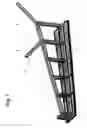
Some embodiments of the invention are provided with the help of FIGS. 1-8.
FIG. 1 represents a configuration of the support with a single framework.
FIG. 2 represents a configuration of the support with a multiple framework.
FIGS. 3 and 4 represent a front view of the same previous configurations, after the laying of the pipeline and after the lateral buckling of the pipeline itself, respectively.
FIGS. 5 and 6 represent a front view of a configuration with a constant tilting surface and a variable tilting surface, respectively.
FIG. 7 represents a front view of a configuration in which the final section of the upper surface of the support is counter-inclined.
FIG. 8 represents a front view of a configuration in which the upper surface of the support consists of a succession of surfaces with varying inclinations alternating with horizontal stretches.
The following numbers indicate:
- (1) the base structure;
- (2) the tilting upper surfaces;
- (3) the funnels;
- (4) the fixed bumpers;
- (5) the movable bumpers after the laying of the pipeline;
- (Pi) the pipeline after laying;
- (Pf) the pipeline after the triggering of the lateral buckling;
- (F) the seabed;
- (C) the laying corridor;
- (α) the inclination angle of the upper surface with respect to the horizontal plane.
Claims
1-16. (canceled)
17. A method for triggering and controlling lateral buckling of underwater pipelines by installation of supporting systems positioned in certain points of the seabed, the method comprising:
tilting upper surfaces of the supports, on which the pipelines rest, with respect to the horizontal plane, and transversally with respect to the direction of the pipelines.
18. The method according to claim 17, further comprising:
installing the supporting systems in certain points of the seabed;
laying underwater pipelines by resting the pipelines on the upper surfaces of the support.
19. The method according to claim 18, wherein the underwater pipelines are rested on the upper surfaces of the support and also have funnels formed by structures present around a higher end of a carrying structure of the support.
20. The method according to claim 19, wherein at least part of the structures present at the higher end of the carrying structure are removed after the pipelines have been rested on the upper surfaces.
21. The method according to claim 17, wherein the inclination angle of the upper surface with respect to the horizontal plane ranges from 3 to 30°.
22. The method according to claim 21, wherein the inclination angle ranges from 5 to 15°.
23. The method according to claim 17, wherein the upper surface of the support has a constant inclination.
24. The method according to claim 17, wherein the upper surface of the support has a varying inclination in one or more points.
25. The method according to claim 17, wherein the upper surface of the support includes a succession of sections with a varying inclination alternating with horizontal stretches.
26. The method according to claim 17, wherein a final section of the upper surface of the support is counter-inclined.
27. A support for resting of underwater pipelines for triggering and control of lateral buckling of the underwater pipelines, comprising:
a structure, positioned on the seabed, with a simple or lattice framework with foundations,
wherein an upper surface, where the pipeline is rested, is tilted transversally with respect to the direction of the pipeline.
28. The support according to claim 27, wherein the upper surface is coated with material having a defined friction coefficient.
29. The support according to claim 27, wherein the friction between the upper surface and the pipeline is defined by supporting rollers.
30. The support according to claim 27, comprising one or more funnels formed by structures present around a higher end of a carrying structure of the support.
31. The support according to claim 27, wherein the inclination of the upper surface can be varied by suitable devices.
32. The support according to claim 27, wherein the foundations are of mud-muts or suction piles type.
Images & Drawings included:



Sources:
- United States Patent and Trademark Office - verify current appl. status at the USPTO↗
Recent applications in this class:
- » 20250075826 2025-03-06
Submarine Reel Drive System And Method For Reeling In And Launching Flexible Pipes And Umbilicals - » 20220003336 2022-01-06
METHOD FOR INSTALLING A GAS TRANSPORTATION ARRANGEMENT - » 20210301945 2021-09-30
Method for controlling buckling in deepwater pipeline with inclined sleepers - » 20200103049 2020-04-02
Offshore vessel, marine pipeline installation system and method - » 20190063638 2019-02-28
Marine reel lay method pipeline installation system and methods - » 20180313467 2018-11-01
Modular Lay System - » 20180156358 2018-06-07
Offshore vessel, marine pipeline installation system and method - » 20180066770 2018-03-08
Method of installing an electrically-heatable subsea flowline and electrically-heatable subsea flowline thereof - » 20170350536 2017-12-07
Method for mounting an undersea installation comprising at least one section of pipe, and associated installation - » 20160123499 2016-05-05
Methods of deploying and operating variable-buoyancy assembly and non-collapsible fluid-line assembly for use with fluid-processing plant