Wing energy unit
US20080157533A1
2008-07-03
10/593,042
2005-03-07
✅ Patent granted
US 7,531,910 B2
2009-05-12
WO; PCT/EP2005/051003; 20050307
WO; WO2005/091490; 20050929
Nicholas Ponomarenko | Pedro J Cuevas
2025-11-27
Abstract:
The invention relates to a wind energy unit, connected to an electrical 3-phase AC network, comprising a generator with a rotor, provided with a regulator device, whereby the regulator device comprises a first and a second regulation unit. A network voltage analyzer is connected to the regulator device and the electrical 3-phase AC network, by means of which a network fault can be recognized, said network fault being defined as a deviation of the network voltage sinor representation from a given set interval, whereby the second regulation unit takes over control from the first regulation unit in the case of a recognized fault and the first regulation performs the control for a non-faulty 3-phase AC network.
Inventors:
- Jorg Flottemesch 3 🇩🇪 Bubenreuth, Germany
- Michael Weinhold 2 🇩🇪 Erlangen, Germany
- Hermann Holfeld 1 🇩🇪 Herzogenaurach, Germany
- Stephan Schaller 1 🇩🇪 Altdorf, Germany
Assignee:
- SIEMENS AKTIENGESELLSCHAFT 12,417 🇩🇪 Munich, Germany
Interested in similar patents?
Get notified when new applications in this technology area are published.
Classification:
H02J3/386 » CPC main
Circuit arrangements for ac mains or ac distribution networks; Arrangements for parallely feeding a single network by two or more generators, converters or transformers; Dispersed generators the generators exploiting renewable energy Wind energy
H02J3/381 » CPC further
Circuit arrangements for ac mains or ac distribution networks; Arrangements for parallely feeding a single network by two or more generators, converters or transformers Dispersed generators
H02J3/50 » CPC further
Circuit arrangements for ac mains or ac distribution networks; Arrangements for parallely feeding a single network by two or more generators, converters or transformers; Controlling of the sharing of output between the generators, converters, or transformers Controlling the sharing of the out-of-phase component
H02P9/007 » CPC further
Arrangements for controlling electric generators for the purpose of obtaining a desired output Control circuits for doubly fed generators
H02J2300/28 » CPC further
Systems for supplying or distributing electric power characterised by decentralized, dispersed, or local generation; The dispersed energy generation being of renewable origin The renewable source being wind energy
H02P2101/15 » CPC further
Special adaptation of control arrangements for generators for wind-driven turbines
Y02E10/76 » CPC further
Energy generation through renewable energy sources; Wind energy Power conversion electric or electronic aspects
Y02E10/76 » CPC further
Energy generation through renewable energy sources; Wind energy Power conversion electric or electronic aspects
H02P9/04 IPC
Arrangements for controlling electric generators for the purpose of obtaining a desired output Control effected upon non-electric prime mover and dependent upon electric output value of the generator
F03D9/00 IPC
Adaptations of wind motors for special use; Combinations of wind motors with apparatus driven thereby; Wind motors specially adapted for installation in particular locations
Description
CROSS REFERENCE TO RELATED APPLICATIONS
This application is the US National Stage of International Application No. PCT/EP2005/051003, filed Mar. 7, 2005 and claims the benefit thereof. The International Application claims the benefits of German Patent application No. 10 2004 013 131.7 filed Mar. 17, 2004. All of the applications are incorporated by reference herein in their entirety.
FIELD OF THE INVENTION
The invention relates to the regulation of a wind energy unit, especially a doubly-fed asynchronous machine.
BACKGROUND OF THE INVENTION
Previously these wind energy generators were constructed and regulated in ways such as that presented in S. Müller, M. Deicke, Rik W. de Doncker: “Doubly fed induction generator systems for wind turbines—a viable alternative to adjust speed over a wide range at minimal cost”, IEEE industry application magazine, May/June 2002. The converter is currently preferably designed as a back-to-back circuit of two self-commutated indirect converters. Each converter is assigned a regulation unit. The corresponding regulation unit determines the switching states of the assigned converter to be implemented and communicates these switching states to the control circuits of the converter. The control circuits are generally integrated into the converter.
The rotor winding-side converter determines with its switching states the currents flowing in the rotor windings. The network-side converter must regulate the direct current to a constant value. The network-side converter can also regulate the direct current for a number of windmills. In this case a direct current network is arranged between a number of windmills. In each case however the rotor winding-side converter is assigned to precisely one windmill.
SUMMARY OF THE INVENTION
The invention described relates especially to the regulation of the rotor winding-side converter. This converter is used as an actuator for creating a current system in the rotor windings. This current system defines the active power and reactive power exchanged between the stator windings of the machine and the 3-phase AC network.
By contrast with the known method, the inventive regulation preferably comprises a network voltage analyzer, a commutator and two separate regulation units.
Depending on the state of the 3-phase AC network (faulty or non-faulty) the assigned regulation unit is connected to the actuator (=rotor winding-side converter).
The state of the 3-phase AC network can be determined in the network voltage analyzer, by evaluation of the network voltage at the connection point of the wind energy unit or wind park to the superordinate 3-phase AC network: If the network voltage (or the amount of the network voltage sinor representation) deviates too greatly from an expected value, the 3-phase AC network is recognized as faulty. A corresponding switchover between the regulation units is then undertaken by the commutator, i.e. the rotor winding-side converter now obtains its switching status signals from the other regulation unit.
Conversely a switch back to the regulation unit “for a non-faulty 3-phase AC network” is undertaken if the network voltage measured at the connection point is once again interpreted as “non-faulty”, i.e. the deviation of the network voltage from its expected value is back within a tolerance range.
The regulation units thus have the following different functions:
-
- Regulation unit for non-faulty superordinate 3-phase AC network:
The wind energy generator is operated with a constant power factor (precisely: Basic oscillation shift factor cos φ1). The detailed design of such regulation is known from literature.
The power factor demanded by the network operator at the connection point can if necessary deviate from the fixed setting of cos φ1. A separate compensation unit takes care of the adaptation.
-
- Regulation unit for faulty superordinate 3-phase AC network:
The regulation unit attempts within the framework of the adjustment range of the wind energy unit (WKA) to regulate the network voltage at the connection point to its rated value (=set value). On the one hand this mode of operation allows the WKA to contribute to clearing network errors in the superordinate 3-phase AC network and simultaneously to provide network voltage backup. Both modes are preferred operating modes of the WKA for network errors in the view of the network operator.
BRIEF DESCRIPTION OF THE DRAWINGS
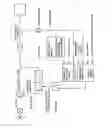
The FIGURE shows a diagram in accordance with the present invention.
DETAILED DESCRIPTION OF THE INVENTION
One embodiment of the regulation implemented in the regulation unit is as follows:
The network voltage measured at the connection point between wind energy unit and network or wind farm and network is compared to a set value. The difference is evaluated in the network voltage regulator. This regulator can include a drooping characteristic to prevent oscillations between network operating resources. The output signal of the network voltage regulator is the set values for the currents to be fed by the current converter into the rotor windings.
The actual rotor winding current values are compared via a lower-ranking regulation unit with these set values. The switching states of the rotor winding-side current converter are determined by evaluating this regulation deviation.
In the calculations it can be advantageous to use information for angular position and rotational speed of the rotor. Both can be determined by corresponding additional devices (e.g.: tachogenerator and angle of rotation sensor).
Claims
1-8. (canceled)
9. A wind energy unit connected to an electrical 3-phase AC network, comprising:
a wind turbine;
a generator having a rotor, a rotor winding and a rotor winding side converter connected to the wind turbine; and
a generator regulation device that regulates the generator having
a first and a second regulation unit that each operate on a rotor-winding side converter,
wherein a network voltage analyzer connects to the electrical 3-phase AC network and determines whether a network fault has occurred if the network voltage sinor representation deviates from a predetermined set interval and if a network fault has occurred the first regulation unit is assigned to regulate a non-faulty 3-phase AC network and the second regulation unit is assigned to regulate the generator rotor winding.
10. The wind energy unit as claimed in claim 9, wherein a compensation unit undertakes a reactive power regulation with a non-faulty 3-phase AC network to a desired reactive power component determined by a basic oscillation shift factor.
11. The wind energy unit as claimed in claim 10, wherein
the reactive power regulation is regulated by the compensation unit, and
the first regulation unit is set for regulating a basic oscillation shift factor that cannot be changed during normal operation.
12. The wind energy unit as claimed in claim 11, wherein the reactive power regulation is regulated exclusively by the compensation unit.
13. The wind energy unit as claimed in claim 12, wherein the generator is a doubly-fed asynchronous generator.
14. The wind energy unit as claimed in claim 13, further comprising
a commutator that activates either the first of the second regulation units based on a specification of the network voltage analyzer.
15. The wind energy unit as claimed in claim 14, wherein the network voltage analyzer receives parameters relating to a rotor current in the generator.
16. The wind energy unit as claimed in claim 15, wherein the network voltage analyzer receives parameters relating to the angular position and the speed of rotation of the rotor in the generator.
17. The wind energy unit as claimed in claim 13, wherein the first and second regulation units are implemented by one and the same physical unit and are embodied either as first or second regulation unit by operating this physical unit with different regulation programs.
Images & Drawings included:

Sources:
- United States Patent and Trademark Office - verify current appl. status at the USPTO↗
Recent applications in this class:
- » 20200274365 2020-08-27
System and method for operating a hybrid energy facility having multiple power sources - » 20200266632 2020-08-20
Random rolling scheduling method for power system based on Newton method - » 20200144826 2020-05-07
System and method for wind power generation and transmission in electrical power systems - » 20200127461 2020-04-23
Systems and methods for managing resonance in wind turbine power systems - » 20200127460 2020-04-23
Systems and methods for dynamic management of wind turbines providing reactive power - » 20200091728 2020-03-19
Method for feeding electrical power into an electrical power supply network - » 20200091727 2020-03-19
System of critical datacenters and behind-the-meter flexible datacenters - » 20200059102 2020-02-20
Wind park with multiple wind turbines - » 20200052493 2020-02-13
Systems and methods for controlling electrical power systems connected to a power grid - » 20200044455 2020-02-06
Method for feeding electrical power into an electrical supply network
Recent applications for this Assignee:
- » 20250262772 2025-08-21
PLACE CONDITIONED PICK FOR ROBOTIC PICK AND PLACE OPERATIONS - » 20250242498 2025-07-31
SYSTEM AND METHOD FOR PICK POSE ESTIMATION FOR ROBOTIC PICKING WITH ARBITRARILY SIZED END EFFECTORS - » 20250216836 2025-07-03
PRIORITIZATION BETWEEN AGENTS IN AGENT-BASED PROCESS AUTOMATION - » 20250168873 2025-05-22
WLAN Communication Method and Devices - » 20250168152 2025-05-22
Communication System, Adapter for a Terminal and Method for Securely Transmitting Time-Critical Data within the Communication System - » 20250166165 2025-05-22
TRAINING SYSTEMS FOR SURFACE ANOMALY DETECTION - » 20250162095 2025-05-22
Method for Operating a Machine Tool, Computer Program Product, Control Unit, Machine Tool, Simulation Program Product and Use of the Control Unit - » 20250147755 2025-05-08
INDUSTRIAL APPLICATION PACKAGE MANAGEMENT - » 20250126041 2025-04-17
METHOD OF CAPTURING PACKETS FROM APPLICATIONS HOSTED ON CONTAINERS - » 20250117920 2025-04-10
SELF-SUPERVISED ANOMALY DETECTION FRAMEWORK FOR VISUAL QUALITY INSPECTION IN MANUFACTRUING