Superior shelf system
US20080164387A1
2008-07-10
11/897,219
2007-08-30
Abstract:
The SUPERIOR SHELF SYSTEM is a method which enables the adjustable slides to be installed without screws or tools of any kind in just seconds and in comfort. Also, when it is desirable for a tray to be relocated to a higher or lower level, it can be done easily and comfortable in a few seconds without the use of tools, thereby providing the solution to all of the previous installation and utility problems resulting in the following advantages:
-
- 1) EFFICIENT USE OF STORAGE SPACE—Height adjustments can be made in increments of one inch (no wasted space);
- 2) ACCESSABILITY—The full-extension slides provide easy access to every item in the cabinet;
- 3) EASE OF INSTALLATION—The next section will show that the SUPERIOR SHELF SYSTEM never requires the installer to crawl into the rear of a cabinet or assume any other awkward position;
- 4) TIME SAVING—Installation of the tray hardware and relocation of the trays takes only a few seconds.
Inventors:
- Fedele (Phil) Anthony Porreca 1 🇺🇸 Henderson, NV, United States
- Richard Lee Kocher 1 🇺🇸 Henderson, NV, United States
- Andre M. Lagomarsino 1 🇺🇸 Las Vegas, NV, United States
Interested in similar patents?
Get notified when new applications in this technology area are published.
Classification:
A47B88/423 » CPC main
Drawers for tables, cabinets or like furniture; Guides for drawers; Sliding drawers; Slides or guides therefor Fastening devices for slides or guides
A47B88/407 » CPC further
Drawers for tables, cabinets or like furniture; Guides for drawers; Sliding drawers; Slides or guides therefor Adjustably or detachably mounted drawers
A47B96/06 IPC
Details of cabinets, racks or shelf units not covered by a single one of groups - ; General details of furniture Brackets or similar supporting means for cabinets, racks or shelves
A47B57/08 IPC
Cabinets, racks or shelf units, characterised by features for adjusting shelves or partitions with means for adjusting the height of the shelves consisting of grooved or notched ledges, uprights or side walls
Description
BACKGROUND OF THE INVENTION
The field of endeavor to which this invention pertains is cabinetry; specifically, the organization of the interior storage space with the objective of increasing the cabinet's storage capacity and, at the same time, providing easy accessibility to every item, regardless of where it is stored. Presently, “under-the-counter” cabinets and pantries are equipped with either fixed or height-adjustable shelves which offer no contribution toward realizing this objective.
A partial solution, presently used, is to remove the shelves and substitute them for “trays” to which metal drawer slides have been attached, thus enabling the tray to be fully extended. However, although these full-extension slides provide full accessibility to the tray's contents, they do not increase the cabinet's storage capacity.
Consider a tray whose contents are no taller than five inches and the tray above it installed at twelve inches higher. Seven inches of valuable storage space are wasted because the trays are fixed at the level at which they were installed. Therefore, this method of screwing slides to the cabinet walls should be abandoned, along with the fixed shelves, if the desired objective is to be achieved.
Another equally important reason for not using the “fixed shelf method,” is that it is very uncomfortable and time-consuming to install. Consider screwing several pairs of slides to the walls of a cabinet which are under the counter. Each slide must be installed level, from front to rear, and level with its mate on the opposite wall, repeating this procedure for every tray to be installed. And because the cabinet is low and screws must be driven into the slide at the rear of the cabinet, the installer must assume very uncomfortable positions. In addition, when the installation has been completed, the user is left with fixed trays that are either too far apart or too close together to be efficient.
Claims
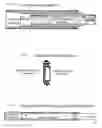
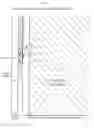
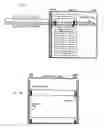
1. THE SLOTTED GRIDS: FIGS. 2A and 2B—Panels affixed to both walls of a cabinet, providing a series of locations (horizontal slots) one inch apart, ascending from bottom to top, from which “slide” hardware can be hung, thus allowing the tray between the slides to be easily installed or relocated.
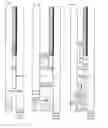
2. THE “Z” BRACKET: FIGS. 3A and 3B—The “Z” Bracket is permanently affixed to the slide so that when the top leg of the bracket is inserted into a slot, the slide is securely held against the grid by the 45° bevel at the rear of the slot and bracket, and remains secure during use because the tray, although fully extended, continues to keep pressure against the front of the slide.
3. HANGER BRACKET: FIGS. 9A and 9B—The alternative method eliminates the “Z” Bracket which is replaced by a part called a “Hanger.” Hangers are manufactured separate from the slides and are joined by inserting a slide into the front of the Hanger. Using this method, the parts of the slide always remain assembled and connected to the sides of the drawer. In practice, it shows that in using this method, shelves can be relocated to a higher or lower position much easier and faster. The Hanger can be manufactured in various heights to accommodate any slide.
Images & Drawings included:




Sources:
- United States Patent and Trademark Office - verify current appl. status at the USPTO↗
Recent applications in this class:
- » 20250151897 2025-05-15
SLIDING RAIL DEVICE - » 20240277142 2024-08-22
CABINET DRAWER MECHANISM - » 20230404259 2023-12-21
Pull-out guide - » 20230380590 2023-11-30
FURNITURE FITTING AND METHOD FOR PRODUCING A FURNITURE FITTING - » 20230346122 2023-11-02
HOOKING DEVICE FOR DRAWERS - » 20230157449 2023-05-25
FURNITURE FITTING FOR MOUNTING A FURNITURE PART - » 20230037625 2023-02-09
Fixing Means - » 20220160128 2022-05-26
Fixing assembly - » 20220160127 2022-05-26
Slide rail assembly - » 20220117391 2022-04-21
A DRAWER SLIDING SYSTEM