Benzimidazole-Substituted Polybezimidazoles as Initial Material For Producing Proton-Conducting Membranes
US20080171798A1
2008-07-17
11/795,613
2006-01-19
Abstract:
The invention relates to application of benzimidazole-substituted polybenizimidazole polymers as initial material for preparing proton-conductive membranes, preferably used in high-temperature fuel cells. Detail methods are provided, comprising the steps of obtaining the polymers, preparing film containing the polymer, doping the film with predetermined acid, thereby forming a proton-conductive membrane with improved proton conductivity. Particularly, a group consisting of three types of the polymers is described. In a preferred embodiment, the predetermined acid is being phosphoric acid.
Inventors:
- Dmitry Yurevich Likhachev 1 🇷🇺 Moscow, Russian Federation
- Aleksei Yurevich Leikin 1 🇷🇺 Moscow, Russian Federation
- Alexandr Lvovich Rusanov 1 🇷🇺 Moscow, Russian Federation
Interested in similar patents?
Get notified when new applications in this technology area are published.
Classification:
B01D71/62 » CPC main
Semi-permeable membranes for separation processes or apparatus characterised by the material; Manufacturing processes specially adapted therefor; Organic material; Other polymers having nitrogen in the main chain, with or without oxygen or carbon only Polycondensates having nitrogen-containing heterocyclic rings in the main chain
B01D71/82 » CPC further
Semi-permeable membranes for separation processes or apparatus characterised by the material; Manufacturing processes specially adapted therefor; Organic material; Macromolecular material not specifically provided for in a single one of groups - characterised by the presence of specified groups, e.g. introduced by chemical after-treatment
C08J5/2256 » CPC further
Manufacture of articles or shaped materials containing macromolecular substances; Manufacture of shaped structures of ion-exchange resins; Films, membranes or diaphragms based on organic and/or inorganic macromolecular compounds; Synthetic macromolecular compounds based on macromolecular compounds obtained by reactions other than those involving carbon-to-carbon bonds, e.g. obtained by polycondensation
H01M8/1027 » CPC further
Fuel cells; Manufacture thereof; Fuel cells with solid electrolytes characterised by the electrolyte material; Polymeric electrolyte materials characterised by the chemical structure of the main chain of the ion-conducting polymer having carbon, oxygen and other atoms, e.g. sulfonated polyethersulfones [S-PES]
H01M8/103 » CPC further
Fuel cells; Manufacture thereof; Fuel cells with solid electrolytes characterised by the electrolyte material; Polymeric electrolyte materials characterised by the chemical structure of the main chain of the ion-conducting polymer having nitrogen, e.g. sulfonated polybenzimidazoles [S-PBI], polybenzimidazoles with phosphoric acid, sulfonated polyamides [S-PA] or sulfonated polyphosphazenes [S-PPh]
H01M8/1048 » CPC further
Fuel cells; Manufacture thereof; Fuel cells with solid electrolytes characterised by the electrolyte material; Polymeric electrolyte materials; Polymer electrolyte composites, mixtures or blends; Mixtures of at least one polymer and at least one additive Ion-conducting additives, e.g. ion-conducting particles, heteropolyacids, metal phosphate or polybenzimidazole with phosphoric acid
H01M8/1081 » CPC further
Fuel cells; Manufacture thereof; Fuel cells with solid electrolytes characterised by the electrolyte material; Polymeric electrolyte materials characterised by the manufacturing processes starting from solutions, dispersions or slurries exclusively of polymers
H01M8/1088 » CPC further
Fuel cells; Manufacture thereof; Fuel cells with solid electrolytes characterised by the electrolyte material; Polymeric electrolyte materials characterised by the manufacturing processes; After-treatment of the membrane other than by polymerisation Chemical modification, e.g. sulfonation
C08J2379/06 » CPC further
Characterised by the use of macromolecular compounds obtained by reactions forming in the main chain of the macromolecule a linkage containing nitrogen with or without oxygen, or carbon only, not provided for in groups - ; Polycondensates having nitrogen-containing heterocyclic rings in the main chain; Polyhydrazides; Polyamide acids or similar polyimide precursors Polyhydrazides; Polytriazoles; Polyamino-triazoles; Polyoxadiazoles
H01M2300/0082 » CPC further
Electrolytes; Non-aqueous electrolytes; Solid electrolytes Organic polymers
Y02E60/50 » CPC further
Enabling technologies; Technologies with a potential or indirect contribution to GHG emissions mitigation; Hydrogen technology Fuel cells
Y02E60/50 » CPC further
Enabling technologies; Technologies with a potential or indirect contribution to GHG emissions mitigation; Hydrogen technology Fuel cells
Y02P70/50 » CPC further
Climate change mitigation technologies in the production process for final industrial or consumer products Manufacturing or production processes characterised by the final manufactured product
Y02P70/50 » CPC further
Climate change mitigation technologies in the production process for final industrial or consumer products Manufacturing or production processes characterised by the final manufactured product
B01J39/18 IPC
Cation exchange; Use of material as cation exchangers; Treatment of material for improving the cation exchange properties; Use of material as cation exchangers; Treatment of material for improving the cation exchange properties; Organic material Macromolecular compounds
Description
CROSS-REFERENCE TO RELATED APPLICATIONS
This application is a U.S. national phase application of a PCT application PCT/RU2006/000012 filed on 19 Jan. 2006, published as WO2006078193, whose disclosure is incorporated herein in its entirety by reference, which PCT application claims priority of a Russian Federation patent application RU2005/101117 filed on 20 Jan. 2005.
FIELD OF THE INVENTION
The present invention relates to materials for production of proton-conducting membranes, specifically for membranes of high-temperature fuel cells, and in particular it relates to application of benzimidazole-substituted polybenzimidazoles as initial material for preparing the above-mentioned membranes. This invention can be used for preparing proton-conductive membranes, in particular membranes for high-temperature fuel cells.
BACKGROUND OF THE INVENTION
Currently polymer proton-conducting membranes are widely used for fuel cells with solid polymer electrolyte, where such membranes are exposed to long-term operation under high temperatures in the presence of oxidizers and other aggressive reagents. In relation to this, certain main requirements are imposed upon material for high-temperature membrane, such as thermal resistance, chemical stability, and possession of a set of satisfactory mechanical properties, ensuring reliable operation of membranes under elevated temperatures.
Recent efforts of developers of materials for proton-conducting membranes for high-temperature fuel cells have been focused on application of basic polymers complexes with strong acids. Thus there is an application known of polybenzimidazole as initial material, which is doped with phosphoric acid and is used for producing proton-conducting membranes for high-temperature fuel cells (J-T. Wang, J. S. Wainright, R. F. Savinell, M. Litt., Electrochim. Acta, v. 41, p. 193-197, (1996); J. A. Asensio, S. Borros, J. Polym. Sci., A 40, p. 3703-3710, (2002)).
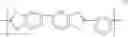
There is a known application of such polymer as poly [2,2′-(m-phenylene)-5,5′-bibenzimidazole] with the following formula for preparing proton-conducting membranes:
The value of proton conductivity of a polymer structured according to formula (1), doped with phosphoric acid, reaches 5×10⁻³ S/cm (X. Glipa, B. Bonnet., J. Mater. Chem., v. 9, p. 3045-3049, (1999)).
The main disadvantage of applications of the known materials as proton-conducting membranes is their insufficient proton conductivity. Conductivity of the doped systems is determined mainly by content of the dopant, in particular phosphoric acid, in a polymer matrix. Previously there have been attempts made to increase a level of acid adsorption by the polymers through introduction of fragments with high basicity, e.g., pyridine rings into constitutional units of the polymer (CUP) (described in an International Application publication WO 2004024796).
However, polybenzimidazoles based on 3,3′-diaminobenzidine and pyridine dicarboxylic acids are soluble in phosphoric acid of medium concentration (40-50%). To remove this disadvantage one has to introduce into the constitutional units of the polymer certain fragments (e. g., p-phenylene), which significantly reduce its solubility and hence the ability to process it into a film.
There are known benzimidazole-substituted polybenzimidazoles (i.e. polybenzimidazoles containing lateral benzimidazole substituents) based on bis-benzoylenebenzimidazoles, used as thermally resistant anti-adhesion coatings for heating elements (A. P. Travnikova, PhD in Chemistry Thesis, INEOS RAS, 1973).
BRIEF DESCRIPTION OF THE INVENTION
The present invention is intended to solve the aforementioned problem, and increase the proton conductivity of proton-conductive membranes. This problem is solved by the use of of benzimidazole-substituted polybenzimidazoles as initial material for preparing proton-conducting membranes.
The proposed polymers with branched structure much more intensively absorb acid versus linear polymers described in formula (1), and that ensures an increase in proton conductivity of the membrane and extends its lifetime.
According to the invention claimed, it is proposed to use complexes of similar polymers with mineral or organic acids, phosphoric acid in particular, for producing proton-conductive membranes.
In a particular preferred embodiment of the invention implementation, benzimidazole-substituted polybenzimidazoles are selected from the group consisting of comprising poly-2,2′-[dibenzimidazole-2-yl-benzene]bibenzimidazole, poly-2,2′-[dibenzimidazole -2-yl-diphenyloxide]bibenzimidazole, poly-2,2′-[dibenzimidazole -2-yl-diphenyloxide]-oxy-bibenzimidazole.
PREFERRED EMBODIMENTS AND BEST MODE OF THE INVENTION
While the invention may be susceptible to embodiment in different forms, there are described in detail herein below, specific embodiments of the present invention, with the understanding that the present disclosure is to be considered an exemplification of the principles of the invention, and is not intended to limit the invention to that as illustrated and described herein.
Benzimidazole-substituted polybenizimidazoles, application of which is proposed in this invention, can be represented by various structures, such as poly-2,2′-[dibenzimidazole-2-yl-benzene]bibenzimidazole of formula (2), poly-2,2′-[dibenzimidazole-2-yl-diphenyloxide]bibenzimidazole of formula (3), poly-2,2′-[dibenzimidazole -2-yl-diphenyloxid]-oxy-bibenzimidazole of formula (4), which are prepared according to the following schemes of synthesis:
Table 1 below shows comparative assessment of the phosphoric acid absorption level, which indicates that polymers with the above branched structure, according to formulas (2)-(4), much more intensively absorb the acid versus linear polymers according to formula (1).
| TABLE 1 |
| Absorption of phosphoric acid by substituted polybenzimidazoles |
| of various structures at doping with 50% H3PO4 |
| Concentration of H3PO4 | Mole of H3PO4/ | |
| Polymer | in membrane, % | mole of CUP |
| 1 | 23 | 1.5 |
| 2 | 24 | 2.7 |
| 3 | 28 | 4.3 |
| 4 | 30 | 5.1 |
Table 2 below illustrates an increase in proton conductivity of the proposed polymers with branched structure, according to formulas (2)-(4), versus linear polymers according to formula (1).
| TABLE 2 |
| Proton conductivity of membranes based on substituted |
| polybenzimidazoles of various structures |
| Proton | ||
| Mole of H3PO4/ | conductivity, S/cm | |
| Polymer | mole of CUP | (20° C.) |
| 1 | 1.,5 | 4.8 × 10⁻³ |
| 2 | 2.7 | 5.9 × 10⁻³ |
| 3 | 4.3 | 8.6 × 10⁻³ |
| 4 | 5.1 | 9.0 × 10⁻³ |
The preferred embodiments of the inventive method for producing proton-conductive membranes are disclosed herein below through the following specific examples.
EXAMPLE 1
Synthesis of oxy-bis-benzoylenbenzimidazole
Oxy-bis-benzoylenbenzimidazole is produced according to the following reaction:
6.96 g of o-phenylenediamine are dissolved in 25 ml of nitrobenzene and suspension of 10 g of oxyi-diphthalic anhydride in nitrobenzene is poured to the solution obtained. The reaction mass is agitated under room temperature during 2 hours and then refluxed with water separation for 7 hours. The solution obtained is kept over night; then resulting sediment is filtered, washed on filter with nitrobenzene two times and with ether 2 times, and then dried to constant mass at 80° C. and 0.1 mm Hg. Yield of the target product is −7.9 g (54% of theoretically possible).
EXAMPLE 2
Synthesis of bis-benzoylenbenzimidazole
Bis-benzoylenbenzimidazole is prepared by the procedure similar to Example 1, from 10 g of pyromellitic anhydride and 9.9 g of o- phenylenediamine producing 10 g of the target product (60% of theoretically possible).
EXAMPLE 3
Preparing the Polymer According to Formula (2)
Charges of bis-benzoylenbenzimidazole (3 g), 3,3′- diaminobenzidine (1.7734 g) and 85% polyphosphoric acid (60 g) are placed into a two-neck flask with agitator. The flask is purged with argon for 30 minutes, then the temperature of the reaction mass is increased up to 200° C., and the reaction is carried out in a flow of argon during 10 hours. The hot reaction mass is poured into water, the polymer obtained is washed with water and kept in aqueous ammonia (pH=10) during 5 hours to neutralize the residual phosphoric acid. The neutralized polymer is washed with water and dried at 200° C. to a constant mass with production of 4.3 g of polymer (96% of theoretically possible).
EXAMPLE 4
Preparing the Polymer According to Formula (3)
Synthesis of the polymer of formula (3) is carried out according to the procedure of Example 3 from oxy-bis-benzoylenbenzimidazole (2 g) and 3,3′-diaminobenzidine (0.9427 g).
2.7 g of polymer are produced (97% of theoretically possible).
EXAMPLE 5
Preparing the Polymer According to Formula (4)
Polymer according to formula (4) is prepared by utilizing a procedure similar to the one described in Example 3 from oxy-bis-benzoylenbenzimidazole (2 g) and 3,3′,4,4′-tetraminodiphenyloxide (1.0132 g).
2.7 g of polymer are produced (95% of theoretically possible).
EXAMPLE 6
Casting Polymer Films
First, polymer charge is dissolved in a 3% solution of lithium chloride in dimethylacetamide at heating. The solution obtained is filtered through a glass filter, evenly spread over glass substrate and dried first in air until it becomes hazy, and then at a gradual increase of temperature from 50 up to 200° C. during 1 hour. The resultant film is removed from the substrate in a flow of water, washed with warm water to remove lithium chloride (3 times for 30 minutes) and dried at 200° C. to a constant mass.
EXAMPLE 7
Preparing Proton-Conductive Membranes by Doping
First, a polymer film is placed for 24 hours into a water solution containing 50% of phosphoric acid. Then the obtained film is dried with filter paper until no moisture is present on the surface, and then dried under vacuum (0.1 mm Hg) over P205 during 1 hour.
Claims
1. A method of new use of a benzimidazole-substituted polybenzimidazole polymer as initial material for preparing proton-conducting membranes comprising the steps of:
a) preparing a film containing said polymer; and
b) doping said film with phosphoric acid.
2. The method of new use according to claim 1, wherein said polymer being selected from the group consisting of
(A) poly-2,2′-[dibenzimidazole-2-yl-benzene]bibenzimidazole,
(B) poly-2,2′-[dibenzimidazole-2-yl-diphenyloxide]bibenzimidazole, and
(C) poly-2,2′-[dibenzimidazole-2-yl-diphenyloxid]-oxy-bibenzimidazole.
3. A method for production of proton-conductive membranes comprising:
a) a step for providing a benzimidazole-substituted polybenizimidazole polymer;
b) a step for preparing a film containing said polymer; and
c) a step for doping said film with predetermined acid thereby forming a proton-conductive membrane with improved proton conductivity.
4. The method according to claim 3, wherein
said predetermined acid being phosphoric acid.
5. The method according to claim 3, wherein said polymer being selected from the group consisting of
(A) poly-2,2′-[dibenzimidazole-2-yl-benzene]bibenzimidazole,
(B) poly-2,2′-[dibenzimidazole-2-yl-diphenyloxide]bibenzimidazole, and
(C) poly-2,2′-[dibenzimidazole-2-yl-diphenyloxid]-oxy-bibenzimidazole.
6. The method according to claim 4, wherein said polymer being selected from the group consisting of
(A) poly-2,2′-[dibenzimidazole-2-yl-benzene]bibenzimidazole,
(B) poly-2,2′-[dibenzimidazole-2-yl-diphenyloxide]bibenzimidazole, and
(C) poly-2,2′-[dibenzimidazole-2-yl-diphenyloxid]-oxy-bibenzimidazole.
Images & Drawings included:


Sources:
- United States Patent and Trademark Office - verify current appl. status at the USPTO↗
Recent applications in this class:
- » 20250099921 2025-03-27
POLYPYRROLE-GRAPHITIC CARBON NITRIDE (PPY-G-C3N4) DECORATED POLYMERIC/CERAMIC COMPOSITE FILTRATION MEMBRANE - » 20250033002 2025-01-30
Porous Polybenzimidazole Membrane Supports for Composite Membranes - » 20240390865 2024-11-28
THERMALLY CROSSLINKED POLYTRIAZOLE SEPARATION MEMBRANES - » 20230024915 2023-01-26
Porous polybenzimidazole membrane supports for composite membranes - » 20220023804 2022-01-27
Intrinsically microporous ladder-type Tröger's base polymers - » 20210178340 2021-06-17
Functionalized poly(diallylpiperidinium) and its copolymers for use in ion conducting applications - » 20190060843 2019-02-28
Composite membranes and applications thereof - » 20190060842 2019-02-28
FUNCTIONALIZED POLY(DIALLYLPIPERIDINIUM) AND ITS COPOLYMERS FOR USE IN ION CONDUCTING APPLICATIONS - » 20170209839 2017-07-27
Porous ABPBI [phosphoric acid doped poly (2, 5-benzimidazole)] membrane and process of preparing the same - » 20170165614 2017-06-15
Asymmetric membranes for use in nanofiltration