Synergistic Blends of (Alkyl)Naphthalene Formaldehyde Condensate Sulfonates and Lignosulfonates Useful in Agrochemical Formulations
US20080214401A1
2008-09-04
11/916,310
2006-05-29
Abstract:
The invention generally relates to a synergistic co-spray dried blend of (alkyl)naphthalene formaldehyde condensate sulfonates and lignosulfonates. This co-spray dried blend is useful as a dispersant in useful in agrochemical formulations.
Assignee:
- AKZO NOBEL N.V. 310 🇳🇱 Arnhem, Netherlands
Interested in similar patents?
Get notified when new applications in this technology area are published.
Classification:
A01N25/30 » CPC further
Biocides, pest repellants or attractants, or plant growth regulators, characterised by their forms, or by their non-active ingredients or by their methods of application, e.g. seed treatment or sequential application ; Substances for reducing the noxious effect of the active ingredients to organisms other than pests characterised by the surfactants
A01N25/04 » CPC further
Biocides, pest repellants or attractants, or plant growth regulators, characterised by their forms, or by their non-active ingredients or by their methods of application, e.g. seed treatment or sequential application ; Substances for reducing the noxious effect of the active ingredients to organisms other than pests containing liquids as carriers, diluents or solvents Dispersions, emulsions, suspoemulsions, suspension concentrates or gels
A01N43/70 » CPC further
Biocides, pest repellants or attractants, or plant growth regulators containing heterocyclic compounds having rings with three nitrogen atoms as the only ring hetero atoms 1,3,5-Triazines, not hydrogenated and not substituted at the ring nitrogen atoms with two or three nitrogen atoms directly attached to ring carbon atoms Diamino—1,3,5—triazines with only one oxygen, sulfur or halogen atom or only one cyano, thiocyano (—SCN), cyanato (—OCN) or azido (—N) group directly attached to a ring carbon atom
A01N2300/00 » CPC further
Combinations or mixtures of active ingredients covered by classes - with other active or formulation relevant ingredients, e.g. specific carrier materials or surfactants, covered by classes -
A01N25/12 » CPC main
Biocides, pest repellants or attractants, or plant growth regulators, characterised by their forms, or by their non-active ingredients or by their methods of application, e.g. seed treatment or sequential application ; Substances for reducing the noxious effect of the active ingredients to organisms other than pests Powders or granules
Description
FIELD OF THE INVENTION
The present invention generally relates to a synergistic blend of (alkyl) naphthalene formaldehyde condensate sulfonates and lignosulfonates useful in agrochemical formulations.
BACKGROUND OF THE INVENTION
Lignosulfonates and naphthalene condensate sulfonates are both used as dispersants in agricultural formulations, specifically suspension concentrates, suspoemulsions, water dispersible granules and wettable powders. Typically they are used alone in a formulation, but there are instances where they are used together in order to improve the physical stability and/or dilution performance of the finished product. When used together, the manufacturer will combine the individual liquids or powders into the formulation during manufacturing.
The present inventors have discovered an improved blend of lignosulfonates and naphthalene condensate sulfonates. More particularly, it has been discovered that the performance of lignin sulfonates plus naphthalene condensate sulfonates is increased when solutions of the two are blended and co-spray dried instead of blended together as individual powders, or added as individual solutions to the formulated product.
SUMMARY OF THE INVENTION
The invention generally relates to a synergistic blend of (alkyl) naphthalene formaldehyde condensate sulfonates and lignosulfonates useful in agrochemical formulations. More particularly, the invention relates to a synergistic co-spray dried blend lignosulfonates and naphthalene condensate sulfonates.
DETAILED DESCRIPTION OF THE INVENTION
The present invention relates to an improved dispersing agent composition useful in the agricultural industry. The dispersing agent composition of the present invention comprises a free-flowing powder of a blend of a) at least one lignin sulfonate, and b) at least one naphthalene condensate sulfonate. The free flowing powder of the invention is obtained by blending an aqueous solution of component a) and b), followed by a drying step. Drying can be accomplished by various means, including evaporation, freeze-drying, spray drying and the like. In one embodiment, the drying is accomplished in a (co-) spray drying step.
The present inventors have found that the performance of lignin sulfonates plus naphthalene condensate sulfonates is increased when solutions of the two are blended and dried, such as by spray-drying, instead of blended together as individual dry powders, or added as individual solutions to the formulated product.
Exemplary components a) are water-soluble salts of lignin sulfonate, e.g., the sodium, potassium, magnesium, calcium or ammonium salts of lignin sulfonate are preferably employed as component a) of the synergistic blend disclosed herein. The sodium salt of lignin sulfonate is preferred for use herein. Any commercially available lignin sulfonate salt which does not contain added surfactant, may be conveniently employed herein. Commercially available lignin sulfonate emulsifiers include, but are not limited to: Reax.RTM., LTS, LTK and LTM, respectively, the potassium, magnesium and sodium salts of lignosulfonate (50% aqueous solutions), Scott Paper Co., Forest Chemical Products; Marasperse CR.RTM. and Marasperse CBOS-3.RTM., sodium lignosulfonate, and Marasperse C21.RTM., calcium sulfonate, Reed Lignin Co., Polyfon O.RTM., Polyfon T.RTM., Reax 88B.RTM., Reax 85B.RTM., sodium salts of lignin sulfonate, Westvaco Polychemicals.
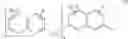
Component b) is an alkyl naphthalene formaldehyde condensate sulfonate of the formula:
wherein each R is independently hydrogen, a C1-30 straight or branched chain alkyl or alkenyl group, preferably a C1-4 alkyl group; and each X is independently hydrogen, an alkali metal, an alkaline earth metal, ammonium, a mono-, di-, or tri-C1-4 alkyl ammonium, or a mono-, di- or tri-C1-4 hydroxyalkyl ammonium moiety. In the above formula I, it is understood that the R groups can be present in any position on the naphthalene nucleus. The n groups show the repetition of the monomer units. In most embodiments, each n is on average from 1-25.
The alkyl naphthalene condensate sulfonates of formula I are preferably manufactured by the process of U.S. Pat. No. 5,110,981 to Milstein, which is incorporated herein by reference. As stated in this patent, the alkyl naphthalene condensate sulfonates are usually obtained in the form of mixtures, containing both mono- and di-alkyl sulfonates, as well as small quantities of unreacted naphthalene and/or unsulfonated alkyl naphthalenes which will not interfere with their use in the practice of the present invention.
In general, components a) and b) are mixed together at 100% active concentrations in the following ratio 5:95 to 95:5, in another embodiment 10:90 to 90:10, in another embodiment 15:85 to 85:15, in another embodiment 25:75 to 75:25 and in still another embodiment of 50:50. Thereafter, aqueous solutions of each are prepared for use in preparing the free flowing powder of the invention.
Each of components a) and b) are typically obtained as 45% solids solutions from the respective synthesis routes. Once obtained, aqueous solutions of a) and b) are mixed together to form an aqueous blend of a) and b). Alternatively, a dry, or semi-dry powders of each of components a) and b) can be utilized. Said (semi)dry powders could be blended either before and/or after the addition of water, with the objective of obtaining an aqueous blend of a) and b).
The quantity of solution a) and b) are blended together to give the desired ratio, such as 15:85 and 85:15, based on the percent solids present in solution a) and b). Either solution a) or b) would be charged into the appropriate tank and heated to a target temperature to facilitate homogeneity, typically between 50° C. and 70° C. Once the target temperature has been achieved the other solution is added to the tank. That mixture is mixed until homogenous. Homogeneity should be verified via analysis before the solution is dried.
Thereafter, the aqueous blend of a) and b) is dried in order to get the dry free-flowing powder of the invention. In one embodiment, the liquid blend is dried using a Co-current type spray drier. Suitably it is a top fed, atomized spray drier. The inlet temperature on the drier ranges from 300° F. to 500° F. and the outlet temperature ranges between 200° F. and 270° F. The liquid if fed into the drier at a rate of between 10 and 20 gallons per minute.
The dry blends of the alkyl naphthalene condensate sulfonates and lignosulfonates are used as dispersants for wettable powders, water dispersible granules, suspension concentrates and suspoemulsions. Generally the blend is used with either non-ionic or an-ionic surfactant(s) acting as wetting agent or formulation stabilizer. The blends are used in suspension concentrates and suspoemulsions at a concentration range of 1.0 to 20% wt of the formulation, preferably 1.0 to 12.5% wt. Ideal embodiments utilize between 2.0 and 7.5% wt. In water dispersible granules and wettable powders, the use rate can range between 1.0 and 25% wt, preferably 2.0 to 15% wt but most desired between 2.5 and 10% wt.
The dry blends of the present invention can be used to disperse any, and all, insecticides, herbicides, fungicides and plant growth regulators that have a water solubility of less than 1000 ppm and a melting point of greater than 50° C. The most preferred properties would be a water solubility of less than 400 ppm and a glass transition temperature of 40° C. or higher.
The invention will now be illustrated by the following non-limiting example.
EXAMPLE
Two Atrazine suspension concentrates were produced; one using Morwet D-425 plus lignosulfonate, made by dry blending the two dry products, and the second used a Morwet + lignin powder wherein aqueous solutions of each were prepared, mixed, and co-spray dried. The following recipe was used to make the suspension concentrates:
| Atrazine | 43.0% wt | |
| Dispersant blend | 2.5% wt | |
| Water | 54.5% wt | |
The technical was dry milled to an average particle size of 5 microns, so the finished suspension concentrates were not wet milled. The dispersant blend was added to the water and mixed until homogenous. The technical was then added and dispersed using high shear. Shearing continued until all of the technical was wetted and dispersed. The suspensibility of the suspension concentrates was measured using CIPAC method MT161.
The suspensibility of the two suspension concentrates was measured, and the results were:
| 345 ppm water | 1000 ppm water | |
| Dispersant | % suspensibility | % suspensibility |
| Calcium lignin: D-425 (mix) | 59.8 | 14.9 |
| Calcium lignin: D-425 (codry) | 83.4 | 49.8 |
The suspensibility of the suspension concentrate that contained the co-dried dispersant blend of the invention was substantially higher in 345 ppm and 1000 ppm water when compared to the suspension that contained the dry blend of dispersants according to the prior art. This result is both surprising and unexpected.
Claims
1. A process for preparing an improved dispersing agent composition in the form of a free flowing powder, said process comprising a step of co-drying a) at least one lignin sulfonate, and b) at least one naphthalene formaldehyde condensate sulfonate, said process comprising the sub-steps of blending an aqueous mixture of a) and an aqueous mixture of b), in order to obtain a blended aqueous mixture of components a) and b), followed by drying said blended aqueous mixture in order to obtain said improved dispersing agent composition in the form of a free-flowing powder.
2. The process of claim 1 wherein said at least one lignin sulfonate is a water-soluble salt of lignin sulfonate.
3. The process of claim 2 wherein said water-soluble salt of lignin sulfonate is the sodium, potassium, magnesium, calcium or ammonium salt of lignin sulfonate.
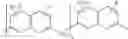
4. The process of claim 1 wherein said at least one naphthalene condensate formaldehyde sulfonate is of the formula:
wherein each R is independently hydrogen, a C1-30 straight or branched chain alkyl, or alkenyl group; each X is independently hydrogen, an alkali metal, an alkaline earth metal, ammonium, a mono-, di-, or tri-C1-4 alkyl ammonium, or a mono-, di- or tri-C1-4 hydroxyalkyl ammonium moiety, and n is an integer of from 1-25.
5. The process of claim 4 wherein each R is independently a C1-4 alkyl group.
6. The process of claim 1 wherein the ratio of component a) at least one lignin sulfonate, and b) at least one naphthalene formaldehyde condensate sulfonate is in the range of from about 5:95 to 95:5 at 100% actives concentration.
7. The process of claim 6 wherein the ratio of component a) to component b) is in the range of from about 10:90 to 90:10 at 100% actives concentration.
8. The process of claim 7 wherein the ratio of component a) at least one lignin sulfonate, and b) at least one naphthalene formaldehyde condensate sulfonate is in the range of from about 25:75 to 75:25 at 100% actives concentration.
9. An improved dispersing agent composition in the form of a free flowing powder, wherein said composition comprises a dried blend of a) at least one lignin sulfonate, and b) at least one naphthalene condensate sulfonate, wherein said dispersing agent composition has a % suspensibility of at least 83% based on a 43 wt % Atrazine suspension concentrate containing 345 ppm water, measured according to CIPAC method MT161.
10. The composition of claim 9 wherein said at least one lignin sulfonate is a water-soluble salt of lignin sulfonate.
11. The composition of claim 10 wherein said water-soluble salt of lignin sulfonate is the sodium, potassium, magnesium, calcium or ammonium salt of lignin sulfonate.
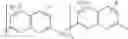
12. The composition of claim 9 wherein said at least one naphthalene condensate sulfonate is an alkyl naphthalene condensate sulfonate of the formula:
wherein each R is independently hydrogen, a C1-30 straight or branched chain alkyl, or alkenyl group; each X is independently hydrogen, an alkali metal, an alkaline earth metal, ammonium, a mono-, di-, or tri-C1-4 alkyl ammonium, or a mono-, di- or tri-C1-4 hydroxyalkyl ammonium moiety, and n is from 1-25.
13. The composition of claim 12 wherein each R is independently a C1-4 alkyl group.
14. The composition of claim 9 wherein the ratio of component a) at least one lignin sulfonate, and b) at least one naphthalene formaldehyde condensate sulfonate is in the range of from about 5:95 to 95:5 at 100% actives concentration.
15. The composition of claim 14 wherein the ratio of component a) at least one lignin sulfonate, and b) at least one naphthalene formaldehyde condensate sulfonate is in the range of from about 10:90 to 90:10 at 100% actives concentration.
16. The composition of claim 15 wherein the ratio of component a) at least one lignin sulfonate, and b) at least one naphthalene formaldehyde condensate sulfonate is in the range of from about 25:75 to 75:25 at 100% actives concentration.
17. A biologically active suspension concentrate that comprises a dispersing effective amount of at least one dispersing agent according to claim 9.
18. The concentrate of claim 17 which contains an insecticide, herbicide, fungicide, plant growth regulator, or mixtures thereof.
19. The concentrate of claim 17 wherein said dispersing agent is present in an amount of from about 1.0 to 20% wt based on the weight of the concentrate.
20. The concentrate of claim 19 wherein said dispersing agent is present in an amount of from about 2.0 to 7.5% wt based on the weight of the concentrate.
Images & Drawings included:
Sources:
- United States Patent and Trademark Office - verify current appl. status at the USPTO↗
Similar patent applications:
Recent applications in this class:
- » 20240423199 2024-12-26
COMPOSITIONS FOR CONTROLLING PHYTOPLANKTON CONTAMINATION - » 20240324588 2024-10-03
ESSENTIAL OIL MICROPARTICLES FOR POWDER COATING APPLICATIONS - » 20240164372 2024-05-23
Granulated agricultural adjuvant and method of making and using same - » 20240057589 2024-02-22
EFFERVESCENT SOLID DOSAGE FORM COMPOSITIONS CONTAINING ENVIRONMENTALLY SAFER ANTI-MICROBIAL COMPONENTS - » 20230413809 2023-12-28
DISINFECTANT COMPOSITION FOR SURFACES AND THE PREPARATION THEREOF - » 20230320348 2023-10-12
COMPOUND, PRODUCTION METHOD THEREFOR, AND HYDROGEN SUPPLY METHOD - » 20230240289 2023-08-03
ANTIMICROBIAL SUBSTRATES - » 20230240288 2023-08-03
FRUIT TREE POLLINATION METHOD FOR PREVENTING AND CONTROLLING ERWINIA AMYLOVORA-CAUSED DISEASE - » 20230225314 2023-07-20
PREPARATION METHOD FOR L-GLUFOSINATE-AMMONIUM POWDER - » 20230014223 2023-01-19
IMPREGNATED PESTICIDE GRANULAR COMPOSITION FOR SOIL APPLICATION
Recent applications for this Assignee:
- » 20150307631 2015-10-29
Process to prepare crosslinked cellulose ethers, crosslinked cellulose ethers obtainable by such process and the use thereof - » 20150201612 2015-07-23
Viscoelastic system for drift reduction - » 20150057467 2015-02-26
PROCESS TO PREPARE ETHYLENE AMINES - » 20150007956 2015-01-08
Silica-based sols - » 20140378309 2014-12-25
Gel prevention agents - » 20140360692 2014-12-11
Filler for paper making process - » 20140318727 2014-10-30
Process for the production of paper - » 20140316029 2014-10-23
Process for production of powder redispersible in water and use thereof - » 20140256998 2014-09-11
ADDITIVE FOR PRESERVING THE FLUIDITY OF FLUIDS CONTAINING GAS HYDRATES - » 20140179953 2014-06-26
Process to prepare ethylene amines