Process for the production of carboxanilides
US20080262242A1
2008-10-23
12/093,619
2006-11-13
✅ Patent granted
US 7,820,830 B2
2010-10-26
WO; PCT/EP2006/010866; 20061113
WO; WO2007/057140; 20070504
Kamal A Saeed
2027-09-03
Abstract:
The present invention relates to a novel process for the preparation of a compound of general formula (I): wherein R1 is H or C1-4 alkyl and R2 is difluoromethyl or trifluoromethyl, which comprises reacting a compound of general formula (II): wherein R1 has the meaning given above and X is chloro or bromo, with a compound of general formula (III): wherein R2 has the meaning given above, in the presence of a base, a palladium catalyst and a ferrocenyl biphoshine ligand of the Josiphos type, the reaction being carried out in an ether solvent at a reflux temperature of at least 100° C.
Inventors:
- Hans Tobler 53 🇨🇭 Basel, Switzerland
- Camilla Corsi 30 🇨🇭 Basel, Switzerland
- Harald WALTER 38 🇨🇭 Basel, Switzerland
- Josef EHRENFREUND 35 🇨🇭 Basel, Switzerland
Assignee:
- SYNGENTA CROP PROTECTION, INC. 407 🇺🇸 Greensboro, NC, United States
Interested in similar patents?
Get notified when new applications in this technology area are published.
Classification:
A61P31/00 » CPC further
Antiinfectives, i.e. antibiotics, antiseptics, chemotherapeutics
A61P31/10 » CPC further
Antiinfectives, i.e. antibiotics, antiseptics, chemotherapeutics Antimycotics
C07D231/14 » CPC main
Heterocyclic compounds containing 1,2-diazole or hydrogenated 1,2-diazole rings not condensed with other rings having two or three double bonds between ring members or between ring members and non-ring members with hetero atoms or with carbon atoms having three bonds to hetero atoms with at the most one bond to halogen, e.g. ester or nitrile radicals, directly attached to ring carbon atoms
Description
The present invention relates to a novel process for preparing certain o-cyclopropyl-carboxanilides, which are useful as microbiocides and especially as fungicides.
Various o-cyclopropyl-carboxanilides, methods for their preparation and their use as microbicides are described in WO 03/074491. In one method of preparation an o-cyclopropyl-aniline of the formula (C), shown in Scheme 1 below, where R3 may be, inter alia, a substituted cyclopropyl group, is reacted with an acid chloride of the formula Het-COCl, where Het is for example a substituted pyrazolyl group, to form an o-cyclopropyl-carboxanilide of the formula (D):
The o-cyclopropyl-aniline (C) is made by a multi-stage process which culminates in the two steps shown in Scheme 1:
As seen from Scheme 1, this process involves the conversion of a 2-(2-halophenyl)-cyclopropane of the formula (A), where Hal is bromo or iodo and R3 is, as mentioned above, a substituted cyclopropyl group, to the o-cyclopropyl-aniline (C) via the imine (B). The imine (B) is formed by reacting the cyclopropane (A) with benzophenone imine for several hours in a solvent, such as benzene or toluene, at its reflux temperature in the presence of sodium tert-butoxide, tris-dibenzylideneacetone-dipalladium (Pd2dba3) and racemic 2,2′-bis(diphenyl-phosphino)-1,1′-binaphthyl (BINAP) and then added (usually as a crude, isolated product) to a mixture of hydroxylamine hydrochloride, sodium acetate and a solvent, such as methanol, to form a cis-/trans-mixture of the aniline (C).
This process for preparing o-cyclopropyl-carboxanilides starting from a 2-(2-halo-phenyl)-cyclopropane of the formula (A) is expensive and not well suited to large scale production. Amongst other disadvantages, it involves three separate stages and requires the use of the expensive benzophenone imine and the isolation of the intermediate imine (B). In addition, according to WO 03/074491, the cyclopropane (A) must be a bromo- or iodo-phenyl cyclopropane and not the corresponding, cheaper, but less reactive, chlorophenyl cyclo-propane.
It has now been found that certain o-cyclopropyl-carboxanilides may be prepared directly from a 2-(2-bromo- or 2-chlorophenyl)-cyclopropane in a one-stage process, better suited to, and less costly for, use on a commercial scale.
Thus, according to the present invention, there is provided a process for the preparation of the compound of the general formula (I):
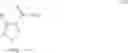
wherein R1 is H or C1-4 alkyl and R2 is difluoromethyl or trifluoromethyl, which comprises reacting the compound of the general formula (II):
wherein R1 has the meaning given above and X is chloro or bromo (preferably chloro), with a compound of the general formula (III):
wherein R2 has the meaning given above, in the presence of a base, a palladium catalyst and a ferrocenyl biphoshine ligand of the Josiphos type, the reaction being carried out in an ether solvent at a reflux temperature of at least 100° C.
The term “alkyl” mentioned herein refers to branched or unbranched alkyl groups containing from 1 to 4 carbon atoms and is methyl, ethyl, n-propyl, iso-propyl, n-butyl, sec-butyl, iso-butyl or tert-butyl.
The base used in the process of the invention is preferably a strong base, typically an alkali metal or alkaline earth metal hydroxide, carbonate or alkoxide or an alkali metal phosphate or bicarbonate, or mixtures thereof. Particularly suitable are the hydroxides or carbonates of sodium, potassium, cesium, lithium, calcium and barium, the phosphates of sodium and potassium and the C1-C4 alkoxides of sodium and potassium. Of particular interest are potassium tert-butoxide, sodium tert-butoxide, potassium hydroxide, sodium hydroxide, sodium methoxide, sodium ethoxide, sodium carbonate, potassium carbonate, cesium carbonate and potassium phosphate.
The amount of base used will depend on the particular base chosen, but will normally be from 1 to 3, conveniently from 1 to 2 and typically 1.2 to 1.6 moles per mole of compound (II).
The palladium catalyst used in the process of the invention is suitably palladium dichloride, palladium(II) acetate, tris-dibenzylideneacetone-dipalladium (Pd2dba3) or bis-dibenzylideneacetone palladium (Pd(dba)2). Palladium(II) acetate has been found particularly convenient to use.
The ferrocenyl biphoshine ligand used is of the Josiphos type. Such ligands are commercially available and include:
- (R)-(−)-1-[(S)-2-(bis(4-trifluoromethylphenyl)phosphino)ferrocenyl]ethyl-di-tert-butyl-phosphine;
- (R)-(−)-1-[(S)-2-(di(3,5-bis-trifluoromethylphenyl)phosphino)ferrocenyl]ethyldicyclohexylphosphine;
- (R)-(−)-1-[(S)-2-(di(3,5-bis-trifluoromethylphenyl)phosphino)ferrocenyl]ethyldi(3,5-dimethyl-phenyl)phosphine;
- (R)-(−)-1-[(S)-2-(dicyclohexylphosphino)ferrocenyl]ethyldi-tert-butylphosphine;
- (R)-(−)-1-[(S)-2-(dicyclohexylphosphino)ferrocenyl]ethyldicyclohexylphosphine;
- (S)-(+)-1-[(R)-2-(dicyclohexylphosphino)ferrocenyl]ethyldicyclohexylphosphine;
- (S)-(+)-1-[(R)-2-(dicyclohexylphosphino)ferrocenyl]ethyldiphenylphosphine;
- (R)-(−)-1-[(S)-2-(bis(3,5-dimethyl-4-methoxyphenyl)phosphino)ferrocenyl]ethyldicyclohexyl-phosphine;
- (S)-(+)-1-[(R)-2-(di-furylphosphino)ferrocenyl]ethyldi-3,5-xylylphosphine;
- (R)-(−)-1-[(S)-2-(diphenylphosphino)ferrocenyl]ethyldi-tert-butylphosphine;
- (S)-(+)-1-[(R)-2-(diphenylphosphino)ferrocenyl]ethyldi-tert-butylphosphine;
- (R)-(−)-1-[(S)-2-(diphenylphosphino)ferrocenyl]ethyldicyclohexylphosphine;
- (R)-(+)-1-[(R)-2-(diphenylphosphino)ferrocenyl]ethyldicyclohexylphosphine
- (S)-(+)-1-[(R)-2-(diphenylphosphino)ferrocenyl]ethyldicyclohexylphosphine;
- (R)-(−)-1-[(S)-2-(dicyclohexylphosphino)ferrocenyl]ethyldiphenylphosphine;
- (R)-(−)-1-[(S)-2-(diphenyl)phosphino)ferrocenyl]ethyldi(3,5-dimethylphenyl)phosphine;
and racemic mixtures thereof, especially racemic mixtures of 2-(dicyclohexylphosphino)-ferrocenyl]ethyldi-tert-butylphosphine.
Other Josiphos ligands which may be used include: - (R)-(−)-1-[(S)-2-(di-tert-butyl-phosphino)ferrocenyl]ethyl-di-o-tolylphosphine
- (R)-(−)-1-[(S)-2-(bis(3,5-dimethyl-4-methoxyphenyl)phosphino)ferrocenyl]-ethyl-di-tert-butylphosphine
- (R)-(−)-1-[(S)-2-(diethylphosphino)ferrocenyl]-ethyl-di-tert-butylphosphine
- (R)-(−)-1-[(S)-2-(P-methyl-P-isopropyl-phosphino)ferrocenyl]ethyldicyclohexylphosphine
- (R)-(−)-1-[(S)-2-(P-methyl-P-phenyl-phosphino)ferrocenyl]ethyl-di-tert-butylphosphine
and racemic mixtures thereof, especially racemic mixtures of 2-(di-tert-butylphosphino)-ferrocenyl]ethyl-di-o-tolylphosphine.
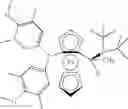
A Josiphos ligand which has been found particularly useful is (R)-(−)-1-[(S)-2-(dicyclohexyl-phosphino)ferrocenyl]ethyldi-tert-butylphosphine; which has the structural formula:
In the invention process, the palladium catalyst will normally be employed in a ratio of from 0.001 to 10 mol %, preferably from 0.01 to 1 and typically about 0.02 mol %, based on compound (II).
The Josiphos ligand will normally be used with one equivalent of the palladium catalyst, or thereabouts.
The solvent used for carrying out the process is an ether solvent, inert under the reaction conditions of the process, having a boiling point such that the reaction mixture can be refluxed at atmospheric pressure at a temperature of at least 100° C. Such solvents include dialkyl ethers of alkylene- and polyalkyleneglycols and, in particular, diethyleneglycol dialkylethers having the general formula:
ROCH2CH2OCH2CH2OR
wherein R is C1-4 alkyl. Most conveniently, the solvent is di(ethylene glycol) dimethyl ether (diglyme), which has a boiling point of about 162° C.
The process of the invention is carried out at the reflux temperature of the solvent employed, which should be at least 100° C., usually at least 130° C., normally from 130 to 200° C., and typically from 140 to 180° C.
The process may be carried out at atmospheric pressure. The vessel used for the process may be purged with nitrogen before the reactants are introduced, but this is not a requirement.
The 2-chloro- or bromophenyl bicyclopropyl compound (II) used in the process of the invention may exist as a cis- or trans-isomer or a mixture of both. The invention process includes the use of either isomer or any mixture thereof in any proportion and the compound (I) may be obtained as one or other isomer or a mixture of both, accordingly.
The amount of the pyrazole carboxylic acid amide (III) used in the process is conveniently from 1 to 5 moles, for example from 1 to 1.5 moles and typically from 1 to 1.2 moles, for each mole of bicyclopropyl compound (II) used.
The reaction time will depend, inter alia, on the scale of the process and the temperature, but will usually take from 1 to 48 hours, for example, from 6 to 24 hours, and typically from 10 to 20 hours.
The process is conveniently carried out by adding the compounds (II) and (III) with the base, catalyst and ligand to the solvent in a suitable reaction vessel. The order of addition is not critical. When the reaction is adjudged complete, for example, by gas chromatographic analysis of a sample of the reaction mixture, the crude product may be isolated by adding ethyl acetate to the reaction mixture, washing the organic phase with water, drying it and distilling off the solvent. It may then be purified by standard laboratory techniques, for example, by column chromatography.
The product (I) is a useful microbiocide, having especially good fungicidal properties as described in, for example, WO 2003/074491.
The following non-limiting examples illustrate the invention in more detail.
EXAMPLE 1
Preparation of 3-difluoromethyl-1-methyl-1H-pyrazole-4-carboxylic acid (2-bicycloprop-2-yl-phenyl) amide from 2-(2-chlorophenyl)bicyclopropyl using sodium tert-butoxide as base
In a sulfonation flask 2-(2-chlorophenyl)bicyclopropyl (0.58 g; 0.0028 mol; trans/cis mixture ca. 2:1), 3-difluoromethyl-1-methyl-1H-pyrazole-4-carboxylic acid amide (0.5 g; 0.003 mol), sodium tert-butoxide (0.38 g; 0.004 mol), palladium(II) acetate (13 mg; 0.057 mmol) and (R)-(−)-1-[(S)-2-(dicyclohexylphosphino)ferrocenyl]ethyldi-tert-butylphosphine (31 mg; 0.057 mmol) were added to di(ethylene glycol) dimethyl ether (15 ml). The mixture was heated and stirred at its reflux temperature for 16 hours. After cooling, ethyl acetate was added and the organic phase was washed three times with water. After drying and distilling off the solvent in a water jet vacuum a brownish residue remained. This crude product was purified by column chromatography on silica gel (eluant: ethyl acetate/hexane 1:1).
Yield: 0.64 g 3-difluoromethyl-1-methyl-1H-pyrazol-4-carboxylic acid (2-bicycloprop-2-yl-phenyl) amide (68% theory) in the form of a brown solid (trans/cis ratio: ca. 2.7:1).
EXAMPLE 2
Preparation of 3-difluoromethyl-1-methyl-1H-pyrazole-4-carboxylic acid (2-bicycloprop-2-yl-phenyl) amide from 2-(2-bromophenyl)bicyclopropyl using sodium tert-butoxide as base
In a sulfonation flask 2-(2-bromophenyl)bicyclopropyl (0.71 g; 0.0028 mol; trans/cis mixture ca. 2:1), 3-difluoromethyl-1-methyl-1H-pyrazole-4-carboxylic acid amide (0.5 g; 0.003 mol), sodium tert-butoxide (0.38 g; 0.004 mol), palladium(II) acetate (13 mg; 0.057 mmol) and (R)-(−)-1-[(S)-2-(dicyclohexylphosphino)ferrocenyl]ethyldi-tert-butylphosphine (31 mg; 0.057 mmol) were added to di(ethylene glycol) dimethyl ether (15 ml). The mixture was heated and stirred at its reflux temperature for 16 hours. After cooling, ethyl acetate was added and the organic phase was washed three times with water. After drying and distilling off the solvent in a water jet vacuum a brownish residue remained. This crude product was purified by column chromatography on silica gel (eluant: ethyl acetate/hexane 1:1).
Yield: 0.62 g 3-difluoromethyl-1-methyl-1H-pyrazol-4-carboxylic acid (2-bicycloprop-2-yl-phenyl) amide (67% theory) in the form of a brown solid (trans/cis ratio: ca. 2.7:1).
EXAMPLE 3
Preparation of 3-difluoromethyl-1-methyl-1H-pyrazole-4-carboxylic acid (2-bicycloprop-2-yl-phenyl) amide from 2-(2-chlorophenyl)bicyclopropyl using cesium carbonate as base
In a sulfonation flask 2-(2-chlorophenyl)bicyclopropyl (0.3 g; 0.0016 mol; trans/cis mixture ca. 2:1), 3-difluoromethyl-1-methyl-1H-pyrazole-4-carboxylic acid amide (0.37 g; 0.0016 mol), cesium carbonate (0.71 g; 0.0022 mol), palladium(II) acetate (7 mg; 0.031 mmol) and (R)-(−)-1-[(S)-2-(dicyclohexylphosphino)ferrocenyl]ethyldi-tert-butylphosphine (18 mg; 0.031 mmol) were added to di(ethylene glycol) dimethyl ether (15 ml). The mixture was heated and stirred at its reflux temperature for 16 hours. After cooling, ethyl acetate was added and the organic phase was washed three times with water. After drying and distilling off the solvent in a water jet vacuum a brownish residue remained. This crude product was purified by column chromatography on silica gel (eluant: ethyl acetate/hexane 1:1).
Yield: 0.27 g 3-difluoromethyl-1-methyl-1H-pyrazol-4-carboxylic acid (2-bicycloprop-2-yl-phenyl) amide (52% theory) in the form of a brown solid (trans/cis ratio: ca. 2:1).
Claims
1. A process for the preparation of the compound of the general formula (I):
wherein R1 is H or C1-4 alkyl and R2 is difluoromethyl or trifluoromethyl, which comprises reacting the compound of the general formula (II):
wherein R1 has the meaning given above and X is chloro or bromo, with a compound of the general formula (III):
wherein R2 has the meaning given above, in the presence of a base, a palladium catalyst and a ferrocenyl biphoshine ligand of the Josiphos type, the reaction being carried out in an ether solvent at a reflux temperature of at least 100° C.
2. A process according to claim 1 wherein X is chloro.
3. A process according to claim 1 wherein the base is a hydroxide or carbonate of sodium, potassium, cesium, lithium, calcium or barium, the phosphates of sodium or potassium or the C1-C4 alkoxide of sodium or potassium.
4. A process according to claim 1 wherein the palladium catalyst is palladium dichloride, palladium(II) acetate, tris-dibenzylideneacetone-dipalladium or bis-dibenzylideneacetone palladium.
5. A process according to claim 1 wherein the ligand is (R)-(−)-1-[(S)-2-(dicyclohexylphosphino)-ferrocenyl]ethyldi-tert-butylphosphine having the structural formula:
6. A process according to claim 1 wherein the solvent is diethyleneglycol dialkylethers having the general formula:
ROCH2CH2OCH2CH2OR
wherein R is C1-4 alkyl.
7. A process according to claim 5 wherein the solvent is di(ethylene glycol) dimethyl ether.
8. A process according to claim 1 wherein the reaction is carried out at a temperature of from 130 to 200° C.
Images & Drawings included:






Sources:
- United States Patent and Trademark Office - verify current appl. status at the USPTO↗
Recent applications in this class:
- » 20250270171 2025-08-28
HUMAN PLASMA KALLIKREIN INHIBITORS - » 20250257040 2025-08-14
HUMAN PLASMA KALLIKREIN INHIBITORS - » 20240376056 2024-11-14
PHENYL ACETAMIDE BASED IL-17A MODULATORS AND USES THEREOF - » 20240190826 2024-06-13
Novel Host-Targeted Pan-Respiratory Antiviral Small Molecule Therapeutics - » 20240182427 2024-06-06
SOLID DOSAGE FORMS OF A PLASMA KALLIKREIN INHIBITOR - » 20240150296 2024-05-09
Human plasma kallikrein inhibitors - » 20240150295 2024-05-09
Human plasma kallikrein inhibitors - » 20240109845 2024-04-04
Compositions and methods for treating cancer - » 20240109844 2024-04-04
CRYSTALLINE SALTS OF A PLASMA KALLIKREIN INHIBITOR - » 20240083852 2024-03-14
Synthesis method for N-methyl-3-substituted methyl-4-pyrazolamide derivative and N-methyl-3-substituted methyl-4-pyrazolic acid
Recent applications for this Assignee:
- » 20140200214 2014-07-17
Pesticide - » 20140162880 2014-06-12
Controlled Release Granules - » 20140083340 2014-03-27
Systems, components and methods for delivering liquid substances - » 20130203832 2013-08-08
Solid forms of a microbiocide - » 20120270885 2012-10-25
Chemical compounds - » 20120245026 2012-09-27
Spiro fused 1-amino-piperdine pyrrolidine dione derivatives with pesticidal activity - » 20120238452 2012-09-20
Chemical compounds and their use as pesticides - » 20120142529 2012-06-07
Herbicides - » 20120115884 2012-05-10
Insecticidal compounds - » 20120088669 2012-04-12
Herbicidal composition and method of use thereof