Energy-absorbing textile structure, in particular for use in vehicle construction and method for producing said structure
US20090035529A1
2009-02-05
12/223,475
2007-02-01
✅ Patent granted
US 8,877,661 B2
2014-11-04
WO; PCT/EP2007/000851; 20070201
WO; WO2007/090556; 20070816
Elizabeth Cole
Nelson Mullins Riley & Scarborough LLP
2030-06-30
Abstract:
Energy-absorbing textile structure, in particular for use in vehicle construction, which has high-tensile yarns for absorbing force, is formed by a braided fabric (2) with standing ends (3) in the force input direction and in that the textile structure has at least one region (4) with local modification of the fiber structure (2, 3).
Inventors:
- Hanno PFITZER 6 🇩🇪 Furth, Germany
- Franz-Jurgen Kumpers 2 🇩🇪 Rheine, Germany
- Franz-Jürgen KÜMPERS 1 🇩🇪 Rheine, Germany
- Olaf Rüger 1 🇩🇪 Böblingen, Germany
Assignee:
- SGL Kumpers GmbH & Co. KG 2 🇩🇪 Rheine, Germany
Applicant:
Interested in similar patents?
Get notified when new applications in this technology area are published.
Classification:
D10B2403/02411 » CPC further
Details of fabric structure established in the fabric forming process; Cross-sectional features; Fabric incorporating additional compounds enhancing mechanical properties with a single array of unbent yarn, e.g. unidirectional reinforcement fabrics
Y10T428/1369 » CPC further
Stock material or miscellaneous articles; Hollow or container type article [e.g., tube, vase, etc.]; Polymer or resin containing [i.e., natural or synthetic] Fiber or fibers wound around each other or into a self-sustaining shape [e.g., yarn, braid, fibers shaped around a core, etc.]
Y10T428/24636 » CPC further
Stock material or miscellaneous articles; Structurally defined web or sheet [e.g., overall dimension, etc.]; Nonplanar uniform thickness material Embodying mechanically interengaged strand[s], strand-portion[s] or strand-like strip[s] [e.g., weave, knit, etc.]
Y10T442/3187 » CPC further
Fabric [woven, knitted, or nonwoven textile or cloth, etc.]; Woven fabric [i.e., woven strand or strip material]; Woven fabric is characterized by a particular or differential weave other than fabric in which the strand denier or warp/weft pick count is specified Triaxially woven fabric
B32B3/00 IPC
Layered products comprising a layer with external or internal discontinuities or unevennesses, or a layer of non-planar form ; Layered products having particular features of form
B29C70/08 IPC
Shaping composites, i.e. plastics material comprising reinforcements, fillers or preformed parts, e.g. inserts comprising reinforcements only, e.g. self-reinforcing plastics; Fibrous reinforcements only comprising combinations of different forms of fibrous reinforcements incorporated in matrix material, forming one or more layers, and with or without non-reinforced layers
F16F7/00 IPC
Vibration-dampers; Shock-absorbers
D03D13/00 IPC
Woven fabrics characterised by the special disposition of the warp or weft threads, e.g. with curved weft threads, with discontinuous warp threads, with diagonal warp or weft
D04C1/06 » CPC main
Braid or lace, e.g. pillow-lace; Processes for the manufacture thereof Braid or lace serving particular purposes
F16F7/006 » CPC further
Vibration-dampers; Shock-absorbers; One-shot shock absorbers using textile means
Description
CROSS REFERENCE TO RELATED APPLICATIONS
This application claims the benefit of German patent application no. 10 2006 004 885.7, filed Feb. 3, 2006, herein incorporated by reference.
BACKGROUND OF THE INVENTION
The invention relates to an energy-absorbing textile structure, in particular for use in vehicle construction, which has high-tensile yarns for absorbing force, and a method for producing the textile structure.
Energy-absorbing structures are currently substantially formed by metallic structures, which absorb energy by plastic deformation. However, these metallic structures have the drawback of a high weight in relation to the energy absorption. For this reason, there has already been a change to replacing the metallic structures by textile structures, which contain high-tensile fiber materials. These have high weight-specific energy absorption.
The energy-absorbing structures made of high-tensile textile materials are, however, not plastically deformed like the metallic materials, but if appropriate provision is not made, may abruptly fail at a random weak point without absorbing energy to a significant extent. For this reason, corresponding inputs of force are provided in these structures, by means of which a trigger mechanism is initiated, which ensures that the failure starts in a defined manner and progresses continuously.
These force input regions were implemented according to the prior art by changing the geometry of the base body, for example by weakening the wall thickness. This measure is relatively expensive, however, as this has to be carried out in a downstream processing step. A further disadvantage is that the geometric triggers no longer function reliably if other structural elements are attached in the force input region (for example the connection of longitudinal and transverse beams). In these cases, a remedy can only be provided by additional structural elements, which entail weight and additional costs.
SUMMARY OF THE INVENTION
It is therefore the object of the invention to develop an energy-absorbing textile structure, which contains reliable force input regions which can be produced by simple means and to propose a method for producing the structure according to the invention.
This object is achieved in the present invention by providing an energy-absorbing textile structure, in particular for use in vehicle construction, having high-tensile yarns for absorbing force, wherein the textile structure is formed by a braided fabric with standing ends in the force input direction and wherein the textile structure has at least one region with local modification of the fiber structure. The present invention also provides a method for producing such an energy-absorbing structure wherein the base body is displaced relative to braiding tools when braiding onto a base body and in that to produce the local modification in the fiber structure, the movement of the base body is modified.
Further developments according to the invention are described more fully hereinafter.
The change of the fiber structure according to the invention cannot only be implemented with simple means and virtually without additional outlay, but also ensures a targeted, adjustable and reliable local weakening of the structure. This produces a defined force input region, which ensures a defined starting and progression of the failure of the structure.
Apart from a controllable and reduced starting load level, in the process of the further deformation, high energy absorption is maintained. In this manner, the deceleration progress, for example of a motor vehicle when colliding with a resistance, is optimised. It has also been shown that the connection of other structural elements in the force input region does not impair, or only insignificantly, the effect of the trigger. A structure according to the invention is therefore also suitable for complex force input geometries.
The textile structure, according to the invention, is formed by a braided fabric with standing ends in the force input direction. A change of direction of the standing ends, which ensure the essential force absorption, leads to a very effective weakening of the force input and therefore a clear definition of the force input region.
The change in direction is preferably temporary as the remaining regions outside the force input zone have to provide a high measure of energy absorption.
It has been shown that a triple change in direction of the standing ends produces a very clear reduction in the load peak, so no excessively high starting deceleration occurs.
A change in the braiding angle also leads to a local change in the structure. However, a change in the braiding angle alone is only noticeably effective if the deviation in the angle is relatively significant. It is therefore sensible to combine the change in the braiding angle with a change in the direction of the standing ends. In principle, the extent of the effect on the weakening of the structure also changes with the extent of the respective change. Therefore a virtually tailor-made construction for the respective application can be produced by using the invention. The selection of the yam materials in the standing end and in the braiding yarn furthermore contributes thereto. Generally, a particularly high-value material can be dispensed with in the braiding yarn, so glass fibers are used, for example, while more expensive carbon fiber yarns are preferably used for the standing ends.
The method according to the invention exhibits a very economical and flexible production possibility for the structure according to the invention. Fixed braiding tools and yarn guides for supplying the standing end produce the textile structure according to the invention by feeding the base body and a modification of this movement in the region of the local modification. An additional rotation of the base body is carried out to change the direction of the standing ends, while to change the braiding angle, the feed speed of the base body is modified to the desired extent.
BRIEF DESCRIPTION OF THE DRAWINGS
The invention will be described in more detail below with the aid of embodiments. In the associated drawings:
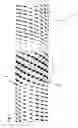
FIG. 1 shows a textile structure according to the invention with a region, in which the direction of the standing ends changes twice,
FIG. 2 shows a textile structure according to the invention with a region, in which the direction of the standing ends changes three times and
FIG. 3 shows a textile structure according to the invention with a region in which the direction of the braiding yarns changes.
DETAILED DESCRIPTION OF THE PREFERRED EMBODIMENTS
In the variant according to the invention, which is shown in FIG. 1, the standing ends 3 made of carbon fibers extending along a base body 1 are deflected twice with respect to their direction in a region 4 and thus form a weak point in the structure, which is used for targeted force input, in other words, by means of which, on the one hand, the load peak which initiates the deformation process is limited and moreover a targeted triggering is favoured, which is used for continuously high energy absorption during he deformation process. The production of this region with a deviating depositing angle of the standing ends 3 takes place by means of a rotary movement of a base body 1 taking place in addition to the feed movement of the base body 1 over a predeterminable angle.
In the example of FIG. 2, the rotary process of the base body 1 takes place back and forth over a predeterminable angle. As a result, the standing ends run at the same height on both sides of the region 4. The effect of the region 4 as a force input region is particular intensive here.
According to FIG. 3, the braiding angle of the braiding yarns 2 is modified in the region 4. A force input region, which is brought about because of the change in the structure is also produced thereby. The change in the braiding angle alone does not lead to a comparable forming of the weakening, however, so, generally, a combination of a change in the braiding angle and the change in direction of the standing ends is preferred. The braiding angle change is brought about by a change in the feed speed of the base body.
Claims
What is claimed is:1. Energy-absorbing textile structure, in particular for use in vehicle construction, which has high-tensile yarns for absorbing force, characterised in that the textile structure is formed by a braided fabric (2) with standing ends (3) in the force input direction and in that the textile structure has at least one region (4) with local modification of the fiber structure (2, 3).
2. Energy-absorbing textile structure according to claim 1, characterised in that the local modification is formed by a change of direction of the standing ends (3).
3. Energy-absorbing textile structure according to claim 2, characterised in that the change of direction is a temporary change.
4. Energy-absorbing textile structure according to claim 3, characterised in that the change of direction is a triple change of direction.
5. Energy-absorbing textile structure according to claim 1, characterised in that the braiding angle is changed in the region (4) of the local modification.
6. Energy-absorbing textile structure according to claim 1 characterised in that at least the standing ends (3) are formed from high-tensile material.
7. Energy-absorbing textile structure according to claim 6, characterised in that the standing ends (3) are formed from carbon fibers.
8. Method for producing an energy-absorbing structure, in particular for use in vehicle construction, which has high-tensile yarns for absorbing force, wherein the textile structure is formed by a braided fabric (2) with standing ends (3) in the force input direction and in that the textile structure has at least one region (4) with local modification of the fiber structure (2, 3), the method characterised in that the base body (1) is displaced relative to braiding tools when braiding onto a base body and in that to produce the local modification in the fiber structure, the movement of the base body (1) is modified.
9. Method according to claim 8, characterised in that to achieve the change in direction of the standing ends (3), the base body (1) is rotated in addition to the feed movement during the change of direction.
10. Method according to claim 9, characterised in that the rotary movement of the base body (1) is adapted to the desired change of direction.
11. Method according to claim 8, characterised in that to change the braiding angle, the feed movement of the base body (1) during the production of the local modification is adapted to the extent of the desired change in braiding angle.
Images & Drawings included:



Sources:
- United States Patent and Trademark Office - verify current appl. status at the USPTO↗
Recent applications in this class:
- » 20250019874 2025-01-16
MULTILAYERED, BRAIDED TUBULAR SLEEVE AND METHOD OF CONSTRUCTION THEREOF - » 20240060221 2024-02-22
Braided Medical Device And Manufacturing Method Thereof - » 20230079900 2023-03-16
Braided medical device and manufacturing method thereof - » 20220259781 2022-08-18
CONTINUOUS FIBER-REINFORCED BUILD MATERIAL FOR ADDITIVE MANUFACTURING - » 20220119997 2022-04-21
Method for producing a braided single-filament stent, device and braiding core for this purpose, and braided single-filament stent - » 20210269952 2021-09-02
Balloon with dividing fabric layers and method for braiding over three-dimensional forms - » 20210180226 2021-06-17
Woven textile - » 20210071331 2021-03-11
THREE DIMENSIONAL BRAID - » 20210071330 2021-03-11
BRAIDED STRUCTURES OF COMPLEX GEOMETRY - » 20200340154 2020-10-29
Braided medical device and manufacturing method thereof