Paper Sheet and Paper Sheet Bonding Method
US20090104397A1
2009-04-23
11/887,298
2006-03-29
Abstract:
[PROBLEMS] To bond a paper sheet containing no thermally fusible component with sufficient strength without forming a through hole, deteriorating texture and increasing the material cost.
[MEANS FOR SOLVING PROBLEMS] While pressing a second paper sheet (11) containing no thermally fusible component against a first paper sheet (10) containing no thermally fusible component, an ultrasonic wave is applied to the press contact portion so that fibers of the second paper sheet (11) enter mechanically between fibers of the first paper sheet (10) thus forming a bonding portion without requiring thermal fusion.
Interested in similar patents?
Get notified when new applications in this technology area are published.
Classification:
B31F5/008 » CPC main
Attaching together sheets, strips or webs; Reinforcing edges by friction, e.g. obtained ultrasonic vibrations
B29C65/086 » CPC further
Joining of preformed parts ; Apparatus therefor by heating, with or without pressure using ultrasonic vibrations using a rotary sonotrode or a rotary anvil using a rotary anvil
B29C66/21 » CPC further
General aspects of processes or apparatus for joining preformed parts; General aspects dealing with the joint area or with the area to be joined; Particular design of joint configurations particular design of the joint lines, e.g. of the weld lines said joint lines being formed by a single dot or dash or by several dots or dashes, i.e. spot joining or spot welding
B29C66/246 » CPC further
General aspects of processes or apparatus for joining preformed parts; General aspects dealing with the joint area or with the area to be joined; Particular design of joint configurations particular design of the joint lines, e.g. of the weld lines said joint lines being closed or non-straight said joint lines forming figures, e.g. animals, flowers, hearts
B29C66/3032 » CPC further
General aspects of processes or apparatus for joining preformed parts; General aspects dealing with the joint area or with the area to be joined; Particular design of joint configurations the joint involving an anchoring effect making use of protusions or cavities belonging to at least one of the parts to be joined
B29C66/45 » CPC further
General aspects of processes or apparatus for joining preformed parts; General aspects of joining substantially flat articles, e.g. plates, sheets or web-like materials; Making flat seams in tubular or hollow articles; Joining single elements to substantially flat surfaces; Joining substantially flat articles ; Making flat seams in tubular or hollow articles Joining of substantially the whole surface of the articles
B29C66/81429 » CPC further
General aspects of processes or apparatus for joining preformed parts; General aspects of machine operations or constructions and parts thereof; General aspects of the pressing elements, i.e. the elements applying pressure on the parts to be joined in the area to be joined, e.g. the welding jaws or clamps characterised by the design of the pressing elements, e.g. of the welding jaws or clamps characterised by the surface geometry of the part of the pressing elements, e.g. welding jaws or clamps, coming into contact with the parts to be joined comprising a single ridge, e.g. for making a weakening line; comprising a single tooth comprising a single tooth
B29C66/9241 » CPC further
General aspects of processes or apparatus for joining preformed parts; Measuring or controlling the joining process by measuring or controlling the pressure, the force, the mechanical power or the displacement of the joining tools by controlling or regulating the pressure, the force, the mechanical power or the displacement of the joining tools by controlling or regulating the pressure, the force or the mechanical power
B29C66/929 » CPC further
General aspects of processes or apparatus for joining preformed parts; Measuring or controlling the joining process by measuring or controlling the pressure, the force, the mechanical power or the displacement of the joining tools characterized by specific pressure, force, mechanical power or displacement values or ranges
B29C66/9513 » CPC further
General aspects of processes or apparatus for joining preformed parts; Measuring or controlling the joining process by measuring or controlling specific variables not covered by groups - by measuring or controlling the vibration frequency and/or the vibration amplitude of vibrating joining tools, e.g. of ultrasonic welding tools characterised by specific vibration frequency values or ranges
B32B7/08 » CPC further
Layered products characterised by the relation between layers; Layered products characterised by the relative orientation of features between layers, or by the relative values of a measurable parameter between layers, i.e. products comprising layers having different physical, chemical or physicochemical properties; Layered products characterised by the interconnection of layers; Interconnection of layers by mechanical means
B32B29/00 » CPC further
Layered products comprising a layer of paper or cardboard
D21H27/40 » CPC further
Special paper not otherwise provided for, e.g. made by multi-step processes; Multi-ply at least one of the sheets being non-planar, e.g. crêped
B29C66/83411 » CPC further
General aspects of processes or apparatus for joining preformed parts; General aspects of machine operations or constructions and parts thereof characterised by the movement of the joining or pressing tools moving with the parts to be joined; Roller, cylinder or drum types; Band or belt types; Ball types Roller, cylinder or drum types
B29C66/83511 » CPC further
General aspects of processes or apparatus for joining preformed parts; General aspects of machine operations or constructions and parts thereof characterised by the movement of the joining or pressing tools moving with the parts to be joined; Jaws mounted on rollers, cylinders, drums, bands, belts or chains; Flying jaws jaws mounted on rollers, cylinders or drums
B29C66/9517 » CPC further
General aspects of processes or apparatus for joining preformed parts; Measuring or controlling the joining process by measuring or controlling specific variables not covered by groups - by measuring or controlling the vibration frequency and/or the vibration amplitude of vibrating joining tools, e.g. of ultrasonic welding tools characterised by specific vibration amplitude values or ranges
B29K2711/126 » CPC further
Use of natural products or their composites, not provided for in groups - , for preformed parts, e.g. for inserts; Paper, e.g. cardboard Impregnated
D21H25/04 » CPC further
After-treatment of paper not provided for in groups - Physical treatment, e.g. heating, irradiating
D21H27/002 » CPC further
Special paper not otherwise provided for, e.g. made by multi-step processes Tissue paper; Absorbent paper
D21H27/02 » CPC further
Special paper not otherwise provided for, e.g. made by multi-step processes Patterned paper
Y10T428/24124 » CPC further
Stock material or miscellaneous articles; Structurally defined web or sheet [e.g., overall dimension, etc.] including grain, strips, or filamentary elements in respective layers or components in angular relation Fibers
B29C66/303 » CPC further
General aspects of processes or apparatus for joining preformed parts; General aspects dealing with the joint area or with the area to be joined; Particular design of joint configurations the joint involving an anchoring effect
B29C65/00 » CPC further
Joining of preformed parts ; Apparatus therefor
B32B5/12 IPC
Layered products characterised by the non- homogeneity or physical structure, i.e. comprising a fibrous, filamentary, particulate or foam layer; Layered products characterised by having a layer differing constitutionally or physically in different parts characterised by structural features of a layer characterised by the relative arrangement of fibres or filaments of different layers, e.g. the fibres or filaments being parallel or perpendicular to each other
B29C65/08 IPC
Joining of preformed parts ; Apparatus therefor by heating, with or without pressure using ultrasonic vibrations
Description
TECHNICAL FIELD
The present invention relates to a paper sheet and paper sheet bonding method.
BACKGROUND ART
As toilet paper, tissue paper, kitchen paper, paper towel and the like, conventionally, there has been proposed a type of sheet produced by overlaying plural pieces of paper sheets having no thermally fusible component to integrate them in order to improve functionality such as durability, liquid permeation property and absorption property, so that this sheet is available as a single sheet (for example, a type of tissue paper in which two sheets are overlaid is called 2-ply).
As a method of manufacturing such an overlaid sheet, a method of forming fine holes like perforated line on paper sheets overlapped on each other and a method of overlaying paper sheets through adhesive agent or through no adhesive agent and performing no-heat or heat embossing is available (see for example, patent document 1).
However, the method of forming fine holes facilitate permeation of liquid due to existence of the holes penetrating the sheet and deteriorates the texture. The method of overlaying sheets through no adhesive agent and performing embossing has a problem that its bonding strength is weak. Further, the method of overlaying papers through adhesive agent and performing embossing increases material cost by an amount of the adhesive agent. Further, the heat embossing cannot avoid deterioration of the texture by heating. Patent document 1: Japanese Patent Application Laid-Open No.
DISCLOSURE OF THE INVENTION
Problem to be Solved by the Invention
Accordingly, a main object of the present invention is to enable the paper sheets to be bonded together with a sufficient strength when bonding the paper sheets having no thermally fusible component, without formation of through holes, deterioration of the texture and increase of material cost.
Means for Solving the Problem
The present invention which has solved the above-described problem is as follows.
<Invention According to Claim 1>
A paper sheet in which a second paper sheet having no thermally fusible component is bonded to a first paper sheet having no thermally fusible component,
wherein fibers of the second paper sheet are made to enter mechanically between fibers of the first paper sheet by pressing the second paper sheet against the first paper sheet and applying ultrasonic wave to a pressed portion so as to bond the first and second paper sheets together without thermal fusion.
(Operation)
If ultrasonic wave is transmitted to a pressed portion with a bonding portion of the paper sheet pressed, fibers of the second paper sheet enter mechanically between fibers of the first paper sheet so that both the sheets can be integrated without thermal fusion. Further, because crystallization of fibers at the bonding portion is accelerated, the bonding portion is supplied with gloss so as to improve the appearance. This principle is considerably different from ultrasonic wave fusion used in other fields than paper art and can achieve a sufficient strength while suppressing deterioration of the texture. Needless to say, formation of through holes or adhesive agent is not needed.
<Invention According to Claim 2>
The paper sheet according to claim 1 or 2 wherein a bonding portion is arranged in a pattern.
(Operation)
Although according to the present invention, deterioration of the texture at the bonding portion is small, a change occurs in the texture as compared to a case where nothing is performed. Thus, it is preferable that providing the bonding portion in a pattern shape compensates for the partial change in the texture by entire functionality or functional beauty.
<Invention According to Claim 3>
The paper sheet according to claim 1 or 2 wherein a degree of gloss 75° at the bonding portion is 1.4 or more times larger than that of a non-bonding portion.
(Operation)
If the degree of gloss at the bonding portion is in this range, the bonding portion is supplied with beautiful gloss so as to improve the appearance. In the meantime, “the degree of gloss 75°” means a degree of gloss measured by 75° gloss degree test stipulated by JIS P8142 and expresses an amount of reflection light at an output angle of 75° in percentage with respect to an amount of incident light when light is projected to an object portion at an incident angle of 75°.
<Invention According to Claim 4>
A method of bonding a second paper sheet having no thermally fusible component to a first paper sheet having no thermally fusible component,
the method comprising: pressing the second paper sheet against the first paper sheet and applying ultrasonic wave to a pressed portion so that fibers of the second paper sheet enter mechanically between fibers of the first paper sheet so as to bond the first and second paper sheets together without thermal fusion.
(Operation)
The same effect as the invention of claim 1 is exerted.
<Invention According to Claim 5>
The paper sheet according to claim 4 wherein a linear pressure of the pressing is 0.5 to 5.0 kgf/cm, a frequency of the ultrasonic wave is 17 to 100 kHz and an amplitude of the ultrasonic wave is 10 to 100 μm.
(Operation)
If the linear pressure, frequency and amplitude are in this range when the bonding of the present invention is carried out, it is extremely advantageous.
EFFECT OF THE INVENTION
As described above, the present invention enables paper sheets having no thermally fusible component to be bonded to each other with a sufficient strength without formation of through holes, deterioration of the texture and increase of material cost.
BEST MODE FOR CARRYING OUT THE INVENTION
Hereinafter, the embodiment of the present invention will be described with reference to the accompanying drawings.
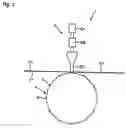
FIG. 1 shows an example of a paper sheet bonding apparatus 1, which comprises an anvil roll 4 having projecting portions 3, 3, . . . formed in a predetermined pattern on its outer peripheral face and an ultrasonic wave applying portion 2 which makes a pressure contact with the projecting portions 3, 3, . . . of the anvil roll 4. First paper sheet and second paper sheet 10, 11 are passed through between the ultrasonic wave applying portion 2 and the anvil roll 4 while they overlap each other.
The ultrasonic wave applying portion 2 is so constructed that ultrasonic wave vibration generated by the ultrasonic wave vibrator 2A is amplified (amplitude is enlarged) by an amplifying means called booster 2B and transmitted to an object by a means 2C called horn or cone. A drive current corresponding to an operation condition such as amplitude and frequency is supplied to the ultrasonic wave vibrator 2A through an oscillating circuit (not shown). The direction of the ultrasonic wave vibration may be determined appropriately corresponding to the type or installation position of the ultrasonic wave vibrator, as a direction along a plane of the paper sheets 10, 11, that is, a roll width direction and a direction perpendicular to or obliquely-crossed with the roll width direction.
To transmit ultrasonic wave energy to the paper sheets 10, 11 effectively, it is not preferable to use a material which absorbs vibration (such as rubber) for the anvil roll 4.
Although not shown, this apparatus 1 comprises a pressurizing means which pressurizes the horn 2C against the anvil roll 4 and a rotation driving means for the anvil roll 4. As the pressurizing means, a structure of freely pressing the horn 2C to the anvil roll 4 side with a driving source such as an air cylinder may be adopted. As the rotation driving means, a motor or the like may be used and it is preferable to make the rotation speed adjustable in order to adjust a press contact time.
Upon bonding together, the first and second paper sheets 10, 11 are passed through between the ultrasonic wave applying portion 2 (horn 2C thereof) and the anvil roll 4 of the bonding apparatus 1 while the paper sheets overlap each other. The first and second paper sheets 10, 11 are produced using pulp fiber such as NBKP and LBKP by adding softener, paper durability enhancing agent, pigment or the like and does not contain thermally fusible component such as thermally fusible fiber. The first and second paper sheets may be of the same material or of different materials.
The first and second paper sheets 10, 11 placed between the ultrasonic wave applying portion 2 and the anvil roll 4 are partially pressed by the projecting portions 3 of the anvil roll 4 while ultrasonic wave is transmitted to the press contact portion from the ultrasonic wave applying portion 2. Consequently, fibers are vibrated by the ultrasonic wave energy so that fibers of the second paper sheet 11 enter mechanically between the fibers of the first paper sheet 10 and thus, the press contact portions are integrated with each other without thermal fusion so as to form a bonding portion 12. Because the crystallization of fibers is accelerated at the bonding portion 12, the bonding portion is supplied with gloss, thereby providing an excellent appearance.
Preferably, the pressure of the press contact is 0.5 to 5.0 kgf/cm in terms of linear pressure and particularly 2.0 to 3.0 kgf/cm. This press contact pressure may be adjusted with a pressurizing means. If the press contact pressure is too low, bonding is likely to be insufficient, and if the press contact pressure is too high, the paper sheets 10 and 11 may be bored, or the sheet becomes easy to cut at the time of processing, or wearing of the horn or anvil roll is progressed easily, which is not preferable.
Preferably, the press contact speed (length of a sheet bonded per unit time) is 10 to 100 m/minute, particularly 50 to 10 m/minute. The press contact speed may be adjusted by a sheet feeding speed. If the press contact speed is too high, bonding is likely to be insufficient, and if it is too low, productivity drops or a bonding portion 12 is burnt, which is not preferable.
Preferably, the frequency of ultrasonic wave is in a range of 17 to 100 kHz and preferably, the amplitude of ultrasonic wave is in a range of 10 to 100 μm. If the frequency is too low, bonding becomes insufficient unless the press contact time is increased, and if the frequency is too high, processing is progressed excessively unless the press contact time is decreased, which is not preferable. If the amplitude is too low or too high, entering of fibers likely becomes insufficient, so that bonding is likely to be weak.
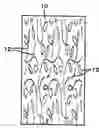
When the projecting portions 3 of the anvil roll 4 are provided in a pattern shape, the bonding portion 12 is formed corresponding to that pattern. Although this pattern can be determined appropriately, a pattern in which the dot-like bonding portions 12 are arranged in lateral and vertical directions or at random is preferred. The bonding portion 12 may be of any shape, for example, a diamond shape as shown in FIGS. 2 and 3 or an elliptic shape as shown in FIG. 4. A preferred dimensional example of the bonding portion 12 in these cases is 0.8 mm in maximum length a, 0.39 mm M2 in minimum length b and 0.156 mm in area and a preferred application example is 3.1 mm in long pitch A and 1.5 mm in short pitch B.
The bonding portion 12 may adopt a continuous linear pattern such as stripe pattern along a flow direction or a direction perpendicular thereto instead of the dot pattern. Further, the bonding portion 12 may be of picture-like shape as shown in FIG. 5 as well as of geometric pattern.
As another example, the entire surfaces of the sheets 10 and may be formed into the bonding portion instead of providing the bonding portions 12, 12 . . . partially.
EXAMPLE
A sample of 2-ply (double layers) toilet paper was manufactured by ultrasonic wave bonding of the present invention by adjusting the linear pressure, ultrasonic wave frequency and amplitude, and a degree of gloss and bonding strength of the bonding portion were evaluated. Table 1 shows the result. In the Table, the degree of gloss of the bonding portion is a relative value when the degree of gloss of a non-bonding portion is assumed to be 100. As regards the bonding strength, “weak” means a bonding strength of an extent which allows sheets to be separated easily in a continuous usage process as toilet paper, and “strong” means a bonding strength of an extent which inhibits the sheets from being separated in a continuous usage process as toilet paper.
| TABLE 1 | |||||
| Linear | |||||
| pressure | Frequency | Amplitude | Degree of | Bonding | |
| (kgf/cm) | (kHz) | (μm) | gloss | strength | |
| Example 1 | 2 | 50 | 50 | 181 | strong |
| Example 2 | 5 | 100 | 100 | 198 | strong |
| Example 3 | 10 | 100 | 100 | 199 | strong |
| Example 4 | 5 | 150 | 100 | 192 | strong |
| Example 5 | 5 | 100 | 150 | 195 | strong |
| Example 6 | 0.1 | 50 | 50 | 103 | weak |
| Example 7 | 2 | 10 | 50 | 101 | weak |
| Example 8 | 2 | 50 | 5 | 105 | weak |
INDUSTRIAL APPLICABILITY
The present invention can be applied to application for bonding plural pieces (not limited to two pieces) of papers as typified by toilet paper, tissue paper, kitchen paper, paper towel and the like.
BRIEF DESCRIPTION OF THE DRAWINGS
FIG. 1 is a schematic diagram of a bonding apparatus.
FIG. 2 is a plan view showing an example of a bonding pattern.
FIG. 3 is a sectional view taken along III-III of FIG. 2.
FIG. 4 is a plan view showing an example of a bonding pattern.
FIG. 5 is a plan view showing an example of a bonding pattern.
DESCRIPTION OF REFERENCE NUMERALS
1: bonding apparatus, 2: ultrasonic wave applying portion, 3: projecting portion, 4: anvil roll, 10: first paper sheet, 11: second paper sheet, 12: bonding portion
Claims
1. A paper sheet in which a second paper sheet having no thermally fusible component is bonded to a first paper sheet having no thermally fusible component,
wherein fibers of the second paper sheet are made to enter mechanically between fibers of the first paper sheet by pressing the second paper sheet against the first paper sheet and applying ultrasonic wave to a pressed portion so as to bond the first and second paper sheets together without thermal fusion.
2. The paper sheet according to claim 1 or 2 wherein a bonding portion is arranged in a pattern.
3. The paper sheet according to claim 1 or 2 wherein a degree of gloss 750 (JIS P8142) at the bonding portion is 1.4 or more times larger than that of a non-bonding portion.
4. A method of bonding a second paper sheet having no thermally fusible component to a first paper sheet having no thermally fusible component,
the method comprising: pressing the second paper sheet against the first paper sheet and applying ultrasonic wave to a pressed portion so that fibers of the second paper sheet enter mechanically between fibers of the first paper sheet so as to bond the first and second paper sheets together without thermal fusion.
5. The paper sheet according to claim 4 wherein a linear pressure of the pressing is 0.5 to 5.0 kgf/cm, a frequency of the ultrasonic wave is 17 to 100 kHz and an amplitude of the ultrasonic wave is 10 to 100 μm.
Images & Drawings included:


Sources:
- United States Patent and Trademark Office - verify current appl. status at the USPTO↗
Similar patent applications:
Recent applications in this class:
- » 20240383222 2024-11-21
SYSTEMS AND METHODS FOR FORMING DUAL FLUTED CORRUGATED BOARD - » 20220080696 2022-03-17
Systems and methods for forming dual fluted corrugated board - » 20220048271 2022-02-17
Method and apparatus for joining paper material - » 20200070462 2020-03-05
Method of ultrasonically bonding paperboard - » 20160311189 2016-10-27
Method for producing packaging, and packaging machine - » 20150165719 2015-06-18
Ultrasonic joining method and ultrasonic joining device - » 20050016690 2005-01-27
Device for connecting a multilayered web by ultrasound