Microencapsulation of fuel for dosage heat release, remote activated
US20090104575A1
2009-04-23
12/254,801
2008-10-20
Abstract:
A method for oil-based fuel dispersion in the form of micron and submicron Droplets with typical size distribution 0.5-20 microns where said Droplets are coated with a polymer-based shell containing metal nanoparticles that enable the droplets to absorb laser irradiation and utilize laser energy to initialize fuel burning.
Interested in similar patents?
Get notified when new applications in this technology area are published.
Classification:
C10L1/328 » CPC main
Liquid carbonaceous fuels consisting of coal-oil suspensions or aqueous emulsions or oil emulsions Oil emulsions containing water or any other hydrophilic phase
C10L5/36 » CPC further
Solid fuels briquettes consisting mainly of carbonaceous materials of mineral origin; Other details of the shaped fuels, e.g. briquettes Shape
C10L5/366 » CPC further
Solid fuels briquettes consisting mainly of carbonaceous materials of mineral origin; Other details of the shaped fuels, e.g. briquettes; Shape Powders
F23C99/001 » CPC further
Subject-matter not provided for in other groups of this subclass Applying electric means or magnetism to combustion
F23Q7/00 IPC
Incandescent ignition; Igniters using electrically-produced heat, e.g. lighters for cigarettes ; Electrically-heated glowing plugs
C10L8/00 IPC
Fuels not provided for in other groups of this subclass
C10L11/06 IPC
Manufacture of firelighters of a special shape
Description
BRIEF DESCRIPTION OF THE DRAWING
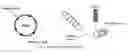
Fuel is encapsulated with a polymeric shell and metallic nanoparticles are incorporated into this shell. The small black circles within the polymer shell are the metallic nanoparticles in the figure. A laser then supplies irradiation to initialize the burning of a single fuel droplet and release heat.
DETAILED DESCRIPTION OF THE INVENTION
A microencapsulation and nanoencapsulation technology that allows fabrication of emulsion of liquid fuel (for instance benzene, sunflower oil and other water non-mixable hydrocarbons of different sort). Size of emulsion droplet is about 0.5-10 microns and can be optimized. Each emulsion drop is coated with polymer based multilayer films. The fuel and coating is referred to as a Capsule. Ceramic nanoparticles (metal, magnetic) should be incorporated as droplet shell constituents within polymeric films. Metallic nanoparticles are susceptible to laser irradiation and produce some heat locally to initialize burning of fuel. Oxidizer must be supplied from external media (could be permanganate dissolved water and other oxidizers) for continuous burning of fuel. Laser beam is conducted via optical waveguide to the chamber containing fuel droplets. Burning of fuel droplets can be done continuously one by one since each impulse of laser power is enough to burn individual droplet. See FIG. 1. Released energy can be consumed by heating of water if fuel emulsion is suspended in water.
Alternatively, the emulsion droplet can be arranged on surface in a closed air chamber. Laser power focusing on each capsule with fuel can release energy within the air chamber that can be utilized either in heating or pressure and mechanical movement. Emulsion shell can be modified with magnetic nanoparticles. Thus, if necessarily, the fuel droplets can be navigated with a magnetic field within the media to a certain location where release of energy is required.
Burning of the capsule can initialize a further reaction with higher temperature increase. Aluminium powder (thermite) with the oxidizer (permanganate) can be deposited close to the fuel droplet. Burning of fuel droplet will lead to thermite reaction (oxidation of aluminum) with extremely high temperature release (up to 2000° C). Aluminum powder in the form of a nanoparticle can be incorporated into a fuel droplet that will form a micro-packaged high capacity fuel.
Potential use:
-
- Medical heating inside the human body to inhibit bleeding
- Micronized internal combustion devise
- Controlled and sustained heat release within closed chamber
- Micron mechanical systems
- Controlled supply of fuel into fuel cell devices
- Sintering/pressuring on microscale
Claims
What is claimed is:1. A Capsule composition comprising a fuel droplet coated with a polymer-based shell containing metallic nanoparticles such that said shell enables the Capsule to absorb irradiation and initialize fuel burning.
2. The method of activating the burning of said fuel contained within the Capsule of claim 1 by means of irradiation.
3. The method of claim 2 where said burning is programmed to have continuous release of energy through sequential activation of the burning of individual Capsules.
4. The method of claim 2 where burning of Capsules is done in a water solution.
5. The method of claim 2 where burning of Capsules is done in gas filled chamber.
6. The method of claim 2 where an oxidizer is placed in the vicinity of the Capsule.
7. The method of claim 2 where thermites such as Al powder are added to the capsule to release more energy.
8. The method of claim 2 where the Capsule is coated with a shell containing magnetic nanoparticles to allow Capsule navigation with an applied magnetic field.
Images & Drawings included:

Sources:
- United States Patent and Trademark Office - verify current appl. status at the USPTO↗
Recent applications in this class:
- » 20240166965 2024-05-23
Emulsification method of fuel oil and desulfurizer for sulfur oxide reduction - » 20240010942 2024-01-11
OIL-IN-WATER EMULSIONS - » 20240002740 2024-01-04
Emulsifier package with a short-chained and optionally with a long-chained surfactant for fuel emulsion - » 20240002739 2024-01-04
Emulsifier package with a branched and optionally with a propoxylated surfactant for fuel emulsion - » 20230416628 2023-12-28
Emulsifier package with quaternary ammonium surfactant for fuel emulsion - » 20230117163 2023-04-20
WATER IN FUEL NANOEMULSION AND METHOD OF MAKING THE SAME - » 20230047581 2023-02-16
Biomass fuel slurry and method of making the same - » 20220340829 2022-10-27
Apparatus for bio emulsion fuel manufacturing from waste oils and method using the same - » 20220220401 2022-07-14
Emulsifier package with quaternary ammonium surfactant for fuel emulsion - » 20220145200 2022-05-12
Water-hydrocarbon fuel emulsion