Method and system for joining pipeline components
US20090146414A1
2009-06-11
12/001,189
2007-12-11
Abstract:
Pipes and pipeline components made of plastic or PVC, which are designed to be assembled into pipelines used to convey water in structures, and which have one bore located on the side, near each end of the pipeline components. After assembling the pipeline in the designated wall, the pipes and pipeline components are glued together by injecting liquid acetone into the bores, causing the pipes and pipeline components to adhere to one another and to become sealed.
Inventors:
- Yuval Golan 2 🇺🇸 New York, NY, United States
- Avraham Zakai 2 🇺🇸 New York, NY, United States
Interested in similar patents?
Get notified when new applications in this technology area are published.
Classification:
F16L13/103 » CPC main
Non-disconnectible pipe-joints, e.g. soldered, adhesive or caulked joints; Adhesive or cemented joints Adhesive joints
B29C65/4895 » CPC further
Joining of preformed parts ; Apparatus therefor using adhesives, i.e. using supplementary joining material; solvent bonding Solvent bonding, i.e. the surfaces of the parts to be joined being treated with solvents, swelling or softening agents, without adhesives
B29C65/54 » CPC further
Joining of preformed parts ; Apparatus therefor using adhesives, i.e. using supplementary joining material; solvent bonding applying the adhesive between pre-assembled parts
B29C66/1122 » CPC further
General aspects of processes or apparatus for joining preformed parts; General aspects dealing with the joint area or with the area to be joined; Particular design of joint configurations particular design of the joint cross-sections; Joint cross-sections comprising a single joint-segment, i.e. one of the parts to be joined comprising a single joint-segment in the joint cross-section; Single lapped joints Single lap to lap joints, i.e. overlap joints
B29C66/5221 » CPC further
General aspects of processes or apparatus for joining preformed parts; General aspects of joining tubular articles; General aspects of joining long products, i.e. bars or profiled elements; General aspects of joining single elements to tubular articles, hollow articles or bars; General aspects of joining several hollow-preforms to form hollow or tubular articles; Joining tubular articles, profiled elements or bars; Joining single elements to tubular articles, hollow articles or bars; Joining several hollow-preforms to form hollow or tubular articles; Joining tubular articles, bars or profiled elements; Joining tubular articles for forming coaxial connections, i.e. the tubular articles to be joined forming a zero angle relative to each other
B29C66/52231 » CPC further
General aspects of processes or apparatus for joining preformed parts; General aspects of joining tubular articles; General aspects of joining long products, i.e. bars or profiled elements; General aspects of joining single elements to tubular articles, hollow articles or bars; General aspects of joining several hollow-preforms to form hollow or tubular articles; Joining tubular articles, profiled elements or bars; Joining single elements to tubular articles, hollow articles or bars; Joining several hollow-preforms to form hollow or tubular articles; Joining tubular articles, bars or profiled elements; Joining tubular articles for forming corner connections or elbows, e.g. for making V-shaped pieces with a right angle, e.g. for making L-shaped pieces
B29C66/52241 » CPC further
General aspects of processes or apparatus for joining preformed parts; General aspects of joining tubular articles; General aspects of joining long products, i.e. bars or profiled elements; General aspects of joining single elements to tubular articles, hollow articles or bars; General aspects of joining several hollow-preforms to form hollow or tubular articles; Joining tubular articles, profiled elements or bars; Joining single elements to tubular articles, hollow articles or bars; Joining several hollow-preforms to form hollow or tubular articles; Joining tubular articles, bars or profiled elements; Joining tubular articles for forming fork-shaped connections, e.g. for making Y-shaped pieces with two right angles, e.g. for making T-shaped pieces
B29C66/52251 » CPC further
General aspects of processes or apparatus for joining preformed parts; General aspects of joining tubular articles; General aspects of joining long products, i.e. bars or profiled elements; General aspects of joining single elements to tubular articles, hollow articles or bars; General aspects of joining several hollow-preforms to form hollow or tubular articles; Joining tubular articles, profiled elements or bars; Joining single elements to tubular articles, hollow articles or bars; Joining several hollow-preforms to form hollow or tubular articles; Joining tubular articles, bars or profiled elements; Joining tubular articles for forming cross-shaped connections, e.g. for making X-shaped pieces with four right angles, e.g. for making +-shaped pieces
B29C66/5229 » CPC further
General aspects of processes or apparatus for joining preformed parts; General aspects of joining tubular articles; General aspects of joining long products, i.e. bars or profiled elements; General aspects of joining single elements to tubular articles, hollow articles or bars; General aspects of joining several hollow-preforms to form hollow or tubular articles; Joining tubular articles, profiled elements or bars; Joining single elements to tubular articles, hollow articles or bars; Joining several hollow-preforms to form hollow or tubular articles; Joining tubular articles, bars or profiled elements; Joining tubular articles involving the use of a socket
B29C65/542 » CPC further
Joining of preformed parts ; Apparatus therefor using adhesives, i.e. using supplementary joining material; solvent bonding applying the adhesive between pre-assembled parts by injection
B29C66/71 » CPC further
General aspects of processes or apparatus for joining preformed parts characterised by the composition, physical properties or the structure of the material of the parts to be joined; Joining with non-plastics material characterised by the composition of the plastics material of the parts to be joined
B29K2027/06 » CPC further
Use of polyvinylhalogenides or derivatives thereof as moulding material PVC, i.e. polyvinylchloride
F16L47/02 » CPC further
Connecting arrangements or other fittings specially adapted to be made of plastics or to be used with pipes made of plastics Welded joints; Adhesive joints
Description
TECHNICAL FIELD
The present invention deals with pipelines, pipes and pipeline components used to convey fluids, as well as a method for joining and sealing pipes and pipe segments to each other.
BACKGROUND ART
Most structures throughout the world are equipped with pipe systems or pipelines used to convey fluids, mainly water. Such pipelines are customarily concealed in the structure's walls, floors and ceilings. Pipelines primarily include pipes, as well as components and accessories that make up the entire pipeline, such as couplings, elbows, valves, fittings and other parts and accessories that are used to join pipes and pipeline parts (hereinafter referred to as “pipeline components”).
For many years it was customary to use pipes and pipeline components (such as couplings, elbows, valves, etc.) that were made of metal and were joined to one another by screwing action. In recent years, it has become customary to use pipes and pipeline components that are made of plastic, mainly PVC. Such PVC pipes and pipeline components are joined to one another using an adhesive referred to in professional jargon as “PVC cement”.
When assembling PVC pipelines in structures, and particularly pipelines intended for the conveyance of water in residential homes, pipelines are usually assembled in stages, as follows:
(a) Pipes are cut according to required lengths;
(b) The pipeline is assembled in the wall (open or exposed wall during the construction of the structure or renovation), but without gluing the part of the pipeline to one another;
(c) After verifying correct dimensions of the pipeline, the pipeline is disassembled from the wall in order to prepare it for gluing;
(d) The pipes and pipeline components are glued to each other according to the order of components in the planned pipeline structure. Gluing is executed by applying PVC cement to the internal part of each relevant pipeline component and to the external part of the pipe that is to be glued to the said component (for instance, a coupling or elbow). After applying PVC cement, the end of the pipe is inserted into the said pipeline component, and after the PVC cement dries, the pipeline is glued, joined and sealed.
(e) After gluing of any number of pipeline components, it is customary to glue the end of this group of glued components to the relevant pipe already fixed in the wall, and so on and so forth, until the entire pipeline is assembled and glued in the wall or floor or other designated place.
Pipes and pipeline components, as they currently exist and the method of their assembly and gluing leads to a considerable waste of time. First, the pipeline is assembled in the designated wall twice. Once in order to verify the dimensions, and a second time, after gluing the pipeline, it is re-assembled in the designated wall. Second, after gluing the pipes and pipeline components to each other, the dimensions may change, since the gluing of the pipes to the pipeline connections slightly changes the connection point of the components, and the accumulation of these changes causes the pipeline to deviate from its designated location and from the location it was in during the first assembly prior to gluing.
The present invention significantly streamlines and reduces the cost of gluing and assembling the pipeline.
THE INVENTION
Numbers in Parentheses Refer to Numbers in Drawing
The present invention deals with pipelines that include pipes and pipeline components, and presents a method and a means of joining together pipes and pipeline components.
The invention, subject of the present patent application, deals with pipes and pipeline components that include bores, as depicted in the drawings attached to the application. Specifically, the invention deals with pipes and pipeline components whereby the side of each such pipe and pipeline component has a bore located at each end. Bores are preferably located 2 to 4 centimeters from each end of the component. Specifically, the bore should be located at about half the distance between the end of the component and its middle point. The desired diameter of the bores is about 1 to 2 mm., although they may be larger or smaller.
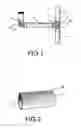
The invention deals with coupling (20) type components that include one or more bores (3), preferably at each end of the coupling, as depicted, for instance, in Drawing No. 2.
The invention deals with elbow (22) type components that include one or more bores (3), preferably at each end of the elbow, as depicted, for instance, in Drawing No. 3.
The invention deals with valve (23) type components that include one or more bores (3), preferably at each end of the valve, as depicted, for instance, in Drawing No. 4.
The invention deals with T-connector (21) type components that include one or more bores (3), preferably at each end of the connector, as depicted, for instance, in Drawing No. 5.
The invention deals with cross (24) type components that include one or more bores (3), preferably at each end of the cross, as depicted, for instance, in Drawing No. 6.
The invention refers to pipes that include one or more bores, preferably at each of their ends.
After assembling the pipeline in the designated wall, liquid acetone is injected into the bores, causing adhesion and sealing of the pipes and pipeline components. Thus, the need to disassemble the pipeline, glue it together using PVC cement and re-assemble it in the designated wall is avoided.
Drawing No. 7 depicts, for example, a T-connector (21) with three bores (3), one end of which is joined to a pipe (1). Also depicted is a spraying device (4) used to inject liquid acetone through the straw (41) directly into the left-hand bore (3), thus, effectively, sealing and gluing the pipe (1) to the connector (21).
Drawing No. 1 depicts, for instance, a pipeline composed of three pipes (1) that are connected to the three ends to a T-connector (21) that has three bores (3). The horizontal pipe (1) is connected to an elbow (22) with two bores (3), one at each end.
DESCRIPTION OF THE DRAWINGS
The drawings attached to the application are not intended to limit the scope of the invention and the possible ways of its application. The drawings are intended only to illustrate the invention and constitute only one of many possible ways of its application.
The drawings attached to the present patent application are described and detailed above.
Claims
What is claimed is:1. Pipes and pipeline components made of plastic or PVC, which are designed to be assembled into pipelines used to convey fluids in structures, and which have one or more bores located on the side of the pipe or pipeline component near each end of the pipe or pipeline component.
2. A method for joining together PVC or plastic pipes and pipeline components designed to be assembled into a pipeline used to convey fluids in structures. The method includes the use of pipeline components with one or more bores at each of their ends and the use of liquid acetone that is injected into the bores after the pipeline is assembled, causing the pipes and pipeline components to adhere to one another and to become sealed.
Images & Drawings included:



Sources:
- United States Patent and Trademark Office - verify current appl. status at the USPTO↗
Similar patent applications:
- » 20090146413
Method and system for joining pipeline components
Recent applications in this class:
- » 20250137560 2025-05-01
CONDUIT COUPLING DEVICE, SYSTEM, AND METHOD - » 20240337334 2024-10-10
SECONDARY RETENTION FOR ADHESIVE BONDED JOINTS - » 20240218947 2024-07-04
Conduit coupling device, system, and method - » 20230167925 2023-06-01
PIPE CONNECTING ASSEMBLY - » 20220082188 2022-03-17
Pipe coupling assembly and method - » 20220057025 2022-02-24
Tubular elements with adhesive joint, method of joining tubular elements thereof - » 20210018119 2021-01-21
PIPE CONNECTION JOINTS WITH FLEXIBLE FUNCTION - » 20190186658 2019-06-20
NONMETALLIC JOINTS AND METHODS FOR FORMATION AND INSPECTION THEREOF - » 20180274701 2018-09-27
ROLLED CONNECTING SYSTEMS FOR ADJACENT ENDS OF INSULATION TUBING - » 20180245719 2018-08-30
Connection Systems for Refrigeration Filter Dryer Units and Methods for their Manufacture