Precious stone ring
US20090199593A1
2009-08-13
12/243,774
2008-10-01
✅ Patent granted
US 8,096,145 B2
2012-01-17
-
-
Thomas Will | Abigail E Morrell
2030-02-06
Abstract:
A jewellery element, in particular a precious stone ring, comprises a magnetic device to cause the jewellery element setting to float with respect to the jewellery element base.
Interested in similar patents?
Get notified when new applications in this technology area are published.
Classification:
A44C17/0241 » CPC main
Gems or the like; Settings for holding gems or the like, e.g. for ornaments or decorations slidably arranged
A44D2203/00 » CPC further
Fastening by use of magnets
Y10S63/90 » CPC further
Jewelry Magnetic connector
A44C17/02 IPC
Gems or the like Settings for holding gems or the like, e.g. for ornaments or decorations
A44C9/00 » CPC further
Finger-rings
Description
BACKGROUND OF THE INVENTION
The present invention relates to a jewellery element, in particular a ring including a precious stone.
As is known, a conventional ring comprises a ring setting supporting a precious stone or other ornamental element.
The setting constitutes an integrating portion of the ring-like element which can be engaged on a finger of a hand.
Also known is the fact that, in the jewellery field, the jewellery element designers are continuously searching novel constructions, that is which are novel from an aesthetic and functional standpoint, thereby, in the time, the jewellery element design patterns have been greatly changed.
SUMMARY OF THE INVENTION
Accordingly, the aim of the present invention is to provide a novel jewellery element construction.
Within the scope of the above mentioned aim, a main object of the invention is to provide a novel jewellery element setting, for setting a precious stone in a ring or the like.
Yet another object of the present invention is to provide such a jewellery element specifically designed for greatly improving the brightness characteristics of the precious stone set therein.
According to one aspect of the present invention, the above mentioned aim and objects, as well as yet other objects, which will become more apparent hereinafter, are achieved by a jewellery element construction, in particular a precious stone ring, characterized in that said jewellery element construction comprises magnetic means for causing the jewellery element construction to float with respect to the jewellery element construction base.
BRIEF DESCRIPTION OF THE DRAWINGS
Further characteristics and advantages of the present invention will become more apparent hereinafter from the following detailed disclosure of a preferred, though not exclusive, embodiment of the invention, which is illustrated, by way of an indicative, but not limitative, example in the accompanying drawings, where:
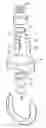
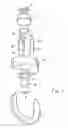
FIG. 1 is an exploded perspective view of the jewellery element construction according to the present invention;
FIG. 2 is a side elevation view of the jewellery element construction according to the invention;
FIG. 3 is a front view of the jewellery element construction according to the invention;
FIG. 4 is a perspective view of the jewellery element construction according to the invention;
and
FIG. 5 is a top plan view of the jewellery element construction according to the invention.
DESCRIPTION OF THE PREFERRED EMBODIMENTS
With reference to the number references of the above mentioned figures, the jewellery element construction according to the present invention, which has been generally indicated by the reference number 1 and which, in particular, comprises a ring including a diamond, comprises an annular body 2 including a base or bottom 3, thereon is mounted a setting 4 supporting a diamond, or other precious stone 5.
According to the invention, the setting 4 is coupled to the base or bottom 3 by magnetic coupling means.
More specifically, the magnetic coupling means comprise two magnets, that is a first magnet 6 and a second magnet 7.
The first magnet 6 is made rigid with the setting 4, whereas the second magnet 7 is made rigid with the base 3 through a small plate 8 and a coupling ring element 9.
The setting 4 is adapted to slide along upright elements 10 clamped to the base or bottom 3.
In the shown embodiment, the upright elements 10 are provided in a number of three, but they may comprise four uprights or any other desired number of uprights.
Each upright element 10 comprises, at a free end portion thereof, an inward turned edge 11, thereby restraining the setting 4 between the edge 11 and base or bottom 3.
Thus, the setting 4 is adapted to slide between the uprights 10 which are preferably arranged at the apex points of an isosceles triangle, thereby providing a guide for the setting 4.
The magnets 6 and 7 are so selected as to repel one another.
Thus, the setting 4, and the diamond 5 assembled therein, are urged upward, with the edge portion 11 operating as detent elements.
The body of the ring 2, the base 3, the setting 4, upright elements 10 and small plate 8 and ring element 9 are preferably made of gold or platinum.
It has been found that the invention fully achieves the intended aim and objects.
In fact, the invention provides an actually novel jewellery element construction.
More specifically, the ring including the construction according to the invention has very pleasant aesthetic properties and is very reliable from a mere functional standpoint.
In practicing the invention, the used materials, as well as the contingent size and shapes, can be any, depending on requirements.
Claims
1. A jewellery element construction, in particular a precious stone ring, said jewellery element construction having a base and a setting, characterized in that said jewellery element construction comprises magnetic means for causing said setting to float with respect to said base.
2. A jewellery element construction, according to claim 1, characterized in that said magnetic means comprise two mutually repelling magnets, a first of said magnet being floating together with the precious stone in guide and holding means, the second magnet being rigid with said jewellery element construction base.
3. A jewellery element construction, according to claim 1, characterized in that said jewellery element construction comprises a ring including a diamond.
4. A jewellery element construction, according to claim 1, characterized in that said jewellery element construction comprises a ring body including a base supporting a setting in turn supporting a diamond or other precious stone, a first magnet being rigid with said setting and a second magnet being rigid with said base through a plate and a ring element, said setting being adapted to slide along upright elements coupled to said base, each said upright element including a free end portion having an inward turned edge operating as a detent element for restraining the setting between an edge and the base.
5. A jewellery element construction, according to claim 4, characterized in that said setting is adapted to slide between said upright elements, said upright elements being arranged at corresponding apex points of an isosceles triangle, thereby providing a guide for said setting, said magnets being designed to repel one another thereby pushing upward said setting and diamond supported thereby, said upright elements having upright element edges operating as a detent means.
6. A jewellery element construction, according to claim 1, characterized in that said jewellery element construction, in particular said ring, base, setting, upright elements, plate and ring element are preferably made of gold or platinum.
Images & Drawings included:

Sources:
- United States Patent and Trademark Office - verify current appl. status at the USPTO↗
Similar patent applications:
- » 20050199007
Ring having a setting of semi-precious stones
Recent applications in this class:
- » 20220218079 2022-07-14
Interchangeable decorative element system - » 20170265608 2017-09-21
JEWELRY WITH SLIDING COLLETS - » 20090133439 2009-05-28
Movable Vertical Displacement Device - » 20070084241 2007-04-19
Magnetic repulsion components for jewelry articles