Vehicle, Especially Military Vehicle, Protected Against the Effect of an External Explosion
US20090282970A1
2009-11-19
12/307,518
2007-06-30
Abstract:
A vehicle protected against the effect of an external explosion and having a vehicle housing disposed on a chassis. The vehicle housing has at least one entry/exit door in at least one side wall, the door being disposed in a door opening of the side wall and being hinged to a front edge of the door opening as viewed in a forward direction of travel and in the longitudinal direction of the vehicle. An inwardly projecting reinforcing rib is disposed on an inner side of the side wall parallel to and in the immediate vicinity of a rear edge of the door opening. A driver's seat is disposed in the vehicle housing in the area of the door opening and has a seat panel and a backrest. The rear edge of the door opening extends essentially parallel to an upright direction of the backrest, and in all positions of the driver's seat the reinforcing rib extends immediately next to or behind the backrest.
Interested in similar patents?
Get notified when new applications in this technology area are published.
Classification:
F41H7/044 » CPC main
Armoured or armed vehicles; Land vehicles with enclosing armour, e.g. tanks; Armour construction Hull or cab construction other than floors or base plates for increased land mine protection
B60J5/0487 » CPC further
Doors arranged at the vehicle sides; Special type simplified doors related to cabins of, e.g. golf carts, tractors, jeeps, cranes, forklifts, etc.
B62D33/06 » CPC further
Superstructures for load-carrying vehicles Drivers' cabs
F41H5/226 » CPC further
Armour; Armour plates; Manhole covers, e.g. on tanks; Doors on armoured vehicles or structures Doors on armoured vehicles or structures
F41H7/02 IPC
Armoured or armed vehicles Land vehicles with enclosing armour, e.g. tanks
Description
The invention relates to a vehicle, especially a military vehicle, that is protected against the effect of an external explosion and has the features of the introductory portion of claim 1. Such a vehicle is known.
As has been shown in combat settings, or also during use in zones threatened by terrorists, with military vehicles the protection against high-explosive bombs that explode laterally next to the vehicle becomes increasingly more important. The doors and the door openings of the vehicle naturally represent a weak spot when absorbing the pressure generated by the explosion. For example, when an explosion occurs laterally next to the vehicle, the door in the door opening can bugle or buckle inwardly to such an extent that the door is pressed through the door opening. It is known to reinforce the door and door opening in order to reduce the bulging-in. Thus, as will be explained in greater detail subsequently, it is known, for example, to dispose an inwardly projecting reinforcing rib on the inner side of the side wall of the vehicle parallel to and in the immediate vicinity of the rear edge of the door opening that contains the door lock.
With known vehicles, these rear edges of the door opening generally extend vertically. Since on the one hand the door opening should not be larger than is necessary for entering or exiting, it has been found out that when arranging the inwardly projecting reinforcing ribs in the immediate vicinity of and parallel to the rear edge of the door opening, the shoulder of the crew member sitting in the area of the door opening is located in the region of this reinforcing rib and is spaced only a slight distance from it. Although as a consequence of the reinforcing rib the side wall, which buckles during an explosion, deforms less, it can none the less, after a short deformation path, strike against the shoulder of the person sitting behind it. Due to the high deformation speed, very severe to deadly injuries occur.
It is an object of the invention to configure a vehicle having the features indicated in the introductory portion of claim 1 in such a way that the danger that the reinforcing rib will strike against the shoulder of the crew member during an explosion next to the vehicle is avoided.
The realization of this object is effected pursuant to the present invention with the features of the characterizing portion of claim 1. Advantageous further developments of the invention are described in the dependent claims.
A basic concept of the invention is to guide the rear edge of the door opening parallel to the backrest of the driver's seat, and in particular in such a way that it extends immediately next to the backrest, or behind the backrest, in other words, is offset toward the rear from the backrest support surface on the backrest. In so doing, two things are achieved:
1. The reinforcing rib of the side wall, during a buckling due to an explosion, no longer strikes the shoulder or the upper arm of the crew member, but rather strikes the backrest of the seat. In this way, the effects upon the person himself or herself are at least reduced or entirely avoided.
2. Since the width of the body at the shoulder or the upper arm, at least with larger people, is greater than the width of the backrest, the spacing between the reinforcing rib and the backrest of the seat is greater than the distance to the shoulder. The buckling side wall thereby does not strike at all with the reinforcing rib or only after a longer path, and hence with a reduced speed. A lower striking speed reduces the likelihood of injury.
In the following, the objective of and an embodiment for the invention will be explained in greater detail with the aid of the accompanying drawings, in which:
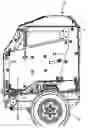
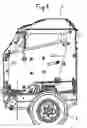
FIG. 1: is a side view of the front portion of a military vehicle having a door disposed next to the driver's seat in the side wall of the vehicle housing;
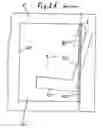
FIG. 2A: is a very schematic side view of the door opening of a military vehicle pursuant to the state of the art;
FIG. 2B is a horizontal partial section view through the vehicle housing in the region of the driver's seat of the military vehicle of FIG. 2A pursuant to the state of the art;
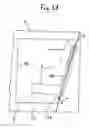
FIG. 3A shows, in an illustration analogous to that of FIG. 2A, the door opening of a military vehicle pursuant to the invention;
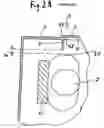
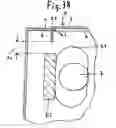
FIG. 3B shows, in an illustration analogous to that of FIG. 2B, the horizontal partial sectional view in the region of the driver's seat for a vehicle pursuant to the invention of FIG. 3A.
FIG. 1 shows the cab F of an otherwise not-illustrated military vehicle, which has a vehicle housing disposed on a chassis 2. Disposed in the side wall 1 of the cab F is an entry/exit door 3, the front edge 3.1 of which, which faces the direction of travel, is hinged to the front edge of a door opening of the side wall 1, and the rear edge 3.2 of which, which faces away from the direction of travel, faces the rear edge of the door opening that contains the door lock.
FIGS. 2A and 2B show the configuration of a vehicle, which corresponds to the state of the art, in the region of the door opening 4′ and the drivers seat 5′. The front and rear edges 4.1′ and 4.2′ respectively of the door opening 4′ extend essentially vertically. The driver's seat 5′ has a seat panel 5.1′ and a backrest 5.2′ that is directed upwardly at an angle. The rear edge 4.2′ of the door opening intersects the backrest 5.2′ of the driver's seat 5′. Disposed on the inner side of the side wall 1′, in the immediate vicinity of the rear edge 4.2′ of the door opening 4′, is an inwardly projecting reinforcing rib 6′ that extends parallel to this edge 4.2′. As can be seen from FIG. 2B, the shoulder area 7.1′ of a person 7′ sitting on the driver's seat 5′ is located across from this reinforcing rib 6′ by the relatively small spacing X1. The shoulder area 7.1′ is indicated by dashed lines in FIG. 2A. The result of this arrangement is that if an explosion takes place laterally next to the vehicle, and an explosion pressure E is exerted upon the side wall 1′ and the door 3′, a certain amount of bulging-in of the side wall 1′ occurs, and the reinforcing rib 6′, after traveling through the small spacing or stretch X1, strikes the shoulder area 7′, so that considerable injuries result.
With the configuration of the vehicle shown in FIGS. 3A and 3B, the door opening 4 in the side wall 1 is configured in such a way that while the front edge 4.1 extends vertically, in contrast the rear edge 4.2 rises or extends rearwardly at an angle α relative to the vertical, and in particular extends parallel to the direction of the backrest 5.2 of the driver's seat 5. In this connection, the reinforcing rib 6, which is guided parallel to the rear edge 4.2, also extends parallel to the backrest 5.2. The arrangement is such that in all positions of the driver's seat 5, i.e. of the seat panel 5.1, as viewed in the longitudinal direction of the vehicle, the reinforcing rib 6 does not enter into the shoulder area 7.1 of the person 7 sitting on the driver's seat 5, but rather extends next to or behind the backrest 5.2. As can be seen from FIGS. 3A and 1, the acute angle α, at which the rear edge 4.2 of the door opening 4, from the bottom, extends at an angle upwardly and toward the rear, can be between 70° and 80°.
As can be seen from FIG. 3B, the spacing X2 between the reinforcing rib 6 and the backrest 5.2 is significantly greater than the spacing X1 between the reinforcing rib 6′ and the shoulder 7.1′ in the configuration of FIGS. 2A and 2B.
If an explosion occurs to the side next to the vehicle, the explosion pressure E again acts upon the door 3 and the side wall 1. If a bulging-in occurs, the reinforcing rib 6 on the one hand no longer strikes against the shoulder area 7.1, but rather against the backrest 5.2, and on the other hand the spacing X2 that the reinforcing rib 6 has to travel through to reach the backrest 5.2 is greater than the spacing X1, so that the reinforcing rib does not strike at all or strikes with a considerably reduced speed.
Thus, at the same spacing of the person 7 relative to the side wall 1, the buckling or bulging space is increased, and the backrest rather than the person is struck.
Claims
1-3. (canceled)
4. A vehicle that is protected against the effect of an external explosion and has a vehicle housing that is disposed on a chassis and is provided with at least one entry/exit door in at least one side wall, wherein the door is disposed in a door opening of the side wall and is hinged to a front edge of the door opening as viewed in a forward direction of travel and in a longitudinal direction of said vehicle, further comprising:
an inwardly projecting reinforcing rib disposed on an inner side of said side wall parallel to and in the immediate vicinity of a rear edge of the door opening; and
a driver's seat disposed in said vehicle housing in the area of the door opening, wherein said driver's seat is provided with a seat panel and a backrest, further wherein said rear edge of the door opening extends essentially parallel to an upright direction of said backrest, and wherein said reinforcing rib, which extends parallel to said rear edge, in all positions of said drivers seat extends immediately next to or behind said backrest.
5. A vehicle according to claim 4, wherein the direction of said rear edge of the door opening extends at a prescribed acute angle from the bottom toward the top and is inclined toward the rear, and wherein said angle essentially corresponds to a prescribed angular position of said backrest of said driver's seat.
6. A vehicle according to claim 4, wherein said prescribed acute angle is between 70 and 80°.
Images & Drawings included:
Sources:
- United States Patent and Trademark Office - verify current appl. status at the USPTO↗
Recent applications in this class:
- » 20210172713 2021-06-10
Aluminum vehicle hull structure and fabrication method - » 20200256648 2020-08-13
PROTECTION APPARATUS FOR A VEHICLE - » 20180224247 2018-08-09
ARMOURED VEHICLE - » 20180017361 2018-01-18
Armored cab for light tactical vehicles - » 20170328685 2017-11-16
Energy absorbing structures for underbody blast protein - » 20170261291 2017-09-14
MOVING SACRIFICIAL VEHICLE HULL - » 20170052002 2017-02-23
MOVING SACRIFICIAL VEHICLE HULL - » 20160245622 2016-08-25
Survivability capsule for armored vehicles - » 20160131458 2016-05-12
Armored cab for light tactical vehicles - » 20160047631 2016-02-18
MOVING SACRIFICIAL VEHICLE HULL