Rodrunner
US20090288524A1
2009-11-26
12/154,418
2008-05-23
Abstract:
In a Commercial/Industrial setting there can be several hundred threaded rods hanging from the ceiling for hundreds of linear feet of support runs for everything from conduit to cabling trays. These are secured to the threaded rods which are anchored into the ceding and can be at least ten feet long and in excess of twelve feet high. The Rodrunner worked very well and saved me time by not having to spin the nut on by hand and I can conceivably work from the floor rather than on a lift or ladder which also brings into account safety issues.
Interested in similar patents?
Get notified when new applications in this technology area are published.
Classification:
B25B23/0021 » CPC main
Details of, or accessories for, spanners, wrenches, screwdrivers; Connections or joints between tool parts Prolongations interposed between handle and tool
B25B13/06 » CPC further
Spanners; Wrenches with rigid jaws of socket type
B25B23/00 IPC
Details of, or accessories for, spanners, wrenches, screwdrivers
Description
BACKGROUND
I am a Union Electrician and my job requires installing cable tray and conduit runs at heights in excess of twelve feet. Support runs are frequently used for a number of applications and require “stacked” levels. Each level must be secured on the rod and the nuts for the top level will of course be substantially further up the rod than the last level.
SUMMARY
The intent is to spin a hex nut onto threaded rod of great length rather than using ones fingers. For example this device would save substantial time in a case where the threaded rod is suspended from the ceiling for the use of support and the nuts are the stop and/or are a component for a bracket.
DESCRIPTION
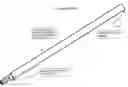
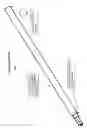
See FIG. 1 (not to scale)
The Rodrunner is a tubular (metallic) device hexagonally shaped on one end to fit one or more hex nuts. The other end will be fitted with an arbor that is permanently affixed or interchangeable to allow attachment to a power drill. The length and diameter will vary according to the specific application.
Claims
1. The Rodrunner is a tool which the primary use would be for Commercial and/or Industrial construction. It is in this setting that I fashioned the first prototype using a scrap piece of conduit with the end shaped to fit the nut and affixed it to my drill. It worked so well and saved so much time that several of my co-workers suggested that I should Patent it.
Images & Drawings included:
Sources:
- United States Patent and Trademark Office - verify current appl. status at the USPTO↗
Recent applications in this class:
- » 20250091182 2025-03-20
High-Intensity Magnetic Tool Extension Rod - » 20250073867 2025-03-06
Socket wrench extension with flange - » 20240217075 2024-07-04
Telescopic socket tools - » 20230321798 2023-10-12
ADJUSTABLE WRENCH - » 20230241747 2023-08-03
SOCKET WRENCH EXTENSION WITH FLANGE - » 20230101161 2023-03-30
MODULAR TOOL BIT HOLDER SYSTEM - » 20230072364 2023-03-09
SOCKET APPARATUS - » 20220152794 2022-05-19
Extendable Wrench Tool - » 20210031339 2021-02-04
Length extension assembly for a hand tool - » 20210023683 2021-01-28
Adjustable wrench