Opaque fiber reinforcement of composites
US20100011702A1
2010-01-21
12/173,776
2008-07-15
✅ Patent granted
US 8,997,416 B2
2015-04-07
-
-
Mark Wendell
Yee & Associates, P.C.
2030-06-18
Abstract:
A composite material includes a polymeric matrix, at least one transparent region including a plurality of optically clear elements provided in the polymeric matrix and at least one opaque region including a plurality of opaque reinforcing elements provided in the polymeric matrix generally adjacent to the at least one transparent region. A structural window and a method for reinforcing a composite material are also disclosed.
Inventors:
- Mark S. Wilenski 15 🇺🇸 Seattle, WA, United States
- Alan M. Markus 12 🇺🇸 Lake Forest, CA, United States
- Larry A. Godby 9 🇺🇸 North Hills, CA, United States
Assignee:
- The Boeing Company 17,071 🇺🇸 Chicago, IL, United States
Applicant:
Interested in similar patents?
Get notified when new applications in this technology area are published.
Classification:
B64C1/14 IPC
Fuselages; Constructional features common to fuselages, wings, stabilising surfaces and the like Windows; Doors; Hatch covers or access panels; Surrounding frame structures; Canopies; Windscreens accessories therefor, e.g. pressure sensors, water deflectors, hinges, seals, handles, latches, windscreen wipers
B32B2262/101 » CPC further
Composition or structural features of fibres which form a fibrous or filamentary layer or are present as additives; Inorganic fibres Glass fibres
B32B2262/106 » CPC further
Composition or structural features of fibres which form a fibrous or filamentary layer or are present as additives; Inorganic fibres Carbon fibres, e.g. graphite fibres
Y02T50/40 » CPC further
Aeronautics or air transport Weight reduction
Y02T50/40 » CPC further
Aeronautics or air transport Weight reduction
Y10T428/249949 » CPC further
Stock material or miscellaneous articles; Web or sheet containing structurally defined element or component; Noninterengaged fiber-containing paper-free web or sheet which is not of specified porosity; Fiber embedded in or on the surface of a polymeric matrix Two or more chemically different fibers
B32B7/04 IPC
Layered products characterised by the relation between layers; Layered products characterised by the relative orientation of features between layers, or by the relative values of a measurable parameter between layers, i.e. products comprising layers having different physical, chemical or physicochemical properties; Layered products characterised by the interconnection of layers Interconnection of layers
B32B27/18 IPC
Layered products comprising synthetic resin characterised by the use of special additives
B29C69/02 IPC
Combinations of shaping techniques not provided for in a single one of main groups - , e.g. associations of moulding and joining techniques; Apparatus therefore of moulding techniques only
E04C2/54 IPC
Building elements of relatively thin form for the construction of parts of buildings, e.g. sheet materials, slabs, or panels Slab-like translucent elements
B32B17/067 » CPC further
Layered products essentially comprising sheet glass, or glass, slag, or like fibres comprising glass as the main or only constituent of a layer, next to another layer of a specific material of fibres or filaments
B29C70/30 » CPC further
Shaping composites, i.e. plastics material comprising reinforcements, fillers or preformed parts, e.g. inserts comprising reinforcements only, e.g. self-reinforcing plastics; Shaping operations therefor Shaping by lay-up, i.e. applying fibres, tape or broadsheet on a mould, former or core; Shaping by spray-up, i.e. spraying of fibres on a mould, former or core
B64C1/1492 » CPC further
Fuselages; Constructional features common to fuselages, wings, stabilising surfaces and the like; Windows; Doors; Hatch covers or access panels; Surrounding frame structures; Canopies; Windscreens accessories therefor, e.g. pressure sensors, water deflectors, hinges, seals, handles, latches, windscreen wipers; Canopies; Windscreens or similar transparent elements Structure and mounting of the transparent elements in the window or windscreen
B29K2995/0025 » CPC further
Properties of moulding materials, reinforcements, fillers, preformed parts or moulds having particular optical properties, e.g. fluorescent or phosphorescent Opaque
B29K2995/0089 » CPC further
Properties of moulding materials, reinforcements, fillers, preformed parts or moulds; Other properties Impact strength or toughness
B29L2031/778 » CPC further
Other particular articles Windows
B32B2605/18 » CPC further
Vehicles Aircraft
B32B17/04 » CPC main
Layered products essentially comprising sheet glass, or glass, slag, or like fibres in the form of fibres or filaments bonded with or embedded in a plastic substance
B29K2995/0026 » CPC further
Properties of moulding materials, reinforcements, fillers, preformed parts or moulds having particular optical properties, e.g. fluorescent or phosphorescent Transparent
E04C1/00 IPC
Building elements of block or other shape for the construction of parts of buildings
B32B17/06 IPC
Layered products essentially comprising sheet glass, or glass, slag, or like fibres comprising glass as the main or only constituent of a layer, next to another layer of a specific material
Description
FIELD OF THE INVENTION
The disclosure relates to composites. More particularly, the disclosure relates to composites having an opaque region or regions of opaque elements adjacent to a transparent region or regions of optically clear elements to reinforce the structural or ballistic performance of the composites.
BACKGROUND OF THE INVENTION
The strength and stiffness of optically clear composite materials may be a function of the quantity, strength, and type of the glass fiber in the materials. The degree of optical distortion may be a function of the quantity of glass in the material. Ultimately, the quantity of glass that is acceptable for many applications may be limited by the optical performance of the system. Therefore, an alternate method of improving the strength and stiffness of optically clear composite materials may be desirable.
SUMMARY OF THE INVENTION
The disclosure is generally directed to a reinforced composite material. An illustrative embodiment of the reinforced composite material includes a polymeric matrix, at least one transparent region including a plurality of optically clear elements provided in the polymeric matrix and at least one opaque region including one or more opaque reinforcing elements provided in the polymeric matrix generally adjacent to the at least one transparent region.
The disclosure is further generally directed to a structural window. An illustrative embodiment of the structural window includes a composite material having a window border and comprising a polymeric matrix, at least one transparent region including a plurality of optically clear elements provided in the polymeric matrix and at least one opaque region including a plurality of opaque reinforcing elements provided in the polymeric matrix generally adjacent to the at least one transparent region.
The disclosure is further generally directed to a method for reinforcing a composite material. An illustrative embodiment of the method includes providing a polymeric matrix resin, providing at least one transparent region including a plurality of optically clear elements in the polymeric matrix resin, providing at least one opaque region including a plurality of opaque reinforcing elements in the polymeric matrix resin and curing the polymeric matrix resin.
BRIEF DESCRIPTION OF THE ILLUSTRATIONS
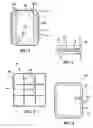
FIG. 1 is a front view of a composite material in the form of a structural window, illustrating an illustrative reinforcing opaque region pattern in the composite material.
FIG. 2 is a cross-sectional view of a transparent region and an adjacent opaque region of the structural window.
FIG. 3 is a front view of another illustrative embodiment of the composite material in the form of a structural window, illustrating an alternative, grid-shaped illustrative reinforcing opaque region pattern in the composite material.
FIG. 4 is a front view of a structural window which includes a composite material having a central transparent region and an outer opaque region.
FIG. 5 is an enlarged sectional view, taken along section line 5 in FIG. 4, with reinforcing opaque elements in the opaque region oriented in generally parallel relationship with respect to optically clear elements in the transparent region of the composite material.
FIG. 6 is a cross-sectional view of a portion of the structural window shown in FIG. 4, with the optically clear elements in the transparent region and the opaque reinforcing elements in the opaque region embedded in a polymeric matrix of the composite material.
FIG. 7 is a flow diagram illustrating an illustrative method for reinforcing a composite material.
DETAILED DESCRIPTION OF THE PREFERRED EMBODIMENT
The disclosure is generally directed to composite materials including at least one opaque region having opaque elements such as opaque fibers and/or ribbons, for example and without limitation, embedded in a polymeric matrix in discrete, designed locations to improve performance of the composite materials. The opaque region or regions may be generally adjacent to a transparent region or regions having optically clear elements such as glass fibers and/or ribbons, for example and without limitation. The reinforcing opaque elements of the opaque region or regions may be oriented in any desired orientation or orientations with respect to the optically clear elements of the transparent region or regions.
Referring initially to FIGS. 1-3, a structural window 14 which includes a composite material 19 is shown in FIGS. 1 and 2. The structural window 14 may have a window border 15 of any desired size and shape depending on the application. The composite material 19 may include a polymeric matrix 18 which may be optically transparent. The polymeric matrix 18 may be any type of polymer which is suitable for fabrication of transparent or other materials, including but not limited to epoxy; polymethyl methacrylate (acrylic); polyurethane, polycarbonate; and transparent polymers.
One or multiple opaque regions 22, each having opaque reinforcing elements 23 (FIG. 2) embedded in the polymeric matrix 18, may be provided at selected locations of the structural window 14 where reinforcement of the composite material 19 is desired. Each opaque reinforcing element 23 may be an opaque fiber(s) or ribbon(s), for example and without limitation, and may be carbon (graphite), organic fibers such as SPECTRA® or KEVLAR®, metal fibers, boron, silicon carbide (SiC), etc., polyimide or other high-strength fiber material. The choice of material for the opaque reinforcing elements 23 may be dependent upon the desired property improvement. For example, an opaque reinforcing element 23 of stiff graphite fiber may be used to improve stiffness performance of the composite material 19, whereas an opaque reinforcing element 23 of high-strain organic fiber may be used for ballistics purposes. As shown in FIG. 2, optically clear elements 17 may be embedded in the polymeric matrix 18 at the transparent region or regions 16 of the composite material 19. The optically clear elements 17 may be any suitable optically clear material such as glass fibers and/or glass ribbons and/or may be optically clear polymer fibers and/or ceramic fibers, for example and without limitation. Depending on the desired properties (such as improved toughness or stiffness, for example) of the composite material 19, the polymeric matrix 18 has resin which may be the same in the transparent region or regions 16 and the opaque region or regions 22 or may be different in the transparent region or regions 16 and the opaque region or regions 22. Furthermore, each transparent region 16 may include multiple transparent layers which may vary in orientation to impart the desired structural, ballistic or other properties to the composite material 19.
The opaque regions 22 with opaque reinforcing elements 23 may be oriented and distributed throughout the polymeric matrix 18 in any suitable pattern. In some embodiments of the structural window 14, shown in FIG. 1, one or multiple longitudinal opaque regions 22a may extend in generally parallel relationship and multiple angled opaque regions 22b may extend in generally angled relationship with respect to a longitudinal axis of the structural window 14. The longitudinal opaque regions 22a and angled opaque regions 22b may frame one or multiple optically-clear transparent regions 16 of the structural window 14. In other embodiments, such as the structural window 14a shown in FIG. 3, the opaque regions 22 may be oriented in intersecting rows and columns in the composite material 19a to form a grid pattern having multiple, adjacent, optically-clear transparent regions 16.
Referring next to FIGS. 4-6, an alternative structural window 14b may include a composite material 19b having a central transparent region 16 and a surrounding opaque region 22 which is generally adjacent to the central transparent region 16. Alternatively, in some embodiments the transparent region 16 may be located outwardly of the opaque region 22 of the structural window 14b. The number and locations of the transparent region 16 and the opaque region 22 throughout the composite material 19b may vary depending on the desired application of the structural window 19b.
Referring next to FIG. 7, a flow diagram 900 which illustrates an alternative illustrative method for reinforcing an optically transparent composite material is shown. In block 902, a polymeric matrix resin is provided. In block 904a, transparent glass fibers are provided. In block 904b, opaque fibers are provided. Blocks 904a and 904b may be carried out simultaneously. In block 905a, a prepreg is created. In block 905b, the prepreg is laid up using the transparent glass fibers provided in block 904a and the opaque fibers provided in block 904b. In block 906, the resulting composite is cured.
While not so limited, the transparent composite article is suitable for use as a component of a window assembly or other transparent device. Window assembly, as used herein, includes a window and components associated with the window, including the window, frames, mounting devices, or other associated equipment or devices. For example, the transparent composite article may be assembled into a window assembly for an aircraft or a transparent portion of an automobile, armored vehicle (e.g., a personnel carrier or transport) or boat (e.g., a glass-bottomed boat). In addition, the transparent composite article may be assembled into a window assembly for a stationary structure, such as a skyscraper or other architectural structure. Further still, in addition to window applications, the transparent composite article is suitable for use with riot gear or other personal protection, such as face shields or arm shields, wherein it is desirable to permit viewing through a ballistic-resistant material.
Although the embodiments of this disclosure have been described with respect to certain exemplary embodiments, it is to be understood that the specific embodiments are for purposes of illustration and not limitation, as other variations will occur to those of skill in the art.
Claims
What is claimed is:1. A composite material, comprising:
a polymeric matrix;
at least one transparent region including a plurality of optically clear elements provided in said polymeric matrix; and
at least one opaque region including a plurality of opaque reinforcing elements provided in said polymeric matrix generally adjacent to said at least one transparent region.
2. The composite material of claim 1 wherein said plurality of opaque reinforcing elements is carbon fibers, organic fibers, metal fibers, boron fibers, silicon carbide fibers and/or polyimide fibers.
3. The composite material of claim 1 wherein said plurality of optically clear elements is glass fibers or glass ribbons.
4. The composite material of claim 1 wherein said plurality of optically clear elements and said plurality of opaque reinforcing elements are embedded in said polymeric matrix.
5. The composite material of claim 1 wherein said polymeric matrix is optically transparent.
6. The composite material of claim 1 wherein said polymeric matrix comprises resin of same material in said at least one transparent region and said at least one opaque region.
7. The composite material of claim 1 wherein said polymeric matrix comprises resin of different materials in said at least one transparent region and said at least one opaque region.
8. The composite material of claim 1 wherein said polymeric matrix comprises epoxy, polymethyl methacrylate (acrylic), polyurethane, or polycarbonate.
9. A structural window, comprising:
a composite material having a window border and comprising:
a polymeric matrix;
at least one transparent region including a plurality of optically clear elements provided in said polymeric matrix; and
at least one opaque region including a plurality of opaque reinforcing elements provided in said polymeric matrix generally adjacent to said at least one transparent region.
10. The structural window of claim 9 wherein said plurality of opaque reinforcing elements is at least one fiber selected from the group consisting of carbon fibers, organic fibers, metal fibers, boron fibers, silicon carbide fibers and polyimide fibers.
11. The structural window of claim 9 wherein said at least one opaque region comprises a plurality of opaque regions oriented in a grid configuration in said polymeric matrix.
12. The structural window of claim 9 wherein said at least one opaque region comprises a first plurality of opaque regions oriented in generally parallel relationship with respect to a longitudinal axis of said composite material and a second plurality of opaque regions oriented in generally angular relationship with respect to said longitudinal axis of said composite material.
13. The structural window of claim 9 wherein said plurality of optically clear elements comprises a plurality of glass fibers or ribbons.
14. The structural window of claim 9 wherein said polymeric matrix comprises resin of same material in said at least one transparent region and said at least one opaque region.
15. The composite material of claim 9 wherein said polymeric matrix comprises resin of different materials in said at least one transparent region and said at least one opaque region.
16. The composite material of claim 9 wherein said polymeric matrix comprises epoxy, polymethyl methacrylate (acrylic), polyurethane, or polycarbonate.
17. A method for reinforcing a composite material, comprising:
providing a polymeric matrix resin;
providing transparent glass elements;
providing opaque elements;
creating a prepreg;
forming a composite by laying up said prepreg using said transparent glass elements and said opaque elements; and
curing said composite.
18. The method of claim 17 wherein said plurality of opaque glass elements is carbon fibers, organic fibers, metal fibers, boron fibers, silicon carbide fibers and/or polyimide fibers.
19. The composite material of claim 17 wherein said plurality of transparent glass elements is glass fibers or glass ribbons.
20. The composite material of claim 17 wherein said polymeric matrix comprises epoxy, polymethyl methacrylate (acrylic), polyurethane or polycarbonate.
Images & Drawings included:


Sources:
- United States Patent and Trademark Office - verify current appl. status at the USPTO↗
Similar patent applications:
- » 20160009032
Opaque fiber reinforcement of composites
Recent applications in this class:
- » 20230139791 2023-05-04
Cover window and display device including the same - » 20220024183 2022-01-27
Open area core sandwich structure assembly with vehicle exterior surface glass - » 20170305117 2017-10-26
Fan case for an aircraft engine - » 20130319609 2013-12-05
Thermosetting resin composition and prepreg and metal clad laminate using the same - » 20120177878 2012-07-12
Part for and method of repairing a damaged structure, in particular an airframe skin, and a repair kit for implementing it - » 20120021161 2012-01-26
Fire resistant encapsulated fiberglass products - » 20120009834 2012-01-12
Architectural membrane and method of making same - » 20110300766 2011-12-08
Silicone Gel Seal And Method For Its Preparation And Use - » 20110194261 2011-08-11
PREPREG, LAMINATE, PRINTED WIRING BOARD, AND SEMICONDUCTOR DEVICE - » 20110135940 2011-06-09
Laminated glass
Recent applications for this Assignee:
- » 20250215535 2025-07-03
REFRACTORY COMPLEX CONCENTRATED ALLOYS FOR IMPROVED OXIDATION RESISTANCE AND STRUCTURAL STABILITY - » 20250153561 2025-05-15
COMPOSITE TANKS FOR REUSABLE LAUNCH VEHICLES AND METHODS OF FABRICATING THEREOF - » 20250121564 2025-04-17
ADDITIVE MANUFACTURING SYSTEM AND METHOD USING ROBOTIC ARMS - » 20240426919 2024-12-26
BATTERY REAL-TIME INTERNAL SHORT CIRCUIT DETECTION - » 20240401953 2024-12-05
Personal Navigation Device Operable in GNSS-Denied Environment - » 20240328752 2024-10-03
AIRCRAFT WEAPONS POD INCLUDING RAIL LAUNCHER - » 20240328371 2024-10-03
BONDED DOUBLE WALL SEAL ASSEMBLY - » 20240328348 2024-10-03
METHODS AND SYSTEMS FOR GENERATING POWER AND THERMAL MANAGEMENT HAVING DUAL LOOP ARCHITECTURE - » 20240327029 2024-10-03
METEOROLOGICAL EQUIPMENT TO SUPPORT FLIGHT OPERATIONS OF VERTICAL TAKEOFF AND LANDING AIRCRAFT - » 20240317402 2024-09-26
System and method for transferring individuals to and from a toilet of a lavatory