Method and device for converting biomass into gaseous products
US20100037520A1
2010-02-18
12/522,833
2007-12-20
✅ Patent granted
US 8,361,175 B2
2013-01-29
WO; PCT/EP2007/011231; 20071220
WO; WO2008/083823; 20080717
Matthew Merkling
Leydig, Voit & Mayer, Ltd.
2030-01-24
Abstract:
A method for converting biomass having a water content of at least 50% into gaseous products includes providing a reactor containing supercritical water and a salt melt. The salt melt includes at least one of a salt and a salt mixture. The reactor and the salt melt are heated to the reaction temperature. The biomass is heated to a preheat temperature. The biomass heated to the preheat temperature is fed into the salt melt. The biomass is heated to the reaction temperature so as to commence a conversion of the biomass into the gaseous products, so as to release from the biomass at least one additional salt into the salt melt. An amount of the salt melt containing at least a portion of the at least one additional salt is withdrawn from the reactor and the amount of the withdrawn salt melt is replaced with a fresh salt solution. The gaseous products are removed from the reactor.
Inventors:
- Nicolaus Dahmen 2 🇩🇪 Bruchsal, Germany
- Andrea Kruse 5 🇩🇪 Bruchsal, Germany
- Hubert Goldacker 3 🇩🇪 Eggenstein-Leopoldshafen, Germany
Assignee:
- FORSCHUNGSZENTRUM KARLSRUHE GmbH. 103 🇩🇪 KARLSRUHE, Germany
- Forschungszentrum Karisruhe GmbH 1 🇩🇪 Karisruhe, Germany
Applicant:
Interested in similar patents?
Get notified when new applications in this technology area are published.
Classification:
C01B3/02 IPC
Hydrogen; Gaseous mixtures containing hydrogen; Separation of hydrogen from mixtures containing it ; Purification of hydrogen Production of hydrogen or of gaseous mixtures containing a substantial proportion of hydrogen
B01J3/008 » CPC main
Processes of utilising sub-atmospheric or super-atmospheric pressure to effect chemical or physical change of matter; Apparatus therefor Processes carried out under supercritical conditions
B01J19/0013 » CPC further
Chemical, physical or physico-chemical processes in general; Their relevant apparatus; Controlling or regulating processes Controlling the temperature of the process
C10J3/14 » CPC further
Production of combustible gases containing carbon monoxide from solid carbonaceous fuels; Fixed-bed gasification of lump fuel; Continuous processes using gaseous heat-carriers
B01J2219/00121 » CPC further
Chemical, physical or physico-chemical processes in general; Their relevant apparatus; Controlling or regulating processes; Controlling the temperature by direct heating or cooling
C10J2300/0916 » CPC further
Details of gasification processes; Details of the feed, e.g. feeding of spent catalyst, inert gas or halogens; Carbonaceous raw material Biomass
Y02P20/145 » CPC further
Technologies relating to chemical industry; Feedstock the feedstock being materials of biological origin
Y02P20/145 » CPC further
Technologies relating to chemical industry; Feedstock the feedstock being materials of biological origin
Y02P20/54 » CPC further
Technologies relating to chemical industry; Improvements relating to the production of bulk chemicals using solvents, e.g. supercritical solvents or ionic liquids
Y02P20/54 » CPC further
Technologies relating to chemical industry; Improvements relating to the production of bulk chemicals using solvents, e.g. supercritical solvents or ionic liquids
C10J3/00 IPC
Production of combustible gases containing carbon monoxide from solid carbonaceous fuels
C10J3/57 IPC
Production of combustible gases containing carbon monoxide from solid carbonaceous fuels Gasification using molten salts or metals
C01B3/36 IPC
Hydrogen; Gaseous mixtures containing hydrogen; Separation of hydrogen from mixtures containing it ; Purification of hydrogen; Production of hydrogen or of gaseous mixtures containing a substantial proportion of hydrogen by reaction of gaseous or liquid organic compounds with gasifying agents, e.g. water, carbon dioxide, air by reaction of hydrocarbons with gasifying agents using oxygen or mixtures containing oxygen as gasifying agents
C01B6/24 IPC
Hydrides of metals including fully or partially hydrided metals, alloys or intermetallic compounds ; Compounds containing at least one metal-hydrogen bond, e.g. (GeH)S, SiH GeH ; Monoborane or diborane; Addition complexes thereof Hydrides containing at least two metals; Addition complexes thereof
C01B3/24 IPC
Hydrogen; Gaseous mixtures containing hydrogen; Separation of hydrogen from mixtures containing it ; Purification of hydrogen; Production of hydrogen or of gaseous mixtures containing a substantial proportion of hydrogen by decomposition of gaseous or liquid organic compounds of hydrocarbons
B01J7/00 IPC
Apparatus for generating gases
B09B1/00 IPC
Dumping solid waste
Description
CROSS REFERENCE TO PRIOR APPLICATIONS
This application is a U.S National Phase application under 35 U.S.C. §371 of International Application No. PCT/EP2007/011231, filed on Dec. 20, 2007 and which claims benefit to German Patent Application No. 10 2007 002 056.4, filed on Jan. 13, 2007. The International Application was published in German on Jul. 17, 2008 as WO 2008/083823 A1 under PCT Article 21(2).
FIELD
The present invention relates to a method and to a device for converting wet biomass, for example, biomass having a water content of at least 50%, into gaseous products.
BACKGROUND
When it comes to utilizing the energy of wet biomass via the modality of thermal decomposition, it is often the case that supercritical water, i.e. water at pressures and temperatures above the critical point of water (22.1 MPa and 374° C.) is used. Whereas supercritical water dissolves organic substances well, inorganic salts easily precipitate and can then clog the reactor.
FIELD
N. Boukis, U. Galla, V. Diem, E. Dinjus, in “Biomass gasification in supercritical water: First results of the pilot plant” in: A. V. Bridgewater, D. G. B. Boocock, Science in Thermal and Chemical Biomass Conversion, cplpress, Volume 2, page 975, 2006, describe a slender tubular flow reactor in which the salts that stem from the biomass and that are insoluble in supercritical water collect at the bottom. Since the precipitating salts have a consistency ranging from tacky to grainy, only the latter can be separated and even then, only partially, by means of methods such as, for example, sedimentation. Up until now, the wet biomass has been heated up to the reaction temperature in an upstream heat exchanger. This method is slow and it already initiates the reaction in the heat exchanger tube as soon as the requisite temperature has been reached.
In an alternative embodiment, the preheated, concentrated biomass is fed into the reactor together with supercritical water. For this purpose, there is sometimes a need for an unfavorable ratio of suspended biomass to supercritical heating water. Even though this accelerates the heating up procedure and shifts the time of the beginning of the reaction to the reactor, most of the salts precipitate in the reactor during the operation in a manner that is uncontrolled and makes them difficult to remove.
U.S. Pat. No. 4,822,497 describes a pressure vessel as a reactor for the oxidation of waste products in supercritical water, whereby the same problems are encountered in terms of salt formation and salt precipitation under reaction conditions. In order to prevent the undesired and detrimental accumulation of salts in the reactor, the system is operated in the bottom section with a water chamber that, by quenching, is kept at a temperature that is considerably lower than the critical temperature. Under these conditions, the salts from the reaction chamber located above dissolve once again in water. The oxidation in supercritical water is highly exothermic and therefore the quenching is justifiable from an energy standpoint. The gasification of biomass, in contrast, is endothermic and thus the quenching is not justifiable from an energy standpoint.
Y. Raja, in “Gasification of waste to produce low-BTU gas by molten salt technique” J. Institution of Engineers India, Volume 70, Part T2, page 15, 1989, describes that high conversion rates are achieved with biomass gasification in dry salt melts, although a great deal of carbon monoxide is generated in the process. In addition, a shift converter must be installed downstream for purposes of generating hydrogen. Moreover, the formation of charcoal or coke cannot be completely prevented during reactions in dry salt melts.
DE 202 20 307 U1 describes a system for treating flowable substances in supercritical water, consisting of a cylindrical reactor with pressure lines for the feedstock and for product discharge, whereby the product discharge line is configured as a stand pipe that protrudes into the reactor chamber from above and ends in the bottom third of the reactor, and a sump drain that is situated at the narrowest place and that has a cooler and an array of valves for the (dis)continuous sump drain is installed at the lower end of the reactor.
U.S. Pat. No. 6,878,479 B2 describes a device for converting fuels directly into electric energy, whereby electrochemical cells, each containing a molten electrolyte, are arranged in a bipolar, tilted configuration in such a way that the electric resistance between the cells is minimized.
US 2005/0066573 A1 describes a method for the thermal decomposition of graphite fibers and polymer composites in an inert atmosphere, wherein a plurality of graphite fibers that are bound to charred material are produced and subsequently, the charred material is separated from the graphite fibers by means of electrochemical oxidation in a salt melt.
EP 1 686 192 A1 describes a method for the production of monosaccharides or oligosaccharides from a polysaccharide, wherein the polysaccharide is hydrolyzed at a pressure of 5 MPa to 100 MPa and at a temperature ranging from 140° C. to 300° C. in a hydrothermal reaction in hot water to which carbon dioxide had been previously added under pressure.
G. Lee, T. Nunoura, Y. Matsumura and K. Yamamoto, in “Comparison of the Effects of the addition of NaOH on the decomposition of 2-chlorophenol and phenol in supercritical water and under supercritical water oxidation conditions”, J. Supercritical Fluids, Volume 24, pages 239-250, 2002, describe that the influence of NaOH on the decomposition of organic compounds must be taken into account when the optimal reaction conditions and the optimal reactor design are being determined.
In their overview article titled “Probing the chemical and electrochemical properties of the SCWO System”, Electrochimica Acta, Volume 47, pages 775-790, 2001, D. D. MacDonald and L. B. Kriksunov describe the advantages of and obstacles encountered with the use of supercritical water oxidation (SCWO). The advantages of SCWO in comparison to combustion stem from the use of closed cycles when the reaction is carried out, and also from the higher decomposition efficiency. The latter, however, comes at the expense of a higher corrosiveness in comparison to conventional materials.
K. Pripopsky, B. Wellig and Ph. R. von Rohr, in “SCWO of salt containing artificial wastewater using a transpiring wall reactor: Experimental results”, J. Supercritical Fluids, Volume 40, pages 246-257, 2007, available from Science Direct as of Jul. 7, 2007, describe a reactor set-up having two partially permeable wall elements by means of which the problem of reactor contamination and clogging due to salt precipitation can be avoided.
M. Hodes, P. A. Marrone, G. T. Hong, K. A. Smith and J. W. Tester in “Salt precipitation and scale control in supercritical water oxidation, Part A: Fundamentals and research”, J. Supercritical Fluids, Volume 29, pages 265-288, 2004, describe the principles of salt precipitation and scaling at high temperatures and pressures, phase diagrams of the salt-water system and the resultant phenomena.
Z. Sun, F. Takahashi, Y. Odaka, K. Fukushi, Y. Oshima and K. Yamamoto, in “Effects of potassium alkalis and sodium alkalis on the dechlorination of o-chlorophenol in supercritical water”, Chemosphere, Volume 66, pages 151-157, 2007, available online as of Jun. 29, 2006, describe the influence of potassium alkalis and sodium alkalis on the dechlorination of o-chlorophenol in supercritical water.
M. D. Bermejo, A. Martin, L. J. Florusse, C. J. Peters and M. J. Cocero, in “The influence of Na2SO4 on the CO2 solubility in water at high pressure”, Fluid Phase Equilibria, Volume 238, pages 220-228, 2005, describe the effective decomposition of organic waste in the example of Na2SO4 in supercritical water. Decomposition rates of more than 99% with residence times of less than 1 minute were observed.
M. D. Bermejo, A. Martin, L. J. Florusse, C. J. Peters and M. J. Cocero, in “Bubble points of the systems isopropanol-water, isopropanol-water-sodium acetate and isopropanol-water-sodium oleate at high pressure”, Fluid Phase Equilibria, Volume 244, pages 78-85, 2006, describe that oxidation in supercritical water is an effective technique for decomposing organic waste at a high yield. As soon as sufficient cations are present, the heteroatoms present precipitate in the form of salts and can be ultimately recovered.
SUMMARY
An aspect of the present invention is to provide a method and a device that do not have at least some of the above-mentioned drawbacks and limitations. In particular, in an embodiment, the thermal decomposition of the biomass and the formation of additional salts from the biomass should take place once the biomass has reached the reactor so that the additional salts can be bound directly at the place of their formation.
In an embodiment, the present invention provides a method for converting biomass having a water content of at least 50% into gaseous products. The method includes providing a reactor containing supercritical water and a salt melt, wherein the salt melt includes at least one of a salt and a salt mixture having a melting point below a reaction temperature required to convert the biomass into the gaseous products. The reactor and the salt melt are heated to the reaction temperature. The biomass is heated to a preheat temperature at which detrimental decomposition of the organic compounds in the biomass does not occur. The biomass heated to the preheat temperature is fed into the salt melt using a first feed pipe immersed in the salt melt so as to heat the biomass to the reaction temperature so as to commence a conversion of the biomass into the gaseous products so as to, by completion of the conversion, release from the biomass at least one additional salt into the salt melt. An amount of the salt melt containing at least a portion of the at least one additional salt is withdrawn from the reactor and the amount of the withdrawn salt melt is replaced with a fresh salt solution. The gaseous products are removed from the reactor using an outlet pipe.
BRIEF DESCRIPTION OF THE DRAWING
The present invention will be described in greater detail on the basis of exemplary embodiments with reference to the FIGURE.
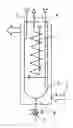
The FIGURE shows an embodiment of a device according to the present invention for carrying out the method according to the present invention.
DETAILED DESCRIPTION
The method according to the present invention is carried out in a pressure reactor at a pressure above the critical pressure of water, preferably above 22.5 MPA, said pressure being applied in a first step a). A sufficiently extensive, stationary salt melt is present in the bottom area of the reactor.
The melting point of the salt used for the salt melt or the melting point of the salt mixture used for this purpose has to be below the reaction temperature at which the biomass is converted into a gaseous product. As a rule, the reaction temperature is between 550° C. and 700° C. [1022° F. and 1292° F.].
Suitable salts preferably include alkali salts, especially preferred are alkali nitrates, alkali hydroxides, alkali carbonates or alkali hydrogen carbonates that form hydrous melts having low melting points. Examples of suitable salt mixtures are a 50:50 mixture of NaNO3 and KNO3 (melting point of 223° C. [433.4° F.]) or a 56:44 mixture of LiNO3 and KNO3 (melting point of 125° C. [257° F.]). An example of a suitable salt is KOH having a melting point of 360° C. [680° F.].
The salts or salt mixtures employed for the salt melt preferably have the following properties as well:
-
- They exhibit sufficient thermal stability for temperatures of up to 700° C. [1292° F.].
- Their corrosiveness is as low as possible.
- When additional salts from the conversion of the biomass are fed in, the melting point only changes to an extent that does not substantially impair the execution of the process.
- The viscosity ensures the flowability of the salt melt in the reactor.
- The specific heat allows a rapid heating up of the preheated biomass through contact with the salt melt.
In step b), the reactor and the salt melt contained in it are heated up from the outside to the reaction temperature that is required to convert the biomass into gaseous products. The heating up is done, for example, with flue gases.
In step c), the biomass is first heated up in a heat exchanger to a preheat temperature at which detrimental decomposition of the organic compounds does not yet begin. Subsequently, the biomass thus heated up is fed into the salt melt through a feed pipe that is immersed into the salt melt which, due to its insolubility in the supercritical water, forms an aqueous salt phase.
In step c), the biomass is then quickly heated up in this salt bath to the reaction temperature. In this process, the amount of biomass fed in and the amount of salt melt are preferably harmonized with each other in such a way that the biomass is heated up to the reaction temperature as quickly as possible already during the contact time of the two media.
This starts up the thermal decomposition of the biomass within a very short time and the biomass carbon is available in a suitable form for the water cleavage (so-called water-gas shift reaction).
The salts released by the thermal decomposition of the biomass in step c) are held in the salt melt. In this context, the reactor is configured in such a way that the formation of a salt melt film is prevented. A salt melt film resembles the falling films known from evaporator technology, and it consists of the same salt melt as that in the bottom area of the reactor and causes incrustation on the inner surface of the reactor due to precipitating biomass salts (subsequent thermal decomposition reactions) in the supercritical plenum of the reactor.
In step d), a portion of the salt melt enriched with salts stemming from the biomass is withdrawn via a drain located at the bottom of the reactor, preferably at periodic intervals. The amount of salt removed is replaced with a fresh salt mixture.
In step e), the gaseous products are removed from the reactor via an outlet pipe.
A device according to the present invention for converting biomass having a water content of at least 50% into gaseous products comprises at least the following components:
-
- a pressure reactor that can be operated at a pressure above the critical pressure of water, preferably above 22.5 MPA, and that is suitable to hold a salt melt,
- a heater that is suitable to heat up the reactor and the salt melt contained in it to the reaction temperature that is necessary to convert the biomass into gaseous products,
- a first feed pipe that is immersed into the salt melt for feeding into the reactor the biomass that was heated up to a preheat temperature at which decomposition of the organic compounds does not yet occur in the biomass,
- a second feed pipe for feeding water and salt solution into the reactor,
- an outlet pipe for discharging the gaseous reaction products out of the reactor, and
- a drain at the bottom of the reactor for withdrawing from the reactor portions of the salt melt that is enriched with the additional salts that have come out of the biomass.
Preferably, a tube reactor that removes heat from the gaseous products is installed upstream from the outlet pipe.
Preferably, a heated valve that lends itself especially to control the periodic removal of portions of the salt melt is provided in the drain at the bottom of the reactor.
The method according to the present invention has, in particular, the following advantages:
-
- The thermal decomposition of the biomass and thus the formation of the additional salts from the biomass do not begin until the preheat temperature inside the reactor has been exceeded, so that the salts can be bound directly at the place of their formation.
- The binding of the salts from the thermal decomposition of the biomass takes place in the provided salt melt that at the same time serves as a heat source for heating up the preheated biomass to the reaction temperature.
- If the salt melt comprises an alkali salt or a salt mixture in which at least one component is an alkali salt, then the reactivity of the biomass can additionally be raised during the heating in the salt melt from the preheat temperature to the reaction temperature to such an extent that the bound carbon atoms contained in the biomass are converted into CO2 and CH4 to the greatest degree possible.
- The bound salts can be removed from the reactor without adversely affecting the operation.
A salt melt 2 is fed into a slender pressure reactor 1 and heated to the reaction temperature by means of a heater 3. The biomass that was heated up to a preheat temperature at which detrimental decomposition of the organic compounds does not yet occur in the biomass is fed into the reactor through a first feed pipe 4 that is immersed into the salt melt 2. A second feed pipe 5, which in this case is not immersed into the melt, serves for feeding water and salt solution into the reactor 1. An outlet pipe 6, which in this case likewise is not immersed into the salt melt, serves to discharge the gaseous reaction products out of the reactor 1. In this embodiment, a tube reactor 7 is installed upstream from the outlet pipe 6. At the bottom of the reactor 1, there is a drain 8 for removing from the reactor 1 portions of the salt melt 2 that is enriched with the additional salts that had come out of the biomass. The preferably periodic removal of portions of the salt melt 2 from the reactor 1 is preferably regulated by a heated valve 9.
The present application is not limited to embodiments described herein; reference should be had to the appended claims.
Claims
1-8. (canceled)
9. A method for converting biomass having a water content of at least 50% into gaseous products, the method comprising:
a) providing a reactor containing supercritical water and a salt melt, wherein the salt melt includes at least one of a salt and a salt mixture having a melting point below a reaction temperature required to convert the biomass into the gaseous products;
b) heating the reactor and the salt melt to the reaction temperature;
c) heating the biomass to a preheat temperature at which detrimental decomposition of the organic compounds in the biomass does not occur, and feeding the biomass heated to the preheat temperature into the salt melt using a first feed pipe immersed in the salt melt so as to heat the biomass to the reaction temperature so as to commence a conversion of the biomass into the gaseous products so as to, by completion of the conversion, release from the biomass at least one additional salt into the salt melt;
d) withdrawing from the reactor an amount of the salt melt containing at least a portion of the at least one additional salt and replacing the amount of the withdrawn salt melt with a fresh salt solution; and
e) removing the gaseous products from the reactor using an outlet pipe.
10. The method recited in claim 9, further comprising associating an amount of the biomass with a second amount of the salt melt so that the biomass is heated to the reaction temperature during a contact time of the biomass with the salt melt.
11. The method recited in claim 9, wherein the at least one of a salt and a salt mixture comprises an alkali salt.
12. The method recited in claim 10, wherein the at least one of a salt and a salt mixture comprises an alkali salt.
13. The method recited in claim 9, wherein the at least one of a salt and a salt mixture comprises at least one of an alkali nitrate, an alkali hydroxide, an alkali carbonate and an alkali hydrogen carbonate.
14. The method recited in claim 9, wherein the withdrawing of the amount of the salt melt from the reactor is performed at periodic intervals.
15. The method recited in claim 10, wherein the withdrawing of the amount of the salt melt from the reactor is performed at periodic intervals.
16. The method recited in claim 11, wherein the withdrawing of the amount of the salt melt from the reactor is performed at periodic intervals.
17. The method recited in claim 12, wherein the withdrawing of the amount of the salt melt from the reactor is performed at periodic intervals.
18. The method recited in claim 13, wherein the withdrawing of the amount of the salt melt from the reactor is performed at periodic intervals.
19. A device for converting biomass having a water content of at least 50% into gaseous products, the device comprising:
a reactor configured to hold a supercritical water and a salt melt;
a heater configured to heat the reactor and the salt melt to a reaction temperature;
a first feed pipe immersed in the salt melt and configured to feed the biomass into the reactor;
a second feed pipe configured to feed at least one of water and a salt solution into the reactor;
an outlet pipe configured to discharge gaseous reaction products from the reactor; and
a drain at a bottom of the reactor configured to withdraw portions of the salt melt from the reactor.
20. The device recited in claim 19, further comprising a tube reactor upstream from the outlet pipe.
21. The device recited in claim 19, further comprising a heated valve configured to control the drain at the bottom of the reactor.
22. The device recited in claim 20, further comprising a heated valve configured to control the drain at the bottom of the reactor.
Images & Drawings included:

Sources:
- United States Patent and Trademark Office - verify current appl. status at the USPTO↗
Recent applications in this class:
- » 20250135422 2025-05-01
CONVERSION OF SUPERCRITICAL WATER ENERGY INTO ELECTRICAL POWER - » 20240335808 2024-10-10
PROCESSES AND APPARATUSES FOR CONVERTING POLY- AND PERFLUOROALKYL SUBSTANCES - » 20240198306 2024-06-20
REACTION CHAMBER FOR SUPERCRITICAL WATER OXIDATION REACTOR - » 20240189790 2024-06-13
CONVERSION OF SUPERCRITICAL WATER ENERGY INTO ELECTRICAL POWER - » 20240157316 2024-05-16
TUBULAR REACTOR FOR SUPERCRITICAL WATER REACTION - » 20230381726 2023-11-30
PHOTOCATALYTIC BATCH REACTOR OPERABLE FOR CONVERTING GASEOUS, LIQUID, AND SUPERCRITICAL CARBON DIOXIDE - » 20230277994 2023-09-07
REACTOR FOR THE SUPERCRITICAL HYDROTHERMAL GASIFICATION OF BIOMASS - » 20230191348 2023-06-22
Pilot-scale supercritical water oxidation oil and hydrogen production system capable of realizing long-distance multi-stage heating of organic rock - » 20230166226 2023-06-01
MONITORING SCHEME AND METHOD OF CORROSION AND FOULING REDUCTION FOR SCWO SYSTEM - » 20230149873 2023-05-18
Method for preparing supercritical fluid by deep-sea pressure
Recent applications for this Assignee:
- » 20110109878 2011-05-12
Implantable system for determining the accommodation requirement by optical measurement of the pupil diameter and the surrounding luminance - » 20110067150 2011-03-17
Cantilever with paddle for operation in dual-frequency mode - » 20100273328 2010-10-28
Method for producing an organometallic layer - » 20100237744 2010-09-23
Actuator on the basis of geometrically anisotropic nanoparticles - » 20100225928 2010-09-09
DEVICE FOR MEASURING STRUCTURES OF AN OBJECT - » 20100167917 2010-07-01
Method for producing a hydrogen storage material - » 20100166623 2010-07-01
DEVICE FOR THE THERMAL DEHALOGENATION OF HALOGEN-CONTAINING SUBSTANCES - » 20100163395 2010-07-01
Method for the rapid pyrolysis of lignocellulose - » 20100132153 2010-06-03
CLEANABLE FILTER SYSTEM - » 20100126965 2010-05-27
Molded body, method for producing the body and use thereof