Routing and quality decision in mobile IP networks
US20100067413A1
2010-03-18
12/377,463
2007-06-15
✅ Patent granted
US 8,873,436 B2
2014-10-28
WO; PCT/EP2007/005285; 20070615
WO; WO2008/019724; 20080221
Un C Cho | Siming Liu
Faegre Baker Daniels LLP
2030-01-12
Abstract:
The invention relates to a method for routing streams of traffic in IP networks, particularly in mobile IP networks. The invention involves a plurality of streams of traffic to be transmitted being routed such that they are transmitted in a carrier/context (7). The plurality of streams of traffic at different destination networks (5; 6) and/or demands on transmission quality for the respective stream of traffic are merged and are transmitted from a terminal (3) via one carrier/context (7) to a network access node (4) in the IP network and are routed from there to the respective destination networks and devices.
Inventors:
- Karl-Heinz Nenner 27 🇩🇪 Bornheim, Germany
- Daniela Schneider 1 🇦🇹 Wien, Austria
- Daniela Schneider 2 🇦🇹 Vienna, Austria
Assignee:
- T-Mobile International AG 27 🇩🇪 Bonn, Germany
Applicant:
Interested in similar patents?
Get notified when new applications in this technology area are published.
Classification:
H04B7/005 IPC
Radio transmission systems, i.e. using radiation field Control of transmission; Equalising
H04L45/308 » CPC further
Routing or path finding of packets in data switching networks; Route determination based on requested QoS Route determination based on user's profile, e.g. premium users
H04L45/12 » CPC further
Routing or path finding of packets in data switching networks Shortest path evaluation
H04L12/28 IPC
Data switching networks characterised by path configuration, e.g. LAN [Local Area Networks] or WAN [Wide Area Networks]
H04W40/12 » CPC main
Communication routing or communication path finding; Communication route or path selection, e.g. power-based or shortest path routing based on transmission quality or channel quality
H04W80/04 » CPC further
Wireless network protocols or protocol adaptations to wireless operation Network layer protocols, e.g. mobile IP [Internet Protocol]
Description
The invention relates to a method and a computer program for routing streams of traffic in IP networks, in particular in mobile IP networks, taking quality criteria into consideration.
In the state of the art communication networks, in particular mobile phone networks or the Internet, are in principle known for the transmission of information contents to various user instances, likewise the associated terminals.
For closer consideration of the inventive environment we proceed from the following scenario:
-
- A terminal has a “context”/a “session” at a local network access point of a packet data network.
- The terminal would like to establish or maintain a plurality of streams of traffic to one or more external networks (simultaneously or in succession) which must be treated differently (“external” refers to the view of the above named network access point). The different treatment of the streams of traffic can be necessary on the basis of the following circumstances:
- The streams of traffic have different destination networks, e.g. a stream of traffic to the public Internet (local access), another to a corporate network/service network/Internet Service Provider (external access).
- The QoS treatment (QoS: Quality of Service) of the streams of traffic is (must be) different, e.g. for stream of traffic 1 the QoS class ‘Background class’ is sufficient, for stream of traffic 2 the QoS class ‘realtime class’ is required.
- National and international roaming: e.g. one stream of traffic is routed via the home network (external access), a second stream of traffic is routed can be routed to external networks at the local access point.
- This differentiation of the streams of traffic can for example be based on the following criteria:
- 1. Differences in the IP header
- 2. Differences in the application header
- 3. Differences in the QoS handling
- 4. Differing contents (user data)
- 5. Different protocols
- 6. Additional criteria
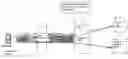
In FIG. 1 the process sequence of an end-terminal-based routing decision in accordance with the state of the art is illustrated as an example.
In accordance with the state of the art the following procedure is customary:
-
- The terminal 3 is assigned an IP address and its own carrier/context 1, 2 for each stream of traffic to be differentiated. The destination network for the streams of traffic is in the process a parameter of a context and can be different for each context.
- The local access node 4 in the mobile network routs the traffic corresponding to the used carrier/context to the respective destination network 5, 6. For example traffic from carrier 1 is routed via a local access to the public Internet 5, traffic from carrier 2 is routed to an external access 6 e.g. to a private input server of a corporate network.
The following are to be named as disadvantages of the state of the art in accordance with today's approach:
-
- The terminal needs a separate context with specific IP address for each connection that goes to a separate network.
- The routing decision must be made already in the terminal.
- The complexity in the terminal is correspondingly high. If now the same application is to be executed on both connections, there can be conflicts.
- The mobile network has only limited control over the routing decision of the individual packets. In the best case it can decide whether a packet on the context used by the terminal is permissible.
Proceeding from this state of the art the invention is based on the object of specifying a new method with new rules and filter criteria for routing and filtering of streams of traffic in IP networks, in particular in mobile networks and a computer program for the carrying out of the new rules and filter criteria, in order to overcome the disadvantages of the state of the art.
This problem is solved by the method claimed in Claim 1. This method is characterized by the fact that a plurality of streams of traffic to be transmitted is routed in such a way that they are transmitted in one carrier/context.
The transmission of the streams of traffic takes place in the process regardless of whether they must be differentiated with regard to destination network and/or QoS. The transmission in one carrier/context takes place in particular on the air interface from the terminal to a network access node.
In addition in accordance with the invention it is proposed that the local network access nodes of the network routs the streams of traffic with the help of rules and filter criteria to the correct destination. Rules (Policy) and filter criteria can be statically or dynamically configured in the respective network or by another network.
Advantageous embodiments of the invention are specified in the dependent claims.
The above named problem is furthermore solved by a computer program with a program code for the carrying out of the claimed method. The advantages of this solution correspond to the advantages named above with regard to the claimed method.
The advantages of the invention are, enumerated in abbreviated form, the following:
-
- Full (flexible) network control in the case of routing decisions, based on configured rules (Policy) & filter criteria
- The terminal is assigned only one IP address
- Unnecessary complexity in the terminal is prevented. The terminal does not have to do any differentiation with regard to the destination network/routings; as a result the complexity in the terminal (hardware/software) is considerably lessened.
- The possibility that the terminal cooperates or expresses its preferences in the decision about the QoS (quality of service) and/or destination network and/or routing is still given.
- The method works uniformly both on networks with the possibility of several contexts per terminal (e.g. GPRS) as well as also on networks which do not support multiple contexts per terminal (e.g. WLAN).
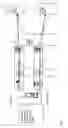
The invention is schematically represented in FIG. 2 and will be described in the following:
Proceeding from the terminal 3 (peer node) in contrast to conventional methods in accordance with FIG. 1 only a single IP address is used in order to be able to transmit different data to the IP network. The data stream consisting of several different streams of traffic is conducted in one single context/carrier 7 to a local access node 4. There, with the help of posted rules and filter criteria, which are for example stored in a memory device, a targeted delivery takes place for specific parts of the data stream to one of if necessary several network nodes of a first network 5. Other parts of the data stream are, on the basis of the posted rules and criteria, also guided to external access nodes 6.
The rules and criteria posted on the network for the routing of the individual streams of traffic can comprise:
- Information in the IP header
- Information in the application header
- Criteria for QoS handling
- The data contents (user data)
- Protocols used
In principle the number of destination networks in accordance with the invention is not limited.
In closing let it be pointed out that all of the individual aspects of the invention disclosed in the description—to the extent that they are useful—can also be combined with one another, even beyond the examples.
Claims
1. A method for routing streams of traffic in IP networks or in mobile IP networks, characterized in that a plurality of streams of traffic to be transmitted are routed in such a way that they are transmitted in one carrier or context (7), wherein several streams of traffic for different destination networks (5; 6) and/or demands on transmission quality for the respective stream of traffic Quality of Service: QoS are merged and are transmitted from a terminal (3) via one carrier/context (7) to a network access node (4) of the IP network.via a carrier or context (7), wherein the transmission of the streams of traffic takes place regardless of whether they must be distinguished with regard to destination network and/or QoS.
2. The method according to claim 1, characterized in that the transmission of the streams of traffic from the terminal (3) to the network access nodes (4) takes place via an air interface.
3. The method according to claim 2, characterized in that rules and filter criteria for statically or dynamically controlling a local network access node (4) of the IP network are configured by its own network or by another network.
4. The method according to claim 3, characterized in that the rules and filter criteria for controlling a local network access node (4) are stored in the access network node.
5. The method according to claim 4, characterized in that the number of the streams of traffic routed together is not limited.
6. A computer program for the carrying out of the method according to claim 1.
7. The method according to claim 1, characterized in that rules and filter criteria for statically or dynamically controlling a local network access node (4) of the IP network are configured by its own network or by another network.
8. The method according to claim 3, characterized in that the rules and filter criteria for controlling a local network access node (4) are stored in the access network node.
9. The method according to claim 1, characterized in that the number of the streams of traffic routed together is not limited.
10. The method according to claim 2, characterized in that the number of the streams of traffic routed together is not limited.
11. The method according to claim 3, characterized in that the number of the streams of traffic routed together is not limited.
12. A computer program for the carrying out of the method according to claim 2.
13. A computer program for the carrying out of the method according to claim 3.
14. A computer program for the carrying out of the method according to claim 4.
15. A computer program for the carrying out of the method according to claim 5.
Images & Drawings included:

Sources:
- United States Patent and Trademark Office - verify current appl. status at the USPTO↗
Recent applications in this class:
- » 20250287286 2025-09-11
COMMUNICATION DEVICE AND METHOD FOR SWITCHING RADIO SCHEMES BASED ON USER PREFERENCE - » 20250287285 2025-09-11
REDUNDANT WIDE AREA NETWORK (WAN) AND REDUNDANT LOCAL LOAD BALANCING MANAGEMENT CONTROLLER ELECTRIC VEHICLE (EV) CHARGING SYSTEM - » 20250280349 2025-09-04
TRANSCEIVER DEVICE AND OPERATION METHOD OF WIRELESS COMMUNICATION NETWORK - » 20250274838 2025-08-28
CONNECTIONLESS MOBILITY MANAGEMENT FOR HYBRID NETWORKS USING RELATIVISTIC ROUTING PROTOCOL - » 20250267548 2025-08-21
COMMUNICATION SYSTEM AND METHOD FOR OPERATING A 5G MESH NETWORK FOR SERVICE CONTINUITY - » 20250267547 2025-08-21
COMMUNICATION METHOD AND COMMUNICATION APPARATUS - » 20250267546 2025-08-21
WIRELESS COMMUNICATION USING MULTIPLE FREQUENCIES SEGMENTS - » 20250267545 2025-08-21
INFORMATION PROCESSING DEVICE - » 20250261080 2025-08-14
MULTI-PATH CONFIGURATION METHOD, APPARATUS, AND SYSTEM - » 20250254598 2025-08-07
METHODS, DEVICES, AND COMPUTER READABLE MEDIUM FOR COMMUNICATION
Recent applications for this Assignee:
- » 20110075660 2011-03-31
DYNAMIC NETWORK SELECTION - » 20110026515 2011-02-03
Communication network with line-and packet-switching control - » 20110014931 2011-01-20
METHOD FOR DELIVERING A SHORT MESSAGE IN A MOBILE COMMUNICATIONS SYSTEM - » 20100313160 2010-12-09
Virtual keyboard of a mobile terminal - » 20100306386 2010-12-02
Parameterizable selection of a communication system on the basis of name resolution mechanisms - » 20100303010 2010-12-02
CIRCUIT-SWITCHED CALL CONTROL VIA AN IP USER CHANNEL CONNECTION IN THE ACCESS NETWORK - » 20100299755 2010-11-25
ANTI-VIRUS/SPAM METHOD IN MOBILE RADIO NETWORKS - » 20100296729 2010-11-25
Method for image analysis, especially for mobile stations - » 20100281120 2010-11-04
Method for transmitting messages using the multimedia message service (MMS) - » 20100268590 2010-10-21
Method for real-time credit calculation of different loyalty programs based on call behavior and use of IP-based multimedia subsystem (IMS) services