Computer-aided method for a cost-optimized calculation of aerodynamic forces on an aircraft
US20100106471A1
2010-04-29
12/348,053
2009-01-02
✅ Patent granted
US 8,041,547 B2
2011-10-18
-
-
Russell W Frejd
2029-12-06
Abstract:
A computer-aided method suitable for assisting in the design of an aircraft by providing the values of dimensional variables, dependant of a predefined set of parameters, for the complete aircraft or an aircraft component, comprising the following steps: a) Defining a parametric space grid; b) Obtaining a suitable Reduced Order Model (ROM) model, particularly a Proper Orthogonal Decomposition (POD) model, for calculating said variables for whatever point over the parametric space through an iterative process. Computer Fluid Dynamics (CFD) is used to calculate said variables for an appropriately selected set of points over the parametric space, which are used to approximate, via ROM and ad hoc interpolation, the variables in any other point over the parametric space. The method minimizes the required number of CFD calculations (to minimize the computational cost, which dramatically depends on this number) for a given level of error.
Inventors:
- Angel Gerardo VELAZQUEZ LOPEZ 5 🇪🇸 Madrid, Spain
- Jose Manuel Vega De Prada 4 🇪🇸 Madrid, Spain
- Luis Santiago Lorente Manzanares 4 🇪🇸 Madrid, Spain
- Diego Alonso Fernandez 2 🇪🇸 Burgos, Spain
Assignee:
- UNIVERSIDAD POLITECNICA DE MADRID 60 🇪🇸 Madrid, Spain
- Airbus Espana, S. L. 3 🇪🇸 Madrid, Spain
Interested in similar patents?
Get notified when new applications in this technology area are published.
Classification:
G06F17/10 IPC
Digital computing or data processing equipment or methods, specially adapted for specific functions Complex mathematical operations
G06F30/15 » CPC main
Computer-aided design [CAD]; Geometric CAD Vehicle, aircraft or watercraft design
G06F2111/06 » CPC further
Details relating to CAD techniques Multi-objective optimisation, e.g. Pareto optimisation using simulated annealing [SA], ant colony algorithms or genetic algorithms [GA]
Y02T90/00 » CPC further
Enabling technologies or technologies with a potential or indirect contribution to GHG emissions mitigation
Y02T90/00 » CPC further
Enabling technologies or technologies with a potential or indirect contribution to GHG emissions mitigation
G06G7/57 IPC
Devices in which the computing operation is performed by varying electric or magnetic quantities; Analogue computers for specific processes, systems or devices, e.g. simulators for fluid flow ; for distribution networks
Description
FIELD OF THE INVENTION
The present invention refers to methods for assisting in the design of aircrafts by making cost-optimized calculations of the aerodynamic forces experimented by the complete aircraft or an aircraft component.
BACKGROUND OF THE INVENTION
A common situation in practical industrial applications related to product development is the need to perform many surveys inside a space of state parameters. In the specific case of aeronautics, the calculation of the aerodynamic forces experimented by aircraft components is an important feature, in order to optimally design its structural components so that the weight of the structure is the minimum possible, but at the same time being able to withstand the expected aerodynamic forces.
Thanks to the increase of the use of the Computer Fluid Simulation Capability, nowadays, the determination of the aerodynamic forces on an aircraft is commonly done by solving numerically the Reynolds Averaged Navier-Stokes equations (RANS equations from now onwards) that model the movement of the flow around the aircraft, using discrete finite elements or finite volume models. With the demand of accuracy posed in the aeronautical industry, each one of these computations requires important computational resources.
The dimensioning aerodynamic forces are not known a priori, and since the global magnitude of the forces may depend on many different flight parameters, like angle of attack, angle of sideslip, Mach number, control surface deflection angle, it has been necessary to perform many lengthy and costly computations to properly calculate the maximum aerodynamic forces experimented by the different aircraft components or the complete aircraft.
In order to reduce the overall number of these lengthy computations, approximate mathematical modelling techniques for obtaining a Reduced Order Model (ROM) have been developed in the past, like Single Value Decomposition (SVD) as a mean to perform intelligent interpolation, or the more accurate Proper Orthogonal Decomposition (POD from now onwards) that takes into account the physics of the problem by using a Galerkin projection of the Navier-Stokes equations.
The idea of these techniques is to define the new analytical solution as a combination of the information obtained before. POD defines several modes that include the solution obtained by Computational Fluid Dynamics (CFD) and then uses those modes to reproduce solutions not obtained by CFD. The application of this techniques may require many CFD calculations involving a large computational cost.
The present invention is intended to solve this drawback.
SUMMARY OF THE INVENTION
It is an object of the present invention to provide methods for making analytical calculations of the aerodynamic forces experimented by a complete aircraft or an aircraft component which are dependant of a significant number of parameter, minimizing the computational costs.
It is another object of the present invention to provide methods for making analytical calculations of the aerodynamic forces experimented by a complete aircraft or an aircraft component which are dependant of a significant number of parameters, minimizing the number of CFD computations.
These and other objects are met by a computer-aided method suitable for assisting in the design of an aircraft by providing the values of one or more dimensional variables, such as the pressure distribution along a wing surface, for the complete aircraft or an aircraft component, being said one or more variables dependant of a predefined set of parameters, such as a set including the angle of attack and the Mach number, comprising the following steps:
-
- Defining a parametric space grid setting predetermined distances between its values.
- Obtaining a suitable model for calculating said one or more dimensional variables for whatever point over the parametric space through an iterative process with respect to a reduced group of points, of increasing number of members in each iteration, comprising the following sub-steps:
- Calculating the values of said one or more dimensional variables for an initial group of points using a CFD model.
- Obtaining an initial ROM model from said CFD computations and calculating the values of said one or more dimensional variables for said initial group of points using the initial ROM model.
- Selecting the e-point of the group with the largest deviation ε between the results provided by the CFD and the ROM models and finishing the iterative process if ε is lesser than a predefined value ε0.
- Selecting new points over the parametric space to be added to the group of points as those points placed inside the parametric space grid at a predefined distance from said e-point.
- Calculating the values of said one or more dimensional variables for the new points using the CFD and the ROM model and going back to the third sub-step.
In particular, said one or more dimensional variables includes one or more of the following: aerodynamic forces, skin values and values distribution around the complete aircraft or aircraft component; said set parameters includes one or more of the following: angle of attack and Mach number; and said aircraft component is one of the following: a wing, an horizontal tail plane, a vertical tail plane.
In a preferred embodiment, said complete aircraft or an aircraft component is divided into blocks and said CFD and ROM models are applied block by block. Hereby an accurate method for providing the values of one or more dimensional variables of an aircraft or an aircraft component is achieved.
In another preferred embodiment said ROM model is a POD model. CFD is used to calculate the pressure distributions for an appropriately selected set of points over the parametric space, which are used to approximate, via POD and ad hoc interpolation, the dimensional variables in any other point over the parametric space. In addition, the method minimizes the required number of CFD calculations (to minimize the computational cost, which dramatically depends on this number) for a given level of error. This is made using POD and interpolation on the already calculated points. New points are selected iteratively, either one by one or in groups. Hereby a method for providing the values of one or more dimensional variables of an aircraft or an aircraft component dependant of a predefined set of parameters, optimizing the computing costs, is achieved.
Other characteristics and advantages of the present invention will be clear from the following detailed description of embodiments illustrative of its object in relation to the attached figures.
DESCRIPTION OF THE DRAWINGS
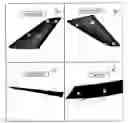
FIG. 1 shows views of the suction side, the pressure side, the leading edge and the tip of an aircraft wing divided in blocks.
FIG. 2 shows a graphic representation of a local sub-grid in the parametric space grid for selecting new points to be added to the group of points used for obtaining the POD model according to this invention.
DETAILED DESCRIPTION OF THE INVENTION
An embodiment of a method according to the present invention will now be described for obtaining a POD model that allows calculating the steady pressure distribution over the surface of the wing of an aircraft, being said pressure distribution dependant of two free parameters: angle of attack (a) and Mach number (M).
Initiation Steps:
Step 1: Division of the wing into several blocks according to the geometry of the object. CFD tools usually divide the 3D computational domain into blocks, as illustrated in FIG. 1 showing the wing divided into 16 main blocks. This is a convenient but non-essential part of the method, which can be applied with just one block.
Step 2: A definition of a parametric space grid is carried out by setting an initial value of the minimal distance in each parameter in the parametric space, dl, l=1, . . . , parameter #, which comes from a first guess of the smallest distance between points in the parametric space in the subsequent steps and could need some calibration. Such distance will be reduced by the method during the iteration, if needed. Then an equispaced grid is defined in parametric space based on these distances. Such grid will evolve during the process and can become non-equispaced.
For instance, if angle of attack (α), in the range −3° to +3°, and Mach number (M), in the range 0.40 to 0.80, are the parameters being considered, the parametric space grid can be defined setting the distances dα=0.5 and dM=0.05.
Step 3: Initiation of the process for an initial group of points over the parametric space selected by the user, such as the following
| Initial | ||
| Group | Mach | Alpha |
| P1 | 0.400 | −3.00 |
| P2 | 0.600 | −3.00 |
| P3 | 0.800 | −3.00 |
| P4 | 0.400 | 0.00 |
| P5 | 0.600 | 0.00 |
| P6 | 0.800 | 0.00 |
| P7 | 0.400 | 3.00 |
| P8 | 0.600 | 3.00 |
| P9 | 0.800 | 3.00 |
Introduction of the New Group of Points
Step 4: Application, block by block, of POD to the initial group of points. A block-dependent set of modes is obtained for each block:
P ( x i _ ; α j , M k ) = P ijk → POD P ijk = ∑ p A p ( α j , M k ) φ ip ,
where P is the pressure distribution, xi are the spatial coordinates, α is the angle of attack, M is the Mach number, Ap are the mode amplitudes, and the columns of the matrix φip are the POD modes. Each mode has an associated singular value, which results from application of POD.
Step 5: Classification of modes:
-
- A first classification (in each block) of the modes into two parts is as follows: (a) those modes yielding a RMSE smaller than some threshold value ε1 (depending on ε0, after some calibration) are neglected; (b) the n1 retained modes are called main modes.
- Main modes, in turn, are classified into two groups, namely n primary modes and n1−n secondary modes with, with n obtained after some calibration, say
n = 4 5 n 1 , .
The root mean squared error (RMSE), is defined as
RMSE = ∑ i = 1 N p error i 2 N p ,
where Np is the total number of points of the mesh that defines the wing, and errori is the difference between the pressure of the approximation and the pressure of the CFD solution at i-th the point of the mesh.
Step 6: POD reconstruction of the pressure distribution for each of the already computed group of points using the (n) main primary modes in each block. Then each point is further approximated using the neighboring points via least squares.
Step 7: Comparison between the CFD calculated and the POD+interpolation-approximated pressure profiles, and estimation of the RMSE in each block, for each already computed points.
The RMSE for the above-mentioned initial group of nine points is the following:
| RMSE | |
| P1 | 0.0371 | |
| P2 | 0.0298 | |
| P3 | 0.0887 | |
| P4 | 0.0273 | |
| P5 | 0.0190 | |
| P6 | 0.0756 | |
| P7 | 0.0605 | |
| P8 | 0.0930 | |
| P9 | 0.1758 | |
Step 8: Selection of the point with largest RMSE.
As shown in the above table in the first iteration this point is P9.
Step 9: Definition, as shown in FIG. 2, of a local sub-grid of the total parametric space grid in the vicinity of the point 21 of maximum error. Such local sub-grid consists of three levels, at distances dl (first level), 2·dl (second level) and 4·dl (third level).
Step 10: Selection of the level in which the new point will be introduced. If there are some points in between of two levels (see below), they are considered to belong to the inner level.
-
- If no points are present in the whole sub-grid, then the new point is introduced in the third level.
- If only the third level exhibits points, then the new point is introduced in the second level.
- If there are no points in the first level and there is only one point in the second level, the new point is introduced in the second level.
- If there are no points in the first level and there are at least two points in the second level, the new point is introduced in the first level.
- If at least one point is present in the first level, then the new point is introduced in the first level with one exception that leads to the introduction of a sub-level in the local grid. This occurs when (a) at least five points are present in the first level, and (b) at least four of these show the largest RMSE among all points in the three levels. In that case, the distances in the local sub-grid are divided by two and step 9 is repeated again with the resulting new subgrid. Note that this step means that each point will generally have a different set of minimal distances dl.
In the example being considered, the new point P10 will be introduced in the third level because none of the points of the initial group is present in the whole sub-grid in the vicinity of P9.
Step 11: Once the target level has been chosen, the most space-filling point in this level is selected as follows. The minimum distance, D, from each possible candidate to the remaining, already selected points is computed. That candidate that shows the largest value of D is selected. D is the distance in the parametric space. In this example, the distance between two points of the parametric space (labeled 1 and 2) is defined as follows:
D12=√{square root over (α122+M122)}
where
α 12 = α 2 - α 1 Δ α and M 12 = M 2 - M 1 Δ M
are the distances in the parameters α and M, and Δα and ΔM are the corresponding total ranges in these parameters.
In the example being considered the distance between third level points and the closest point belonging to the group is shown in the following table.
| Third level | Closest point | |||
| points | of the group |
| Mach | Alpha | Mach | Alpha | Distance |
| 0.650 | 3.00 | 0.600 | 3.00 | 0.1250 |
| 0.650 | 2.50 | 0.600 | 3.00 | 0.1502 |
| 0.650 | 2.00 | 0.600 | 3.00 | 0.2083 |
| 0.650 | 1.50 | 0.600 | 0.0 | 0.2795 |
| 0.700 | 1.50 | 0.600 | 0.0 | 0.3536 |
| 0.750 | 1.50 | 0.800 | 0.0 | 0.2795 |
| 0.800 | 1.50 | 0.800 | 0.0 | 0.2500 |
Therefore the new point to be introduced is P10: Mach=0.700, Alpha=1.50.
Step 12: If more than one point is introduced in each iteration, then the process is repeated from step 8 with the already selected points excluded.
Update of the Set of Modes:
Once the new point (or group of points) has been computed, the set of modes for each block is updated.
Step 13: Application of POD to the group of points, ignoring those modes that show a RMSE smaller than ε1.
Step 14: Computation of some pseudo-points, defined block by block, which consists of two groups:
-
- The n1 main modes of each block, multiplied by their respective singular values.
- The POD modes obtained upon application of POD to the new points resulting from last iteration, multiplied by their respective singular values.
Steps 13 and 14 may be collapsed into just only one step. In this case pseudo-points are defined adding together the main modes of the already computed points, multiplied by their respective singular values, and the new points. Division into steps 13 and 14, as above, is made to filter out numerical errors from the process, which is a well known benefit of the POD method.
Step 15: Application of POD to the set of all pseudo-points, block by block.
Step 16: Repetition of the process from step 5.
To illustrate this iterative process a brief description of the second iteration in the example being considered follows:
The RMSE for the group of then points in the second iteration is the following:
| RMSE | |
| P1 | 0.0313 | |
| P2 | 0.0242 | |
| P3 | 0.0723 | |
| P4 | 0.0275 | |
| P5 | 0.0167 | |
| P6 | 0.0569 | |
| P7 | 0.0853 | |
| P8 | 0.0458 | |
| P9 | 0.1421 | |
| P10 | 0.0260 | |
El maximum error point is still P9 and the new point P11 will be introduced in the second level because there is not any point in the group in levels 1 and 2 and there is a point in level 3 (P10 introduced in the first iteration).
The distance between second level points and the closest point belonging to the group is shown in the following table:
| Second level | Closest point | |||
| points | of the group |
| Mach | Alpha | Mach | Alpha | Distance |
| 0.700 | 3.00 | 0.800 | 3.00 | 0.2500 |
| 0.700 | 2.50 | 0.700 | 1.50 | 0.1667 |
| 0.700 | 2.00 | 0.700 | 1.50 | 0.0833 |
| 0.750 | 2.00 | 0.700 | 1.50 | 0.1502 |
| 0.750 | 2.00 | 0.800 | 3.00 | 0.1662 |
Therefore the new point to be introduced is P11: Mach=0.700, Alpha=2.50.
Stop Criteria:
Step 17: The process is completed when the RMSE, computed in step 7 using POD and both linear and a quadratic least squares interpolation, are both smaller than ε0.
Results
In the execution of the method in the example being considered the initial group of points over the parametric space was, as said before, the following:
| Mach | Alpha | |
| P1 | 0.400 | −3.00 |
| P2 | 0.600 | −3.00 |
| P3 | 0.800 | −3.00 |
| P4 | 0.400 | 0.00 |
| P5 | 0.600 | 0.00 |
| P6 | 0.800 | 0.00 |
| P7 | 0.400 | 3.00 |
| P8 | 0.600 | 3.00 |
| P9 | 0.800 | 3.00 |
Along the iteration process, the following points were added to the group:
| P10 | 0.700 | 1.50 | |
| P11 | 0.700 | 2.50 | |
| P12 | 0.800 | 2.00 | |
| P13 | 0.500 | 1.50 | |
| P14 | 0.750 | 2.50 | |
| P15 | 0.400 | 2.00 | |
| P16 | 0.700 | −1.00 | |
| P17 | 0.750 | 1.50 | |
| P18 | 0.750 | 3.00 | |
| P19 | 0.800 | −1.50 | |
| P20 | 0.500 | 2.50 | |
| P21 | 0.800 | 2.50 | |
| P22 | 0.800 | 1.50 | |
| P23 | 0.700 | 0.50 | |
| P24 | 0.750 | 1.00 | |
| P25 | 0.700 | 3.00 | |
| P26 | 0.750 | 2.00 | |
| P27 | 0.450 | 2.50 | |
| P28 | 0.800 | 1.00 | |
| P29 | 0.450 | 3.00 | |
| P30 | 0.750 | −0.50 | |
An evaluation of the model obtained according to the method of this invention can be done comparing the results obtained in 16 test points using said model in several iterations with the results obtained using the CFD model that are shown in the following tables:
| Invention Model Results |
| Test | 10 | 15 | 20 | 25 | 30 | |||
| Point | Mach | Alpha | CFD | Points | Points | Points | Points | Points |
| Lift Coefficient |
| Tp1 | 0.800 | 2.25 | 0.1965 | 0.1922 | 0.1966 | 0.1965 | 0.1971 | 0.1966 |
| Tp2 | 0.800 | 1.25 | 0.1045 | 0.1061 | 0.1082 | 0.1075 | 0.1054 | 0.1058 |
| Tp3 | 0.800 | −1.25 | −0.1077 | −0.1089 | −0.1085 | −0.1073 | −0.1082 | −0.1088 |
| Tp4 | 0.800 | −2.25 | −0.1920 | −0.1871 | −0.1925 | −0.1927 | −0.1928 | −0.1936 |
| Tp5 | 0.775 | 2.25 | 0.1895 | 0.1899 | 0.1899 | 0.1903 | 0.1910 | 0.1900 |
| Tp6 | 0.775 | 1.25 | 0.1012 | 0.1036 | 0.1051 | 0.1031 | 0.1023 | 0.1018 |
| Tp7 | 0.775 | −1.25 | −0.1048 | −0.1018 | −0.1121 | −0.1057 | −0.1066 | −0.1068 |
| Tp8 | 0.775 | −2.25 | −0.1867 | −0.1853 | −0.1884 | −0.1908 | −0.1912 | −0.1916 |
| Tp9 | 0.725 | 2.25 | 0.1773 | 0.1849 | 0.1778 | 0.1788 | 0.1777 | 0.1774 |
| Tp10 | 0.725 | 1.25 | 0.0966 | 0.0971 | 0.0980 | 0.0965 | 0.0970 | 0.0970 |
| Tp11 | 0.725 | −1.25 | −0.1002 | −0.0962 | −0.1078 | −0.1022 | −0.1029 | −0.1022 |
| Tp12 | 0.725 | −2.25 | −0.1785 | −0.1812 | −0.1816 | −0.1829 | −0.1867 | −0.1864 |
| Tp13 | 0.525 | 2.25 | 0.1577 | 0.1565 | 0.1267 | 0.1563 | 0.1561 | 0.1585 |
| Tp14 | 0.525 | 1.25 | 0.0868 | 0.0722 | 0.0845 | 0.0847 | 0.0873 | 0.0854 |
| Tp15 | 0.525 | −1.25 | −0.0897 | −0.0749 | −0.0960 | −0.0786 | −0.0964 | −0.1084 |
| Tp16 | 0.525 | −2.25 | −0.1600 | −0.1580 | −0.1598 | −0.1196 | −0.1199 | −0.1197 |
| X Momentum Coefficient |
| Tp1 | 0.800 | 2.25 | +0.2062 | 0.1979 | 0.2054 | 0.2054 | 0.2068 | 0.2061 |
| Tp2 | 0.800 | 1.25 | +0.1109 | 0.1124 | 0.1181 | 0.1174 | 0.1128 | 0.1127 |
| Tp3 | 0.800 | −1.25 | −0.1018 | −0.1023 | −0.1024 | −0.1010 | −0.1016 | −0.1022 |
| Tp4 | 0.800 | −2.25 | −0.1866 | −0.1810 | −0.1867 | −0.1866 | −0.1866 | −0.1870 |
| Tp5 | 0.775 | 2.25 | +0.1991 | 0.1957 | 0.1984 | 0.1992 | 0.2010 | 0.1995 |
| Tp6 | 0.775 | 1.25 | +0.1078 | 0.1102 | 0.1140 | 0.1117 | 0.1090 | 0.1085 |
| Tp7 | 0.775 | −1.25 | −0.0987 | −0.0953 | −0.1067 | −0.0993 | −0.0999 | −0.1000 |
| Tp8 | 0.775 | −2.25 | −0.1812 | −0.1790 | −0.1824 | −0.1846 | −0.1848 | −0.1850 |
| Tp9 | 0.725 | 2.25 | +0.1849 | 0.1910 | 0.1858 | 0.1875 | 0.1853 | 0.1849 |
| Tp10 | 0.725 | 1.25 | +0.1036 | 0.1041 | 0.1060 | 0.1029 | 0.1036 | 0.1037 |
| Tp11 | 0.725 | −1.25 | −0.0939 | −0.0894 | −0.1018 | −0.0955 | −0.0959 | −0.0954 |
| Tp12 | 0.725 | −2.25 | −0.1728 | −0.1746 | −0.1749 | −0.1760 | −0.1798 | −0.1796 |
| Tp13 | 0.525 | 2.25 | +0.1654 | 0.1644 | 0.1279 | 0.1637 | 0.1637 | 0.1658 |
| Tp14 | 0.525 | 1.25 | +0.0943 | 0.0809 | 0.0926 | 0.0928 | 0.0953 | 0.0933 |
| Tp15 | 0.525 | −1.25 | −0.0827 | −0.0668 | −0.0879 | −0.0704 | −0.0879 | −0.1001 |
| Tp16 | 0.525 | −2.25 | −0.1534 | −0.1499 | −0.1514 | −0.1100 | −0.1100 | −0.1096 |
| Y Momentum Coefficient |
| Tp1 | 0.800 | 2.25 | −0.1068 | −0.1044 | −0.1076 | −0.1074 | −0.1081 | −0.1076 |
| Tp2 | 0.800 | 1.25 | −0.0345 | −0.0377 | −0.0392 | −0.0387 | −0.0361 | −0.0363 |
| Tp3 | 0.800 | −1.25 | +0.1270 | 0.1278 | 0.1279 | 0.1266 | 0.1273 | 0.1278 |
| Tp4 | 0.800 | −2.25 | +0.1914 | 0.1877 | 0.1921 | 0.1921 | 0.1923 | 0.1928 |
| Tp5 | 0.775 | 2.25 | −0.1036 | −0.1036 | −0.1038 | −0.1044 | −0.1054 | −0.1043 |
| Tp6 | 0.775 | 1.25 | −0.0340 | −0.0374 | −0.0384 | −0.0367 | −0.0351 | −0.0347 |
| Tp7 | 0.775 | −1.25 | +0.1232 | 0.1215 | 0.1295 | 0.1241 | 0.1247 | 0.1248 |
| Tp8 | 0.775 | −2.25 | +0.1858 | 0.1853 | 0.1878 | 0.1892 | 0.1896 | 0.1898 |
| Tp9 | 0.725 | 2.25 | −0.0960 | −0.1017 | −0.0970 | −0.0982 | −0.0967 | −0.0965 |
| Tp10 | 0.725 | 1.25 | −0.0335 | −0.0344 | −0.0356 | −0.0337 | −0.0338 | −0.0338 |
| Tp11 | 0.725 | −1.25 | +0.1171 | 0.1151 | 0.1241 | 0.1188 | 0.1193 | 0.1188 |
| Tp12 | 0.725 | −2.25 | +0.1770 | 0.1800 | 0.1805 | 0.1807 | 0.1833 | 0.1831 |
| Tp13 | 0.525 | 2.25 | −0.0868 | −0.0877 | −0.0618 | −0.0849 | −0.0847 | −0.0867 |
| Tp14 | 0.525 | 1.25 | −0.0321 | −0.0233 | −0.0302 | −0.0302 | −0.0321 | −0.0307 |
| Tp15 | 0.525 | −1.25 | +0.1029 | 0.0911 | 0.1067 | 0.0924 | 0.1078 | 0.1172 |
| Tp16 | 0.525 | −2.25 | +0.1564 | 0.1542 | 0.1548 | 0.1219 | 0.1221 | 0.1218 |
Modifications may be introduced into the preferred embodiment just set forth, which are comprised within the scope defined by the following claims.
Claims
1. A computer-aided method suitable for assisting in the design of an aircraft by providing the values of one or more dimensional variables for the complete aircraft or an aircraft component, being said one or more variables dependant of a predefined set of parameters, characterized by comprising the following steps:
a) Defining a parametric space grid setting predetermined distances between its values;
b) Obtaining a suitable model for calculating said one or more dimensional variables for whatever point over the parametric space through an iterative process with respect to a reduced group of points, of increasing number of members in each iteration, comprising the following sub-steps:
b1) Calculating the values of said one or more dimensional variables for an initial group of points using a CFD model;
b2) Obtaining an initial ROM model from said CFD computations and calculating the values of said one or more dimensional variables for said initial group of points using the initial ROM model;
b3) Selecting the e-point of the group with the largest deviation ε between the results provided by the CFD and the ROM models and finishing the iterative process if ε is lesser than a predefined value ε0;
b4) Selecting new points over the parametric space to be added to the group of points as those points placed inside the parametric space grid at a predefined distance from said e-point;
b5) Calculating the values of said one or more dimensional variables for the new points using the CFD and the ROM model and going back to sub-step b3).
2. A computer-aided method according to claim 1, characterized in that said complete aircraft or an aircraft component is divided into blocks and said CFD and ROM models are applied block by block.
3. A computer-aided method according to claim 1, characterized in that said one or more dimensional variables includes one or more of the following: aerodynamic forces, skin values, values distribution around the complete aircraft or aircraft component.
4. A computer-aided method according to claim 1, characterized in that said set parameters includes one or more of the following: angle of attack, Mach number.
5. A computer-aided method according to claim 1, characterized in that said aircraft component is one of the following: a wing, an horizontal tail plane, a vertical tail plane.
6. A computer-aided method according to claim 1, characterized in that said ROM model is a POD model.
7. A computer-aided method according to claim 6, characterized in that the deviation ε between the results provided by the CFD and the POD models is obtained as the root mean square error between said results.
8. A computer-aided method according to claim 6, characterized in that the POD model is obtained eliminating the less relevant modes of the group of points.
Images & Drawings included:




Sources:
- United States Patent and Trademark Office - verify current appl. status at the USPTO↗
Recent applications in this class:
- » 20250291964 2025-09-18
SYSTEM AND METHOD FOR GENERATING A PRELIMINARY DESIGN OF A STRUCTURAL ARCHITECTURE FOR AN AIRCRAFT PROPULSION SYSTEM - » 20250284856 2025-09-11
GENERALIZABLE END-TO-END AUTONOMOUS DRIVING WITH MULTI-MODAL FOUNDATION MODELS - » 20250278531 2025-09-04
TOOLING MODEL CREATION DEVICE, TOOLING MODEL CREATION METHOD, AND PROGRAM - » 20250278530 2025-09-04
SYSTEMS AND METHODS FOR ACQUIRING DATA OF AIRCRAFT COMPONENTS - » 20250272449 2025-08-28
COMPUTER-IMPLEMENTED METHOD FOR GENERATING A MODIFICATION SUGGESTION AND CORRESPONDING DATA PROCESSING DEVICE - » 20250272448 2025-08-28
METHOD FOR SYNCHRONIZED SOFTWARE-IN-THE-LOOP (SIL) SIMULATION OF MULTI-COMPONENT SIMULATION MODELS - » 20250272447 2025-08-28
TRAINING SET GENERATION METHOD AND ELECTRONIC DEVICE - » 20250265378 2025-08-21
REAL-TIME DIGITAL TWIN FOR AIRCRAFT-BASED INTEGRATED DRIVE GENERATOR - » 20250252226 2025-08-07
METHOD FOR MANUFACTURING SEAT FOR MEASURING STANDARD DRIVING POSTURE OF HUMAN BODY - » 20250238567 2025-07-24
SYSTEMS, APPARATUSES, METHODS, AND COMPUTER PROGRAM PRODUCTS FOR INITIATING PERFORMANCE OF ONE OR MORE INCIDENT RESPONSE ACTIONS
Recent applications for this Assignee:
- » 20240277243 2024-08-22
SYSTEMS, DEVICES AND METHODS FOR NON-INVASIVE HEMATOLOGICAL MEASUREMENTS - » 20230355171 2023-11-09
CLOSED-LOOP DRUG INFUSION SYSTEM WITH SYNERGIC CONTROL - » 20220254024 2022-08-11
Systems, devices and methods for non-invasive hematological measurements - » 20220056871 2022-02-24
Power device based on alkali-water reaction - » 20220050355 2022-02-17
Configurable optical device - » 20220008875 2022-01-13
Method and system for the treatment of materials - » 20210379845 2021-12-09
Machine for adapting a fibre structure to a mould for manufacturing parts of composite material - » 20210032102 2021-02-04
Process and device for direct thermal decomposition of hydrocarbons with liquid metal in the absence of oxygen for the production of hydrogen and carbon - » 20200132633 2020-04-30
Method for operation of resonator - » 20190197854 2019-06-27
Inductive system for data transmission/reception by means of locking the generation of harmonics on a ferromagnetic core