MANUALLY ROTATABLE MACHINE FOR ORDER PROCESSING
US20100133044A1
2010-06-03
12/452,132
2008-06-10
Abstract:
Manually rotatable machine, comprising a fixed base (1) and a rotor (2) assembled on it and characterised by a plurality of arms (3) arranged to form rays. Present on each of said arms is at least one numbered hook (9), for fixing the orders as they are taken, as well as for requesting and serving the same following the same sequence they were gathered in. The operation of the mechanism in question is characterised in that the rotor can rotate on the fixed base following one direction of rotation, due to the arrangement, on said base, of a unidirectional automatic blocking system made up of spring bars (10) tilted towards the direction of rotation.
Interested in similar patents?
Get notified when new applications in this technology area are published.
Classification:
B42F23/00 » CPC main
Filing appliances not provided for in other groups of this subclass
A47F10/06 IPC
Furniture or installations specially adapted to particular types of service systems, not otherwise provided for for restaurant service systems
Description
An object of the present finding is a manually rotatable machine included in field of systems for managing, in chronological sequence, orders taken by the personnel in public premises, in particular in businesses serving and selling foods and/or drinks and the like.
Currently, orders in businesses serving and selling foods and drinks to the public are taken and served chronologically according to two main methods:
-
- manually, by using a series of supports or hooks arranged on one or more rows, fixed on which are papers bearing the orders taken by the personnel;
- through advanced electronic systems, most of which are subjects of patents. In particular worth mentioning are the following electronic systems: a system using a server connected to manual devices operating through an internet connection and based on the WiFi technology (WO 2008/001390); method for transmitting the orders through the Wireless system (WO 2005/036437); a system for taking and requesting orders chronologically through electronically operating stations which transmit the order to a central computer (WO 2007/127344); system for gathering orders on portable computers connected to a central computer through the wireless technology (WO 2003/054815); method for remote gathering of orders through a processors-based system (WO2001/016895). Following are other examples of methods for managing orders: system for gathering orders through several radio apparatus communicating through and sorted by a single computer (EP 1687934 (A1) Aug. 9, 2006); system for gathering orders by means of letters and numbers to which, in an electronic database, foods and drinks are associated operating through an electronic transmission system (WO2004/066052); system used in drive-restaurants by means of two radiotelephones, one of which is moveable and the other is located inside on a fixed counter (FR 2833099); system including a central unit connected to stations for gathering orders, provided with an identifier on each table and connected to a system located on the place where the orders are served. In this system, the identifier allows the identification of each client (FR 2562295).
The present finding is included among the mechanisms for gathering, requesting and serving orders manually, without the help of electronic devices but being equally accurate and quick. As a matter of fact, according to the state of art, on one side there are electronic systems which have the disadvantage of not being suitable (both due to the high cost and due to the greater complexity in terms of installation and use) for small businesses, while on the other hand are manual systems, which have the drawback of not guaranteeing the exact chronological subsequence of the orders. As a matter of fact, given that the traditional systems for gathering orders manually consist in fixing papers with the orders on a panel by means of hooks, once through with the hooks available in a row and once the first orders have been served there arises a disorderly situation in which it is no longer possible to tell the correct order of succession of the orders taken and the orders to be served.
These are the reasons that led to creating the present finding, which thus has the aim of overcoming the difficulties outlined above regarding the management of orders in a manual, simple and economical manner, but with utmost accuracy, ensuring their arrangement in sequence following the chronological sequence of transmission, as well as serving in the same order. As a matter of fact, the present finding provides for the assembly, on a fixed base, of a rotor characterised by a plurality of arms arranged in rays, each provided with at least one hook for fixing the orders as they are taken. Due to the assembly, on the fixed base, of a unidirectional blocking system, the device for gathering orders may rotate only towards one direction, in such a manner to guarantee taking the same orders following the correct chronological sequence.
In the same manner, also the serving of the orders shall follow an identical chronological/numerical sequence, eliminating the risk of losing the correct sequence.
A further advantage is given by the fact that, due to the rotation of the gathering body, a continuous gathering system is obtained, and thus adapted to potentially manage an indefinite number and an uninterrupted sequence of orders.
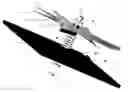
These and other advantages shall be clear from the detailed description of the invention, with particular reference to a preferred non-limiting embodiment shown in drawing 1/1.
Referring to the figure of the abovementioned drawing, the machine in question comprises a fixed base (1) which can be made in any shape and size and a rotor (2) for gathering orders, characterised by the presence of a plurality of arms (3) arranged to form rays. Present at the centre of the fixed base (1) is a hole (4) for mounting a pin, which due to a traditional system comprising screws (5), a bolt cover (6), nuts (7) and washers (8), assembles the fixed base (1) and the rotating body (2) allowing the rotation of the latter simultaneously. Present on each of said arms (3) is at least one numbered hook (9) for arranging the papers bearing the taken orders. In addition, the mechanism is characterised in that the gathering body (2) can rotate following only one direction of rotation, due to the arrangement, on the fixed base (1), of a unidirectional blocking device comprising spring bars (10) tilted towards the direction of rotation.
Therefore, the present finding allows gathering the orders following the chronological sequence of taking and serving the orders following the same succession. As a matter of fact, the orders are arranged one after the other on the numbered hooks (9) of the first arm (3) following the numerical sequence indicated. Once through with the insertion of the orders on an arm, the rotor (2) is rotated towards the only direction of rotation enabled, in such a manner that the other orders shall be fixed on the subsequent arm which shall have taken the place of the preceding one. Serving the orders shall follow the same chronological/numerical sequence, eliminating the risk of losing the correct sequence.
Claims
1. Manually rotatable machine, for managing the correct chronology of orders, comprising:
a fixed base (1);
a rotor (2) for gathering the orders, said rotor being assembled on the fixed base using elements which allow the rotation of the same, said rotor comprises a plurality of arms (3), each arm includes at least one numbered hook (9) for holding the orders;
a device which allows the unidirectional rotation of the rotor, mounted on the fixed base, comprising spring bars (10) tilted towards the preset direction of rotation, said spring bars interfere with said rotor, preventing said rotor from rotating towards the opposite direction.
2. Method of using the machine as described by claim 1, comprising the following steps:
a. Attaching the orders one after the other on the numbered hooks of the first available arm following the numerical order indicated;
b. Rotating the rotor manually towards the only direction allowed, in such a manner that additional orders can be attached on the subsequent numbered hooks of the next available arm;
c. Fulfilling the orders following the same chronological/numerical sequence of taking.
Images & Drawings included:

Sources:
- United States Patent and Trademark Office - verify current appl. status at the USPTO↗
Recent applications in this class:
- » 20230302842 2023-09-28
FILE FOLDER ASSEMBLY AND ORGANIZER WRAP - » 20140050517 2014-02-20
Disaster safe document binder - » 20130294813 2013-11-07
Modular Binder System - » 20130206823 2013-08-15
FILE - » 20080011622 2008-01-17
Plan-pro™ portable blueprint carrier and retractable display