GAMING TOKEN
US20100144449A1
2010-06-10
12/516,385
2007-11-12
Abstract:
A method of forming a gaming plaque in which a decorative design is printed onto a clear polymer film which is then thermoformed into an outer plaque face; two plaque faces are then injection moulded together with a suitable polymer between the rear faces of the faces to form a gaming plaque. An electronic identification and data device connected to an antenna is located between said plaque films or adhered to the rear of one of said plaque films.
Inventors:
- Boris Poel 2 🇦🇺 Heidelberg West, Australia
- William Westmore Purton 1 🇦🇺 Melbourne, Australia
Assignee:
- ELIXIR GAMING TECHNOLOGIES INC. 2 🇺🇸 Las Vegas, NV, United States
Interested in similar patents?
Get notified when new applications in this technology area are published.
Classification:
A44C21/00 » CPC main
Coins ; Emergency money; Beer or gambling coins or tokens, or the like
B29C65/42 » CPC further
Joining of preformed parts ; Apparatus therefor by heating, with or without pressure; Applying molten plastics, e.g. hot melt between pre-assembled parts
B29C65/4815 » CPC further
Joining of preformed parts ; Apparatus therefor using adhesives, i.e. using supplementary joining material; solvent bonding characterised by the type of adhesives; Non-reactive adhesives, e.g. physically hardening adhesives Hot melt adhesives, e.g. thermoplastic adhesives
B29C65/542 » CPC further
Joining of preformed parts ; Apparatus therefor using adhesives, i.e. using supplementary joining material; solvent bonding applying the adhesive between pre-assembled parts by injection
B29C66/1122 » CPC further
General aspects of processes or apparatus for joining preformed parts; General aspects dealing with the joint area or with the area to be joined; Particular design of joint configurations particular design of the joint cross-sections; Joint cross-sections comprising a single joint-segment, i.e. one of the parts to be joined comprising a single joint-segment in the joint cross-section; Single lapped joints Single lap to lap joints, i.e. overlap joints
B29C66/124 » CPC further
General aspects of processes or apparatus for joining preformed parts; General aspects dealing with the joint area or with the area to be joined; Particular design of joint configurations particular design of the joint cross-sections; Joint cross-sections combining only two joint-segments; Tongue and groove joints; Tenon and mortise joints; Stepped joint cross-sections Tongue and groove joints
B29C66/305 » CPC further
General aspects of processes or apparatus for joining preformed parts; General aspects dealing with the joint area or with the area to be joined; Particular design of joint configurations Decorative or coloured joints
B29C66/54 » CPC further
General aspects of processes or apparatus for joining preformed parts; General aspects of joining tubular articles; General aspects of joining long products, i.e. bars or profiled elements; General aspects of joining single elements to tubular articles, hollow articles or bars; General aspects of joining several hollow-preforms to form hollow or tubular articles; Joining tubular articles, profiled elements or bars; Joining single elements to tubular articles, hollow articles or bars; Joining several hollow-preforms to form hollow or tubular articles Joining several hollow-preforms, e.g. half-shells, to form hollow articles, e.g. for making balls, containers; Joining several hollow-preforms, e.g. half-cylinders, to form tubular articles
G06Q20/3278 » CPC further
Payment architectures, schemes or protocols characterised by the use of specific devices or networks using wireless devices; Short range or proximity payments by means of M-devices RFID or NFC payments by means of M-devices
G07F1/06 » CPC further
Coin inlet arrangements; Coins specially adapted to operate coin-freed mechanisms Coins specially adapted to operate coin-freed mechanisms
G07F17/3251 » CPC further
Coin-freed apparatus for hiring articles; Coin-freed facilities or services for games, toys, sports, or amusements; Payment aspects of a gaming system, e.g. payment schemes, setting payout ratio, bonus or consolation prizes involving media of variable value, e.g. programmable cards, programmable tokens
B29C45/006 » CPC further
Injection moulding, i.e. forcing the required volume of moulding material through a nozzle into a closed mould; Apparatus therefor combined with a final operation, e.g. shaping Joining parts moulded in separate cavities
B29C45/14778 » CPC further
Injection moulding, i.e. forcing the required volume of moulding material through a nozzle into a closed mould; Apparatus therefor incorporating preformed parts or layers, e.g. injection moulding around inserts or for coating articles the article consisting of a material with particular properties, e.g. porous, brittle
B29C65/7473 » CPC further
Joining of preformed parts ; Apparatus therefor by welding and severing, or by joining and severing, the severing being performed in the area to be joined, next to the area to be joined, in the joint area or next to the joint area using other than mechanical means using radiation, e.g. laser, for simultaneously welding and severing
B29C2791/009 » CPC further
Shaping characteristics in general; Shaping under special conditions Using laser
B29C2793/009 » CPC further
Shaping techniques involving a cutting or machining operation after shaping
B29K2067/00 » CPC further
Use of polyesters or derivatives thereof , as moulding material
B29K2309/08 » CPC further
Use of inorganic materials not provided for in groups - , as reinforcement Glass
B29K2995/002 » CPC further
Properties of moulding materials, reinforcements, fillers, preformed parts or moulds having particular optical properties, e.g. fluorescent or phosphorescent Coloured
B29K2995/0026 » CPC further
Properties of moulding materials, reinforcements, fillers, preformed parts or moulds having particular optical properties, e.g. fluorescent or phosphorescent Transparent
B29K2995/003 » CPC further
Properties of moulding materials, reinforcements, fillers, preformed parts or moulds having particular optical properties, e.g. fluorescent or phosphorescent Reflective
B29L2017/00 » CPC further
Carriers for sound or information
Y10T428/24802 » CPC further
Stock material or miscellaneous articles; Structurally defined web or sheet [e.g., overall dimension, etc.] Discontinuous or differential coating, impregnation or bond [e.g., artwork, printing, retouched photograph, etc.]
B29K2069/00 » CPC further
Use of PC, i.e. polycarbonates or derivatives thereof , as moulding material
B29K2033/08 » CPC further
Use of polymers of unsaturated acids or derivatives thereof as moulding material takes precedence; Polymers of esters Polymers of acrylic acid esters, e.g. PMA, i.e. polymethylacrylate
B29C66/71 » CPC further
General aspects of processes or apparatus for joining preformed parts characterised by the composition, physical properties or the structure of the material of the parts to be joined; Joining with non-plastics material characterised by the composition of the plastics material of the parts to be joined
B29K2025/06 » CPC further
Polymers of styrene PS, i.e. polystyrene
A63F9/24 IPC
Games not otherwise provided for Games using electronic circuits not otherwise provided for
C04B41/00 IPC
After-treatment of mortars, concrete, artificial stone or ceramics; Treatment of natural stone
Description
This invention relates to an improved gaming token of the kind used in casinos or. In particular it is directed to a method of making it.
BACKGROUND TO THE INVENTION
Plaques are high value gaming tokens used in casinos and are required to be larger and appear to be more expensive than lower value gaming chips.
Conventionally plaques are hand made. A printed clear film is laminated with layers of reflective mesh and polyester and shaped to form a shell with a decorative surface that is created by the layers behind the clear printed film. Two shells are then brought together with the decorative faces outermost. The space between the shells is filled with a plastic binder to create a plaque. The decorative effect is elaborate to make counterfeiting of the plaques difficult. This is an expensive and time consuming process.
U.S. Pat. No. 5,794,532 discloses a method of decorating a gaming chip using pressure pad marking of the surface and edge.
WO 2004/009366 discloses transparent ink for use in a pressure pad method of decorating a gaming chip.
Gaming chips with transponders capable of carrying data that can be read and updated from a remote controller are known from Australian patents 699025 and 700269 disclose gaming chip constructions in which an electronic device is embedded in a cell or recess around which the gaming token is moulded. The concept is to have a gaming chip that is identifiable and can be tracked as it moves around the casino. The transponder is adapted to be read and written to so that the identification data can be updated. U.S. Pat. No. 6,659,875 discloses a simpler construction where the transponder and antenna are located beneath the gaming token label.
It is an object of this invention to provide a less expensive method of producing gaming plaques of high quality appearance.
BRIEF DESCRIPTION OF THE INVENTION
To this end the present invention provides a method of forming a gaming plaque in which a decorative design is printed onto a clear polymer film which is then thermoformed into an outer plaque face; two plaque faces are then injection moulded together with a suitable polymer between the rear faces of the faces to form a gaming plaque.
This invention is predicated on the discovery that the decorative effects favoured for gaming plaques may be achieved by sophisticated printing processes such as silk screen printing and lithography using appropriate decorative inks. Elaborate detailed designs that are difficult to counterfeit can be produced using known screen printing and lithographic printing techniques. This allows the process of forming the plaques to be simplified. Most plaques have an outer surface with a raised rib about the periphery and the decoratively printed film is preferably vacuum or thermoformed into the appropriate surface contours. Two of the formed faces are then inserted into an injection moulding die and an appropriate polymer injected to fill the space between the faces and form a plaque. The edge of the plaque may be coloured by the polymer between the plaque faces. In some instances stripes are incorporated in the edges to provide a visible code for identifying the value or origin of the plaques. These stripes can be added to recesses in the edge s formed during injection moulding.
In a preferred embodiment the plaque may incorporate an RFID electronic device suitable to retain unique identification data and a history of transactions. It may be of the type disclosed in U.S. Pat. No. 5,651,548 which is readable at locations within a casino and capable of sending and receiving data. Usually an antenna will also be needed and this is attached to the electronic chip. The electronic chip and antenna is preferably incorporated between the two plaque faces during fabrication.
In another aspect this invention provides a gaming plaque which includes
-
- a) a body portion having two faces
- b) a decoratively printed shaped plaque film on each face
- c) an electronic identification and data device connected to an antenna located between said plaque films or adhered to the rear of one of said plaque films
Electronic chips operable in the 12-15 MHz range are preferred as they require smaller antenna and less power to operate. They can also be made to be robust enough for the moulding operations necessary to form the gaming chip.
The method of forming plaques according to this invention is faster because the visual effects are created in the printing of the plaque film and is less expensive because the labour content in making the plaques is reduced.
DETAILED DESCRIPTION OF PREFERRED EMBODIMENTS
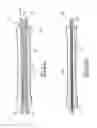
A preferred embodiment of the invention is illustrated in the drawings in which:
FIG. 1 is a side exploded view of the components of the plaque;
FIG. 2 is a side view of the formed plaque;
FIG. 3 is a plan view of the plaque of FIG. 2.
The plaque as shown in the drawings is composed of two mating shells 11, 12 composed of transparent resin material. On the rear of each shell 11, 12 is a decorative film 13, 14. The two shells with their attached decorative films are joined together by the adhesive filler layer 15 of polyurethane or similar resin.
An RFID chip or other electronic identification tag 17 is adhered to the surface of one of the decorative films 13, 14.
The plaque shells are shaped in a mould to form the male shell 11 with the location rib in the edge flange 20 and shell 12 having the complementary groove in the edge flange 21. These are formed from any suitable transparent resin such as acrylic, polystyrene or polycarbonate which may be treated for UV stability strength, toughness and scratch resistance.
The decorative films 13, 14 are preferably coated with a holographic coating to mimic a background such as mother of pearl and then printed with the desired image. The decorated face of the film 13, 14, is then attached to the internal surface of the shell 11, 12. The attachment is preferably made using a transparent adhesive such as polyurethane or methacrylate. An electronic identification device preferably addressable by a radio frequency is attached to the back of one of the films 13, 14.
The shells 11, 12, are brought together so that the edge flanges mate. The space between the backs of the films 13, 14 is then filled with a coloured filler resin 15 chosen for its adhesive and strength properties. The filling occurs through the slot in the edge of the joined shells that does not have the edge flanges 20, 21 as shown in FIG. 3.
After the resin 15 is cured the edge flanges 20, 21 are removed by cutting along the line 19 using any suitable cutting technique although a laser is preferred. This produces a coloured edge effect that is desirable for plaques.
Other enhancements to the plaques are within the scope of this invention including the incorporation of glass beads in the transparent resin used to form the shells 11, 12 to provide colour effects when the angle of incident light is changed. For security patterns may be encrypted in to the hologram pattern to make counterfeiting difficult. Similarly nano trace technology can be used to incorporate minor amounts of nano trace elements in the resins used in the shells 11, 12 or the filler 15 so that the authenticity of the plaques can be checked using optical spectrographic techniques.
From the above it can be seen that the present invention provides a simple and inexpensive alternative to gaming plaques as currently used. Those skilled in the art will realize that this invention may be implemented in embodiments other than those disclosed without departing the core teachings of this invention.
Claims
1. A method of forming a gaming plaque in which a decorative design is printed onto a clear polymer film which is then thermoformed into an outer plaque face; two plaque faces are then injection moulded together with a suitable polymer between the rear faces of the faces to form a gaming plaque.
2. A method as claimed in claim 1 in which each plaque face incorporates an edge flange adapted to mate with the edge flange of a corresponding plaque face and after the space between the plaque faces is filled the edge flanges are removed.
3. A method as claimed in claim 1 in which an electronic identification device is adhered to the internal face of one of said plaque faces.
4. A gaming plaque which includes
a) a body portion having two faces
b) a decoratively printed plaque film on each face
c) an electronic identification and data device connected to an antenna located between said plaque films or adhered to the rear of one of said plaque films.
5. A gaming plaque as claimed in claim 2 in which the electronic identification device is adapted to transmit and receive data in the frequency range 12-15 MHz.
Images & Drawings included:


Sources:
- United States Patent and Trademark Office - verify current appl. status at the USPTO↗
Similar patent applications:
- » 20230039605
Game token tray, table game management system, game token tray system, and game token management method - » 20210110225
Game token tray, table game management system, game token tray system, and game token management method - » 20190392273
Game token tray, table game management system, game token tray system, and game token management method - » 20230394266
Game token tray, table game management system, game token tray system, and game token management method - » 20200394480
Game token tray, table game management system, game token tray system, and game token management method - » 20220277178
Game token money, method of manufacturing game token money, and inspection system - » 20200193772
Game token money, method of manufacturing game token money, and inspection system - » 20190034771
Game token money, method of manufacturing game token money, and inspection system - » 20200272873
GAME TOKEN MONEY, METHOD OF MANUFACTURING GAME TOKEN MONEY, AND INSPECTION SYSTEM - » 20220398421
GAME TOKEN MONEY, METHOD OF MANUFACTURING GAME TOKEN MONEY, AND INSPECTION SYSTEM
Recent applications in this class:
- » 20240341422 2024-10-17
STACKABLE NUMISMATIC - » 20240260723 2024-08-08
LUCKY COIN-BASED TOKEN - » 20220248815 2022-08-11
Stackable magnetic numismatic - » 20210076789 2021-03-18
ENHANCED GAMING CHIPS - » 20210045506 2021-02-18
Composite structure with separator for coins and the like - » 20200383436 2020-12-10
ARTICLE AND METHOD FOR FORMING STRUCTURES WITH VARIABLE OPTICAL PROPERTIES ON A SHINY SUBSTRATE - » 20190320768 2019-10-24
INSPECTION SYSTEM, INSPECTION DEVICE, AND GAMING CHIP - » 20180070687 2018-03-15
Management system for table games and substitute currency for gaming - » 20150296936 2015-10-22
OPTICAL VARIABLE EFFECTS AS SECURITY FEATURE FOR EMBOSSED METAL COINS - » 20150282576 2015-10-08
Coin structure
Recent applications for this Assignee:
- » 20100006654 2010-01-14
GAMING CHIP